
Why cancer treatment disrupts sleep and what actually works
Sleep problems affect up to 75% of cancer patients and survivors, driven by a cycle of treatment side effects and maladaptive sleep behaviors. This article explains the mechanisms and evaluates the most effective treatments — from CBT-I to melatonin — ranked by strength of evidence.
The cruel part of cancer treatment sleep problems is that exhaustion does not guarantee sleep. A person can move through chemotherapy, radiation, surgery recovery, steroid bursts, hormone therapy, scans, pain, nausea, hot flashes, and fear, then arrive at bedtime too tired to read and still be awake at 3 a.m. The body is depleted, but the sleep system is not simply a battery waiting to be recharged.
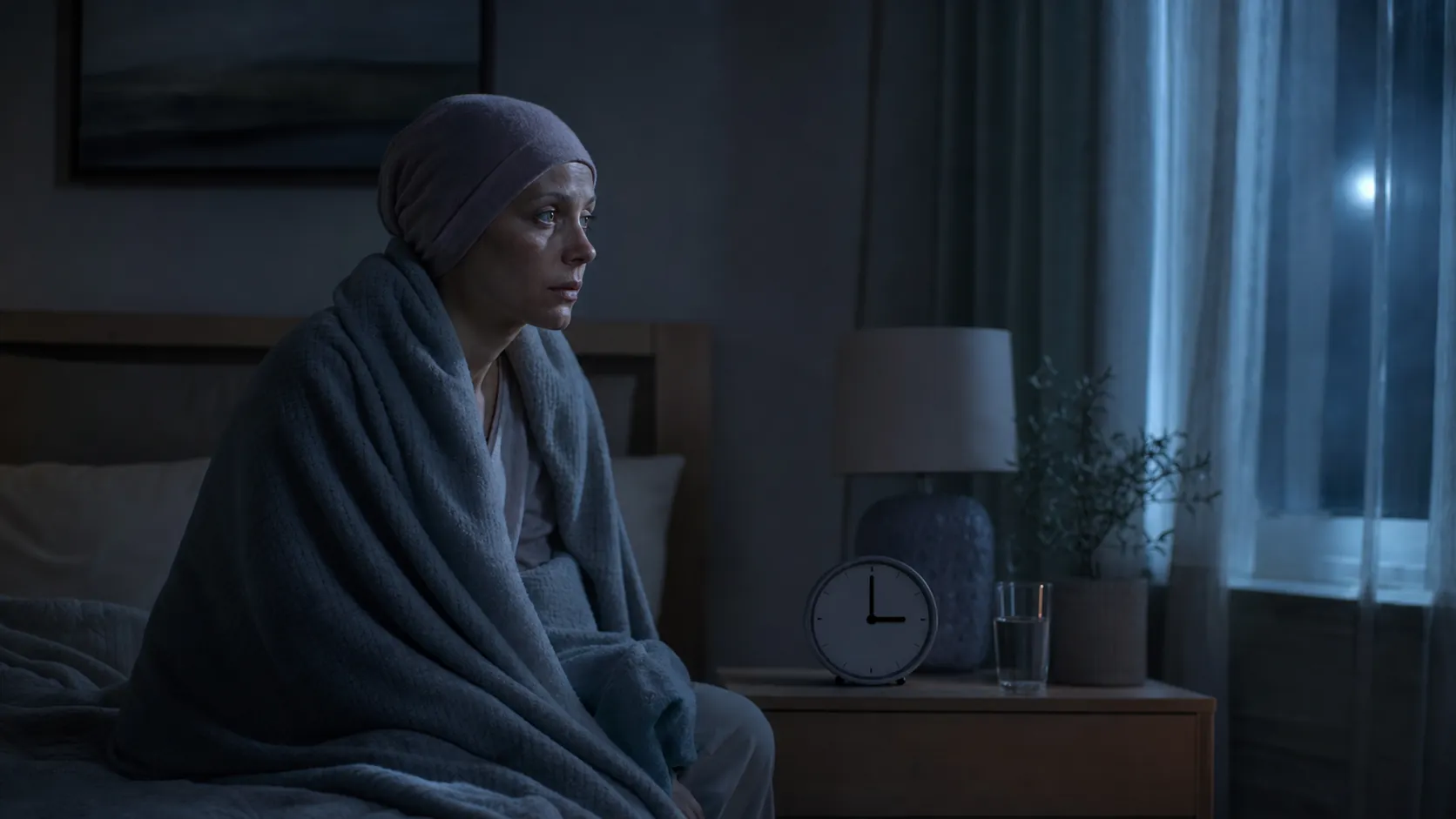
That mismatch is common enough that it should not be treated as background noise. Reviews of oncology sleep research often place sleep problems in roughly 30% to 75% of newly diagnosed or recently treated patients, about two to three times the rate seen in the general population; some oncology samples report difficulty sleeping in as many as 88% of patients, including before treatment begins.[1] The spread is not a statistical inconvenience to wave away. It reflects real differences in cancer type, treatment stage, symptom burden, and whether a study is counting occasional poor sleep, insomnia symptoms, or a diagnosable insomnia disorder.
The problem also does not reliably end when treatment does. One summary of survivorship research reported that about 36% of people still had insomnia symptoms 18 months after treatment, and that 51% of long-term survivors, about nine years after diagnosis, reported ongoing sleep disturbance.[2] Those figures are not a reason to frighten every newly diagnosed patient. They are a reason to stop treating sleep as an optional comfort issue.
Why exhaustion can coexist with insomnia
The most useful way to understand cancer-related insomnia is the 3-P model: predisposing, precipitating, and perpetuating factors. In plain terms, some people arrive with a more vulnerable sleep system, cancer and its treatment then deliver shocks to that system, and the coping behaviors that make sense during crisis can accidentally keep insomnia alive.[3]
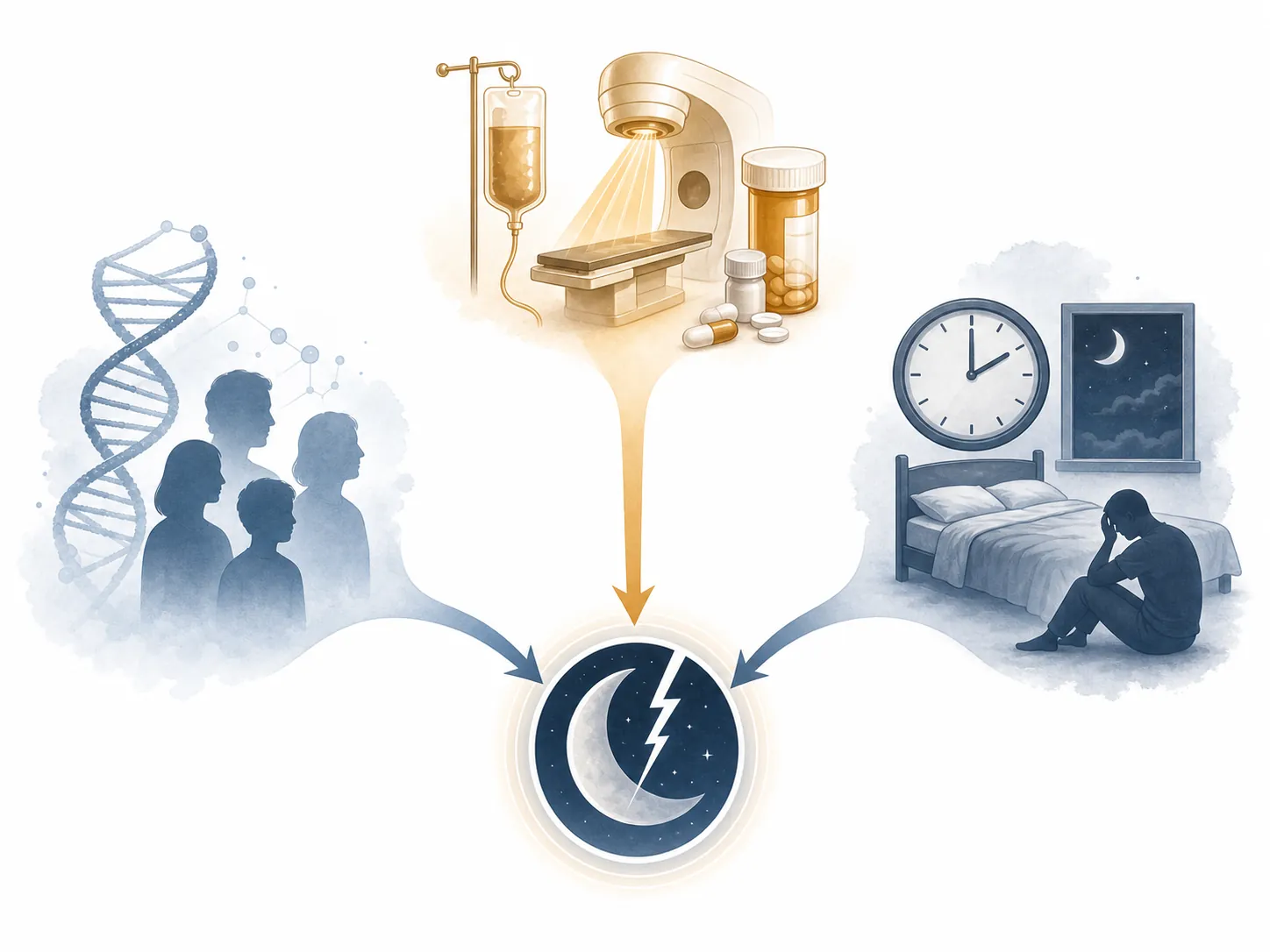
Predisposing factors are the vulnerabilities that were present before cancer entered the room. A person may have a history of light sleep, anxiety, depression, chronic pain, caregiving stress, shift work, menopause-related hot flashes, or an irregular sleep schedule. None of these means insomnia is inevitable. They mean the sleep system has less slack when a diagnosis, a new medication, or a hospital routine disrupts it.
Precipitating factors are the events that push sleep off course. In cancer care, they are not subtle. Chemotherapy can bring nausea, neuropathy, pain, fatigue, and changes in appetite. Radiation can worsen fatigue and local discomfort. Corticosteroids may be necessary for treatment or symptom control, but they can also make the body feel activated at exactly the wrong time. Hormone therapy can intensify hot flashes and night sweats. Hospital stays interrupt light, noise, temperature, and timing. Scan results, treatment decisions, and prognosis conversations can make the bed feel less like a place to sleep than a place to rehearse uncertainty.
Perpetuating factors are where the insomnia loop becomes more durable. A patient who sleeps badly after treatment may spend more time in bed the next day, nap for long stretches, cancel daytime activity, watch the clock, or go to bed earlier and earlier in an attempt to catch any possible sleep. These are understandable responses, not character flaws. But over time, the brain can learn that the bed is a place for wakefulness, monitoring, frustration, pain management, and worry. The original trigger may soften while the pattern remains.
This is why “just rest when you can” can be such poor advice when insomnia has taken hold. Rest matters during treatment, but insomnia is not solved by offering the sleep system an unlimited schedule. Too much time in bed can weaken the association between bed and sleep. Irregular naps can reduce sleep pressure at night. Clock-checking can turn every awakening into a performance review. A person who is already carrying cancer should not also be told that this cycle is simply a failure to relax.
The evidence points first to CBT-I
Once the mechanism is visible, the treatment hierarchy makes more sense. Cancer-related insomnia often begins with treatment side effects, but it is frequently maintained by conditioned arousal, irregular timing, extended time in bed, and fear of the night. Cognitive behavioral therapy for insomnia, or CBT-I, directly targets those maintaining factors. It is not generic sleep hygiene, and it is not a lecture about positive thinking.
A 2024 systematic review and meta-analysis in JNCI Cancer Spectrum pooled 61 randomized controlled trials of insomnia interventions in cancer patients and survivors. CBT-I showed a large effect in cancer survivors, with Hedges’ g = 0.86, and reduced Insomnia Severity Index scores by about 4.6 points compared with control conditions.[4] That is the kind of evidence that should change the order of operations in a clinic, not merely decorate a wellness handout.
Guidelines point in the same direction. The American Academy of Sleep Medicine, American College of Physicians, European Society for Medical Oncology, and National Comprehensive Cancer Network all identify CBT-I as a first-line approach for insomnia in this setting.[4][5] For patients and caregivers, the practical translation is simple: if insomnia is persistent, ask specifically about CBT-I or a cancer-adapted behavioral insomnia program. Do not let the conversation stop at “try better sleep hygiene.”
CBT-I usually includes several pieces: reducing excess time awake in bed, strengthening the bed-sleep association, stabilizing wake time, addressing unhelpful beliefs about sleep, and planning around naps and fatigue. In cancer care, it has to be applied with clinical judgment. A patient with severe anemia, uncontrolled pain, treatment-day nausea, or a high fall risk should not receive a rigid version of sleep restriction as if they were a healthy volunteer with primary insomnia. The principle still matters, but the dose and timing need to fit the person in front of the clinician.
The evidence base also has a representation problem. Much of the CBT-I research in cancer has leaned heavily on breast cancer survivors, often predominantly female, early-stage, and White participants.[4] That does not erase the findings. It does mean confidence is strongest for the populations most studied, and weaker for underrepresented cancer types, advanced disease settings, men, and racially diverse groups. First-line does not mean universally studied in equal depth.
When full CBT-I is too much
A full CBT-I course can be hard to complete during active treatment. Appointments pile up. Fatigue is not theoretical. A person may be deciding whether to shower, eat, answer a portal message, or lie still until the next infusion. This is where brief behavioral therapy for insomnia, or BBT-I, becomes clinically interesting.
In the 2024 meta-analysis, BBT-I showed a promising effect, with Hedges’ g = 0.71.[4] The appeal is not that it has surpassed CBT-I; it has not. The appeal is that a lower-burden format may be more realistic for patients who cannot manage a full protocol during active treatment. If the choice is between a feasible behavioral intervention and another month of untreated insomnia, feasibility matters.
| Priority | Best fit | Evidence position |
|---|---|---|
| CBT-I | Persistent insomnia with conditioned wakefulness, irregular sleep timing, or extended time awake in bed | Strongest evidence and guideline-supported first-line treatment |
| BBT-I | Patients who need a lower-burden behavioral option during active treatment or severe fatigue | Promising evidence, but not as established as full CBT-I |
| Melatonin or light-based approaches | Sleep problems tied to circadian disruption, irregular timing, or light exposure problems | Secondary, mechanism-matched options |
| Hypnotic medication | Short-term crisis use when benefits outweigh risks | Commonly used, but limited by tolerance, dependence, and sedation concerns |
For a patient in active chemotherapy, a brief approach might focus first on one stable wake time, limiting long daytime sleep when medically safe, getting out of bed during prolonged wakefulness, and reserving the bed as much as possible for sleep rather than monitoring symptoms, messages, and fears. That is not the whole of CBT-I. It is a triage version of the parts most likely to loosen the insomnia loop.
Melatonin, exercise, and light are not interchangeable sleep fixes
Melatonin deserves a narrower, more careful place than it usually gets. It may be worth considering when the main problem looks circadian: sleep timing has drifted, hospital routines have flattened day-night cues, light exposure is weak in the morning and strong late at night, or treatment has made the person’s internal clock feel unmoored. The ESMO guideline notes melatonin doses studied in cancer populations in the 2 mg to 20 mg range.[5] That dose range is a research fact, not a standing instruction to take more.
The same restraint applies to bright light therapy. It makes the most sense when the target is circadian timing or daytime alertness, not when the dominant problem is uncontrolled pain, steroid timing, or repeated awakenings from hot flashes. Morning light, dimmer evenings, and regular timing can help anchor the body clock, but they should not be sold as a substitute for treating the cause of nighttime disruption.
Exercise also needs matching to the patient’s actual condition. Movement can support sleep through daytime activity, mood, circadian signaling, and fatigue regulation, but “exercise more” is not an adequate plan for someone with bone metastases, neuropathy, severe anemia, infection risk, or post-surgical restrictions. In cancer care, the useful question is not whether exercise is virtuous. It is what level and timing of activity are safe, sustainable, and likely to improve the night rather than consume the day.
Where sleep medication fits
Hypnotic medications are common in oncology. ESMO reports that 44% to 48% of all psychiatric prescriptions in oncology are for hypnotics.[5] That frequency is understandable. There are nights when a patient is in acute distress, the next treatment day is coming, and a short-term medication may be the most humane tool available.
The tradeoffs are also real: tolerance, dependence, falls, confusion, next-day sedation, and additive effects with pain medicines, anti-nausea drugs, alcohol, or other sedating medications. Daytime sedation is not a small issue for someone already dealing with cancer-related fatigue, driving limits, work decisions, caregiving needs, or fall risk. ESMO’s guidance limits hypnotic use to no more than two weeks.[5]
Medication can quiet a bad stretch. It usually does not retrain the bed, rebuild sleep pressure, stabilize circadian timing, or solve steroid-driven activation. That is why it belongs in a short-term, clearly monitored role rather than as the default answer to months of insomnia.
What to fix first
The right starting point is the driver that is loudest right now. If pain, hot flashes, nausea, urinary symptoms, itching, cough, or shortness of breath are waking the person repeatedly, the insomnia plan has to include symptom control. If steroids are being taken late in the day, the prescribing team may be able to adjust timing. If hospital routines are breaking sleep, the care team may be able to cluster some checks, reduce overnight interruptions, or protect a more consistent sleep window when medically safe.
If the night has become a learned cycle of dread and monitoring, behavioral insomnia treatment should move up the list. That can mean formal CBT-I, a cancer-adapted CBT-I program, or BBT-I when the patient cannot tolerate a longer protocol. If the pattern looks circadian, with a drifting sleep window or flattened day-night rhythm, light timing and possibly melatonin may be reasonable additions. If the situation is acute and severe, a short medication bridge may be appropriate, but it should not quietly become the long-term plan.
A defensible order of operations looks like this:
- Treat the symptoms and treatment factors that are directly waking the person, including pain, hot flashes, nausea, steroid timing, and nighttime care interruptions.
- Screen for persistent insomnia rather than assuming poor sleep is inevitable during cancer care.
- Prioritize CBT-I when insomnia is ongoing, especially when the bed has become associated with wakefulness, worry, or clock-watching.
- Use BBT-I when a lower-burden behavioral option is more realistic during active treatment.
- Add melatonin, light timing, or activity changes only when they match the likely mechanism.
- Reserve hypnotics for short-term use with explicit attention to sedation, dependence, falls, and drug interactions.
There is a broader reason this field matters. Sleep-wake rhythms touch inflammation, mood, metabolism, fatigue, cognition, and treatment tolerance. Some observational findings around rest-activity rhythms and survival in metastatic cancer are compelling, but the evidence is not strong enough to use sleep rhythm as a survival promise. The firmer claim is already important: sleep disturbance is common, measurable, and treatable enough that it deserves a place in oncology care before a patient has spent months being told that sleeplessness is just part of the deal.
Cancer-related sleep problems are common because treatment effects and behavioral reinforcement feed each other. Naming that cycle removes blame and improves prioritization. Match the intervention to the mechanism: control the symptoms that wake the body, use CBT-I to undo the learned insomnia pattern, consider lower-burden behavioral care when stamina is limited, reserve circadian tools for circadian problems, and keep hypnotics short-term when they are needed at all.
References
- Sleep Disturbances in Cancer: A Review. Sleep Medicine Research. 2015.
- Cancer survivors' sleep is affected long after treatment. Harvard Health. 2021.
- Sleep Disturbances in Cancer. PMC.
- Interventions for insomnia in cancer patients and survivors: comprehensive systematic review and meta-analysis. JNCI Cancer Spectrum. 2024.
- Insomnia in adult patients with cancer: ESMO Clinical Practice Guideline. ESMO. 2023.
Explore the mechanism
Next step
Spot an error or have clinical feedback?
Because this article covers clinical, medication, or safety information, we use a moderated correction channel instead of open public comments. Let us know if something about “Why cancer treatment disrupts sleep and what actually works” needs a closer look.
Send feedback on this article