
What Natural Remedies Actually Increase Deep Sleep? An Evidence-Graded Review
If your sleep tracker shows low deep sleep numbers, you need remedies that target slow-wave sleep (SWS), not just any sleep aid. This evidence-graded review separates the herbs, supplements, and lifestyle interventions with published SWS data from those that improve general sleep quality without necessarily boosting deep sleep.
What Is Deep Sleep and Why Does It Matter?
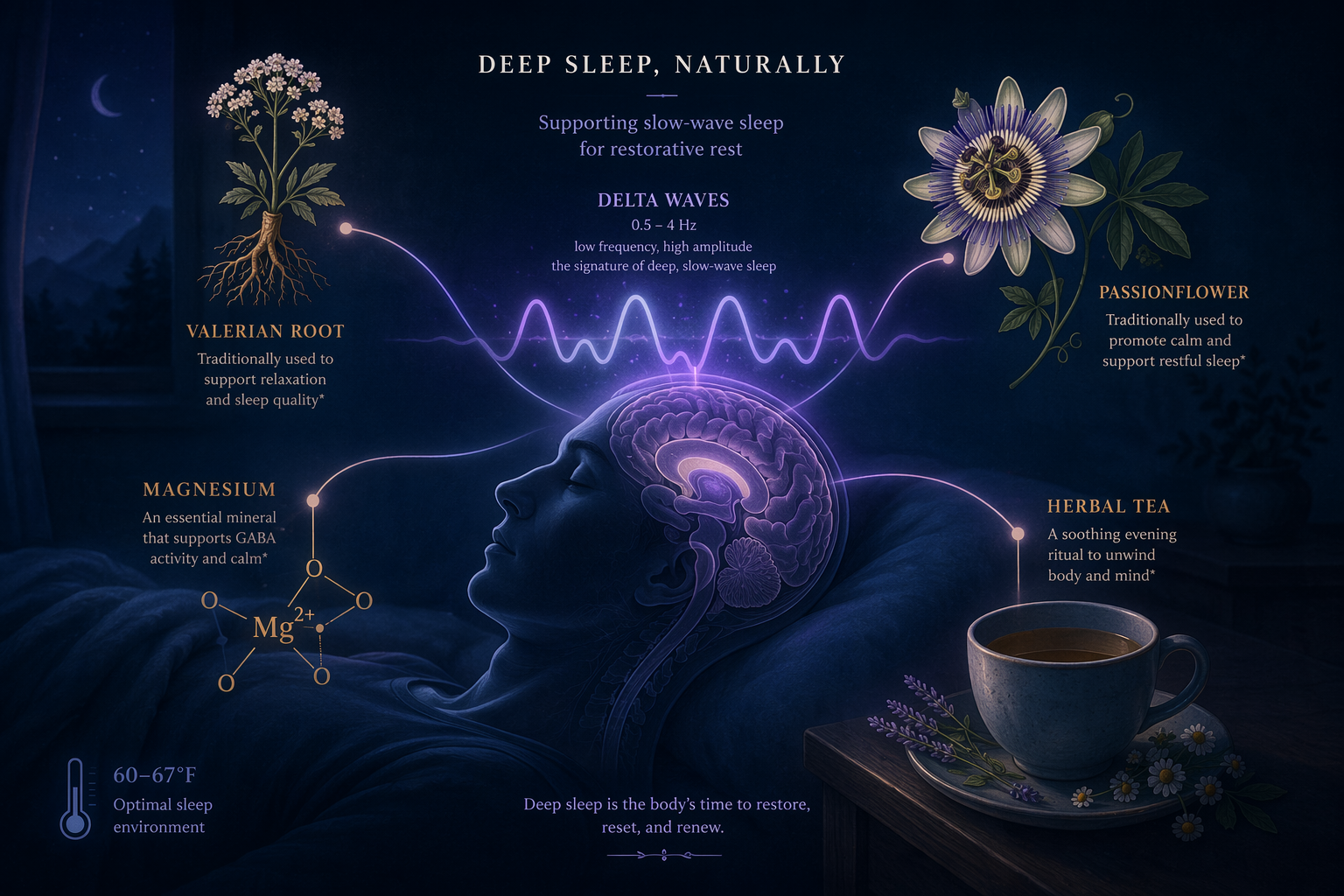
Deep sleep, also called slow-wave sleep (SWS) or stage 3 NREM sleep, is the most physically restorative phase of your sleep cycle. During this stage, your brain produces slow, high-amplitude delta waves, your heart rate and breathing drop to their lowest levels, and your body directs blood flow toward muscle repair and tissue growth. For most adults, deep sleep accounts for roughly 10% to 20% of total sleep time, which translates to about 40 to 110 minutes per night for someone getting seven to nine hours of sleep.
The consequences of insufficient SWS extend beyond feeling groggy. Research links chronically low deep sleep to impaired glucose regulation, increased blood pressure, and reduced immune function. If your wearable device consistently reports low deep sleep numbers, it is worth investigating whether your current sleep habits or supplement regimen are actually supporting this specific stage — because not all sleep aids do.
Why Not All ‘Natural Sleep Aids’ Target Deep Sleep
A common mistake is assuming that any substance marketed for sleep will improve all aspects of sleep equally. Sleep latency (how quickly you fall asleep), total sleep time, sleep efficiency (time asleep versus time in bed), and SWS percentage are separate endpoints. A remedy might shorten the time it takes to drift off without changing how much deep sleep you get — or it might increase total sleep time by adding light stage 2 sleep rather than restorative SWS.
The table below summarizes the key sleep metrics and which natural interventions have evidence for each. This framework helps you match the remedy to the specific deficit your sleep tracker is showing.
| Sleep Metric | What It Measures | Example Remedies With Evidence for This Metric |
|---|---|---|
| Sleep latency | Time to fall asleep | Melatonin (reduces latency), Valerian (reduces latency) |
| Total sleep time | Total minutes asleep | Magnesium (increases time), Melatonin (increases time) |
| Sleep efficiency | Time asleep ÷ time in bed | Magnesium (improves efficiency), Passionflower |
| Slow-wave sleep (SWS) % | Proportion of night in stage 3 NREM | Passionflower, Valerian (in low-baseline individuals), Kava (aqueous extracts), Exercise |
This distinction matters because the supplement aisle is full of products that claim to improve "sleep quality" without specifying which aspect of sleep they influence. If your wearable shows adequate total sleep time but low deep sleep, a melatonin supplement that primarily reduces latency may not solve your problem.
Remedies With Direct Evidence for Increasing Slow-Wave Sleep
The following interventions have published data — from polysomnography (PSG) or EEG studies — showing a measurable increase in slow-wave sleep. This is a short list, and the evidence quality varies, but these are the most promising candidates if your primary goal is boosting SWS.
| Remedy | Evidence for SWS Increase | Key Study / Source | Evidence Quality |
|---|---|---|---|
| Passionflower (Passiflora incarnata) | Increased total sleep and specifically increased slow-wave deep sleep | 2017 study in Sleep Science; also supported by a 2011 study in Phytotherapy Research showing subjective sleep benefits | Moderate — small sample sizes, but direct SWS measurement |
| Valerian root (Valeriana officinalis) | Increased SWS without altering REM; effect strongest in individuals with low baseline SWS | Clinical trials reviewed by ZRT Laboratory; meta-analysis of 18 RCTs found reduced sleep latency and improved sleep quality | Moderate — meta-analysis supports general sleep effects; SWS-specific data from smaller trials |
| Kava (Piper methysticum) — aqueous extracts only | Lengthened deep sleep phase and shortened light sleep in EEG studies; no effect on REM duration | 1991 German EEG study (Emser & Bartylla) using 150–300 mg aqueous extract | Limited — single older study; hepatotoxicity concerns require careful sourcing |
| Moderate aerobic exercise | Boosts amount of slow-wave (deep) sleep | Johns Hopkins Medicine; multiple reviews | Strong — consistent across multiple studies and populations |
| Warm bath before bed | May induce more slow-wave sleep through the body's subsequent cooling phase | Journal of Physiological Anthropology (cited by Sleep Foundation) | Moderate — plausible mechanism, supportive but limited direct SWS data |
| Binaural beats | May contribute to more stage 3 sleep | Frontiers in Human Neuroscience (cited by Sleep Foundation) | Limited — emerging area, small studies |
| High-fiber diet | Associated with more deep sleep; high saturated fat linked to less SWS | Sleep Foundation (citing dietary sleep research) | Observational — association, not causation |
Passionflower is one of the few herbs with direct SWS-specific data. A 2017 study published in Sleep Science found that passionflower extract increased total sleep time and specifically increased slow-wave deep sleep. The mechanism is thought to involve GABA modulation — passionflower contains compounds that bind to GABA receptors, promoting the neural oscillations characteristic of SWS.
Valerian root has a more extensive evidence base overall, but its SWS-specific effects are most pronounced in people who start with low baseline deep sleep. A review of clinical trials by ZRT Laboratory reported that valerian increased slow-wave sleep without altering REM sleep, and that the effect was strongest in individuals with lower baseline SWS. A meta-analysis of 18 randomized controlled trials found valerian significantly reduced sleep latency (standardized mean difference -0.71) and improved sleep quality (standardized mean difference -0.46), though the SWS-specific findings come from smaller trials.
Remedies With General Sleep Evidence but Limited SWS-Specific Data
Many popular natural sleep aids have solid evidence for improving sleep latency, total sleep time, or subjective sleep quality — but they lack consistent polysomnography-graded data showing a direct increase in SWS percentage. This does not mean they are ineffective; it means their primary mechanism of action may not target slow-wave sleep specifically.
| Remedy | What It Does Well | SWS-Specific Data? | Key Source |
|---|---|---|---|
| Melatonin | Reduces sleep latency; increases total sleep time in primary insomnia | No — meta-analysis of 19 RCTs found no consistent increase in SWS percentage | PMC 2024 literature review |
| Magnesium (500 mg/day) | Increases sleep time, sleep efficiency, and serum melatonin; reduces cortisol and insomnia severity | No — SWS was not measured as a primary endpoint in the Abbasi et al. 2012 trial | Abbasi et al. 2012 double-blind RCT in 46 older adults |
| L-theanine | May enhance sleep quality by reducing nighttime awakenings | No — does not appear to help people fall asleep; SWS effects not established | Sleep Foundation |
| Glycine (3 g before bed) | Improves sleep quality and reduces daytime sleepiness by facilitating a drop in body temperature | No — one study found faster sleep onset and less daytime sleepiness, but SWS not measured | Verywell Health; Sleep Foundation |
| CBD (cannabidiol) | Some evidence for anxiety-related sleep disturbance | No — very limited human PSG data; most studies are preclinical or subjective | Verywell Health |
| Chamomile | Mild sedative effects; may improve sleep quality in mild insomnia | No — studies show subjective improvement but no consistent SWS increase | PMC 2024 literature review |
Melatonin is the most studied sleep supplement, but its effects are primarily on circadian timing and sleep onset. A meta-analysis of 19 randomized controlled trials found that melatonin significantly reduced sleep latency and increased total sleep time in people with primary insomnia, but it did not consistently raise SWS percentage. If your sleep tracker shows adequate total sleep time but low deep sleep, melatonin is unlikely to be the solution.
Magnesium at 500 mg per day (as magnesium oxide) for eight weeks produced statistically significant improvements in sleep time, sleep efficiency, and insomnia severity in a double-blind, placebo-controlled trial involving 46 older adults. The same trial found increased serum melatonin and decreased serum cortisol. These are promising results for overall sleep quality, but the study did not measure SWS as a primary endpoint, so we cannot conclude that magnesium directly increases slow-wave sleep.
Practical Protocols: Dosing, Timing, and Third-Party Verification
If you decide to try one of the top-tier remedies with SWS-specific evidence, the following table provides typical dosage ranges and timing guidance. These are general reference points, not medical prescriptions. Individual responses vary, and the optimal dose for you may differ.
| Remedy | Typical Dosage Range | Timing Relative to Bedtime | Form Notes |
|---|---|---|---|
| Passionflower | As tea: 1 cup steeped 10 min; as extract: 250–500 mg | 30–60 minutes before bed | Tea and aqueous extracts are most studied; avoid alcohol-based tinctures if concerned about interactions |
| Valerian root | 300–600 mg of standardized extract | 30–60 minutes before bed | Effects may take 2–4 weeks to become noticeable; not for acute use |
| Kava (aqueous extract) | 150–300 mg extract (containing 105–210 mg kava lactones) | 60 minutes before bed | Only use aqueous (water-based) extracts; avoid if you have liver conditions or consume alcohol regularly |
| Magnesium | 200–500 mg (as magnesium glycinate or citrate) | With evening meal or 1 hour before bed | Magnesium oxide is less absorbable; glycinate form is gentler on digestion |
Beyond supplements, several non-supplement strategies have consistent evidence for supporting deep sleep:
- Moderate aerobic exercise during the day boosts slow-wave sleep. Johns Hopkins Medicine recommends finishing exercise at least four hours before bedtime to avoid interfering with sleep onset.
- A warm bath or shower 60–90 minutes before bed triggers a subsequent drop in core body temperature, which signals the brain to enter SWS. The ideal bedroom temperature for deep sleep is between 60 and 67°F (15–19°C).
- A diet high in fiber is associated with more deep sleep, while high saturated fat intake is linked to less slow-wave sleep. This is an observational finding, but the mechanism — gut microbiome influence on sleep-regulating neurotransmitters — is biologically plausible.
- Consistent sleep-wake timing reinforces the circadian rhythm, which in turn supports the normal cycling through sleep stages. Erratic schedules fragment sleep architecture and reduce SWS.
When to See a Sleep Specialist
If you have tried lifestyle adjustments and targeted supplements for several weeks but your wearable still shows persistently low deep sleep, or if you experience any of the following, professional evaluation is warranted:
- Loud, disruptive snoring or witnessed pauses in breathing during sleep — these are hallmark signs of obstructive sleep apnea, which fragments sleep architecture and severely reduces SWS.
- Excessive daytime sleepiness despite spending adequate time in bed — this suggests that sleep quality, not quantity, is the problem.
- Chronic insomnia lasting more than three months — the first-line treatment is cognitive behavioral therapy for insomnia (CBT-I), not supplements.
- Suspected periodic limb movement disorder or restless legs syndrome — these conditions repeatedly pull you out of SWS without you being fully aware of it.
Safety Caveats and Population-Specific Warnings
Natural does not mean risk-free. The following table summarizes critical safety considerations for the remedies discussed in this article. Always consult a healthcare provider before starting any new supplement, especially if you are pregnant, breastfeeding, over 65, or taking prescription medications.
| Remedy | Key Safety Concern | Population-Specific Warning |
|---|---|---|
| Kava | Hepatotoxicity (liver injury) — FDA has issued warnings; risk increases with alcohol use and pre-existing liver conditions | Avoid if you have liver disease, hepatitis, or consume alcohol regularly; use only aqueous extracts |
| Valerian root | Insufficient safety data during pregnancy and breastfeeding; may potentiate sedative effects of alcohol and CNS depressants | Avoid during pregnancy and breastfeeding unless approved by a healthcare provider |
| Melatonin | Generally safe for short-term use; long-term safety data is limited; may interact with anticoagulants and immunosuppressants | Use with caution in older adults — Beers Criteria does not list melatonin as high-risk, but dosing should start low (0.5–1 mg) |
| Magnesium | High doses (>500 mg/day) can cause diarrhea, cramping, and electrolyte imbalances | Kidney impairment increases risk of magnesium toxicity; avoid magnesium oxide if you have digestive sensitivity |
| Diphenhydramine (Benadryl, ZzzQuil) | Anticholinergic effects; associated with increased risk of dementia with long-term use; listed in Beers Criteria as potentially inappropriate for older adults | Avoid in adults over 65; not recommended for chronic sleep aid use |
Drug interactions are another important consideration. Valerian, kava, and passionflower all potentiate GABA activity, which means they can amplify the effects of prescription sedatives, benzodiazepines, and alcohol. Melatonin may interact with blood thinners (warfarin) and immunosuppressants. If you take any prescription medication, check with a pharmacist or physician before adding a sleep supplement.
Finally, remember that supplements are not a substitute for clinical evaluation. If your sleep problems are caused by an underlying condition like sleep apnea, restless legs syndrome, or clinical insomnia, no amount of valerian or magnesium will resolve the root cause. Use the evidence-graded framework in this article to match the remedy to the specific deficit, and seek professional help when the data suggests it is warranted.
Explore the mechanism
Next step
Spot an error or have clinical feedback?
Because this article covers clinical, medication, or safety information, we use a moderated correction channel instead of open public comments. Let us know if something about “What Natural Remedies Actually Increase Deep Sleep? An Evidence-Graded Review” needs a closer look.
Send feedback on this article