
Diphenhydramine vs. Doxylamine: Mechanisms, Pharmacokinetics, and Safety for Short-Term Sleep
A mechanistic comparison of the two most common OTC sleep antihistamines — diphenhydramine (ZzzQuil, Benadryl) and doxylamine (Unisom SleepTabs) — covering how they work, how their pharmacokinetics differ by age, what the clinical evidence shows about effectiveness and tolerance, and who should avoid each based on population-specific safety data including the 2023 AGS Beers Criteria.
Two Antihistamines Dominating the OTC Sleep Aisle
Walk down the sleep aid aisle of any pharmacy and you will find dozens of products — ZzzQuil, Benadryl, Tylenol PM, Unisom SleepTabs, Unisom SleepMelts, Nytol, Simply Sleep — but nearly all of them contain one of two active ingredients: diphenhydramine or doxylamine succinate. Both are first-generation antihistamines. Both cause sedation as a side effect of their primary mechanism. And both have been sold for decades as the default OTC answer to short-term sleeplessness.
The brand names create the impression of variety. In practice, most products in that aisle are minor formulation variations on the same two molecules. Unisom SleepTabs use doxylamine; Unisom SleepMelts and most other Unisom products use diphenhydramine. ZzzQuil and Benadryl use diphenhydramine. Tylenol PM pairs diphenhydramine with acetaminophen.
The two drugs share a mechanism but diverge in ways that matter: their pharmacokinetics differ by age group, their next-day impairment profiles differ, and their population-specific risk profiles differ substantially. Both also face the same fundamental ceiling — rapid tolerance development makes nightly use self-defeating within days, and neither is appropriate for chronic insomnia.
How Both Drugs Produce Sedation: The Shared Mechanism
Diphenhydramine and doxylamine both produce sedation primarily by acting as inverse agonists at H1 histamine receptors in the hypothalamus and limbic regions of the brain. Histamine is a key wake-promoting neurotransmitter — it keeps you alert by maintaining activity in cortical arousal circuits. When an H1 inverse agonist occupies these receptors, it actively suppresses histaminergic signaling, reducing cortical activity and promoting drowsiness.
On top of this, both drugs have significant anticholinergic activity — they block muscarinic acetylcholine receptors. This contributes to sedation but also drives the side effect profile: dry mouth, constipation, urinary retention, blurred vision, and cognitive fog all stem from the same muscarinic blockade.
An important distinction: neither drug acts on sleep-specific neural pathways. Z-drugs (zolpidem, eszopiclone) act on GABA-A receptors at specific subunits involved in sleep regulation. Orexin receptor antagonists (suvorexant, lemborexant) block the orexin/hypocretin system that actively promotes wakefulness. Diphenhydramine and doxylamine do neither. They produce sedation by broadly suppressing wake-promoting histamine signaling — which is why they cause drowsiness, not physiologically normal sleep architecture.
Pharmacokinetics Compared: Where the Two Drugs Diverge
Both drugs onset within roughly 20–30 minutes and reach peak plasma concentrations within 1–3 hours. After that, their pharmacokinetic profiles separate — and the difference becomes most significant when age enters the picture.
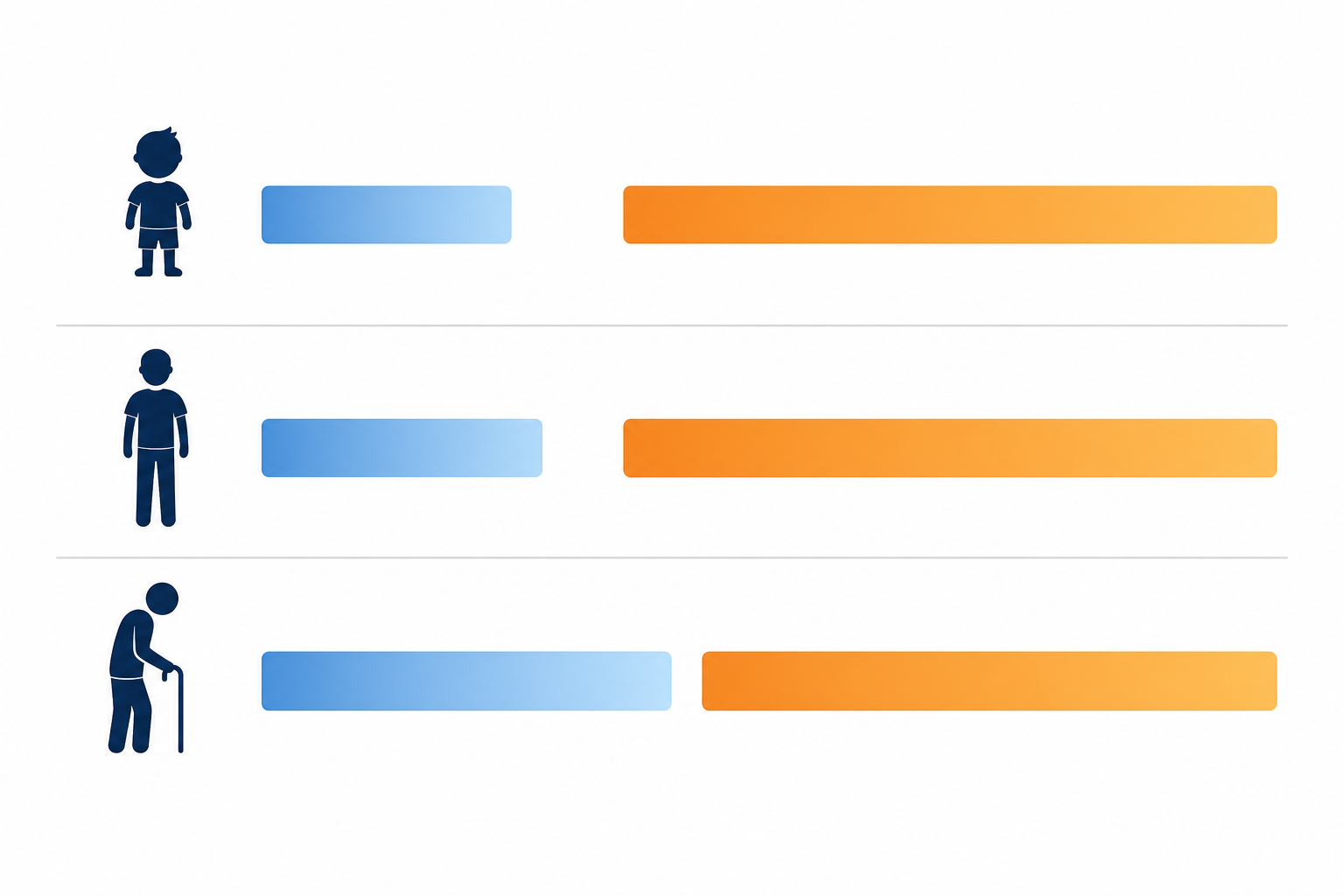
Diphenhydramine's half-life is not a single number. Age-stratified data from Simons et al. (1990), cited in a 2025 expert consensus published in the Journal of Clinical Medicine, shows that half-life increases substantially with age: approximately 5.4 hours in children, 9.2 hours in young adults, and 13.5 hours in elderly adults. Hepatic clearance drops from roughly 49 mL/min/kg in children to 11.7 mL/min/kg in the elderly — the drug is cleared far more slowly as the liver ages.
Doxylamine's half-life for the OTC immediate-release tablet is approximately 10–12 hours. The delayed-release formulation used in the prescription Diclegis/Bonjesta product has a reported half-life of 11.7 hours. Unlike diphenhydramine, doxylamine's half-life does not show the same dramatic age-dependent extension in the available data — but it starts longer and stays long across age groups.
| Characteristic | Diphenhydramine | Doxylamine |
|---|---|---|
| Standard OTC dose | 25–50 mg | 25 mg |
| Onset of sedation | ~20–30 minutes | ~20–30 minutes |
| Time to peak plasma (Tmax) | ~1.7h (range 2–3h in adults) | ~2–3h |
| Half-life — children | ~5.4h (Simons et al. 1990) | Not well-characterized |
| Half-life — young adults | ~9.2h (Simons et al. 1990) | ~10–12h (OTC IR) |
| Half-life — elderly adults | ~13.5h (Simons et al. 1990) | ~10–12h (limited age data) |
| Primary elimination | Hepatic (CYP2D6) | Hepatic |
| Anticholinergic potency | High | High (similar) |
| Common brands | ZzzQuil, Benadryl, Tylenol PM | Unisom SleepTabs |
What do these numbers mean in practice? A young adult taking diphenhydramine at 10 p.m. may still have half of the drug's active concentration in their system at 7 a.m. the next morning. An elderly adult taking the same dose could have more than half remaining at noon the following day. Doxylamine at 10 p.m. produces a similar or longer residual presence for most adults, regardless of age.

What the Clinical Evidence Shows About Effectiveness
The clinical evidence base for both drugs is real but modest. Most trials are short-term, conducted in healthy adults without clinical insomnia diagnoses, and show small-to-moderate effect sizes on subjective sleep measures.
A 2025 expert consensus using Delphi methodology, published in the Journal of Clinical Medicine and compiled by Ariza-Salamanca and colleagues, reviewed the available trial data and reached 100% panel agreement that diphenhydramine is effective for short-term insomnia in adults aged 18–65, with a maximum recommended duration of approximately four weeks. The same panel reached 0% agreement that diphenhydramine is useful for chronic insomnia.
Key trials in the evidence base include:
| Study | Drug / Dose | Sample | Duration | Key Finding |
|---|---|---|---|---|
| Rickels et al. (1983) | Diphenhydramine 50 mg | n=111 | Short-term | Improved subjective sleep latency and restfulness vs. placebo |
| Morin et al. (2005) | Diphenhydramine 50 mg BID | n=184 | 14 days | Improved sleep efficiency in first two weeks; effects diminished with continued use |
| Schweitzer et al. (1994) | Diphenhydramine | Healthy adults | 3 days | Sedative tolerance developed by day 3; performance impairment on day 1 reversed by day 3 |
| Richardson et al. (2002) | Diphenhydramine | Healthy adults | 4 days | Increased drowsiness on day 1; tolerance to sedative effects by day 4 |
| Stewart et al. (1987) | Diphenhydramine vs. temazepam | Adults | Short-term | Diphenhydramine inferior to temazepam on most objective sleep measures |
The American Academy of Sleep Medicine's position is more cautious than the expert consensus. The AASM does not recommend OTC antihistamines for insomnia. A separate analysis of the existing research, cited by the Sleep Foundation, concluded that evidence supporting OTC antihistamines as insomnia treatments is limited and that long-term use can be harmful. The AASM does not give doxylamine a specific recommendation; both drugs fall under the broader class that the AASM declines to endorse.
Tolerance: Why Nightly Use Becomes Self-Defeating Within Days
This is the most clinically important limitation of both drugs — and the one most underrepresented on product labels.
Schweitzer et al. (1994) showed that the sedative effects of diphenhydramine diminish by day 3 of consecutive use. Richardson et al. (2002) confirmed a similar pattern, with tolerance apparent by day 4. In both studies, the performance impairment seen on day 1 had largely reversed by the time tolerance set in — meaning the drug was producing residual next-day grogginess without delivering meaningful sedation at night.
The mechanism is receptor-level adaptation, not drug accumulation. With repeated exposure, H1 receptors downregulate or adapt to the inverse agonist signal, reducing the histamine-suppressing effect. The drug is still present; the brain has adjusted to it.
The practical consequence: someone who takes diphenhydramine or doxylamine every night for a week will likely get meaningful sedation on nights one and two, diminishing returns on nights three and four, and minimal sleep benefit by the end of the week — while still experiencing next-day grogginess and anticholinergic side effects. Escalating the dose to recover the sedative effect is not a solution; it increases side effect burden without reliably restoring efficacy.
Side Effects: Anticholinergic Burden and Next-Day Impairment
The side effect profiles of diphenhydramine and doxylamine are driven by the same two mechanisms that produce their sedation: H1 blockade and muscarinic acetylcholine receptor blockade. Understanding the mechanism makes the side effect list more predictable — and more concerning.
Muscarinic blockade is responsible for the anticholinergic side effects that affect multiple organ systems simultaneously:
- Dry mouth and throat (reduced salivary gland secretion)
- Constipation (reduced gastrointestinal motility)
- Urinary retention (reduced detrusor muscle contraction, especially relevant in men with benign prostatic hyperplasia)
- Blurred vision (impaired ciliary muscle function)
- Cognitive fog and memory impairment (acetylcholine is involved in learning and memory consolidation)
Next-day psychomotor impairment is clinically documented for diphenhydramine. A study by Katayose et al. (2012) found that diphenhydramine significantly impaired next-day psychomotor performance — relevant for anyone who drives or operates machinery the morning after use. Doxylamine's longer half-life (~10–12h vs. diphenhydramine's ~9.2h in young adults) means it carries an equal or higher next-day impairment risk for healthy adults.
The longer-term concern involves cumulative anticholinergic exposure. A large observational study by Gray et al., published in JAMA Internal Medicine in 2015 and reported by Harvard Health Publishing, followed nearly 3,500 adults aged 65 and older for an average of seven years. Those who had taken anticholinergic drugs for the equivalent of three or more years showed a 54% higher rate of dementia diagnosis compared to those who had taken the same dose for three months or less.
Population-Specific Safety: Who Should Avoid Each Drug
The safety picture for these two drugs is not uniform across age groups. The population you belong to determines whether occasional use is reasonable, requires caution, or should be avoided entirely.
Adults 18–65: Appropriate for Short-Term Use With Caveats
The 2025 expert consensus reached 100% agreement that diphenhydramine is appropriate for short-term insomnia management in adults aged 18–65, with a maximum recommended duration of approximately four weeks. This applies to genuinely occasional use — jet lag, acute situational stress, shift schedule disruption — not as a nightly sleep aid.
Even within this group, next-day driving impairment is a real concern, particularly with doxylamine's longer half-life. Anyone who needs to drive or operate machinery in the morning should account for residual sedation.
Adults 65 and Older: Both Drugs Listed as Potentially Inappropriate
The 2023 American Geriatrics Society Beers Criteria explicitly lists both diphenhydramine (oral) and doxylamine as potentially inappropriate medications for adults aged 65 and older. The recommendation is Avoid. Quality of evidence: Moderate. Strength of recommendation: Strong.
The Beers Criteria rationale is specific: both drugs are highly anticholinergic; clearance is reduced with advanced age; tolerance develops as a hypnotic; and there is elevated risk of confusion, dry mouth, constipation, falls, delirium, and a cumulative anticholinergic burden associated with dementia risk. The Criteria also note that using two or more anticholinergic agents simultaneously compounds these risks.
Diphenhydramine's age-dependent pharmacokinetics make this especially concrete. In elderly adults, its half-life extends to approximately 13.5 hours — meaning a 10 p.m. dose may still be at half-concentration the following afternoon. The expert consensus panel reached no agreement across three rounds on whether diphenhydramine is appropriate for use in elderly adults.
Pregnancy: A Critical Distinction
Doxylamine's role in pregnancy requires careful framing. The FDA-approved prescription product — doxylamine succinate combined with pyridoxine hydrochloride, marketed as Diclegis (approved 2013) and Bonjesta (extended-release) — holds FDA Pregnancy Category A status. It is the only antiemetic with Category A status, approved specifically for nausea and vomiting of pregnancy (NVP), and studied in over 200,000 pregnant women.
This is not the same product as OTC doxylamine (Unisom SleepTabs, 25 mg) taken for insomnia during pregnancy. The Rx combination product contains a specific dose of doxylamine plus pyridoxine in a delayed-release formulation, approved for a specific indication. OTC doxylamine alone, taken for sleep, does not carry this approval or this safety record for pregnancy.
Diphenhydramine is not specifically contraindicated in pregnancy, but it is not a first-line recommendation. Both Hopkins Medicine and Cleveland Clinic note that neither drug is recommended during pregnancy without explicit guidance from a healthcare provider.
| Population | Diphenhydramine | Doxylamine |
|---|---|---|
| Adults 18–65 (healthy) | Appropriate for short-term use (~4 weeks max); next-day impairment risk | Appropriate for short-term use; longer half-life increases next-day sedation risk |
| Adults 65+ | Avoid — Beers Criteria 2023 (Strong recommendation); extended half-life (~13.5h) in elderly | Avoid — Beers Criteria 2023 (Strong recommendation); consistently long half-life |
| Pregnancy (NVP) | Not first-line; not specifically contraindicated but not recommended without provider guidance | Rx combination with pyridoxine (Bonjesta/Diclegis) is FDA Category A for NVP only — not OTC doxylamine alone |
| Pregnancy (insomnia) | Not recommended; consult provider | OTC doxylamine for insomnia does not carry Pregnancy Category A status — consult provider |
| Children under 12 | Not recommended for sleep use | Not recommended for sleep use |
| Closed-angle glaucoma, BPH, urinary retention | Contraindicated | Contraindicated |
Drug Interactions to Know Before Use
Both drugs interact with several commonly used substances and medications. The interactions are largely predictable from their mechanism — additive CNS depression and additive anticholinergic burden are the primary concerns.
- Alcohol: Additive CNS depression. Combining alcohol with either drug increases sedation, impairs coordination, and raises next-day impairment risk substantially. This combination should be avoided.
- MAO inhibitors (MAOIs): Intensified CNS depression and enhanced anticholinergic effects. MAOIs are rarely prescribed today but are still used for certain depression and Parkinson's disease indications. Concurrent use is contraindicated.
- Other anticholinergic agents: Cumulative anticholinergic burden. The 2023 Beers Criteria explicitly flags that using two or more anticholinergic drugs simultaneously increases the risk of cognitive decline, delirium, and falls. Many common medications carry anticholinergic activity — certain antidepressants, bladder medications, antiemetics, and antispasmodics. Combining any of these with diphenhydramine or doxylamine multiplies the burden.
- Benzodiazepines and z-drugs: Enhanced sedation. Combining OTC antihistamines with prescription sleep medications (zolpidem, temazepam, eszopiclone) or benzodiazepines increases CNS depression and next-day impairment risk.
- Oxybates (sodium oxybate / Xyrem): Contraindicated with diphenhydramine specifically. Oxybates are prescribed for narcolepsy; concurrent use with diphenhydramine is not safe.
When to Skip Both: CBT-I as First-Line for Chronic Insomnia
If the sleep problem you are trying to solve has been present for more than a few weeks, OTC antihistamines are the wrong tool — not because they are dangerous in the short term for healthy adults, but because they do not address what is actually maintaining the insomnia.
Chronic insomnia is typically maintained by a set of learned behavioral and cognitive patterns: irregular sleep schedules, extended time in bed while awake, conditioned arousal in the bedroom, and anxiety about sleep itself. OTC antihistamines do not change any of these patterns. They suppress wakefulness temporarily and build tolerance within days. They leave the underlying insomnia untouched.
Cognitive behavioral therapy for insomnia (CBT-I) addresses these perpetuating factors directly. It uses stimulus control, sleep restriction, and cognitive restructuring to break the behavioral cycles that maintain chronic insomnia. The 2025 expert consensus explicitly acknowledges CBT-I as the widely recognized first-line therapy for chronic insomnia. The AASM, AASM guidelines, and the American College of Physicians all endorse CBT-I as the primary treatment for chronic insomnia in adults.
CBT-I produces durable improvement without tolerance risk. Unlike medication, its effects do not diminish over time — they tend to consolidate as the behavioral changes become habitual. Accessibility has historically been a barrier, but digital CBT-I programs have expanded availability substantially.
Decision Framework: Choosing Between Diphenhydramine and Doxylamine
Neither drug is universally better. The right choice — if either is appropriate — depends on your age, your morning schedule, your concurrent medications, and whether your sleep difficulty is genuinely short-term.
When Diphenhydramine May Be the Better Fit
- You are a healthy adult under 65 and need to be alert and functional the following morning — diphenhydramine's shorter half-life (~9.2h in young adults) means slightly less residual sedation than doxylamine's ~10–12h.
- You want the drug with more published clinical trial data behind it — the diphenhydramine evidence base is larger, even accounting for the P&G-funded expert consensus.
- You are using it genuinely occasionally — a single night of jet lag, a one-off stressful night — and not as a consecutive-night routine.
When Doxylamine May Be the Better Fit
- You need stronger or more prolonged sedation on a specific night and have no morning obligations requiring full alertness.
- You find diphenhydramine's sedative effect insufficient — doxylamine is generally described as producing stronger drowsiness.
When Both Should Be Avoided
- You are 65 or older — both are listed as potentially inappropriate by the 2023 AGS Beers Criteria (Avoid, Strong recommendation).
- Your insomnia is chronic (three or more nights per week for three or more months) — neither drug is appropriate, and CBT-I should be the focus.
- You are already taking other anticholinergic medications — cumulative burden compounds risks across all age groups.
- You are pregnant and seeking relief from insomnia — neither OTC product is appropriate without provider guidance; the Rx doxylamine/pyridoxine combination is approved for NVP, not for insomnia.
- You have closed-angle glaucoma, benign prostatic hyperplasia, or urinary retention — anticholinergic activity makes both drugs contraindicated.
- You need to drive or operate machinery the morning after use — residual impairment is documented for both, with doxylamine's longer half-life posing greater risk.
| Attribute | Diphenhydramine | Doxylamine |
|---|---|---|
| Mechanism | H1 inverse agonist + anticholinergic | H1 inverse agonist + anticholinergic |
| Half-life — young adults | ~9.2h | ~10–12h |
| Half-life — elderly adults | ~13.5h (markedly extended) | ~10–12h (limited age-specific data) |
| Next-day impairment risk (young adult) | Moderate | Moderate to high (longer half-life) |
| Evidence quality for sleep | Limited — short-term trials, modest effect sizes | Limited — smaller trial base than diphenhydramine |
| Tolerance onset | Day 3–4 of consecutive use | Day 3–4 of consecutive use (assumed similar) |
| 2023 Beers Criteria (65+) | Avoid — Moderate evidence, Strong recommendation | Avoid — Moderate evidence, Strong recommendation |
| Pregnancy (NVP) | Not first-line; not Category A | Rx combination with pyridoxine only — FDA Category A for NVP; OTC alone does not carry this status |
| AASM position | Not recommended for insomnia (class) | Not specifically addressed; class not recommended |
| Appropriate use window | Occasional, short-term (up to ~4 weeks for adults 18–65) | Occasional, short-term (up to ~4 weeks for adults 18–65) |
| Common brands | ZzzQuil, Benadryl, Tylenol PM | Unisom SleepTabs |
Explore the mechanism
Next step
Spot an error or have clinical feedback?
Because this article covers clinical, medication, or safety information, we use a moderated correction channel instead of open public comments. Let us know if something about “Diphenhydramine vs. Doxylamine: Mechanisms, Pharmacokinetics, and Safety for Short-Term Sleep” needs a closer look.
Send feedback on this article