
L-Theanine for Sleep: Evidence, Dosage, and Safety
An evidence-graded guide for adults evaluating L-theanine as a sleep supplement — covering how it works, what a 2025 systematic review of 13 trials actually shows about sleep quality versus duration, who is most likely to benefit, dosage guidance, and honest safety caveats including population-specific risks and the limits of current evidence.
What Is L-Theanine?
L-theanine is a non-protein amino acid found almost exclusively in the leaves of Camellia sinensis — the plant that produces green, black, oolong, and white tea. It occurs naturally in tea at low concentrations and is also produced synthetically or through fermentation for use in dietary supplements.
In the United States, L-theanine is sold as a dietary supplement — a regulatory category that sits outside the FDA's drug approval framework. This means it has not been reviewed or approved by the FDA to treat, cure, or prevent any sleep condition.
The FDA has separately evaluated L-theanine as a food ingredient under its GRAS (Generally Recognized As Safe) notification process. In 2007, the FDA responded to GRN No. 209 — filed by Taiyo International for its Suntheanine product — with the statement "FDA has no questions." That GRAS determination covers L-theanine as a food ingredient at up to 250 mg per serving in specific food categories.
How L-Theanine May Affect Sleep: The Mechanistic Pathway
L-theanine's proposed sleep-supporting effects do not work through sedation. This is a meaningful distinction from antihistamine-based OTC sleep aids like diphenhydramine or doxylamine, which blunt the histamine system to induce drowsiness and carry well-documented risks of next-morning cognitive impairment and grogginess.
L-theanine crosses the blood-brain barrier in a dose-dependent manner. After oral ingestion, plasma concentrations peak at approximately 45 to 50 minutes. Once in the brain, it appears to work through several overlapping pathways.
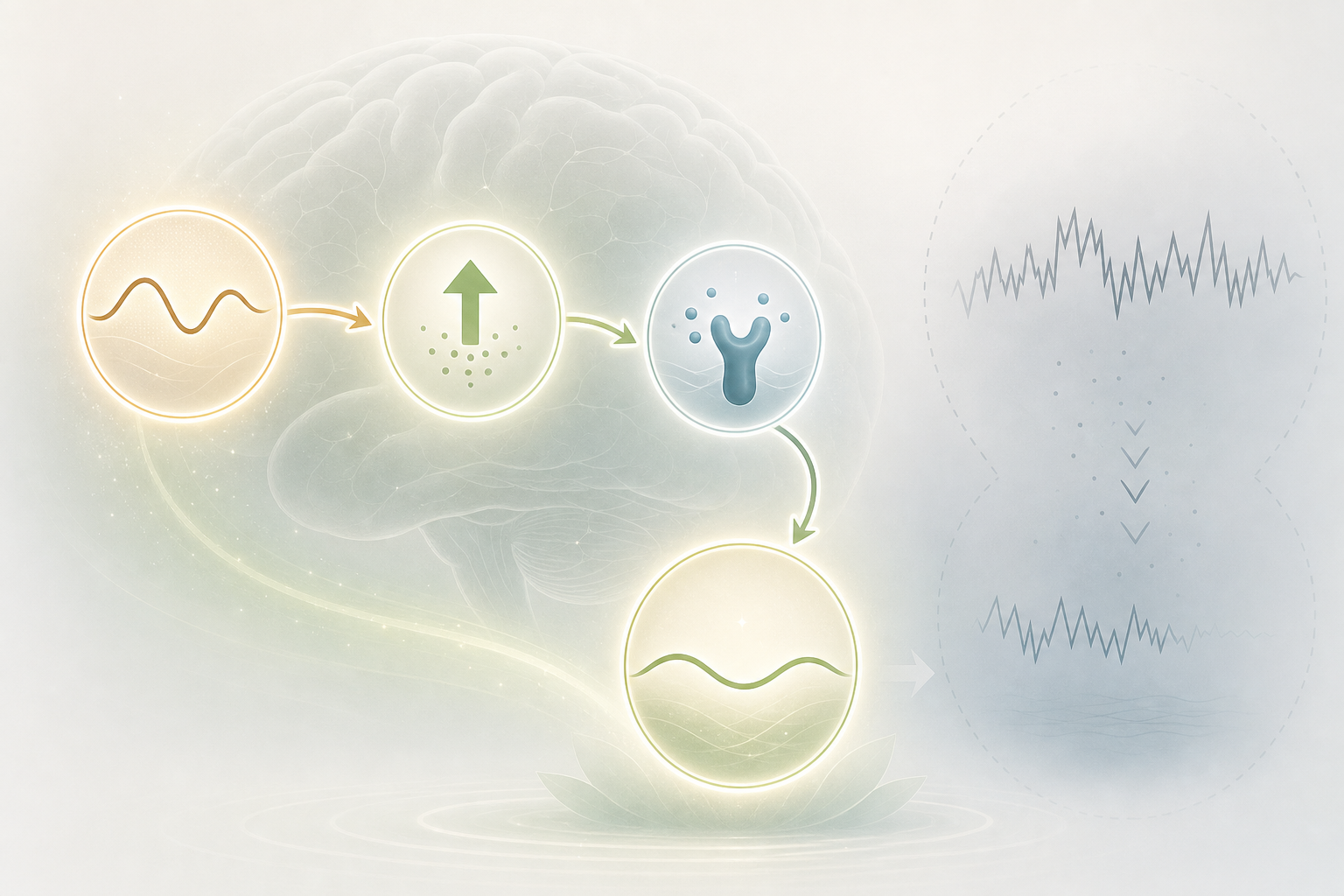
- Alpha-wave induction: At doses of 50–200 mg, L-theanine increases alpha-wave activity in the brain. Alpha waves are associated with a relaxed but alert mental state — the kind of calm wakefulness that precedes natural sleep onset, rather than the suppressed consciousness produced by sedatives.
- GABA and acetylcholine modulation: Preclinical studies in rodents suggest L-theanine upregulates GABA and acetylcholine activity. A rodent study (Kim et al., 2019) found that a GABA and L-theanine combination reduced sleep latency and increased sleep duration in mice, with GABA-A receptor expression elevated 1.53-fold. These are animal findings and cannot be directly applied to humans, but they provide mechanistic plausibility for the GABA pathway.
- Glutamate NMDA receptor competition: L-theanine is structurally similar to glutamate and may compete at NMDA receptors, potentially reducing excitatory neural activity. This is consistent with its observed effects on perceived stress and mental calm in human trials.
The net effect of these pathways — if they operate similarly in humans as the preclinical data suggests — is a state of mental relaxation without sedation. This is why L-theanine does not appear to cause the next-morning grogginess or cognitive blunting associated with antihistamine sleep aids. It facilitates the conditions for sleep rather than forcing the brain into an altered state.
What the Clinical Evidence Shows
The most comprehensive recent evaluation of L-theanine's effects on sleep is a 2025 PRISMA-compliant systematic review by Ebajemito et al. published in Nutritional Neuroscience. It identified 13 eligible trials involving 550 participants and provides the most structured synthesis of the standalone L-theanine evidence to date.
The headline finding: 9 of the 13 trials showed statistically significant or trend-level improvements in sleep-related outcomes. However, the nature and limits of those improvements matter considerably.
| Finding | Detail |
|---|---|
| Trials with positive results | 9 of 13 (statistically significant or trend-level) |
| Dose threshold for positive results | Most positive trials used ≥200 mg/day |
| Primary benefit area | Sleep quality markers: latency, efficiency, disturbance, waking satisfaction |
| Total sleep duration | Little evidence of increase — not a reliable outcome |
| Effect sizes | Small-to-medium where reported |
| Overall study quality rating | "Fair" — due to small samples, incomplete power reporting, design heterogeneity |
| Total participants across all trials | n = 550 |
Two individual trials are worth examining in more detail.
Hidese et al. (2019): 200 mg/day over 4 Weeks
This randomized, double-blind, placebo-controlled crossover trial enrolled 30 healthy adults and administered 200 mg/day of L-theanine (as Suntheanine, supplied by the funder, Taiyo Kagaku Co., Ltd.) for four weeks. Pittsburgh Sleep Quality Index (PSQI) total scores decreased significantly during L-theanine compared to placebo (p = 0.013). Three PSQI subscales — sleep latency, sleep disturbance, and use of sleep medication — improved significantly. The sleep duration subscale showed no significant change in either condition.
No adverse events were reported. The study population was healthy adults with stress-related concerns, not individuals with diagnosed insomnia disorder.
Moulin et al. (2024): 400 mg/day over 28 Days
This 28-day double-blind RCT tested 400 mg/day of AlphaWave L-theanine against placebo in 30 healthy adults with moderate stress. The L-theanine group showed a significant reduction in actigraphy-measured light sleep at Days 14 and 28, and improved cognitive attention (Stroop test reaction time). However, there was no significant between-group difference in subjective sleep scores on the HPSQI, and a substantial placebo effect was observed for perceived stress.
Two adverse events — metallic taste and dry mouth — were classified as mild and possibly related to the study product. No serious adverse events occurred. Importantly, the L-theanine group's baseline time asleep was approximately 38 minutes longer than the placebo group's, which complicates interpretation of the actigraphy findings. The trial was funded by Ethical Naturals Inc., the manufacturer of AlphaWave.
The Clinical Insomnia Gap: Who the Evidence Does Not Cover
Most positive L-theanine sleep trials enrolled healthy adults experiencing stress-related or anxiety-adjacent sleep difficulty — not people meeting clinical diagnostic criteria for insomnia disorder. This distinction matters.
The Ebajemito systematic review explicitly found "limited and mixed results" for participants who met criteria for clinical insomnia. One RCT subgroup of 18 insomnia patients showed no benefit from L-theanine compared to non-insomnia participants in the same trial. A separate trial in cancer patients with insomnia found that L-theanine showed some benefit but was inferior to melatonin for managing insomnia symptoms.
This evidence gap is not a minor caveat. If you have been diagnosed with insomnia disorder, or if your sleep difficulty has persisted for three or more months and significantly impairs daytime functioning, the current evidence does not reliably support L-theanine as an effective intervention for your situation.
Dosage Guidance
The clinical trial literature supports a dosage range of 200 to 450 mg per day for sleep-related outcomes. Most trials that showed positive results used doses at or above 200 mg/day — the lower end of this range is where the evidence is most concentrated.
| Dosage Parameter | Evidence-Based Reference |
|---|---|
| Studied range | 200–450 mg/day |
| Most-studied dose | 200 mg/day (Hidese et al. 2019, Suntheanine) |
| Higher-dose RCT | 400 mg/day (Moulin et al. 2024, AlphaWave) |
| Timing in trials | 30–60 minutes before bed |
| Threshold for positive results | ≥200 mg/day drove most positive outcomes per systematic review |
| Standard cup of tea | ~25 mg per 200 ml — insufficient to replicate supplement effects |
One frequently misunderstood point: drinking green or black tea does not replicate the doses used in sleep research. A standard 200 ml cup of commercially available tea contains approximately 25 mg of L-theanine. To reach the 200 mg threshold used in the most-studied RCT, you would need to drink roughly eight cups — a quantity that would introduce enough caffeine to significantly disrupt sleep rather than support it.
Safety, Regulatory Status, and Drug Interactions
Across the 13 trials reviewed in the 2025 systematic review, no serious adverse events were reported in any L-theanine arm. The most notable adverse events in any single trial were metallic taste and dry mouth, both classified as mild and possibly related to the investigational product in the Moulin et al. (2024) study.
However, the absence of serious adverse events across short-duration trials does not constitute a comprehensive safety profile. A meaningful gap in the evidence is the absence of data on continuous use beyond 8 weeks — none of the trials reviewed extended beyond this window. Long-term safety remains genuinely unknown.
Population-Specific Safety Flags
| Population | Safety Status | Guidance |
|---|---|---|
| Pregnant individuals | Insufficient evidence | No adequate safety data exists. Avoid unless cleared by a clinician. |
| Breastfeeding individuals | Insufficient evidence | No adequate safety data exists. Avoid unless cleared by a clinician. |
| Elderly adults (65+) | Insufficient evidence | No Beers Criteria data available for L-theanine. No dedicated geriatric trials identified. Consult a clinician before use. |
| Children | Very limited evidence | One pediatric ADHD study exists; this is not a basis for general pediatric use. Not recommended without clinician guidance. |
| Adults on blood pressure medications | Potential interaction | L-theanine may have additive blood pressure-lowering effects. Clinician consultation required. |
| Adults on sedatives or CNS depressants | Potential interaction | Additive CNS effects are plausible. Clinician consultation required. |
| Healthy adults (18–65, no relevant comorbidities) | Mild adverse events only in trials | Best-studied population; short-term use at 200–450 mg/day appears well-tolerated based on available trial data. |
A note on the GRAS determination and supplement doses: the FDA's GRAS notice GRN 209 covers L-theanine as a food ingredient at up to 250 mg per serving for specific notified products (Suntheanine). This determination does not automatically extend to all L-theanine supplement products on the market, particularly those sold at doses above 250 mg. The GRAS pathway is a food-safety framework, not a drug-approval or efficacy-endorsement process.
How L-Theanine Compares to Melatonin
L-theanine and melatonin are frequently mentioned together as sleep supplements, but they work through different mechanisms and are suited to different situations. They are not interchangeable.
| Characteristic | L-Theanine | Melatonin |
|---|---|---|
| Primary mechanism | Alpha-wave induction, GABA/glutamate modulation → relaxation | Circadian clock signaling via MT1/MT2 receptors → sleep timing |
| Best use case | Stress- or anxiety-driven difficulty winding down before sleep | Circadian phase disruption: jet lag, shift work, delayed sleep phase |
| Effect on sleep duration | Little evidence of increase (systematic review finding) | Modest evidence for reducing sleep onset time; limited effect on duration |
| Sedation profile | Non-sedative; no next-morning impairment in trials | Low sedation potential at physiologic doses; higher doses may cause grogginess |
| Evidence for clinical insomnia | Limited and mixed (systematic review finding) | Also limited; stronger for circadian-related insomnia than behavioral insomnia |
| Regulatory status (US) | Dietary supplement; not FDA-approved for sleep | Dietary supplement; not FDA-approved for sleep |
The cancer-patient trial referenced in the Ebajemito systematic review is illustrative: in a population with significant insomnia, L-theanine showed some benefit but melatonin was superior. This is consistent with the mechanistic difference — melatonin's circadian-signal pathway is more directly relevant to the sleep-onset deficits common in insomnia, while L-theanine's relaxation pathway is more relevant to the anxiety and hyperarousal that precede sleep difficulty in otherwise healthy adults.
Evidence-Graded Bottom Line
Based on the 2025 systematic review of 13 trials (n=550), L-theanine at doses of 200–450 mg/day produces small-to-medium improvements in sleep quality markers — including sleep latency, sleep efficiency, nighttime disturbance, and waking satisfaction — in healthy adults, particularly those experiencing stress-related sleep difficulty. The evidence for these outcomes is rated "fair" overall, reflecting small sample sizes, heterogeneous study designs, and incomplete power reporting across the trial literature.
What L-theanine does not appear to do: increase total sleep duration. The systematic review found little evidence for this outcome, and individual RCTs that measured sleep duration as a primary endpoint did not show significant between-group differences.
What the evidence does not cover well: people with diagnosed chronic insomnia disorder. The review found limited and mixed results for this population. A subgroup of insomnia patients in one trial showed no benefit. If your sleep difficulty meets diagnostic criteria for insomnia disorder — difficulty sleeping at least three nights per week for at least three months, with meaningful daytime impairment — L-theanine is not an evidence-supported primary intervention.
Explore the mechanism
Next step
Spot an error or have clinical feedback?
Because this article covers clinical, medication, or safety information, we use a moderated correction channel instead of open public comments. Let us know if something about “L-Theanine for Sleep: Evidence, Dosage, and Safety” needs a closer look.
Send feedback on this article