
How to Fix Early Retirement Anxiety and Sleep Problems
Early retirement anxiety and sleep problems usually do not begin because a person forgot how to sleep. They often begin because the day stopped giving reliable proof that things are handled: money reviewed, body used, people seen, responsibilities met. Then nighttime becomes the first quiet stretch long enough for every unfinished worry to line up.
The short answer is this: treat the sleep problem as a 24-hour pattern, not only a bedtime problem. Keep a fixed wake time, rebuild daytime evidence that your body and judgment still work, schedule one meaningful obligation outside yourself, and move worry onto paper before evening. Bedtime techniques can lower arousal, but they cannot carry the whole repair job.
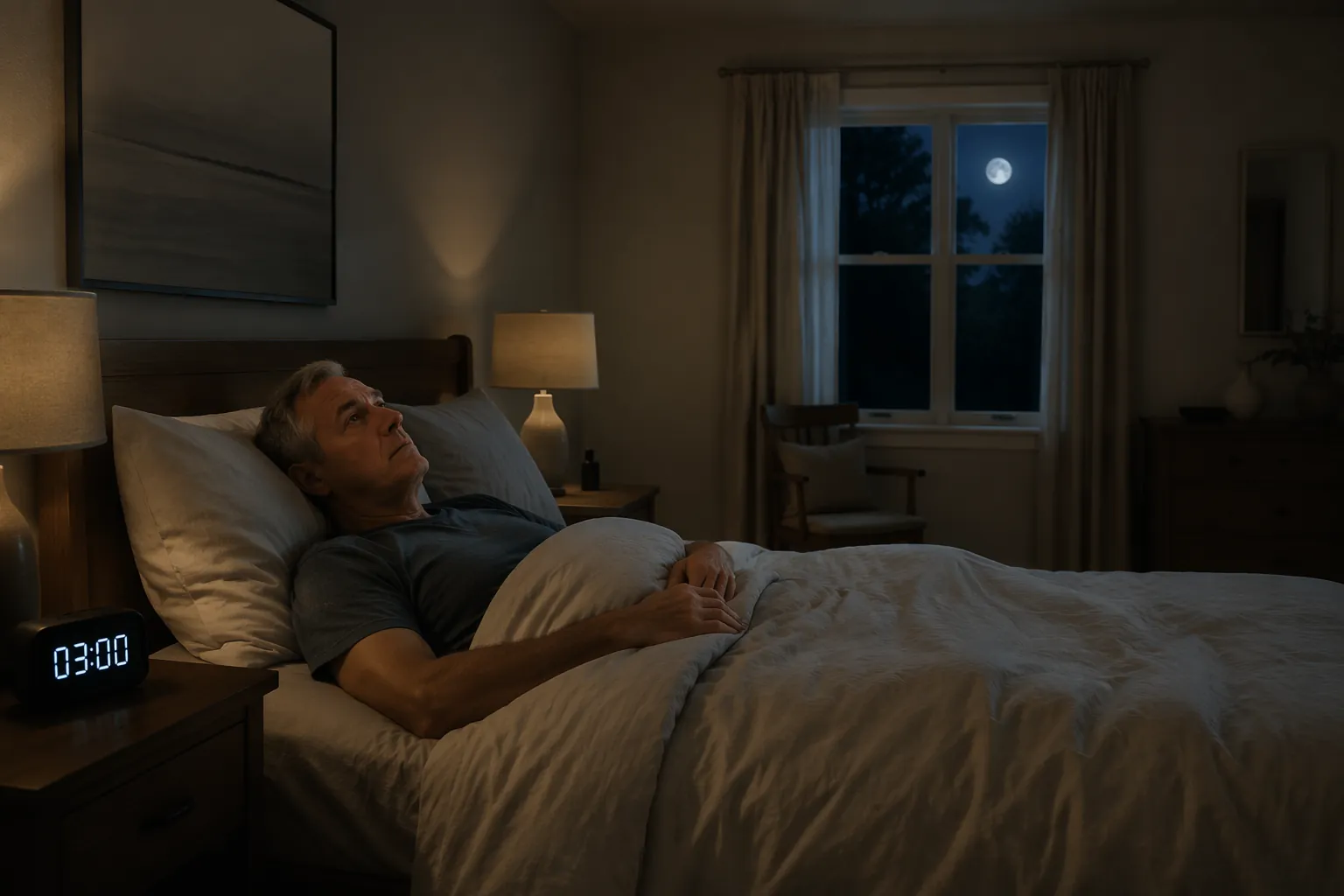
Why early retirement can make anxiety show up at bedtime
Work is not always healthy, and retirement is not automatically a loss. For some people, leaving work removes years of strain. The trouble starts when retirement removes structure faster than the retiree can replace it. A person may have more hours, yet fewer external cues for when to get up, move, solve problems, talk to others, and stop thinking.
That matters because research on adults age 60 and older in the 2020 Health and Retirement Study found that self-rated health mediated 21.95% of the association between anxiety and sleep disorder, while life satisfaction mediated 17.04% of that association.[1] Those are not magic percentages, and the study design was cross-sectional, so they do not prove that improving health perception or life satisfaction will cause sleep to improve for every retiree. They do point to two very believable pathways: how safe you feel in your body during the day, and whether the day still feels worth inhabiting.
That is why a retiree can follow ordinary sleep hygiene rules and still lie awake. The bedroom may be dark, cool, and quiet, while the mind is still asking: Am I healthy? Am I useful? Did I avoid the account statement again? Did I do anything today that made tomorrow easier?
For broader context on why retirement can improve sleep for some people and worsen it for others, see How Retirement Affects Sleep Quality – What You Should Know. The focus here is the practical question: what to do next.
The protocol, in the order you actually live the day
| When | What to do | What it is trying to change |
|---|---|---|
| Wake time | Get up at the same time every day, even after a poor night. | Stabilizes the sleep clock and stops the bed from becoming an all-day recovery zone. |
| Morning | Get 15–30 minutes of outdoor light and take a planned walk or equivalent activity. | Rebuilds perceived physical capacity and gives the body a clear daytime signal. |
| Daytime | Schedule one meaningful role, task, volunteer shift, class, or small work commitment. | Restores life satisfaction through usefulness and contact. |
| Late afternoon or early evening | Use a written worry window: concern, next action, date, and who can help. | Moves problem-solving out of bed and into daylight. |
| Night | Limit time in bed to roughly 7–8 hours and use breathing or guided imagery for arousal. | Protects the bed-sleep link without asking relaxation to solve retirement. |

Start with a fixed wake time, not a perfect bedtime
After a bad night, the natural impulse is to sleep in, linger in bed, or cancel the morning. That feels merciful for an hour and costly by evening. A late wake time weakens sleep pressure, delays light exposure, and gives anxiety a whole day of evidence that the night has already won.
Choose a wake time you can keep seven days a week. It does not have to be heroic. If you used to wake at 5:30 for work and now have no reason to, 6:30 or 7:00 may be more realistic. The important part is that the day starts by decision, not by how the night went.
- Get out of bed within a few minutes of the alarm.
- Open curtains or go outside as soon as practical.
- Do not use extra time in bed to audit your health, your finances, or yesterday’s choices.
- If the night was poor, make the day simpler, not shapeless.
Use movement to rebuild trust in your body
Self-rated health is not the same thing as a medical chart. It is the working opinion you carry around about whether your body is basically safe, capable, and recoverable. Early retirement can disturb that opinion. Without the old schedule, small aches get more attention. A slow morning feels like decline. A skipped errand becomes evidence.
The first daytime intervention is not to become an athlete. It is to give yourself repeated, modest evidence that your body can do what you ask of it. A morning walk is useful because it combines light, movement, and a visible beginning to the day. If walking is painful or unsafe, substitute a chair routine, pool exercise, physical therapy exercises, or another clinician-approved option.
There is also a useful caution against assuming retirement itself is the villain. In the GAZEL cohort of 14,714 French workers, sleep disturbances improved after retirement, and the largest improvements appeared among people who had prior depression or mental fatigue; the reported odds ratio was 0.55 in that group compared with 0.74 overall.[2] That finding does not transfer neatly to every U.S. early retiree, especially because the workers studied had strong pension guarantees. Still, it is an important reminder: leaving work can relieve sleep strain when work was the source of the strain.
For the anxious early retiree, the practical target is narrow: do one planned physical activity most mornings, then record completion rather than performance. A check mark is enough. Distance, pace, and calories are less important than the accumulating message: I got up, I moved, I kept a promise to myself.
Put one useful obligation back on the calendar
Life satisfaction is too large a phrase to fix with a scented candle and a gratitude list. In early retirement, it often depends on something more ordinary: having a reason to be expected somewhere, by someone, for something that matters a little beyond your own mood.
That may be a volunteer shift, a standing childcare afternoon, a class with attendance, a walking group, a faith community role, a board position, a garden club task, or a small encore work commitment. The right choice has two features. It is specific enough to appear on a calendar, and it has enough external reality that canceling it would affect someone or something besides your private plan.
Do not begin by filling the week. Early retirement anxiety often comes with an injured sense of competence, and overpromising can turn quickly into avoidance. Start with one repeating commitment. Protect it for a month. Let it become part of the scaffolding.
- If money worry is high, choose a low-cost or no-cost role.
- If health anxiety is high, choose something physically manageable and close to home.
- If loneliness is high, choose a role with predictable human contact, not only solo projects.
- If identity loss is high, choose a role that uses a skill you already trust.
Keep sleep mechanics simple and firm
Once the day has a wake time, light, movement, and one meaningful anchor, the sleep rules become easier to follow. They are still necessary. Anxiety makes people negotiate with the bed: getting in early to feel safe, staying late to recover, napping because the afternoon feels impossible. Those choices are understandable, but they blur the signal that bed is for sleep.
- Keep the same wake time regardless of bedtime.
- Get 15–30 minutes of morning sunlight, outdoors when possible.
- Limit your sleep window to about 7–8 hours unless a clinician has advised otherwise.
- Avoid compensatory naps after a poor night; if you must nap for safety, keep it brief and early.
- Do not go to bed early to escape an anxious evening.
The hardest rule is often the sleep window. If you are awake from 2:30 to 4:30, it feels sensible to stay in bed until midmorning. But that teaches the body that bed is also a place for waiting, worrying, and recovering from worry. A steadier window gives the next night a better chance.
Move worry to a scheduled place before evening
Retirement worries are not imaginary just because they appear at 3:00 AM. Money, health, housing, insurance, family obligations, and purpose can all require real decisions. The mistake is letting the bed become the meeting room for all of them.
Set a 20-minute worry window in the late afternoon or early evening. Use paper if possible. The point is not to produce a perfect life plan. The point is to separate concern from rumination by giving each worry a next action.
| Write this | Example |
|---|---|
| The worry | I am afraid I retired too early and will run out of money. |
| The next action | Gather the last three account statements. |
| The date | Tuesday at 10:00 AM. |
| The helper or reviewer | Spouse, financial planner, benefits office, or trusted tax professional. |
| The bedtime phrase | This has a scheduled next step; bed is not the place to solve it. |
This is especially useful for financial anxiety because vague dread is much harder to sleep beside than a written next step. One widely circulated 2026 article cited a survey claim that 87% of Americans report financial anxiety affecting health and relationships, but the original methodology was not independently verified in the available material, so it should be treated as cultural context rather than a firm benchmark.[3] Your own numbers matter more than a headline statistic.
At bedtime, downshift arousal instead of trying to solve retirement
Breathing exercises, guided imagery, and body scans are useful when they are given the right job. Their job is to lower physiological arousal. Their job is not to prove that your retirement plan is sound, your blood pressure is fine, your adult child is safe, or your purpose is fully restored.
Try a repeatable sequence. Dim the room. Put the phone away. If a worry appears, write one line only if it is genuinely new; otherwise point back to the worry-window page. Then use slow breathing or a guided image you have already practiced. Familiarity matters because the anxious brain is not looking for novelty at bedtime.
- Inhale gently through the nose.
- Exhale longer than you inhale.
- Relax the jaw, shoulders, hands, and abdomen.
- Return to the same neutral image each time the mind wanders.
- If you are wide awake and frustrated, leave the bed briefly and return when sleepy.
What if depression is part of the sleep problem?
A retirement sleep problem can look like insomnia on the surface while depression is doing much of the work underneath. In the REST Study, depression mediated up to 49.5% of the association between insomnia and early retirement.[4] That does not mean every early retiree with insomnia is depressed, and the cohort was predominantly White and college-educated, which limits how broadly the finding should be applied. It does mean mood burden deserves direct screening rather than being waved away as adjustment.
Pay attention if sleep trouble comes with persistent low mood, loss of interest, hopelessness, unusual irritability, appetite changes, heavy guilt, or thoughts that others would be better off without you. Those are not problems to solve with a stricter bedtime. They are reasons to involve a clinician promptly.
How long should you try this before getting help?
Give the protocol enough time to become visible, but do not let pride turn insomnia into a private endurance test. If you have kept a fixed wake time, morning light, planned activity, one meaningful obligation, a limited sleep window, and a written worry window for several weeks and sleep is still badly stuck, the next move is targeted help.
- Use a CBT-I specialist when the main pattern is conditioned insomnia: dread of bed, long wake periods, clock-watching, and an expanding sleep effort.
- Use a primary care clinician or mental health professional when depression, panic, health anxiety, medication effects, pain, or breathing symptoms are prominent.
- Use a qualified financial planner when money fear is concrete, recurring, and still vague because no one has reviewed the numbers.
- Seek urgent help immediately if you have thoughts of self-harm or feel unable to stay safe.
The responsible handoff depends on what is keeping the loop alive. A sleep specialist can tighten the insomnia pattern. A clinician can evaluate mood and health anxiety. A financial professional can turn money dread into numbers and choices. The bed should not have to perform all three jobs.
References
- Anxiety and sleep disorders in middle-aged and older adults: the chain mediating role of self-rated health and life satisfaction - Frontiers in Psychology - 2026 - https://www.frontiersin.org/journals/psychology/articles/10.3389/fpsyg.2026.1810526/full
- Study shows that sleep disturbances improve after retirement - American Academy of Sleep Medicine - https://aasm.org/study-shows-that-sleep-disturbances-improve-after-retirement/
- How to Overcome Retirement Stress and Sleep Better - Yahoo Health - June 2026 - https://health.yahoo.com/wellness/sleep/articles/overcome-retirement-stress-sleep-better-190838708.html
- The Association Between Insomnia and Early Retirement: A Mediation Analysis - REST Study - https://pmc.ncbi.nlm.nih.gov/articles/PMC7921848/
Read the full guide: How Reading to Your Pet Before Bed Improves Sleep