
The Health Risks of Sleeping Only 3 Hours a Night
Sleeping only three hours a night is severe sleep deprivation, not a personal sleep style. One awful night is survivable. A recurring pattern is different: it narrows your safety margin for driving and work, strains blood pressure and glucose regulation, weakens immune defense, and is linked with higher mortality in large population studies.
The evidence is strongest when three hours is treated honestly: exact three-hour data are limited, because many studies group people into categories such as <=4, <5, <6, or <7 hours. The best-known large cohort that separated a three-hour category found that women reporting three hours of sleep had a statistically significant 33% higher mortality hazard, while the fully adjusted result for men at three hours was elevated but did not reach statistical significance.[1] That does not make three hours safe. It means the most careful answer is: the exact number is hard to isolate, but the surrounding evidence on very short sleep is consistently concerning.
Evidence tier: large observational cohorts and meta-analyses for mortality and cardiometabolic risk; controlled impairment studies for performance and safety; more indirect evidence for immune, endocrine, and brain-clearance pathways. Last reviewed: July 25, 2026.

The first danger is that you may feel functional while you are impaired
People often judge sleep loss by whether they can still answer messages, get children dressed, finish a shift, or keep a household moving. That is a compassionate reason for underestimating the problem, but it is not a reliable measurement.
In a controlled performance study, being awake for 17 to 19 hours produced cognitive and motor impairment comparable to a blood alcohol concentration of 0.05%.[2] A person sleeping three hours a night can reach that kind of wakefulness window routinely, especially if the sleep is fragmented or pushed to odd circadian times.
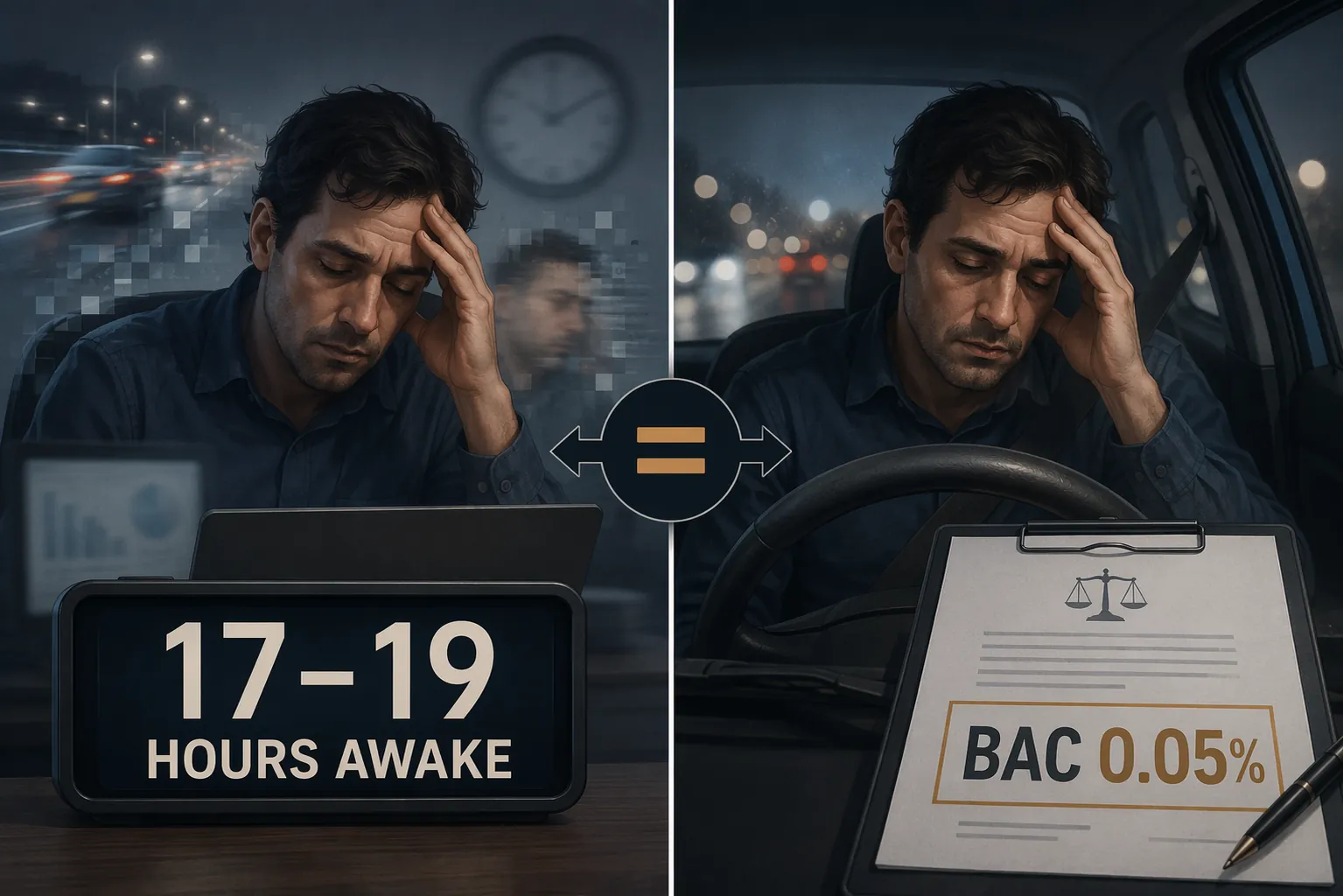
This is the uncomfortable gap: sleep-deprived people can keep acting competent after their attention, reaction time, judgment, and error monitoring have already slipped. That matters if you drive, operate equipment, supervise children, prepare medication, make clinical or financial decisions, or work in any setting where a delayed reaction becomes someone else’s risk.
What mortality studies can and cannot say about three hours
The Cancer Prevention Study II analysis by Kripke and colleagues included more than one million participants and is especially useful because it reported a three-hour sleep category. Among women, three hours of sleep was associated with a mortality hazard ratio of 1.33, with a confidence interval from 1.08 to 1.64. Among men, the hazard ratio was 1.19, with a confidence interval from 0.96 to 1.47, which was not statistically significant in the fully adjusted model.[1]
That sex-specific detail is not a footnote. It prevents a sloppy claim that every adult sleeping exactly three hours has the same measured mortality increase in that study. But it also does not rescue the habit. Three hours sits at the extreme end of short sleep, and the broader evidence around short sleep shows a pattern that should be taken seriously.
A meta-analysis by Gallicchio and Kalesan reported a pooled relative risk of 1.10 for all-cause mortality among short sleepers, using a short-sleep definition of less than seven hours.[1] That is not a three-hour statistic, and it should not be used as though it were. It does show that even broader short-sleep categories carry a measurable mortality signal across populations.
The most dramatic mortality figure in this evidence base applies to a narrower group: men with chronic insomnia plus objectively measured short sleep of less than six hours. In the Penn State cohort, that profile was linked with more than four times the mortality risk, with an odds ratio of 4.33; adjusted mortality was 51.1% compared with 9.1%.[3] This does not mean every person sleeping under six hours has a fourfold mortality risk. It does mean that insomnia plus objectively short sleep is a high-risk pattern, not merely a frustrating symptom.
Cardiovascular strain is one of the main reasons three hours is not sustainable
Sleep is not a passive break for the cardiovascular system. During healthy sleep, heart rate, blood pressure, autonomic tone, inflammation, and hormonal signaling shift into a different operating mode. When sleep is repeatedly cut to three hours, the body spends too much time in a wake-like stress state and too little time in recovery.
A Harvard Health summary of an analysis involving more than 700,000 people reported that sleeping four hours or less doubled the risk of hypertension.[4] Three hours falls inside that very-short-sleep range, but the statistic itself belongs to <=4 hours, not to exactly three. The clinical meaning is still direct: if someone is routinely sleeping three hours, blood pressure risk deserves attention, not reassurance.
Coronary risk also appears in pooled evidence. A review cited by the American College of Cardiology’s CardioSmart program described findings from 15 studies with about 475,000 participants, in which sleeping less than five to six hours was associated with a 48% higher risk of coronary heart disease mortality.[5] Again, this is an adjacent threshold, not an exact three-hour measurement. But three hours is not adjacent in the safer direction; it is deeper into the exposure category.
For a reader who already has hypertension, coronary disease, diabetes, sleep apnea, heavy alcohol use, or rotating night shifts, the concern sharpens. Short sleep does not need to be the only cause of harm to worsen the load on systems that are already under pressure.
Metabolism changes before life feels obviously unmanageable
Three-hour sleep often gets described as tiredness, but the body treats it as a metabolic disruption. Sleep restriction can alter glucose handling, appetite signaling, stress hormones, and insulin sensitivity. That is why the risk is not limited to feeling foggy at breakfast.
A review in the Journal of Endocrinology reported that people sleeping five to six hours had about double the risk of prediabetes or diabetes compared with those sleeping seven to eight hours.[6] This does not prove that every person at three hours will develop diabetes, and it does not isolate exactly three hours. It does show that chronically shortened sleep is linked with metabolic disease even at sleep durations longer than the one being asked about here.
This is one reason “I’m used to it” is such a poor safety test. Blood glucose patterns, appetite regulation, and vascular strain can deteriorate quietly. The person may still be working, parenting, and appearing composed while their physiology is paying a debt they cannot feel in real time.
The immune system also loses margin
Short sleep is associated with greater infection susceptibility. In research summarized by Cleveland Clinic and Sleep Foundation, sleeping less than seven hours was associated with higher odds of developing a cold, with an odds ratio of 2.94.[7][8] That figure applies to less than seven hours, not specifically three. Still, if risk rises across a broad short-sleep group, three hours should not be treated as a harmless private inconvenience.
The practical consequence is familiar: illnesses hit harder, recovery feels slower, and the person has less reserve for caregiving, shift work, school pickups, or the next disrupted night. Immune effects are not usually the first reason someone seeks help for three-hour sleep, but they add to the same pattern of lost resilience.
Brain health: strong short-term evidence, more cautious long-term claims
The short-term brain effects of severe sleep restriction are not subtle: slower reaction time, poorer attention, weaker impulse control, memory problems, and more errors. These are the effects that make driving and work safety so important after nights of minimal sleep.
Long-term brain-health discussions are more delicate. Sleep is involved in waste-clearance and restoration processes in the brain, and there is active research on sleep disruption, the glymphatic system, and dementia pathways. But the cited evidence does not provide a precise dementia number for exactly three hours of sleep per night. The safer conclusion is that chronic severe sleep deprivation is biologically unfavorable for brain health, while exact long-term risk depends on more than sleep duration alone.
Who should treat three-hour sleep as urgent
Any adult consistently sleeping around three hours should treat it as a health problem worth changing. The cause matters because the route out will differ: a newborn, perimenopause, night shifts, caregiving, ADHD-related timing problems, untreated sleep apnea, restless legs, pain, medication effects, alcohol, anxiety, depression, and chronic insomnia do not all need the same plan.
Several situations deserve faster medical help rather than another round of self-blame or generic sleep tips:
- You are sleeping around three hours most nights for more than a short crisis period.
- You feel sleepy while driving, have near-misses, or rely on stimulants to stay safe.
- You have chest pain, uncontrolled blood pressure, palpitations, diabetes, pregnancy complications, or another condition that sleep loss can aggravate.
- You snore loudly, stop breathing during sleep, wake gasping, or have severe morning headaches.
- You want to sleep but cannot, especially if insomnia has become chronic.
- You are having thoughts of self-harm, feeling unsafe, or becoming too impaired to care for yourself or others.
There are rare people with natural short-sleep traits, but that is not the same as becoming accustomed to deprivation because life has cornered you. A person who needs alarms, caffeine, catch-up sleep, weekend crashes, or sheer force of will is not demonstrating natural short sleep.
What to do with the information
The next useful question is not whether three hours is enough. It is what is holding sleep at three hours and how quickly that pattern can be changed.
Start by separating cause from coping. If the problem is opportunity, such as caregiving, a newborn, multiple jobs, or shift scheduling, the intervention begins with protection: redistributed coverage, safer driving plans, protected sleep blocks, and fewer high-risk tasks after long wake periods. If the problem is insomnia, the priority is assessment and evidence-based treatment rather than spending more hours in bed fighting wakefulness. If the problem may be sleep apnea, restless legs, medication effects, pain, mood symptoms, or circadian timing, a clinician needs to look for the driver instead of labeling the person undisciplined.
Life-stage and neurodivergent sleep guides can help explain why sleep collapses during pregnancy, perimenopause, ADHD, older adulthood, caregiving, and shift work, but the safety judgment does not wait for a perfect category. Three hours a night is severe deprivation. If it is happening consistently, it deserves a plan, and often professional help, because the body is already operating with too little recovery time.
References
- Mortality Associated with Short Sleep Duration, PMC.
- Moderate sleep deprivation produces impairments in cognitive and motor performance equivalent to legally prescribed levels of alcohol intoxication, Occupational and Environmental Medicine.
- Study finds an increased risk of death in men with insomnia and a short sleep duration, American Academy of Sleep Medicine.
- How sleep deprivation can harm your health, Harvard Health.
- Less Than Six Hours of Sleep a Night Could Shorten Your Lifespan, CardioSmart, American College of Cardiology.
- Short- and long-term health consequences of sleep disruption, PMC.
- Sleep Deprivation, Cleveland Clinic.
- Sleep Deprivation, Sleep Foundation.