
How Cyclospora Explosive Diarrhea Disrupts Sleep
At 2:40 a.m., cyclosporiasis does not behave like a mild stomach upset politely interrupting sleep once or twice. At its worst, it can mean urgent watery stool again and again, sometimes with only a short window between bathroom trips. The body feels emptied out, but the gut keeps signaling. Then come the cramps, weakness, shaky legs, thirst, chills or heat, and the miserable half-sleep of waiting for the next wave.
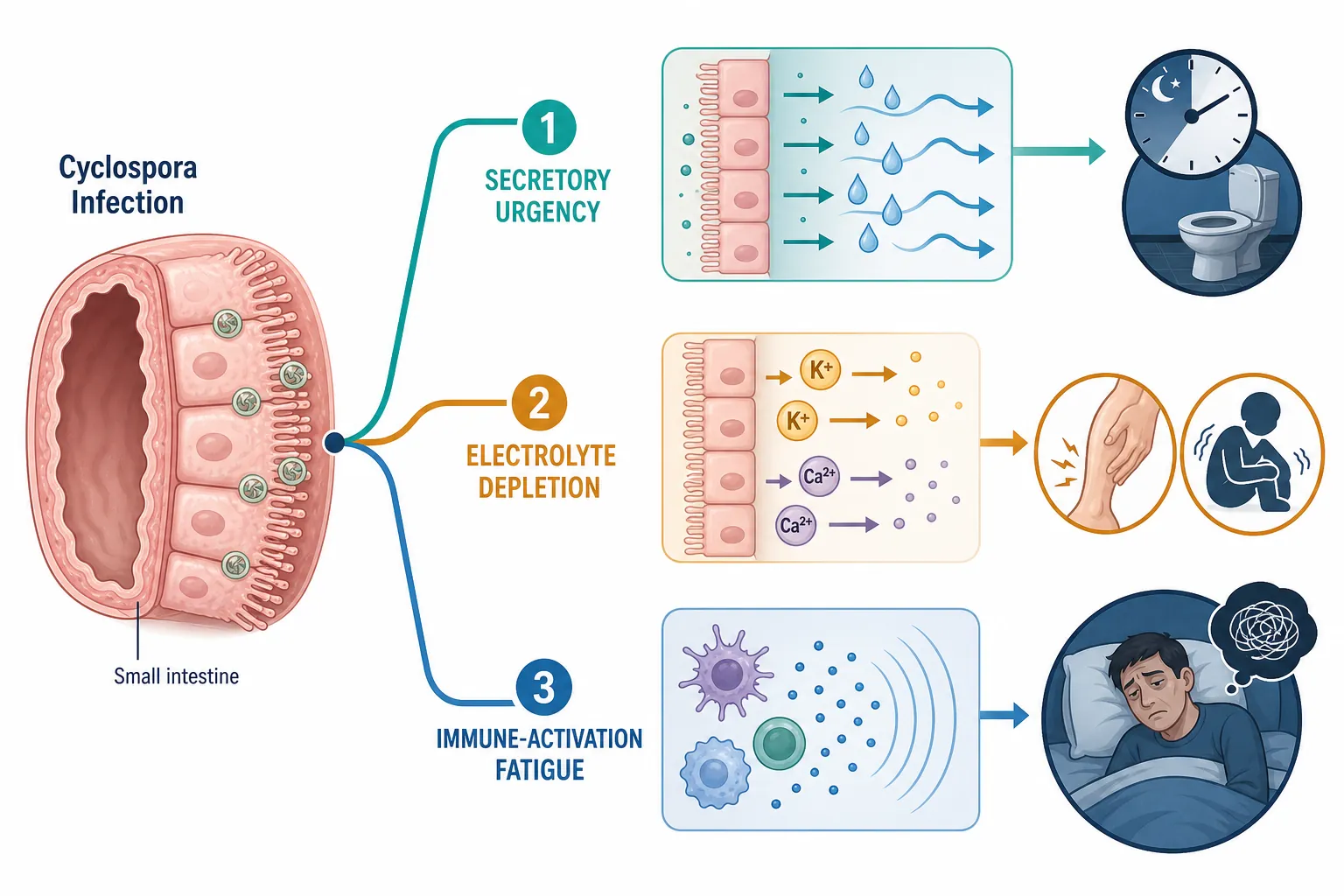
That is why generic advice for diarrhea at night often feels too small for Cyclospora. The main problem is not just that sleep is being interrupted. The infection can disrupt sleep through three overlapping mechanisms: secretory water loss from the small intestine, fluid and electrolyte depletion, and immune-activation fatigue. Each one asks for a different kind of response.

There is one important limit to be clear about before going further: there do not appear to be cyclosporiasis-specific sleep studies using polysomnography or actigraphy. The sleep explanation is inferred from what is known about Cyclospora pathophysiology, infectious diarrhea, dehydration and electrolyte effects, and post-infectious fatigue. That is still enough to make the nighttime pattern less mysterious and to separate useful steps from bedtime folklore.
Secretory urgency keeps the gut active at night
Cyclospora cayetanensis invades epithelial cells in the small intestine. Stanford Medicine’s David Relman explains that the small intestine normally absorbs about 90% of the water from intestinal contents; when the parasite damages or impairs those absorptive cells, that water is not reclaimed the way it should be.[1]
That mechanism matters at night. Sleep does not turn the infected small intestine off. When absorption is impaired and watery stool keeps moving through, the person in bed is not simply being awakened by discomfort. They are being awakened by a fluid-handling failure inside the gut. At peak severity, the urgency can come every 20 to 30 minutes, which makes “keep the path to the bathroom clear” an incomplete plan.[1]
This also helps explain why nocturnal diarrhea from infection should not be filed under the same mental category as functional bowel patterns. Medical News Today distinguishes infectious nocturnal diarrhea from irritable bowel syndrome patterns, where diarrhea that wakes a person from sleep is treated as a warning feature rather than an expected IBS rhythm.[2] With Cyclospora, nighttime stooling fits the infectious process.
The practical response is not elegant, but it is protective: shorten the distance between bed and toilet, reduce decisions in the dark, and prepare for urgency as if it will happen before the person is fully awake. That can mean a clear route, a night-light, a robe or easy clothing, wipes or barrier cream, a lined trash bag, spare underwear, and a towel or waterproof layer if leakage is a real risk. For older adults, this is not just comfort planning; rushing half-asleep to the bathroom increases fall risk.
The goal is to remove as much friction as possible from a cycle that may repeat many times. If the person has to search for supplies, negotiate stairs, or sprint across a dark room, the infection gets to steal extra minutes of wakefulness and extra safety margin every time.
Fluid and electrolyte depletion fragments sleep between trips
Watery diarrhea is not only water leaving the body. It also means the loss of dissolved electrolytes that nerves and muscles depend on. Stanford Medicine notes that some patients with cyclosporiasis can lose up to 10% of body weight from fluid loss.[1] That degree of loss is not a sleep-hygiene problem. It is a physiologic stressor.
Between bathroom trips, dehydration and electrolyte shifts can keep the body restless. Muscle cramps, weakness, lightheadedness, palpitations, headache, and restless legs-type sensations can make a person feel too uncomfortable to settle, even when the gut gives them a temporary break. Someone may be exhausted enough to fall asleep quickly, then wake again because their calves cramp, their heart feels fast, or they feel too weak and wired at the same time.
Plain water may help thirst, but it may not be enough when stool losses are frequent and watery. Oral rehydration solution, electrolyte solution, or clinician-recommended rehydration drinks are meant to replace both fluid and salts. This is especially relevant overnight, when a person may drink a large amount of water after each episode but still wake feeling shaky, crampy, or unable to get comfortable.
| Nighttime problem | What it can mean | Practical response |
|---|---|---|
| Repeated watery stools | Ongoing intestinal fluid loss | Use electrolyte-aware rehydration, not only plain water |
| Cramps or restless legs-type sensations | Possible electrolyte depletion or dehydration-related neuromuscular irritability | Rehydrate steadily and seek medical advice if symptoms are persistent, severe, or paired with weakness |
| Lightheadedness, very dark urine, inability to keep fluids down | Possible clinically significant dehydration | Contact a clinician promptly or seek urgent care depending on severity |
| Frequent nighttime bathroom trips in an older adult | Fluid loss plus fall risk | Keep the route lit, remove trip hazards, and consider assistance |
A clinician quoted by AARP advised medical evaluation when diarrhea exceeds about 6 to 8 episodes per day.[3] That number should be treated as a practical clinical threshold, not a universal rule that makes fewer episodes automatically safe. A person who is pregnant, older, medically fragile, unable to keep fluids down, dizzy on standing, confused, or producing very little urine should not wait for a numeric target.
Medication context also matters. The standard treatment for cyclosporiasis is trimethoprim-sulfamethoxazole, often abbreviated TMP-SMX, usually for 7 to 10 days, and Cleveland Clinic notes that most people feel better within 1 to 2 weeks.[4] But TMP-SMX can be a poor fit with some medications or health situations. AARP and HealthPals both flag interaction concerns in older adults, including warfarin, diabetes medications, diuretics, and ACE inhibitors.[3][5] That is not a reason to avoid care; it is a reason not to self-direct treatment from leftovers in a cabinet.
Exhaustion can persist without restorative sleep
Cyclosporiasis can produce the frustrating state of being profoundly tired while still unable to sleep well. Part of that is mechanical: the gut keeps waking the person. Part of it is metabolic: fluid, salts, and nutrition are being disrupted. And part of it is the immune system’s sickness response, the same broad pattern that can make people feel heavy, slowed down, achy, and mentally foggy during infection.
A synthesis of 8 PubMed-indexed studies summarized by Inciteful Med reports that fatigue after cyclosporiasis treatment can last “a few weeks.”[6] Michigan Gastro also notes that gut microbiome recovery after cyclosporiasis can take several months.[7] Those points do not prove a specific sleep-architecture change in Cyclospora patients. They do support a more realistic expectation: the gut may stop dominating the night before energy feels fully normal.
This is where people often misread their own bodies. They assume that if they are exhausted, they should be able to sleep deeply. During infection, exhaustion can coexist with fragmented, non-restorative sleep because the signals competing with sleep are still active: urgency, cramps, thirst, inflammation, anxiety about the next episode, and sometimes hunger mixed with poor tolerance for food.
The CDC describes cyclosporiasis symptoms as potentially remitting and relapsing: they “may go away and then return.”[8] That pattern is especially hard at bedtime. After one quieter evening, a person may lie down hopeful, then wake two hours later with the same urgency. After that happens once or twice, the bed itself starts to feel unreliable. Anticipatory anxiety is not the cause of the infection, but it can add another layer of wakefulness.
What to do at night, matched to the mechanism
The useful question is not “How do I sleep through this?” If stool is urgent and watery every few minutes, sleeping through it may be neither realistic nor safe. The better question is: which mechanism is most active tonight, and what reduces harm while the infection is being treated or evaluated?
- For secretory urgency: set up the room before lying down. Clear the route, use low light, keep supplies within reach, and reduce anything that forces rushed decisions while half-awake.
- For fluid and electrolyte loss: sip steadily rather than trying to catch up all at once, use an oral rehydration or electrolyte strategy when losses are frequent, and treat dizziness, very low urine, confusion, or inability to keep fluids down as medical concerns.
- For cramps, weakness, or restless sensations: do not assume the problem is insomnia. These symptoms can be part of dehydration or electrolyte disturbance and deserve attention, especially if they worsen overnight.
- For immune-fatigue: rest in shorter windows if that is all the gut allows. A broken night during active infection is not a personal failure, and pushing hard the next day can make recovery feel worse.
- For relapse anxiety: prepare the same way even on a better evening. The point is not pessimism; it is removing the fear that a returning episode will catch the person unprepared.
Food choices at night should be conservative and boring if the gut is active. Heavy meals, alcohol, and large volumes right before lying down can make the next few hours harder to interpret and manage. Small sips, simple tolerated foods, and a plan for rehydration usually matter more than any elaborate sleep routine.
Pregnancy deserves a lower threshold for individualized care because dehydration is the main concern, and antibiotic decisions need patient-specific review. Women’s Health CT emphasizes dehydration risk during pregnancy and the need for individualized antibiotic guidance rather than one-size-fits-all advice.[9]
Where the 2026 outbreak fits
The outbreak context is worth knowing, but it should not crowd out the bedside problem. In a CDC Health Alert Network notice dated July 14, 2026, the agency reported more than 1,645 confirmed cyclosporiasis cases across 34 states, with 141 hospitalizations; the median age was 44, with a range from 2 to 95.[10] Because the outbreak was ongoing, those figures are a dated snapshot rather than a final count.
For the person awake tonight, the case count is less important than the pattern: frequent watery diarrhea, dehydration risk, possible relapse, and the need for treatment decisions that account for medical history and medications. Better sleep usually follows control of the infection and fluid losses. If episodes are frequent, dehydration signs are present, the person is pregnant or older, or medication interactions are possible, this is not something to sleep-manage in isolation.
References
- Cyclosporiasis diarrheal outbreak: What experts say, Stanford Medicine, 2026.
- What causes diarrhea in the middle of the night?, Medical News Today.
- Cyclospora Outbreak: What Older Adults Should Know, AARP.
- Cyclosporiasis, Cleveland Clinic.
- Cyclospora in Older Adults, HealthPals.
- Does Cyclospora Cause Severe Fatigue?, Inciteful Med.
- How to Care for Your Digestive Health After Cyclosporiasis Treatment, Michigan Gastro, July 10, 2026.
- Symptoms of Cyclosporiasis, Centers for Disease Control and Prevention.
- Cyclospora Outbreak & Pregnancy: What Connecticut Patients Should Know, Women’s Health CT.
- Increase in Reported Cyclosporiasis Cases — United States, 2026, Centers for Disease Control and Prevention, July 14, 2026.
Read the full guide: How the Aquarius Full Moon Disrupts Each Zodiac Sign's Sleep