
How to choose a kid-safe smartphone that protects sleep
The best kid safe smartphone to avoid sleep disruption is usually not the phone with the strongest blue light filter. It is the phone that blocks the route your child actually uses to stay awake: light exposure, stimulating content, or simple access to one more app when sleep should already have started.
That distinction matters at bedtime. A child who reads quietly on a dimmed screen, a child who is pulled into group chats, and a child who keeps checking a phone because it is on the nightstand are not having the same sleep problem. They may all be called “screen time,” but they do not need the same phone restrictions.
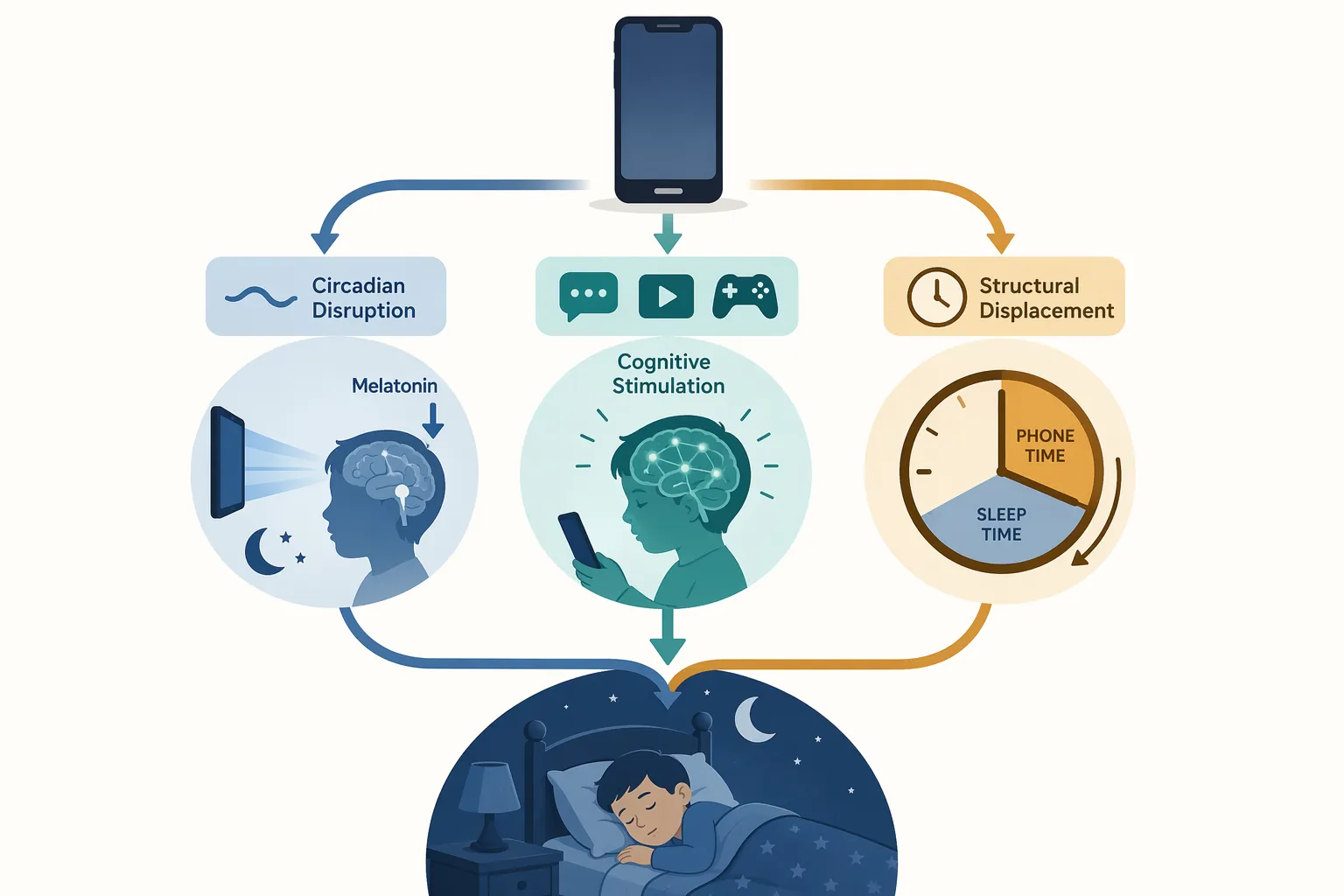
The three sleep pathways a phone can open
A sleep-protective phone needs to be judged against three different mechanisms.
- Circadian disruption: evening screen light can suppress melatonin and shift the body later, especially in children.
- Cognitive stimulation: videos, games, messages, and conflict keep the brain emotionally and socially engaged when it should be winding down.
- Structural displacement: the phone simply takes up minutes that would otherwise belong to sleep.
The first pathway is real. Children are not just small adults with the same light response. Sleep Foundation summarizes evidence that children’s melatonin may be suppressed about twice as much as adults’ under comparable blue light exposure, which is why evening brightness and device timing still deserve attention.[1]
But light is not the whole story, and it is not always the largest bedtime problem. A BBC Future review published in April 2026 discussed evidence from 11 studies and reported that screen light alone delayed sleep by about 9 minutes in adults, while also noting that children may be more light-sensitive than adults.[2] That does not make blue light harmless. It does make “has night mode” a weak standard for choosing a child’s phone.
The second pathway is often the one families feel most sharply. Rochester Regional Health describes teens delaying sleep by more than 30 minutes with phone use, notes that phone engagement can interfere with the normal evening decline in cortisol, and reports worse sleep even when phones are kept in the room without being used.[3] A filter does not stop a child from answering a message, watching one more short video, or checking whether a friend responded.
The third pathway is less dramatic but very common: the phone is available, so bedtime becomes elastic. Pew Research Center reported that 45% of teens say they are online “almost constantly,” which does not prove that every teen is losing sleep to a phone, but it does show why access itself has to be part of the sleep question.[4]
Why a blue light filter is not enough
Blue light controls can be useful. A dimmer screen, warmer color temperature, and earlier device cutoff reduce one kind of biological pressure against sleep. They are worth turning on. They are not enough to make a phone sleep-safe.
A filter changes the light coming from the device. It does not change what the child is doing on the device. A heated group chat still invites vigilance. A game still asks for the next move. A video feed still offers the next clip. The child may be lying still in a dark room while the nervous system is still responding to social reward, novelty, or conflict.
This is where the evidence tension is useful rather than confusing. The established guidance about light exposure still matters, especially for younger children. At the same time, if light alone is associated with a roughly 9-minute sleep delay in the adult studies discussed by BBC Future, while phone engagement in teen-focused clinical material is associated with delays over 30 minutes, a parent should not choose a device mainly because its night mode looks reassuring.[2][3]
The practical question is not “Does this phone have a sleep feature?” It is “What can my child still do after bedtime?” If the answer is browse, message, watch, scroll, or reopen blocked apps through a workaround, the main sleep risk may still be in place.
Start with the child’s most likely bedtime failure point
Parents often ask for a product name because they are tired of negotiating. A better first step is to identify the most predictable way the child’s bedtime gets pushed later.
| Bedtime pattern | Likely pathway | Restriction that matters most |
|---|---|---|
| The child winds up from videos, games, chats, or social conflict | Cognitive stimulation | No browser, app blocking, content limits, monitoring alerts, or tightly limited app approval |
| The child seems sleepy until the phone is used late under bright light | Circadian disruption | Earlier cutoff, dimming, night mode, and a firm no-screen wind-down |
| The child keeps checking the phone because it is nearby | Structural displacement | Downtime, bedtime schedules, no bedroom phone, and charging outside the room |
| The child finds workarounds or reopens apps after limits | Access failure | A simpler phone architecture with fewer loopholes or parent-controlled app access |
This is also where age and maturity matter. Common Sense Media has reported that about half of U.S. children get their first phone by age 11 and that teens check their phones a median of 51 times a day.[5] Those figures do not tell a parent which device to buy, but they do explain why a bedtime rule that depends on a tired child repeatedly making the mature choice is fragile.
A large Sapien Labs analysis discussed by CNN in July 2025 found that smartphone ownership before age 13 was associated with later self-reported problems including sleep disruption among nearly 2 million participants.[6] That finding is correlational and self-reported, so it should not be treated as proof that a first phone causes a specific child’s sleep problem. It does, however, fit what many families see: earlier and easier access gives sleep more competition.
How common kid-phone controls map to sleep
Product labels can blur the issue. “Kid-safe” may mean no browser, location tracking, content alerts, app approval, bedtime schedules, or all of those in different combinations. For sleep, those differences are not cosmetic.
No-browser phones reduce the places bedtime can go
A no-browser design removes a major route into late-night novelty. Pinwheel presents itself as a child-focused phone with no web browser and parent-managed apps, and Gabb’s starter option is also positioned around a no-browser approach.[7][8] Those are vendor claims, not independent sleep-outcome trials, but the architecture addresses a real sleep problem: the child cannot drift from one approved task into the open internet as easily.
No-browser phones are most relevant when the child’s issue is cognitive stimulation or workaround hunting. They do less for the child who is allowed to text late into the night, and they do not replace a bedroom rule.
Bedtime schedules remove one more decision
A bedtime schedule matters because bedtime is a poor time to ask for self-control. Pinwheel includes bedtime scheduling, and Teracube’s Family app describes the ability to block all apps from 7 p.m. to 8 a.m.[7][9] The exact hours a family chooses may differ, but the principle is the same: after the cutoff, the phone should stop inviting negotiation.
Scheduling is strongest against displacement. It protects the hour that disappears in small pieces: one reply, one search, one extra video, one app reopened after lights-out.
Content monitoring helps with stimulation, but it is not the same as sleep protection
Bark is built more around monitoring, app oversight, and content alerts than around being a bare-bones phone.[10] That can be useful when the sleep problem is social or emotional: bullying, sexual content, conflict, threats, or spiraling chats. A parent may need to know that the phone is not just being used late, but that something on it is keeping the child activated.
Monitoring alone still leaves an important gap. An alert tomorrow morning does not give back last night’s sleep. For a child who cannot disengage once a conversation starts, content monitoring works best when paired with app cutoff times and a no-phone bedroom rule.
iPhone Screen Time can work, if the setup is not treated as optional
A mainstream iPhone can address all three pathways if Screen Time is configured tightly: Downtime for the sleep window, app limits or blocked categories for stimulating content, communication limits where appropriate, content restrictions, purchase and installation controls, and a parent-held passcode. Apple describes these as Screen Time and parental-control features rather than as sleep-specific treatment tools.[11]
The advantage is flexibility. The weakness is that flexibility creates parent workload. If a family needs twelve settings to stay aligned, and one missed toggle reopens the browser, app store, or late-night messaging, the system may be too delicate for the actual household. For some children, a simpler phone is not more moral; it is just less leaky.
The bedroom rule still carries more weight than the brand name
A phone can be safer and still be in the wrong place. If the device sleeps next to the child, it remains a cue: check me, answer me, make sure nothing changed. Rochester Regional Health’s material is especially pointed here because it notes worse sleep even when phones are kept in the room without use.[3]
Pediatric sleep physician Dr. Craig Canapari has advised keeping devices out of the bedroom, a rule that sounds simple until a family has to enforce it every night.[12] Still, from a sleep standpoint, it is the cleanest intervention. The phone charges somewhere public. The child does not have to resist it from under the covers. The parent does not have to prove whether it was used at 11:40 p.m.
The American Academy of Pediatrics’ updated screen-time guidance, summarized by CHOC Children’s in 2026, continues to emphasize family media planning rather than a single universal time limit.[13] That approach fits sleep better than a generic daily allowance. A child may tolerate some daytime phone use well and still need a hard evening boundary.
A practical sleep-protection standard
When comparing kid-safe smartphones, ask these questions in order:
- Can the phone block or remove the most stimulating content my child uses at night?
- Can it shut down app access during the sleep window without relying on my child to stop voluntarily?
- Can it prevent browser or app-store workarounds that reopen the same problem under a new name?
- Can calls and emergency contacts remain available without leaving entertainment available?
- Can the phone be charged outside the bedroom every night without breaking the family’s communication needs?
- Does it include light controls as a supporting layer, not as the whole sleep plan?
That order is intentional. Light settings belong in the plan, especially for children who are sensitive to evening brightness. But a phone that warms the screen while leaving social feeds, games, video, and messaging available at 10 p.m. has not solved the larger sleep problem for many families.
A sleep-protective kid phone should make the desired bedtime behavior easier than the undesired one. For one child, that may mean a no-browser phone with a strict bedtime schedule. For another, it may mean a carefully configured iPhone with Downtime and communication limits. For another, it may mean monitoring because the content itself is the red flag, paired with app shutoff so the monitoring does not become a next-day report on a predictable lost hour.
The goal is not a perfectly optimized device. It is fewer opportunities for a tired child to re-enter the phone at night.
References
- How Does Blue Light Affect Children's Sleep? Sleep Foundation
- The blue light from your phone isn't ruining your sleep BBC Future, April 2026
- Teens and Sleep: How Smartphones Impact Sleep Rochester Regional Health
- Teens, Social Media and Technology Pew Research Center
- Teen phone use and checking frequency Common Sense Media
- Kids who get smartphones before age 13 have worse mental health, study suggests CNN, July 2025
- Pinwheel phone features Pinwheel
- Gabb starter plan Gabb
- Teracube Family app Teracube
- Bark monitoring and content alerts Bark
- Use parental controls on your child's iPhone and iPad Apple
- Keep devices out of the bedroom Dr. Craig Canapari
- AAP updated 2026 screen time guidelines CHOC Children's, 2026
Read the full guide: How to Sleep With a Sinus Infection Tonight