Light Flip phone and sleep: it's not about the blue light
If you are asking whether the Light Flip phone will reduce blue light enough to help you sleep, the clean answer is: probably not in any meaningful optical sense. Its small LCD is still a lit screen. The better reason it may help is more ordinary and more useful: it makes the thing that keeps many people awake harder to continue.
That distinction matters because the strongest recent evidence does not make screen blue light look like the main bedtime problem. A 2024 meta-analysis covering 73 studies and 113,370 participants found that screen blue light delayed sleep by an average of only 2.7 minutes; a related review of 11 experimental studies put the effect at roughly nine minutes at worst.[1] A few minutes can matter at the edges, but it is not the scale of harm most people imagine when they blame a bad night on the color of the pixels.
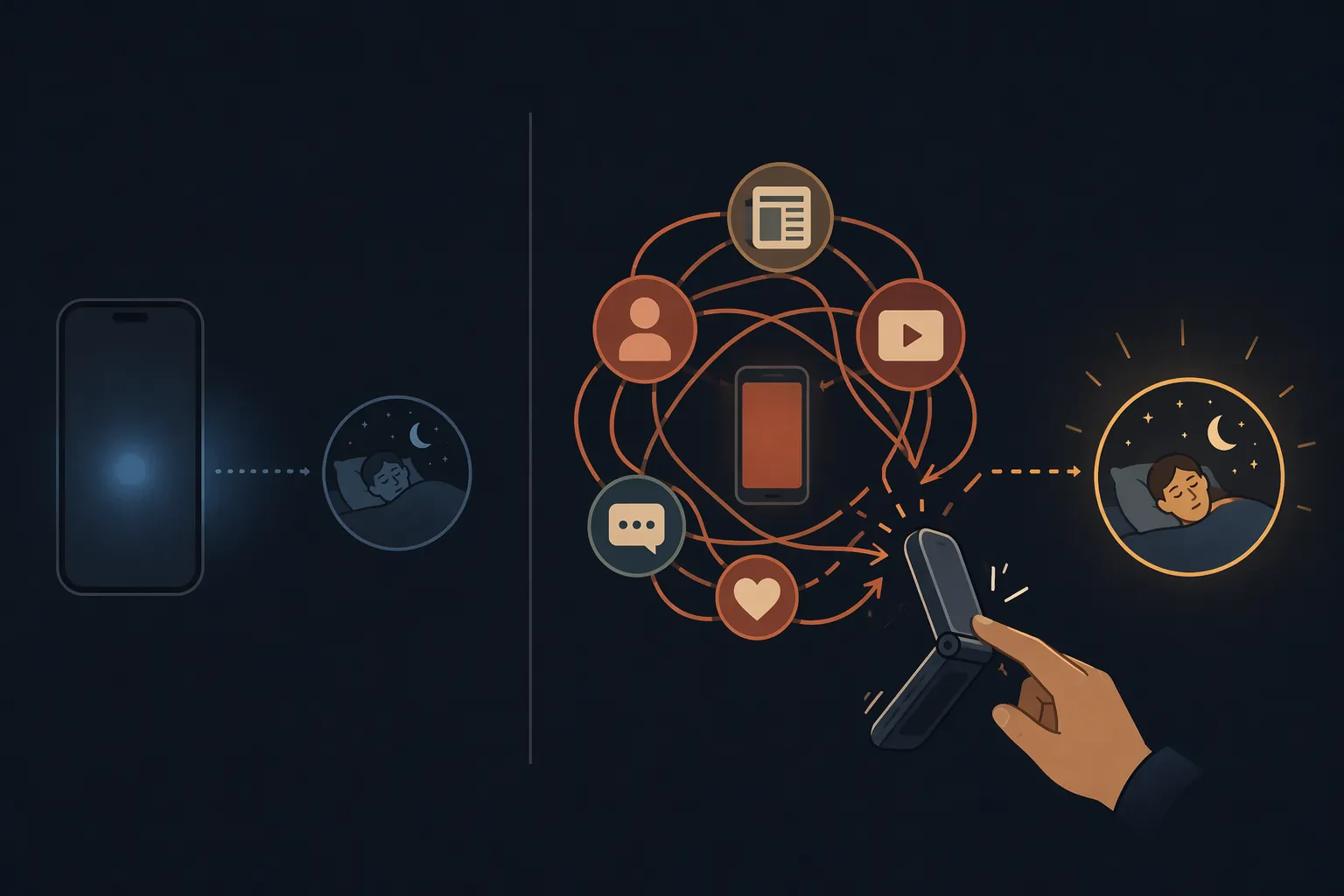
Jamie Zeitzer, a circadian researcher at Stanford, puts the light exposure in perspective: smartphone screens emit about 50 to 80 lux, typical indoor lighting is around 100 lux, and outdoor daylight ranges from about 10,000 to 100,000 lux. His blunt summary is the one most bedtime phone advice should start with: “It is much more the content, rather than the light, that is keeping people awake.”[1]
The Light Flip Is More Plausible As A Behavior Change Tool
The closest evidence for a Light Flip-style sleep benefit does not come from a flip-phone trial. It comes from a randomized controlled trial that asked people to stop using their phones for 30 minutes before bed for four weeks. In that study, which included 38 participants, Pittsburgh Sleep Quality Index scores fell from 10.05 to 5.63, sleep latency dropped by about 12 minutes, sleep duration increased by about 18 minutes, and pre-sleep arousal and mood improved.[2]
That is a much better match for the real bedtime complaint: not “my screen emitted blue wavelengths,” but “I opened one thing and then lost the next hour.” The intervention did not require a new spectrum of light. It removed the phone from the last half hour, which means it removed messages, videos, headlines, shopping carts, work reminders, and the small reward of checking just once more.
This is where the Light Flip becomes interesting. The product details that matter for sleep are not glamorous specs. The announced phone has a 2.8-inch non-touchscreen LCD, a physical T9 keypad, no outer notification screen, and no browser or social media apps. It also leans on the old clamshell motion: open the phone to use it, close it to end the interaction.[3]
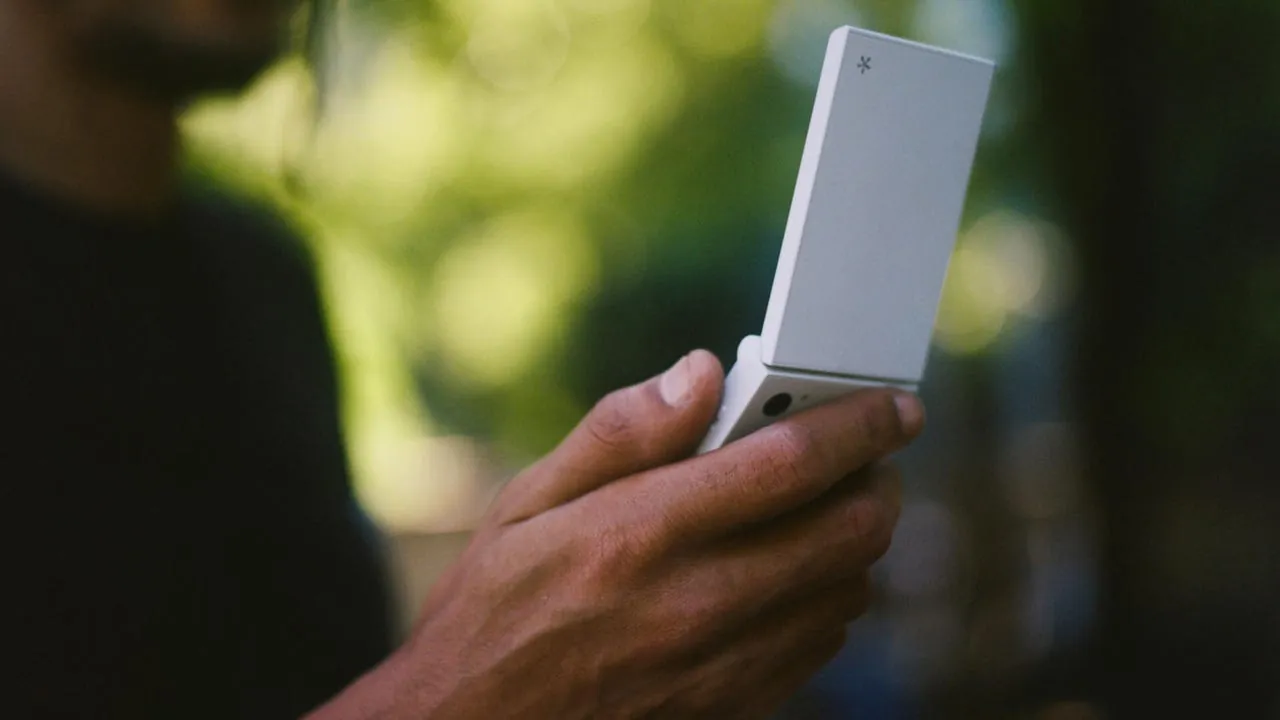
Those constraints change the last minutes before sleep in concrete ways. No outer screen means there is no glowing preview asking to be checked from the pillow. No social apps or browser means there is less chance that a text turns into a feed, a feed into a search, and a search into a second wind. A physical keypad slows the casual reply. The small inner screen is still a screen, but it is a poor stage for the kind of content that tends to keep the brain busy.
The closing gesture may matter too. Zeitzer has described the possibility of a Pavlovian cue: if the same action consistently ends device time, the brain can learn that the interaction is over.[1] That does not make the hinge medical technology. It makes it a boundary you can feel in your hand, which is often more reliable at 11:47 p.m. than a promise to stop scrolling after one more thing.
Blue-Light Filters Are Not The Main Lever
Night mode, warmer displays, and blue-light filters are not useless, especially if they make a screen more comfortable. They are just easy to overrate. One 2024 observational study reported that 80% of participants never used blue-light filter apps and found no significant association between filter use and sleep quality, with a p-value of 0.925.[4] That does not prove filters can never help anyone, but it fits the larger pattern: software tinting is a weak substitute for stopping the behavior that keeps the mind engaged.
Stuart Peirson of Oxford made the same point in a 2024 WIRED discussion of blue light and sleep: “A much greater issue is likely to be the content viewed.”[5] That sentence is worth sitting with before buying any device marketed around sleep. A warmer screen that still delivers work email, argument threads, sports highlights, breaking news, and short videos has not solved the main bedtime exposure.
There is a fair complication here. A 2023 student study by Randjelović and colleagues, with 43 participants, reported a large PSQI improvement from blue-light reduction alone.[6] It should not be waved away. But it also should not outweigh the broader evidence by itself. Smaller samples can catch real effects, exaggerated effects, or context-specific effects. The safer reading is that blue-light reduction may help some people, while the average effect of screen blue light on sleep timing appears small compared with the effect of phone use itself.
Who Is Most Likely To Sleep Better With It
The Light Flip is most likely to help the person whose sleep problem has a visible behavioral trail: they get into bed tired, check one practical thing, then spend 30 to 90 minutes in content they did not plan to consume. For that person, a device without feeds, a browser, an outer notification display, or easy touchscreen navigation removes several steps in the loop.
| Bedtime Pattern | How The Light Flip Might Help |
|---|---|
| You delay sleep because you keep scrolling | It removes the main feed-and-browser pathways that stretch phone use. |
| You check notifications from bed | The lack of an outer notification screen makes passive checking less rewarding. |
| You respond to one message and stay engaged | The physical keypad adds friction to long, casual back-and-forth use. |
| You need a clear ending cue | Closing the phone gives device time a physical stop point. |
| You wake for pain, nocturia, hormonal symptoms, or persistent insomnia | A simpler phone is unlikely to address the root cause. |
The last row is not a small caveat. If the problem is primary insomnia, hot flashes, pain, reflux, medication timing, anxiety that does not depend on the phone, nocturia, or another medical pattern, changing the phone may remove one irritant without treating the sleep problem. A quieter device can support a bedtime routine; it cannot diagnose why you are awake.
It is also worth separating evening phone restraint from circadian light hygiene. Zeitzer and Kallestad have pointed to the value of 30 minutes of outdoor morning light at 10,000 lux or more for anchoring circadian phase and reducing sensitivity to evening light.[1] That is a different lever from buying a smaller nighttime screen. If your schedule has drifted late, morning light may do more for the body clock than a tiny display at night.
What We Still Do Not Know About The Light Flip
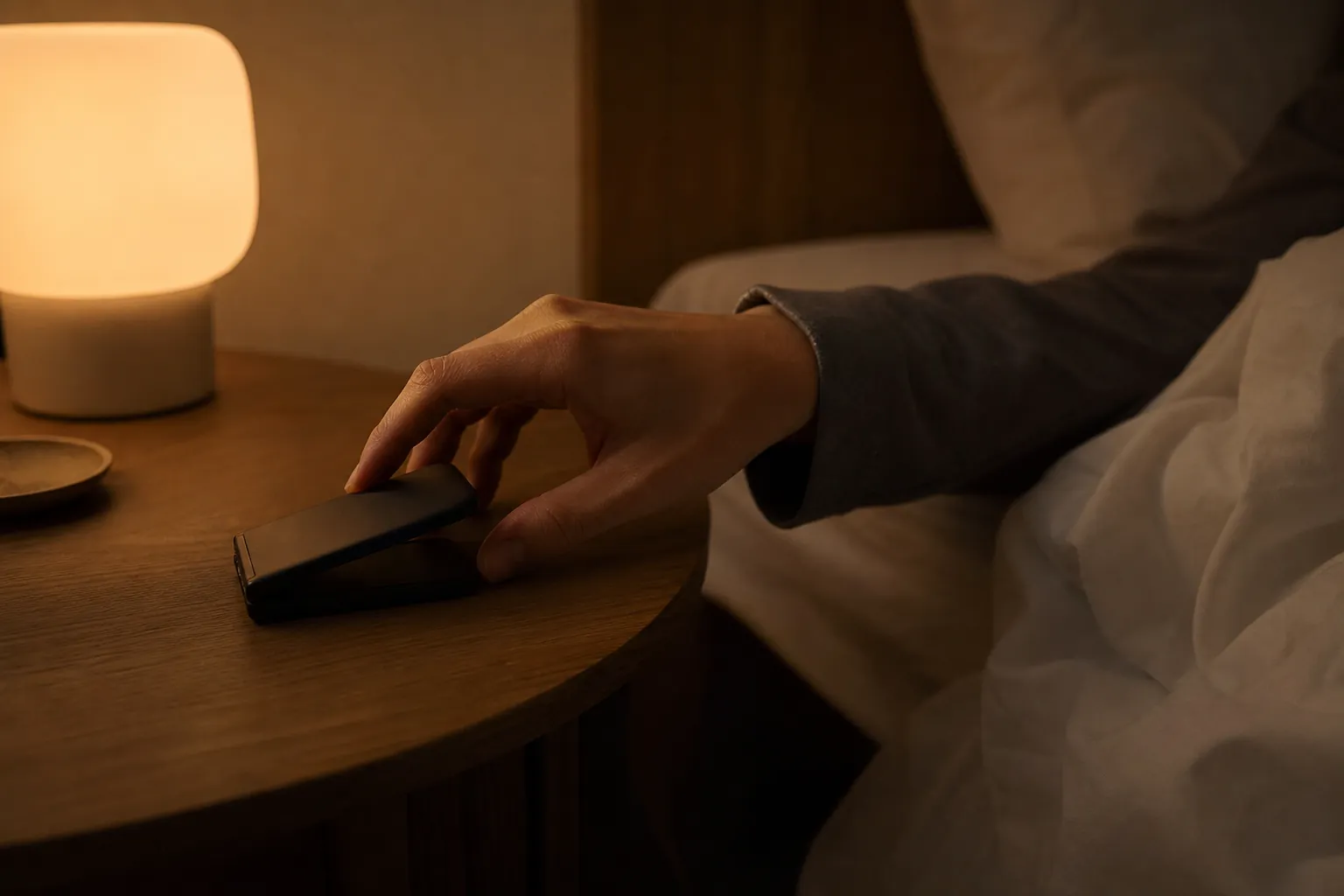
No published randomized trial has tested the Light Flip, or dumbphones as a category, against smartphones for sleep outcomes. So the sleep argument is an evidence-based extrapolation, not product-specific proof. The behavioral pathway is plausible because phone restriction before bed has been tested; the Light Flip itself has not.
There is also a product boundary. The Light Flip was announced on July 21, 2026 as a $299 preorder, with shipping expected in early 2027.[3] Final hardware and software details should be checked when units ship, especially if someone is making a sleep decision based on the screen, notification behavior, or available apps.
For sleep, though, the buying logic should already be narrow. Do not buy the Light Flip because you think a 2.8-inch LCD has solved blue light. Consider it only if you want a phone that makes bedtime scrolling awkward, makes notification checking less tempting, and gives you a simple physical way to close the day’s device use.
References
- BBC Future article on screen light, circadian timing, and sleep, BBC Future, April 2026.
- Effect of restricting bedtime mobile phone use on sleep, arousal, mood, and working memory: A randomized pilot trial, PLOS ONE, 2020.
- The Light Phone 3 gets a cheaper flip phone sibling, The Verge, July 21, 2026.
- Blue-light filter apps and sleep quality, PubMed, 2024.
- WIRED article on blue light and sleep, WIRED, 2024.
- Randjelović et al. study on blue-light reduction and sleep quality in students, 2023.
Read the full guide: How to Sleep With a Sinus Infection Tonight