Why Power Restoration Disrupts Sleep More Than the Outage
Quick answer
Power restoration after an outage can disrupt sleep because the return of electricity can change the bedroom all at once: a lamp snaps on, a router or security panel starts chirping, an alarm clock resets, and the room no longer sounds or feels like the one your brain fell asleep in. That combination is not just annoying. Sudden light, alarm-like sound, and sensory novelty are exactly the sort of cues a sleeping brain is built to check.
The blackout may be quiet. The restoration is often busy. For sleep, that difference matters.
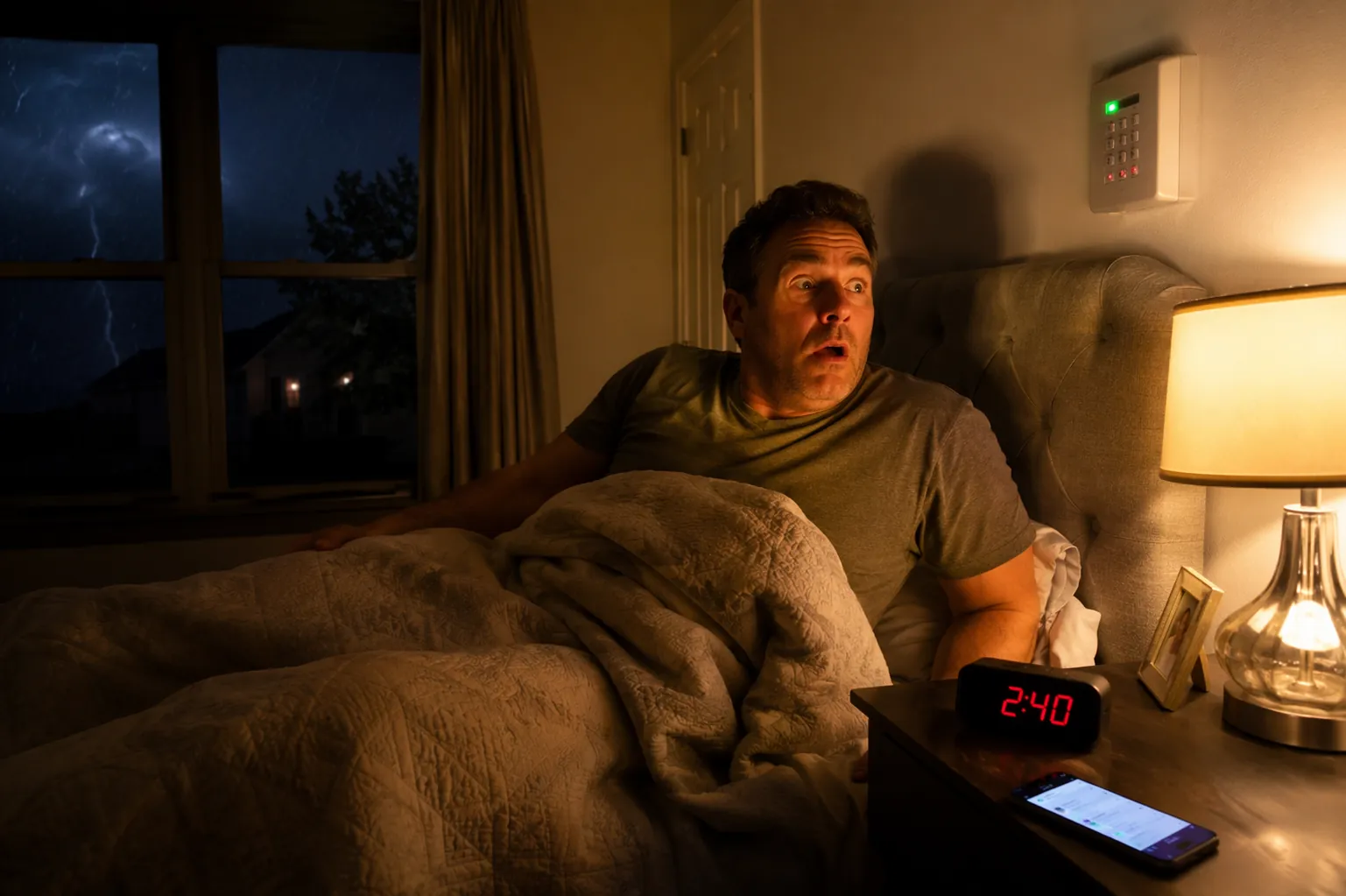
There is not a single peer-reviewed sleep study that treats “power restoration” as its own formal sleep-disruption category. The better explanation is built from adjacent evidence: how the brain sleeps in an unfamiliar environment, how household systems behave after power loss, and how outages affect people who rely on powered devices. That is enough to make the restoral phase worth planning for, without pretending it has been studied as neatly as insomnia or sleep apnea.
The outage is passive. Restoration is an event.
During an outage, the bedroom usually becomes simpler. It is darker. The fan may stop. The thermostat may drift. That can absolutely make sleep worse, especially for anyone who is temperature-sensitive. For the outage phase itself, including perimenopause-specific heat and sleep issues, the broader guide on how a power outage disrupts your sleep is the more complete companion piece.
The missed handoff is the moment the utility feed comes back and the house reboots around a sleeping person.
| What changes when power returns | Why it wakes people | What to prepare before sleep |
|---|---|---|
| Bedroom lights, smart bulbs, or LED fixtures turn on | Abrupt light tells the brain the environment has changed | Switch lamps off, unplug nonessential lights, and test smart-bulb recovery behavior |
| Security panels, smoke/CO devices, routers, or appliances beep | Beep patterns resemble alarms and can repeat through the night | Know the correct silence procedure and keep high-NRR foam earplugs nearby |
| Alarm clocks reset or electronics power-cycle | The sleeper wakes to check whether something needs attention | Use a battery-powered alarm clock and unplug nonessential bedroom electronics |
| CPAP, BiPAP, medical-alert, or other health-related devices restart | The consequence is higher-stakes than a nuisance beep | Follow the device manufacturer’s outage and restart guidance before storms |
The practical goal is not to make the house outage-proof. It is to stop the bedroom from announcing, at full volume and full brightness, that the outage is over.
Why the sleeping brain treats restoration as something to check
Sleep is not a shutdown state. The brain continues to monitor the environment, and it is especially sensitive when the sleep setting feels changed or unfamiliar. In a 2016 Current Biology study of the first-night effect, Tamaki and colleagues found evidence that one hemisphere of the brain stayed more vigilant during sleep in a new environment and showed greater responsiveness to external sounds than the other hemisphere did.[1]
That study was not about storms, generators, security panels, or power restoration. It should not be stretched into a claim that the brain has a special outage-restoral circuit. Its usefulness is narrower and more interesting: when the bedroom is altered, the sleeping brain may behave less like it is in a familiar safe cave and more like it is keeping a night watch.
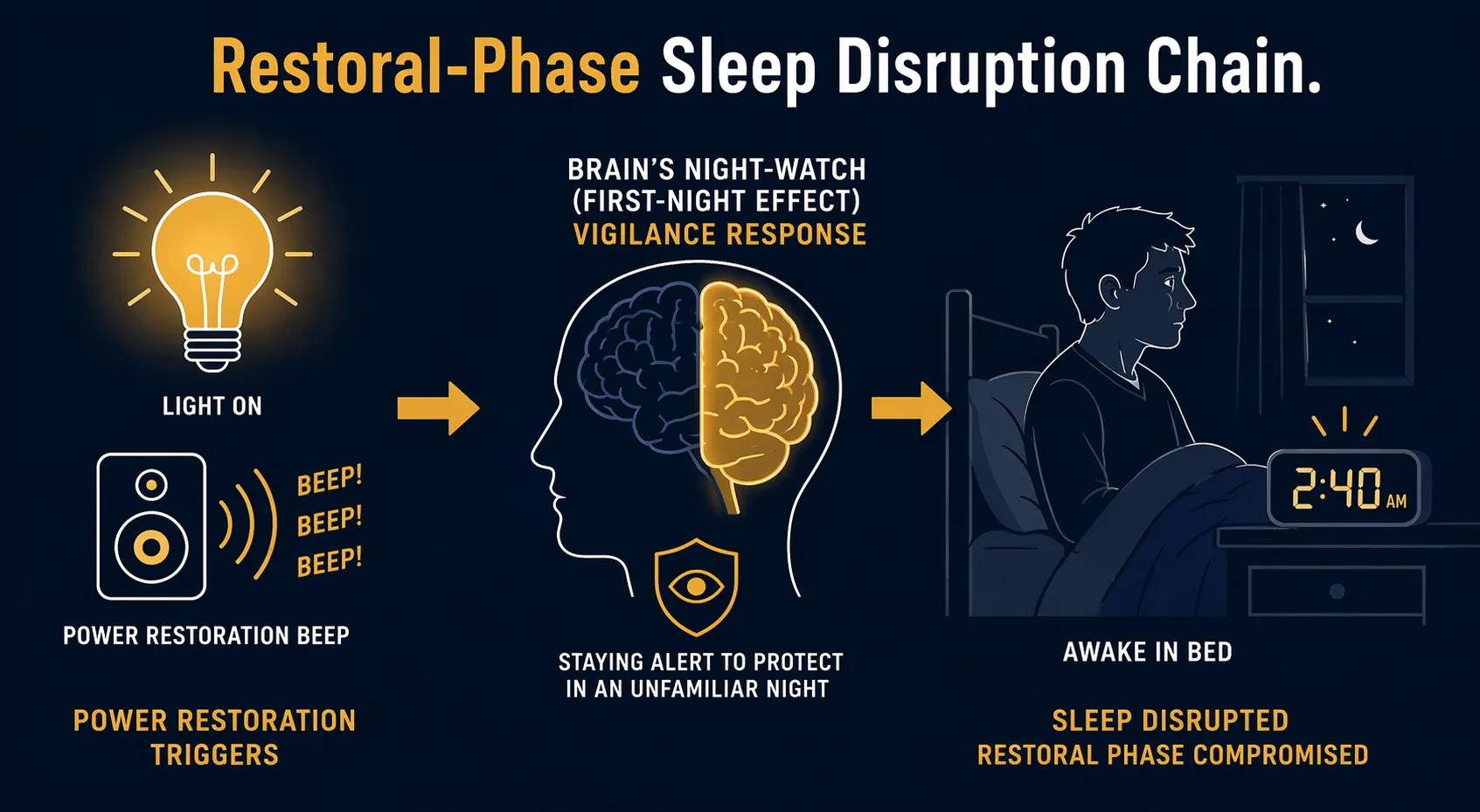
A power-outaged bedroom can become unfamiliar in small ways. The fan noise is gone. The hallway light is out. The room is warmer or colder than usual. The charger LED is dark. Someone may have moved through the room with a flashlight. Then, when power returns, the sensory profile flips again. The ceiling light blinks, the air handler starts, the refrigerator motor kicks in down the hall, and a device gives one sharp chirp. Even if each cue is ordinary by daylight, the sequence is strange at 2:40 a.m.
That is why the restoral awakening often feels different from simply stirring because the room got warm. The brain is not only noticing discomfort. It is sorting out whether the house needs a response.
The beep problem is not imaginary
Light gets blamed first because it is obvious. The more persistent restoral problem is often sound. Security panels, smoke and carbon monoxide devices, battery backups, routers, appliances, and chargers can all produce brief sounds after power returns. The worst ones do not beep once and stop. They wait until everyone has calmed down and then start again.
Security-system support documentation gives a concrete example. SafeTouch Security describes power-outage trouble beeps and notes that a system may continue trouble-beeping while a drained backup battery recharges.[2] HS Tech Group similarly describes systems beeping after a power outage and says the beeping can occur every 4–10 hours for 24–48 hours while the battery recharges.[3]
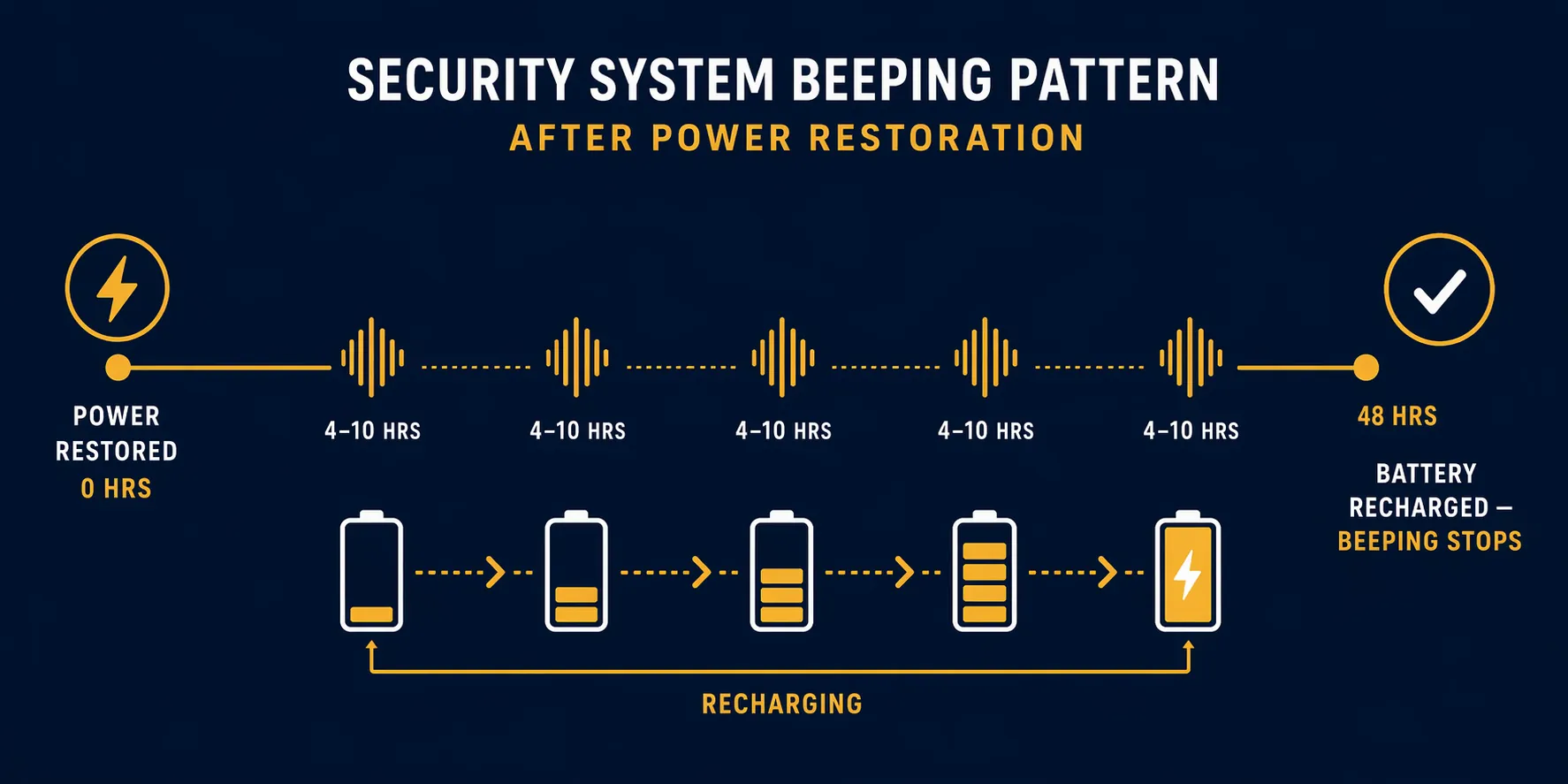
Those numbers are not universal rules for every panel, battery, or brand. They are support-documentation examples, and that distinction matters. Your system may have a different trouble code, silence method, recharge time, or battery-replacement threshold. But the pattern is exactly the sort of thing that ruins a night: a predictable, documented sound source that many people do not identify until it has already woken them twice.
The fix is not to start yanking batteries out of safety devices in the dark. It is to know, before the storm, which device makes which sound and how the manufacturer says to silence a trouble condition safely. For a monitored alarm system, that may mean acknowledging a trouble code at the keypad. For a smoke or CO device, it may mean replacing an aging backup battery. For some systems, it may mean waiting through a recharge period after AC power returns. The correct answer lives in the manual, not in a half-asleep guess.
Light restoration is easier to prevent than to sleep through
A lamp coming on after midnight is a crude little sunrise. It does not need to be bright enough to illuminate the whole room to break sleep; it only needs to be sudden and meaningful. The problem is worse when the light source is close to the bed: a bedside lamp, a closet light, a bathroom fixture visible through an open door, or a smart bulb that returns to an “on” state after power is restored.
Because smart bulbs and LED fixtures vary, the useful move is testing, not trusting. On a normal afternoon, turn the light on, cut power at the switch or by unplugging the lamp, wait briefly, and restore power. If the bulb returns on, assume it may do that during an outage. If the app offers a “power loss recovery” or “last state” setting, set it deliberately and test again.
For sleep, the simplest preparation is still physical: before settling in during an outage, turn off wall switches that control bedroom and hallway lights, unplug nonessential lamps near the bed, and close doors that would let a restored light spill into the room. This is not elegant home automation. It is a sleeping-person-friendly default.
The small bedside kit that helps during restoration
Most outage kits are built for being awake: flashlight, water, phone battery, blankets. The restoral kit is smaller and closer to the pillow. It exists for the person who has already done the hard part and fallen asleep.
- High-NRR foam earplugs, stored where you can reach them without turning on a light. They will not solve a safety alarm that needs attention, but they can reduce nuisance chirps, router sounds, and appliance beeps after the source has been checked.
- A battery-powered alarm clock. If your phone is low, your smart speaker is offline, or your plug-in clock resets, you still have a wake time that does not depend on the house rebooting cleanly.
- A short list of known beep sources: security panel, smoke/CO devices, UPS battery backup, modem or router, kitchen appliances, medical devices, and anything with a backup battery.
- The silence or trouble-code instructions for your actual security system and safety devices. A screenshot saved on your phone is better than searching the internet while the panel complains at 3 a.m.
- A plan for nonessential bedroom electronics: unplug the decorative lamp, diffuser, speaker, charger hub, or display that might light up, chime, or reset when power returns.
The point is not to sleep through an emergency. The point is to stop nonemergency devices from successfully impersonating one.
Higher-stakes devices need a restoration plan, not just an outage plan
For some households, restoral disruption is more than a nuisance. A narrative review on power outages and community health discusses health impacts including interruption of durable medical equipment, which is the category that can include powered home health devices.[4] That broader context is why “just go back to sleep” is not good advice for everyone.
CPAP and BiPAP users should not rely on generic runtime claims from forums or battery ads when planning for outages. The safer preparation is specific: follow the device manufacturer’s guidance for outage use, battery backup, humidifier settings, restart behavior, and what to check when power returns. If the machine stops and then restarts, the sleeper or bed partner may need to confirm that therapy resumed correctly, the mask is sealed, and settings were not disturbed.
Medical-alert systems deserve the same attention. They may have backup batteries, base stations, charging cradles, status lights, or voice prompts. A device that protects someone during the day can still become a repeated night disturbance if no one knows what its restoral signal means. Older adults and caregivers should treat those signals as part of the device plan, not as an afterthought.
For perimenopausal sleepers, the restoral phase can land on an already fragile night. If the outage has warmed the room or interrupted a fan, finally falling asleep may have taken real effort. A restored lamp or trouble beep can cost more than a few minutes because it restarts the cooling, settling, and vigilance cycle. That does not require a separate strategy so much as stricter control of the bedroom: fewer plugged-in surprises, fewer lights that can turn themselves on, and fewer devices allowed to chirp without a known reason.
What to do before you fall asleep during an outage
The useful window is not after the power returns. It is the quiet hour before everyone gives up and goes to bed. Walk the sleep space once, with restoration in mind.
- Turn off switches for bedroom, hallway, closet, and bathroom lights that could wake you if they come back on.
- Unplug nonessential bedroom electronics that may glow, chime, reset, or power-cycle.
- Set a battery-powered alarm clock if your normal alarm depends on wall power, Wi-Fi, or a phone that may not charge.
- Identify the devices that can beep after restoration, especially security panels, smoke/CO devices, battery backups, and medical equipment.
- Put earplugs, a flashlight, and any needed device instructions within reach.
- For CPAP, BiPAP, medical-alert, or other health-related devices, follow the manufacturer’s outage and restart guidance rather than improvising in the dark.
If power returns and something wakes you anyway, keep the response boring. Check for a real safety issue. Silence the known trouble source according to its instructions. Avoid turning the whole bedroom into a work site unless the device actually requires attention. The less light and decision-making you add, the easier it is to return to sleep.
Power restoration feels mysterious only because most homes are not prepared for it. The moment is predictable: light, sound, reboot, check. Preparing the bedroom for the return of power, not only the loss of it, removes much of what wakes people after they have finally fallen asleep.
References
- Night Watch in One Brain Hemisphere during Sleep Associated with the First-Night Effect in Humans, Current Biology, 2016
- Power outages and Trouble beeps, SafeTouch Security
- How to stop your security system from BEEPING when there is a power outage, HS Tech Group
- Power outages and community health: a narrative review, 2020
Read the full guide: Why Heat Disrupts Your Sleep and What to Do About It