
Save on Medicare Part D 2027 and Stop Losing Sleep Over It
Yes: there are concrete ways to make 2027 Medicare Part D costs more predictable before Open Enrollment pressure starts. And yes: there is evidence that ongoing financial strain in older adults is linked with objectively worse sleep, including lower sleep efficiency. The useful work is to separate the costs you can actually act on from the ones you can only wait to confirm.
For 2027, the most practical moves are to compare final plan premiums and formularies when they are released, understand the $700 deductible and $2,400 out-of-pocket cap, consider the Medicare Prescription Payment Plan if early-year pharmacy bills would strain your cash flow, screen for Extra Help, and check whether any of your medications are among the 15 Part D drugs with newly negotiated prices taking effect January 1, 2027.[1][2]

What can I do now to save on Medicare Part D in 2027?
Start with the list of medicines you actually take, not with a general article about Medicare changes. The plan that looks affordable for a neighbor may be a poor fit if one of your prescriptions lands on a different formulary tier, needs prior authorization, or is not covered the same way.
The 2027 numbers available now are still partly preliminary. CMS estimated that most Part D enrollees will see premium increases under $10 per month, while about 45% may see increases of $11 to $20 per month after the Premium Stabilization Demonstration ends after 2026. Final plan data is expected in September 2026, which is when household decisions should move from “watching the news” to checking named plans against named drugs.[1][2]
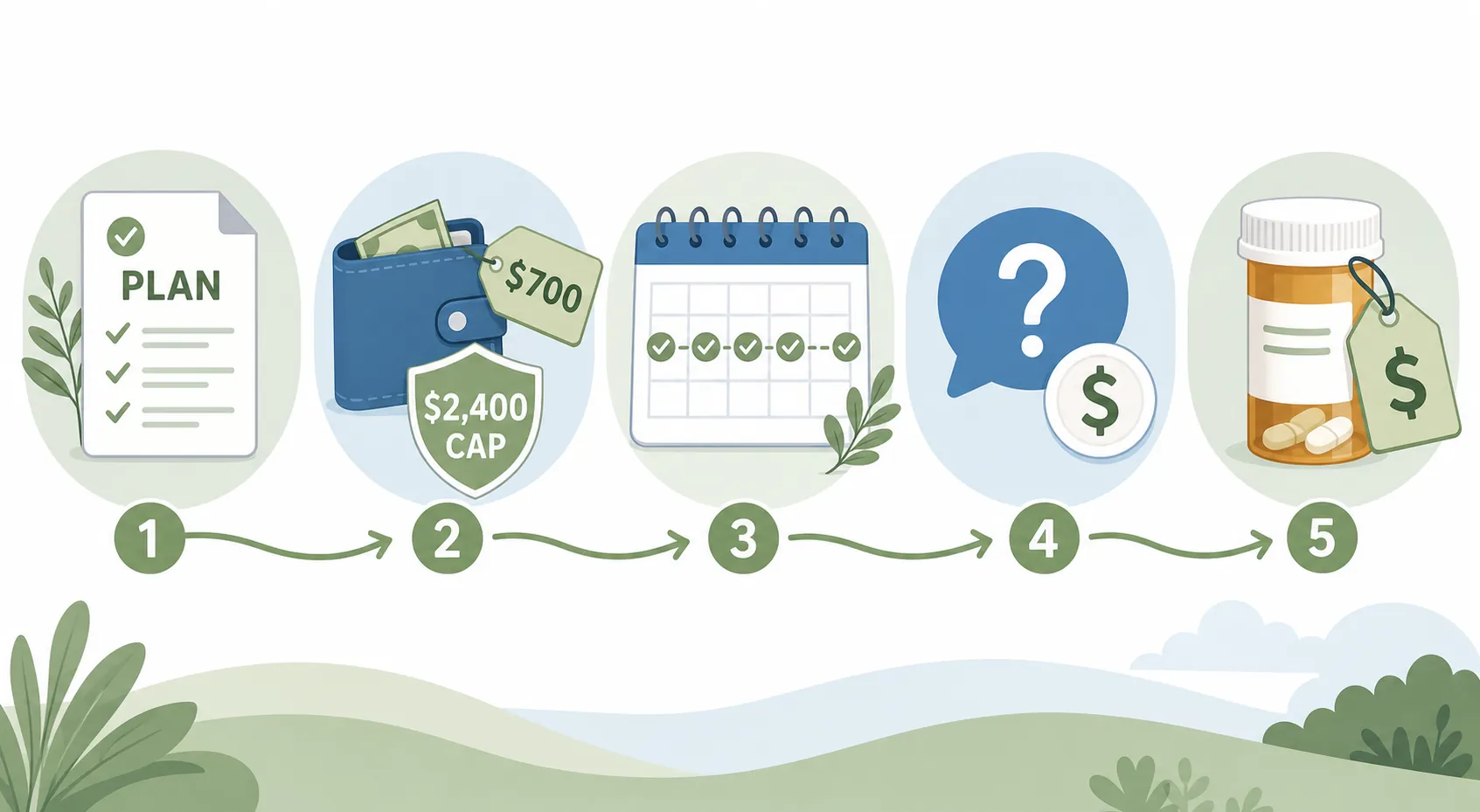
| Step | What to check | What it changes |
|---|---|---|
| 1. Compare final 2027 plans | Premium, formulary, pharmacy network, tiers, restrictions | Whether your specific prescriptions are covered affordably |
| 2. Understand the deductible and cap | $700 standard deductible and $2,400 out-of-pocket cap | How high covered Part D costs can go during the year |
| 3. Consider cost-smoothing | Whether large early-year bills would create cash-flow stress | When you pay, not the total amount you owe |
| 4. Screen for Extra Help | Income and asset eligibility | Premiums, deductibles, and copays may drop substantially |
| 5. Check negotiated drugs | Whether your medications are on the 2027 negotiated list | Possible savings if your drug and plan cost-sharing line up |
Use the $2,400 cap to put a ceiling on the year
The 2027 standard Part D deductible is $700. More important for a person staring at refill dates is the $2,400 annual out-of-pocket cap: after a beneficiary reaches that amount for covered Part D drugs, covered drugs cost $0 for the rest of the calendar year.[1]
That cap does not make every prescription inexpensive. It does not cover drugs outside the plan’s formulary, and it does not remove the need to check pharmacy networks or restrictions. But it does change the shape of the worry. Instead of imagining an open-ended series of pharmacy shocks, you can ask a more bounded question: “If all my drugs are covered, how close might I come to the cap, and in which months?”
Use cost-smoothing if January bills would keep you awake
The Medicare Prescription Payment Plan, often described as cost-smoothing, lets Part D enrollees spread out-of-pocket prescription costs across the calendar year instead of paying large amounts all at once at the pharmacy. It is elective. It does not lower the total cost of your medications. Its value is cash-flow relief.[3]
That distinction matters. If a person can afford the yearly total but not a heavy January or February bill, cost-smoothing may prevent the kind of late-night arithmetic that starts with one refill and ends with the electric bill, groceries, and a skipped dental appointment. If the total annual cost itself is unaffordable, cost-smoothing is not enough; that is when Extra Help and plan selection become the more important questions.
A practical way to decide is to look at last year’s refill pattern. If one or two expensive medicines tend to come due early in the year, ask the plan how the monthly payment amount would be calculated and how billing works if your prescriptions change midyear. The point is not to make Medicare paperwork elegant. The point is to keep one pharmacy counter balance from taking over the whole month.
Screen for Extra Help before assuming you are not eligible
Extra Help is the Part D low-income subsidy, and it is the cost lever that can actually reduce what eligible people owe rather than simply spreading payments out. For 2026, eligibility generally includes individuals with income at or below 150% of the federal poverty level, listed as $23,940 per year for an individual, plus limited assets. The 2027 limits are expected to adjust later in 2026, so the 2026 figures should be treated as a screening guide, not the final word for 2027.[4][5]
The average annual value of Extra Help is estimated at $5,700 per person. For eligible beneficiaries, it can eliminate Part D premiums and deductibles and limit copays; current 2026 figures are roughly $12.65 for brand-name drugs and $5.10 for generics.[4][5]
People often talk themselves out of applying because they own a modest car, have a small savings account, or assume a previous denial settles the matter forever. It is better to check with Social Security, Medicare, a State Health Insurance Assistance Program counselor, or another trusted benefits counselor. A denial gives information. An unfiled application gives nothing.
Check the 15 negotiated drugs, but do not count savings twice
Fifteen Part D drugs have newly negotiated prices scheduled to take effect January 1, 2027. The list includes drugs such as Ozempic, Trelegy Ellipta, and Xtandi. CMS projects $685 million in beneficiary out-of-pocket savings, but that is a program-wide projection, not a promise about any one person’s pharmacy receipt.[6][1]
This check is still worth doing. If one of your current medications is on the negotiated list, ask how your plan will apply the negotiated price, what tier the drug will be on, and whether prior authorization, step therapy, or pharmacy-network rules apply. If none of your drugs are on the list, move on. There is no virtue in spending an afternoon studying savings that cannot touch your medicine cabinet.
Will lowering Part D uncertainty really help sleep?
It may help, especially if the thing waking you up is repeated financial rumination. The best evidence here is not that Medicare plan shopping cures insomnia. It is narrower and more useful: in older adults, ongoing financial strain has been associated with worse objectively measured sleep.
In a polysomnography study of 75 community-dwelling older adults with a mean age of 74, participants who reported ongoing financial strain took longer to fall asleep, spent more time awake after sleep onset, and had lower sleep efficiency than those without financial strain. The reported sleep latency was 35.4 minutes versus 23.5 minutes; wake time after sleep onset was 87.9 minutes versus 68.9 minutes; and sleep efficiency was 73.8% versus 80.9%, with the sleep-efficiency difference remaining significant after adjustment for age, sex, mental health, and physical health.[7]
Financial strain accounted for an additional 9.6% of the variance in sleep efficiency beyond those covariates. That is a meaningful finding, but it should be kept in its proper size. The study was cross-sectional, included 75 participants, and the sample was predominantly white and relatively healthy. It shows an association, not proof that fixing a drug plan will make someone sleep through the night.[7]
Still, the connection is not imaginary. A person who knows the annual ceiling, has spread large bills across the year, has applied for Extra Help, and has checked whether any current drug has a negotiated price has fewer unknowns to rehearse at 2 a.m. For some households, that is the difference between a vague threat and a set of dates, forms, and dollar limits.
If medication-access anxiety is already part of your sleep pattern, the same practical logic applies beyond Part D. Readers dealing with prescription disruption may also find the discussion of levothyroxine recall and sleep disruption useful, because it stays close to the way medication uncertainty can become nighttime vigilance.
What should I do when final 2027 plan data appears?
When final 2027 plan details are available, sit down with the current medication list, preferred pharmacies, and any notices from the plan. If an adult child or neighbor helps, give them the exact drug names, doses, and refill frequency. Guessing from memory is how people miss the expensive medicine that only comes up every few months.
- Check whether each prescription is on the plan formulary and whether the plan uses prior authorization, step therapy, or quantity limits.
- Compare total estimated annual cost, not just the monthly premium.
- Look at which months may carry the highest out-of-pocket charges before the $2,400 cap is reached.
- Ask whether enrolling in the Medicare Prescription Payment Plan would smooth those payments in a way that helps your budget.
- Apply for Extra Help or recheck eligibility if income, assets, marital status, or household circumstances have changed.
- Confirm whether any of your drugs are among the 15 negotiated-price medications effective January 1, 2027.
For readers navigating Medicare coverage rules more broadly, especially where medication eligibility and sleep conditions overlap, this guide to sleep apnea weight-loss medication eligibility may help with the habit of checking criteria before assuming coverage.
If the bills are clearer but sleep is still broken
Once the Part D uncertainty is narrowed, persistent insomnia deserves its own care. Medicare Part B can cover cognitive behavioral therapy for insomnia, or CBT-I, as a medically necessary behavioral health service. Under Original Medicare, the patient typically pays 20% coinsurance after the Part B deductible; reported patient costs are often in the $20 to $50 per-session range, but actual costs vary by provider, plan type, and network rules. Digital CBT-I has been covered since January 2025.[8][9]
CBT-I is worth asking about before reaching for sedating medications, especially in older adults who may already be managing several prescriptions. The cleaner order is simple: make the 2027 drug-cost year as predictable as possible, see whether that eases the financial vigilance at night, and if sleep remains poor, ask a Medicare-participating clinician about CBT-I coverage.
References
- CMS fact sheet on 2027 Medicare Part D cost landscape. Centers for Medicare & Medicaid Services. July 28, 2026.
- USA Today report on 2027 Medicare Part D premium increases. USA Today. July 29, 2026.
- Medicare Prescription Payment Plan. Medicare.gov.
- Extra Help / Low-Income Subsidy information. National Council on Aging.
- Extra Help with Medicare Prescription Drug Plan Costs. Social Security Administration.
- Medicare Drug Price Negotiation Program information on 15 Part D drugs. KFF.
- Financial Strain Is a Significant Correlate of Sleep Continuity Disturbances in Late-Life. Biological Psychology. 2008. https://pmc.ncbi.nlm.nih.gov/articles/PMC2267650/
- Medicare coverage information for behavioral health services. Medicare.gov.
- Medicare coverage of CBT-I. Healthline.
Read the full guide: What the 2027 Medicare Part D premium increase means for your sleep