
Does skipping food before bed improve sleep quality?
Skipping food before bed can improve sleep quality only if “skipping” means avoiding a heavy meal close to bedtime. If it means going to bed uncomfortably hungry, it can backfire. The best-supported answer is a middle one: leave a buffer after your last real meal, usually about 2 to 4 hours, and do not treat genuine hunger as a character flaw.
That distinction matters because two very different pieces of advice often get collapsed into one bedtime rule. “Don’t eat a large dinner at 10:30 p.m. and lie down at 11” is sensible for many people. “Ignore hunger for hours because all calories before bed are bad” is a much weaker claim.
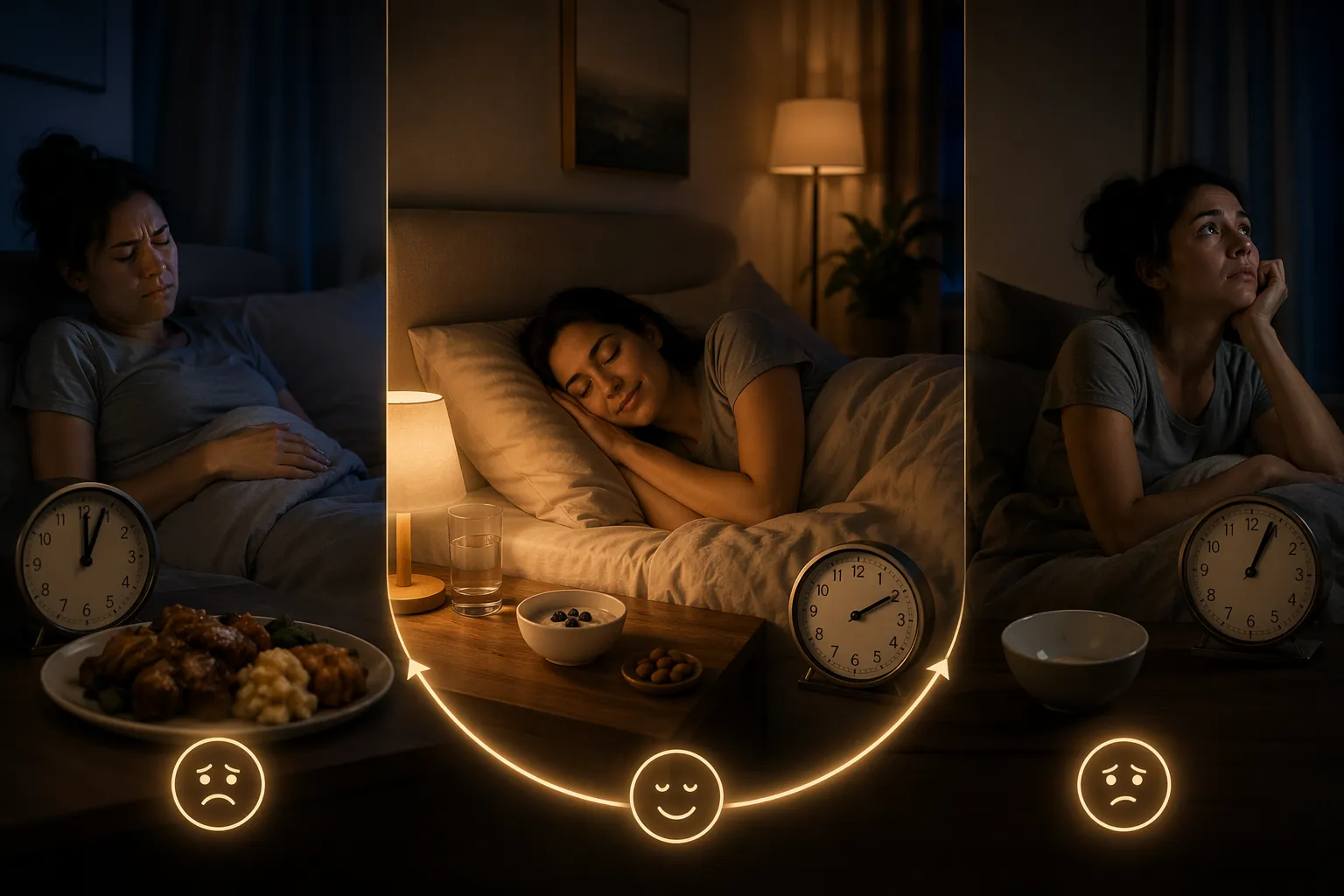
The evidence points to a timing curve, not a total food ban
The strongest timing signal comes from a large analysis using the American Time Use Survey. In that study of 124,239 adults, eating within 1 hour of bedtime was associated with 2.26 times higher odds of wake after sleep onset. Eating 4 to 6 hours before bed had the lowest odds of sleep disruption in the analysis.[1]
That does not mean everyone needs a 6-hour fast before sleep. It does mean that the last hour before bed is a risky place to put a large meal. Digestion is still active, the stomach is fuller, reflux is more likely for susceptible people, and sleep can become lighter or more broken. The practical takeaway is not “no food after dark.” It is “do not make your body handle a full dinner while it is trying to settle into sleep.”
A smaller study of 793 young adults points in the same direction. Eating within 3 hours of bedtime was associated with about 40% more nocturnal awakenings.[2] That is not as large or as broadly representative as the American Time Use Survey finding, but it reinforces the same curve: sleep tends to do worse when meaningful eating is pushed too close to bedtime.
Why 2 to 4 hours is a useful buffer
A 2-to-4-hour buffer works because it solves the problem most people are actually trying to solve. It gives a real meal time to move out of the “I just ate” stage, while keeping the gap short enough that many people will not be lying in bed distracted by hunger.
For example, if bedtime is around 11 p.m., a normal dinner around 7 to 8:30 p.m. is usually a very different sleep setup from a heavy dinner at 10:30 p.m. The earlier meal gives digestion more room. The later one asks sleep, stomach stretching, blood sugar handling, and possibly reflux control to happen at the same time.
The buffer also prevents a different mistake: moving dinner so early, or skipping it entirely, that bedtime becomes a hunger event. A person who eats at 5 p.m., stays up until midnight, and then tries to sleep through a growling stomach is not necessarily practicing better sleep hygiene. They may simply have traded one form of arousal for another.
| Evening pattern | Likely sleep issue | Better adjustment |
|---|---|---|
| Heavy meal within 1–2 hours of bed | More awakenings, reflux risk, digestion-related discomfort | Move the full meal earlier when possible |
| Normal dinner 2–4 hours before bed | Often the most practical middle ground | Keep this as the default if sleep feels stable |
| Long food gap plus strong hunger at bedtime | Hunger-related alertness and difficulty settling | Use a small, simple snack instead of forcing wakefulness |
Hunger is not always quiet at night
The body does not interpret low energy availability as a wellness challenge. One system involved is orexin, also called hypocretin. Orexin neurons help promote wakefulness, and low energy availability can activate this arousal system. In plain terms, when the brain senses that fuel is scarce, staying awake to seek food is a biologically coherent response, not a failure of discipline.[3]
Blood glucose dips can add another layer. If the body reads the drop as a problem, stress hormones such as cortisol and adrenaline may rise to help mobilize energy. That can feel like being strangely alert, restless, or unable to settle even though the clock says it is time to sleep. Ghrelin, a hunger-signaling hormone, can also make food feel more urgent when the gap since dinner has stretched too long.
This is why rigid advice can fail the person it is supposed to help. Someone may skip dinner, feel proud of following the rule, then lie awake at 1 a.m. because their body is more activated, not less. That outcome does not prove late-night eating is harmless. It proves that “empty stomach” and “sleep-ready body” are not the same thing.
If you are actually hungry near bedtime
First, separate appetite from habit as gently as possible. If you are bored, stressed, or looking for a reward, a snack may not change sleep much. If you feel physically hungry — stomach discomfort, shakiness, preoccupation with food, or a clear sense that you under-ate — a small snack can be the more sleep-friendly choice.

Keep the snack small enough that it does not become a second dinner. A useful bedtime snack is usually simple: some protein, a complex carbohydrate, or both. Think yogurt with a few nuts, whole-grain toast with nut butter, a small bowl of oatmeal, or a banana with a protein-containing option. The point is steadiness, not fullness.
The foods most likely to cause trouble are the ones that recreate the late-meal problem: large portions, greasy or very high-fat foods, spicy foods if you are reflux-prone, and sugary foods that leave you feeling more stimulated or hungry again. If a snack makes you feel heavy, hot, or acidic when you lie down, it was probably too much or the wrong fit for your body.
- If you are comfortably full: stop eating and let the buffer do its work.
- If you are neutral: do not snack just because a rule says you should.
- If you are genuinely hungry: choose a small protein-rich or complex-carb snack and keep it boring enough that it supports sleep rather than turning into grazing.
- If reflux is common for you: be more cautious with portion size, fat, spice, and lying down immediately after eating.
Where the evidence is less certain
The American Time Use Survey finding is important, but it is cross-sectional. It can show an association between eating close to bedtime and sleep disruption; it cannot prove that the eating caused the awakenings. It is also possible that some longer sleep after eating very close to bed reflects compensatory sleep after more fragmented sleep, not better sleep.[1]
There is also no direct randomized trial that cleanly answers the everyday question, “Should this person skip food or eat a light snack before bed tonight?” The best answer has to be assembled from meal-timing research, sleep-fragmentation findings, digestive physiology, and hunger biology. That is enough to reject extreme rules, but not enough to prescribe one universal bedtime menu.
Individual variability is real. A person with reflux may need a stricter buffer. A person who is pregnant, managing diabetes, recovering from disordered eating, fasting for religious or medical reasons, or dealing with perimenopausal night waking may need more specific guidance than a general FAQ can provide. The general rule should not override medical advice or a pattern you can clearly observe in your own sleep.
A simple rule to test tonight
Aim to finish your last meaningful meal 2 to 4 hours before bed. Avoid heavy meals in the final 1 to 2 hours before sleep. If genuine hunger shows up near bedtime, have a small, simple snack rather than lying awake trying to prove you can ignore it.
For the next several nights, track only what matters: when you last ate, whether you were hungry at bedtime, how many times you woke up, whether reflux or discomfort appeared, and how rested you felt in the morning. If earlier dinners improve awakenings, keep the buffer. If skipping food leaves you wired and hungry, add a modest snack and watch what changes.
References
- Timing of eating in relation to sleep characteristics in the American Time Use Survey. British Journal of Nutrition. 2022.
- Does the Proximity of Meals to Bedtime Influence the Sleep of Young Adults? A Cross-Sectional Survey of University Students. International Journal of Environmental Research and Public Health. 2020.
- Orexin/hypocretin system and energy homeostasis. PubMed Central.
Read the full guide: How Reading to Your Pet Before Bed Improves Sleep