
How do I sleep during an orange heat alert in Spain?
If AEMET has put your part of Spain under an orange heat alert, tonight’s sleep plan needs to change before bedtime. Orange is not a decorative way of saying “hot.” It signals meteorological danger, and Spain’s heat-warning thresholds vary by region — a temperature that triggers one alert level in Bilbao may not be the same as one in Córdoba.[1] For sleep, the translation is simpler: the flat may not cool down enough overnight for your body to do the cooling it normally needs in order to fall asleep.
That is the part many summer-tip lists underplay. The problem is not only that the pillow feels warm. Sleep onset depends on a fall in core body temperature of roughly 1°C, and hot nights interfere with that heat loss.[2] If the bedroom has spent the afternoon collecting heat behind walls, tiles, furniture, and bedding, seeing “only nighttime heat” on the forecast can be falsely reassuring. By 11 p.m., you may be sleeping inside a stored-heat box.
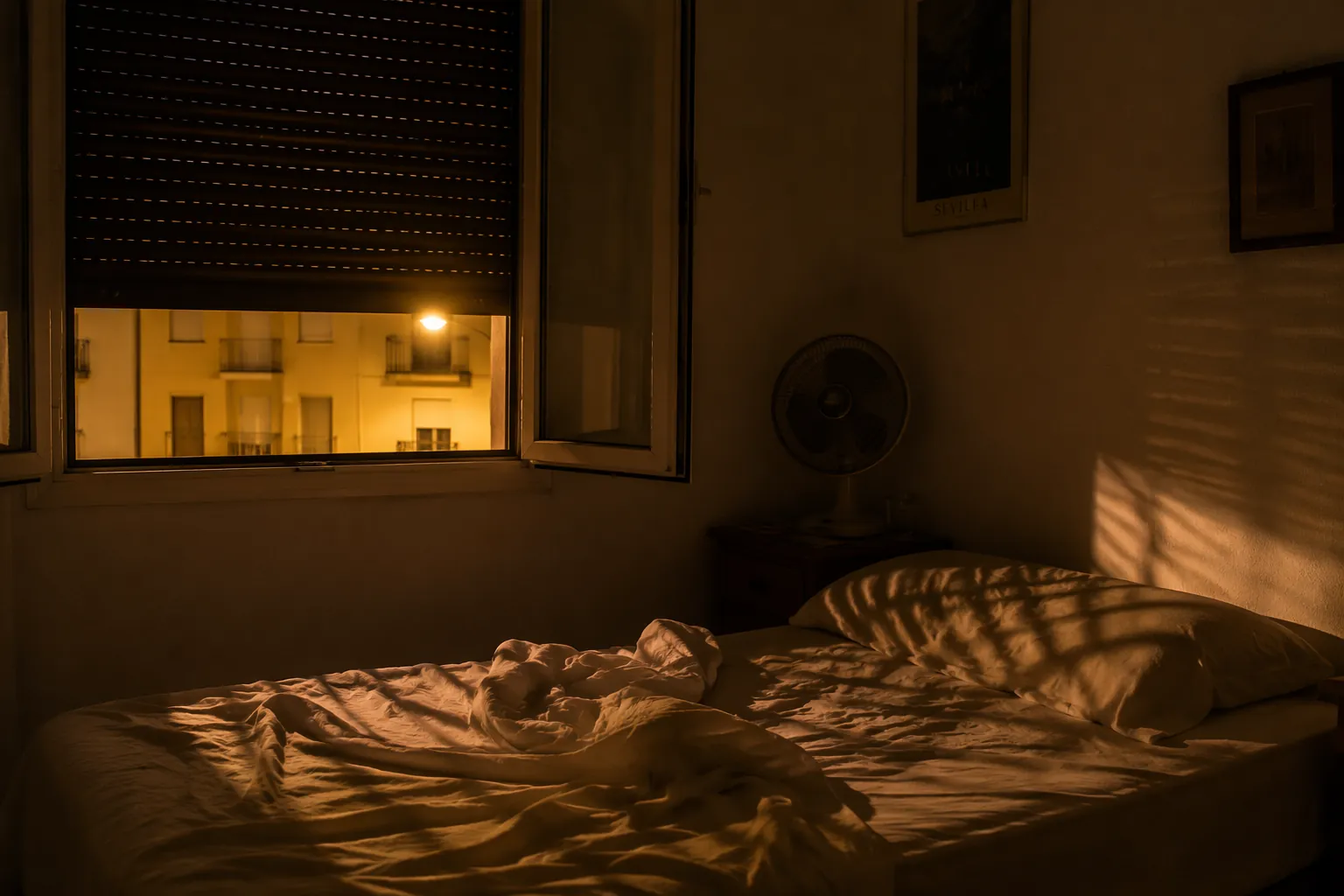
So the useful version of “sleep tips for an orange heat alert in Spain” is not a prettier bedtime routine. It is a daytime-to-nighttime cooling sequence: stop heat getting in, release it only when the outside air helps, then keep the sleeper cool without creating a new risk.
What the orange alert changes for sleep
AEMET’s regional heat alerts are about weather risk, not bedroom comfort. The Local’s explainer of Spain’s alert system emphasizes that thresholds are regional rather than national, so you should read the warning for your province instead of applying a single Spanish temperature rule.[1] That matters in older buildings, attic flats, interior patios, and apartments with only partial air-conditioning, because the indoor temperature can lag behind the forecast. The street may cool a little after sunset while the bedroom continues radiating the afternoon back at you.
The sleep-specific target is narrower than “do I feel a breeze?” The European Insomnia Network’s heatwave recommendations point to a bedroom range of about 20–25°C as more compatible with sleep.[2] In a Spanish orange alert, especially where nighttime temperatures remain high, reaching the lower end may be unrealistic without air-conditioning. But the range is still useful because it tells you when passive habits are working and when they are not. If the room is sitting well above that range at bedtime, a fan pointed at your face is not a strategy; it is a last-minute sensation.
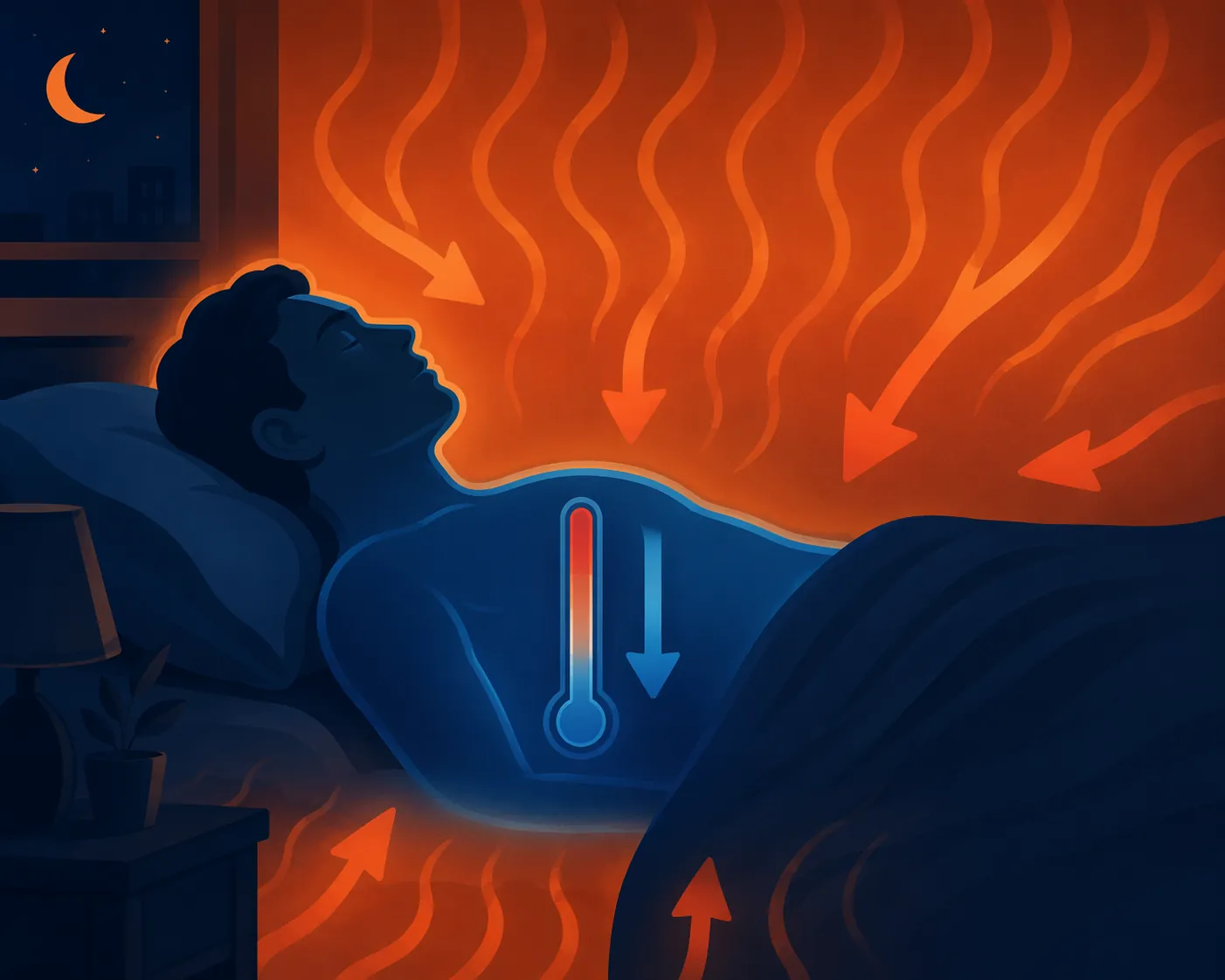
If you want the physiology before the protocol, the related hot-weather sleep FAQ goes deeper into why heat disrupts sleep architecture. For tonight, the practical implication is enough: your body is trying to shed heat, and the room must help rather than argue with it.
Start before the bedroom heats up
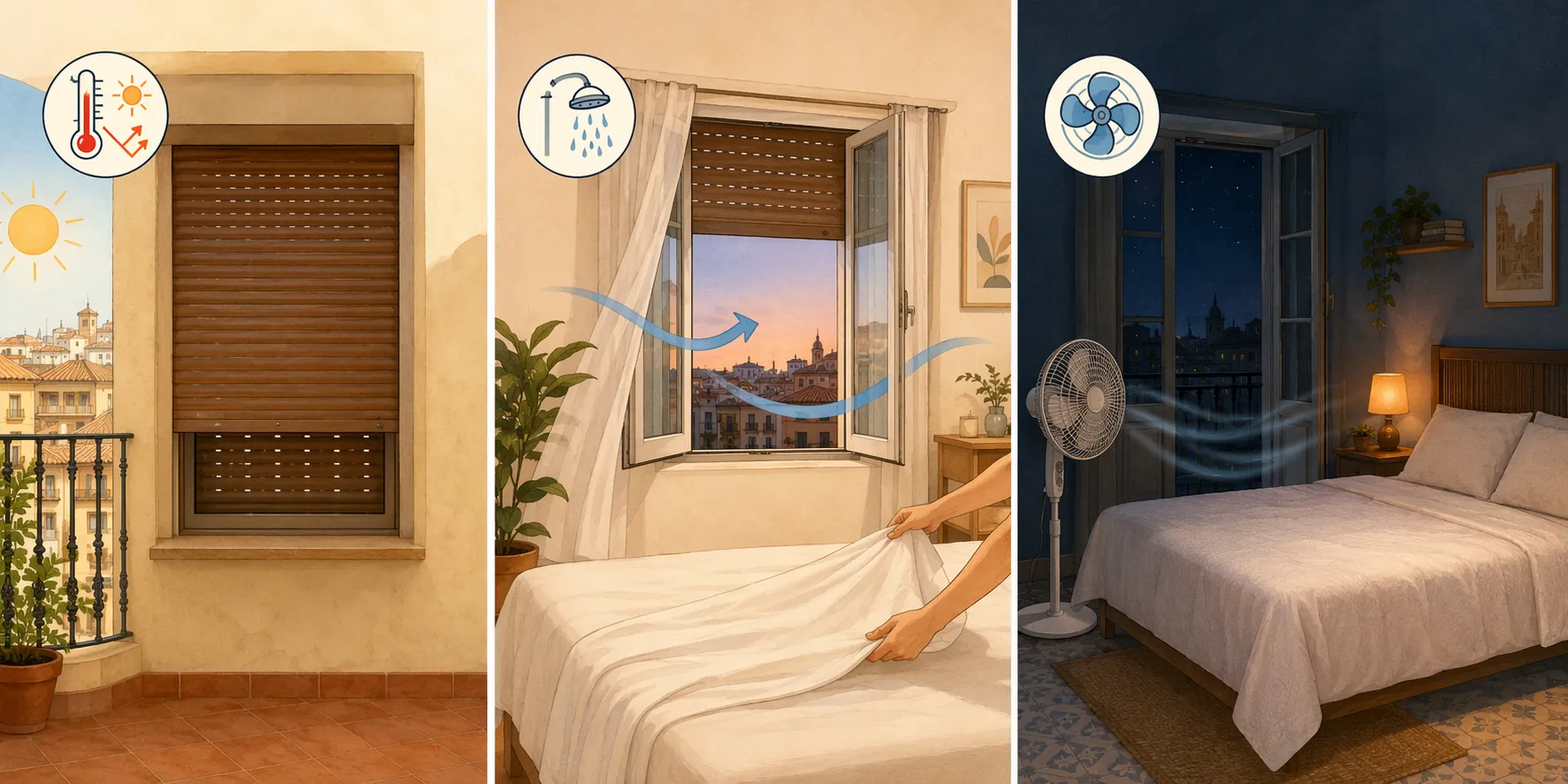
The most important sleep work on an orange-alert day happens while it still feels too early to think about sleep. By late afternoon, a room that has been taking sun through glass for hours will not be rescued quickly by opening a window. The Spanish rituals are not quaint here; they are mechanical. Persianas half-lowered before the sun hits the glass can make more difference than a heroic cold shower at midnight.
| When | What to do | Why it matters for sleep |
|---|---|---|
| Morning, before direct sun reaches the room | Lower persianas, shutters, blinds, or curtains on sun-facing windows. Keep the bedroom door closed if the rest of the flat is hotter. | You are reducing heat gain before walls, flooring, and bedding start storing it. |
| Midday and afternoon | Keep windows closed if outside air is hotter than inside. Avoid adding indoor heat with ovens, dryers, or long appliance use near the sleeping area. | Ventilation is only cooling when the incoming air is cooler than the air you already have. |
| Early evening | Check whether outdoor air has actually cooled. If it has, create cross-ventilation for a limited period; if it has not, keep the hot air out. | Opening every window by habit can make the bedroom warmer, not fresher. |
| One to two hours before bed | If you have air-conditioning, start cooling the room before you get into bed rather than waiting until the mattress is warm. | The aim is to remove stored heat from the room, not merely chill your skin after the room has won. |
A cheap indoor thermometer is more useful than instinct on these nights. People argue over whether to open the windows because each person is measuring a different thing: the air on the balcony, the heat coming off the wall, the stuffiness of the bedroom, the hope that a breeze will appear. Use the thermometer to make the decision boring. If outside is hotter than inside, keep it out. If outside is cooler, ventilate deliberately, then close down again before the room starts absorbing heat from the next warm spell.
Cross-ventilation works best when air can enter and leave. One open window into a still courtyard may do very little. Two openings, even a window and a door to a cooler corridor, can move heat out faster. But do not leave security, noise, or air quality out of the decision. A theoretically perfect draft that keeps someone awake, anxious, or exposed to street noise is not a sleep solution.
Evening cooling: useful, not theatrical
By evening, the goal is to help heat leave the body without shocking it or soaking the bed. A lukewarm shower is usually the sensible version. It cools the skin and removes sweat without the drama of an icy blast, which can feel impressive for thirty seconds and then leave you tense, alert, or reaching for a towel that becomes another damp heat source.
Bedding should be boring: breathable, light, and easy to move away from the body. Cotton or linen sheets, a thin cover if you need the feeling of one, and a pillowcase that can be changed if it becomes damp are more useful than complicated “cooling” layers that trap air underneath you. If the mattress or topper holds heat, consider sleeping on the cooler side of the bed, moving to a lower room, or making a temporary bed in the coolest safe part of the flat.
Air-conditioning, where available, should be used as a room-cooling tool rather than a contest to reach the lowest number. The European Insomnia Network’s 20–25°C bedroom range is a practical reference point for sleep under heatwave conditions.[2] In real Spanish apartments during an orange alert, aiming toward the upper part of that range may be the attainable and safer goal, especially if the sleeper is older or medically vulnerable.
Fans deserve more judgment than they usually get. A fan can help sweat evaporate and can make a warm room feel more tolerable, but placement matters. Aim it across the room, toward a wall, or through a path of air movement rather than straight at a sleeping face or chest all night. If you are using it with an open window, put it where it helps move cooler air through the room, not where it simply stirs hot air around the bed.
The temptation is to turn the fan into a substitute for a cooler room. That is where people get caught. Air movement can help comfort; it does not change the basic sleep problem if the bedroom remains too hot for the body to lose heat.
Overnight decisions: do less, but check the right things
Once someone is in bed, keep the plan simple. Do not keep adjusting every ten minutes unless there is a safety reason. Sleep needs cooling, but it also needs continuity. Set the room up, keep water within reach, and make only the changes that clearly reduce heat load: loosening bedding, changing a damp pillowcase, angling the fan away from the body, or opening windows only if the outside air has become cooler than the room.
- If the room has cooled into a sleep-supportive range, keep conditions steady rather than overcorrecting.
- If the room is still hot and air-conditioning is available, cool the room rather than blasting the sleeper directly.
- If there is no air-conditioning, use timed ventilation only when outdoor air is cooler, and consider moving to the coolest safe room.
- If sweat is soaking bedding, change the layer touching the body instead of adding towels or heavy covers.
- If you are comparing alert systems because you are used to U.S. warnings, see the excessive heat warning sleep guide for the American counterpart.
Hydration belongs in the plan, but it is not the whole plan. Keep water nearby and drink enough to avoid going to bed already depleted. Do not turn the night into repeated large drinks that wake you for the bathroom and fragment sleep unless a clinician has told you to follow a specific fluid plan. The room still has to cool; water by the bed does not cancel an orange alert.
Older adults, medication, and fan safety need their own rule
For an older adult, a person with chronic illness, or someone taking medication that affects heat response, the plan should be more conservative. Age in Spain’s extreme-heat guidance notes that some medications can be affected by high temperatures or can alter the body’s response to heat, and it advises not setting air-conditioning below 23°C.[3] That is a useful guardrail: make the room safer and cooler, but do not create a cold blast, a chill, or a direct airflow problem for someone whose body may not regulate temperature as reliably.
Fans are the clearest example of advice that changes with the sleeper. A healthy adult may find angled airflow helpful in a warm room. A frail sleeper may become chilled on the skin while the room remains too hot, or may not move away from direct airflow once asleep. And when the surrounding air is hotter than skin temperature, fans can become counterproductive by increasing convective heat gain rather than removing heat; a Cochrane review on electric fans in heatwaves highlights this safety caveat.[4]
Caregivers should think in checks rather than slogans: Is the room actually cooler than it was two hours ago? Is the person alert and drinking appropriately? Is the fan moving air around the room rather than blasting the body? Are medications stored away from heat? If the person has become unusually confused, weak, faint, or unable to cool down, this is no longer just a bad night’s sleep.
For a fuller older-adult version of this problem, the heat dome sleep guide for older adults covers caregiver decisions in more detail.
When passive cooling is not enough
There is a point where the respectful thing to say about persianas, cotton sheets, and cross-breezes is that they have done all they can. Under an orange alert, if the bedroom cannot be brought toward a sleep-supportive temperature range, move the sleep location, use available cooling earlier, or seek a cooler safe place rather than pretending the right pillowcase will solve it.
Escalate beyond sleep hygiene if the sleeper is older, medically vulnerable, unable to cool down, or showing signs that look like heat illness rather than ordinary discomfort. Use local health or emergency routes rather than trying to manage a dangerous night with another fan adjustment. An orange alert requires an orange-alert sleep plan: block heat before it enters, ventilate only when it helps, cool the room into a realistic range, and stop treating a dangerous hot night like a normal summer inconvenience.
References
- What Spain's different heat alerts mean and how to act in each case. The Local Spain. June 24, 2026.
- How to deal with sleep problems during heatwaves: practical recommendations from the European Insomnia Network. Journal of Sleep Research. 2023.
- Coping with extreme heat: How to keep cool in extreme temperatures. Age in Spain.
- Electric fans for reducing adverse health impacts in heatwaves. Cochrane Database of Systematic Reviews. 2012.