How to Sleep During Hurricane Fausto in Hawaii
If you are trying to figure out how to sleep during Hurricane Fausto in Hawaii, the safest answer is not “try to get a normal night.” Tonight’s target is usable rest: planned 3–5 hour sleep blocks, one alert adult when possible, and a room setup that lets you move quickly if local officials issue a warning. That 3–5 hour range is a practical consensus estimate from sleep-safety guidance, not a controlled hurricane sleep trial, so treat it as a planning number rather than a promise.[1][2]
As of July 26, 2026, Fausto is forecast to move westward and weaken before reaching the Hawaiian Island chain, but wind and rain impacts remain possible around Monday night into Tuesday, July 28–29. The track can still change. Keep checking the National Weather Service Honolulu office at weather.gov/HFO, NOAA/NWS updates, and your county civil defense alerts instead of relying on any single article once conditions start moving.[3]
Set Up for Broken Sleep Before You Feel Exhausted
The mistake I see in storms is waiting until the house is already loud, hot, and anxious before deciding where everyone will sleep. By then, the person making decisions is usually the same person who has been checking alerts all evening.
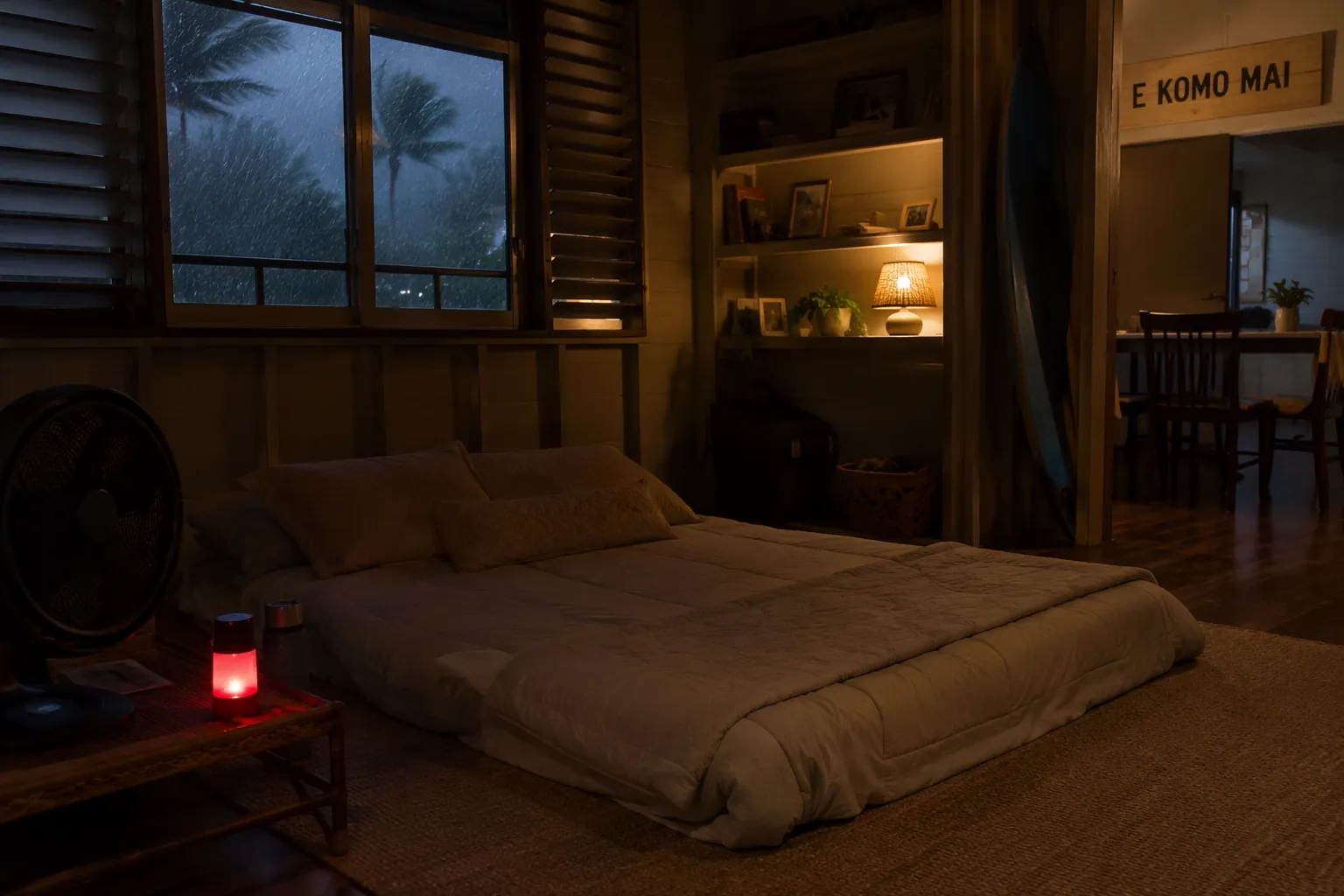
Before dark, choose the safest practical sleep space: the lowest interior room you have, away from windows and exterior doors. In Hawaii, that may mean a hallway, bathroom, interior bedroom, or living-room corner after furniture is moved. Many homes do not have basements, and single-wall construction can make wind noise and heat harder to buffer, so “safe enough to rest” often means a floor mattress, cushions, or mats in a less comfortable but better-protected room.
- Move bedding, pillows, medications, glasses, shoes, and phone chargers into the safe room before dark.
- Keep one red-filter or dim flashlight within reach so you can check the room without fully waking everyone.
- Use earplugs only if another alert system is assigned; earplugs may reduce storm noise substantially, but they should not be your only plan if warnings may come overnight.[1]
- Place a battery fan where it cannot tip into water, bedding, or a walking path.
- Keep slippers or shoes next to each sleeper, especially for children, kupuna, and anyone who may need help moving quickly.
This is also where Hawaii’s 14-day preparation standard matters. The Hawaiʻi Emergency Management Agency’s 2 Weeks Ready framework calls for enough water, food, medication, and supplies for 14 days because island resupply can be delayed after a disaster; it includes planning for backup power for medical devices.[4] That does not mean you need to solve every supply problem at midnight. It does mean the sleep area should not separate someone from the medication, device power, or mobility items they will need before morning.
Use Shift Sleep Like a Safety System
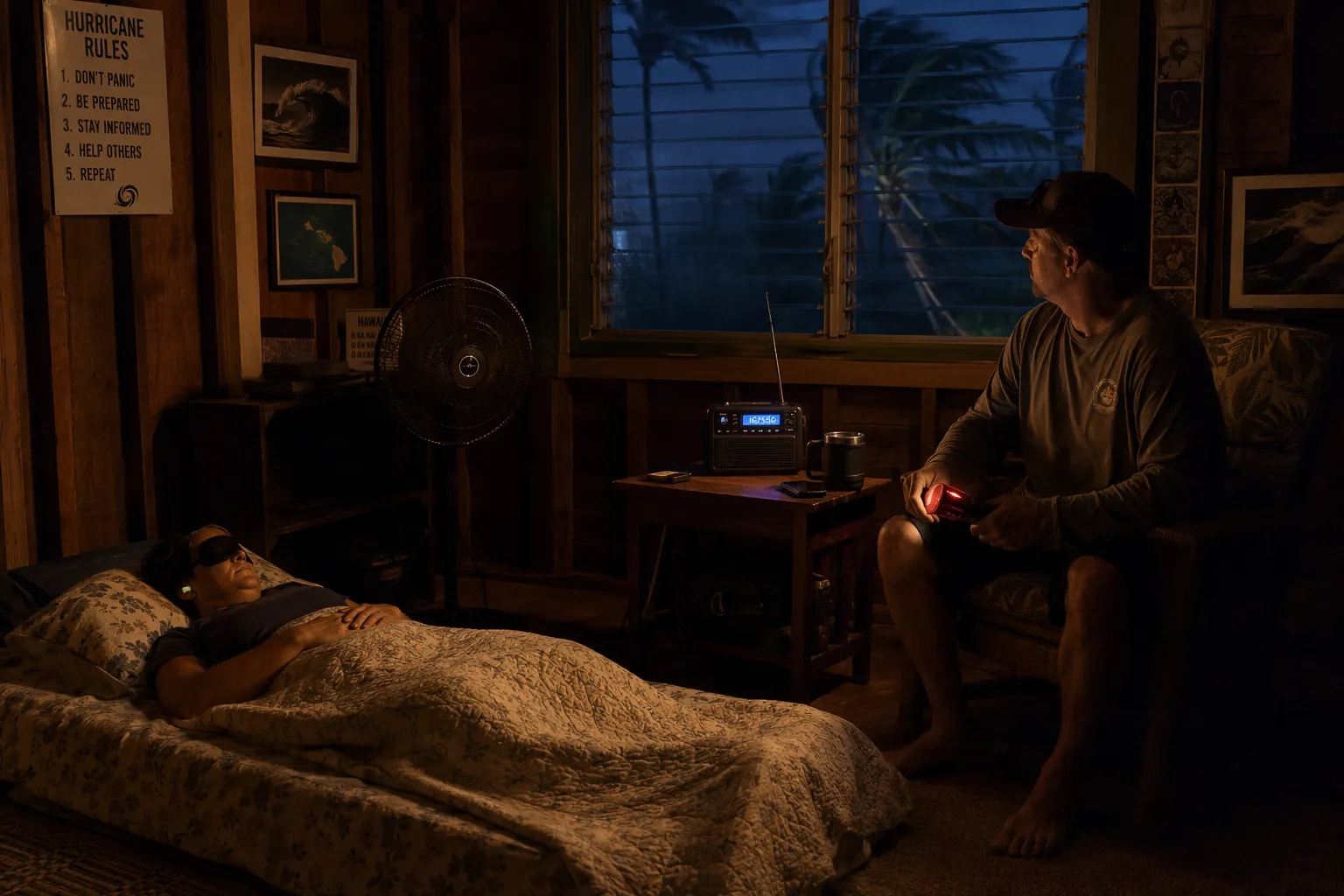
If two capable adults are in the home, do not both half-sleep while both half-monitor alerts. That is how everyone becomes foggy at the same time. Pick one alert adult and one resting adult for the first block, then switch at a planned time.
| Before the first sleep block | During the block | At handoff |
|---|---|---|
| Name the alert adult and the resting adult. | Alert adult monitors official alerts, weather radio, phone, and local civil defense notices. | Resting adult is woken with a short update: current warning status, power status, water leaks, and any household needs. |
| Decide which alerts require waking everyone. | Resting adult uses earplugs or eye mask only if they can still be reached quickly. | Phones, radios, flashlights, and backup batteries are checked before the next person sleeps. |
| Assign who helps children, kupuna, visitors, pets, and anyone with mobility or medical needs. | Alert adult avoids doom-scrolling and checks trusted sources on a schedule unless conditions change. | The next alert adult confirms they are awake enough to make decisions. |
For a household with one adult, the plan changes. You are not failing if you sleep; you are managing your own alertness. Set multiple alarms for official check-in times, keep the phone volume high enough to hear emergency alerts, and sleep in the safe room rather than in a bedroom that would require you to wake fully and relocate during worsening weather.
Visitors in a rental need a faster version of the same plan. Find the interior room before the storm is loud. Learn how alerts will arrive in that county. Put shoes, ID, medication, and a flashlight in one bag. If you do not know the home’s weak spots, do not choose the prettiest bedroom just because it feels more normal.
Build the Sleep Kit Around the Room, Not the Bedtime Routine
Ordinary sleep hygiene advice has its place, but it is not the center of tonight. Caffeine timing, screens, and perfect darkness matter less than whether you can hear the right alert, avoid broken glass, stay cool enough, and keep needed medical equipment running.
- Bedding: floor mattress, yoga mat, futon, cushions, or folded blankets that can stay clear of windows.
- Light: red-filter flashlight or dim light for checks and handoffs; red light is commonly recommended because it is less disruptive to sleep timing than bright white light.[1]
- Sound: earplugs for the resting adult, with a separate alert adult or loud emergency alert system assigned.
- Cooling: battery fan, lightweight clothing, water bottle, and a small towel for cooling pulse points.
- Safety: shoes, flashlight, medications, glasses, mobility aids, pet leash or carrier, and a battery-powered carbon monoxide detector if generator use is possible nearby.
If children are sleeping in the safe room, tell them the plan in plain language before lights-out: who is awake first, where their shoes are, and what will happen if everyone needs to move. Reassurance works better when it is attached to something visible and doable.
For kupuna, the sleep kit should include more than comfort items. Put medications, hearing aids, glasses, dentures, mobility aids, and written emergency contacts in the same reachable area. If you need a fuller checklist for older adults and power outages, use the site’s guide to sleeping safely during a storm power outage.
Protect CPAP and Medical-Device Power First
A CPAP user should not discover the power plan after the lights go out. HIEMA’s preparedness guidance specifically includes backup power planning for medical devices, and CPAP battery guidance commonly names options such as marine deep-cycle batteries with an inverter, portable power stations, and travel CPAP devices.[4][5]
- Charge the CPAP battery, portable power station, and phone power banks before the storm arrives.
- If your clinician or device instructions allow it, consider turning off heated humidification to conserve battery power.
- Keep distilled water, mask parts, tubing, and wipes in the safe room rather than in a bathroom or bedroom across the house.
- Ask your doctor or equipment provider ahead of time how to operate the device during an outage; do not improvise with unfamiliar settings during the storm.
- If the device, cord, outlet, or battery gets wet, do not reuse it until it has been checked according to manufacturer or clinician guidance.
The same logic applies to oxygen equipment, refrigerated medication, mobility-device batteries, and communication devices for someone who cannot easily call for help. Put the power plan on paper where the alert adult can see it.
Stay Cool Without Creating a New Hazard
Power-outage sleep in humid weather often fails because the body cannot dump heat well. Upper floors can also become significantly hotter than lower floors during outages, which is one reason the lowest safe sleeping area is useful for both shelter and temperature control.[1]
- Sleep on the lowest safe floor or lowest practical level of the home.
- Wear loose, lightweight clothing and keep bedding minimal.
- Use a damp towel on the neck, wrists, or ankles; do not soak bedding or place water near powered devices.
- Aim a battery fan across the room or toward the body, away from standing water and cords.
- Use cross-ventilation only while sustained winds are below 40 mph and local conditions make it safe; close windows before winds strengthen or rain is being driven inside.
Do not bring a generator, grill, charcoal stove, or camp stove indoors, onto an enclosed lanai, or near a sleeping area. CDC guidance says generators should be kept outside and at least 20 feet from windows, doors, and vents, and homes should use battery-powered carbon monoxide detectors.[6]
After the Room Is Set, Give Anxiety Somewhere to Go
Storm anxiety is not a character flaw. It is a nervous system trying to keep watch. Physical setup comes first because the body calms more easily when the room, alerts, and handoff plan are no longer vague.
- Try 4-7-8 breathing: inhale for 4 counts, hold for 7, exhale for 8. Stop if it makes you lightheaded.
- Use progressive muscle relaxation: tense and release one muscle group at a time, starting at the feet or hands.
- Write a short worry list, then put one action beside each item you can control tonight.
- Set a next-check time so your brain does not have to keep bargaining with itself every five minutes.
The Anxiety and Depression Association of America includes breathing, muscle relaxation, and structured coping steps among anxiety-management tools, and notes that disaster-related anxiety and insomnia can persist after the event rather than ending the moment the wind drops.[7] For deeper help with storm-related hyperarousal, use the guides on hurricane anxiety and sleep and sleeping during a tropical storm when anxiety strikes.
What to Do When the First Sleep Block Ends
A handoff should be boring and specific. The alert adult should not wake the next person with a long emotional download unless something urgent happened. Give the facts: latest official alert, wind or rain changes, power status, leaks, room temperature, and whether anyone in the household needs help.
The person coming off watch should drink water, use the bathroom if safe, check that their phone is charging or conserved, and then lie down without trying to catch up on every missed update. If local officials issue a warning that requires action, the plan changes. If not, the point of the shift is to let one adult stop monitoring long enough to function later.
After Fausto: Expect Sleep to Lag Behind the Weather
Sleep often does not normalize the first calm night after a storm. A practical expectation is that sleep may begin settling over the next 3–7 days, especially if the home is hot, routines are disrupted, cleanup is noisy, or alerts continue.[1][2]
- Check CPAP equipment, batteries, cords, and outlets for water exposure or damage before reuse.
- Recharge power banks, CPAP batteries, weather radios, fans, and flashlights as soon as power safely returns.
- Keep the safe-room kit together until local officials say the threat has passed.
- Return to normal wake time and morning light when you can, even if the first recovery nights are uneven.
- Seek medical or mental-health help if insomnia, panic, breathing problems, or unsafe daytime sleepiness persists.
This Fausto-specific page was last updated July 26, 2026. The timing note will age as the storm changes, but the sleep-safety plan remains the same for future Hawaii hurricane events: safe room, alert shifts, sleep kit, medical-device power, safe cooling, and recovery sleep that is allowed to be imperfect.
References
- How to Sleep During a Hurricane, Amerisleep
- Sleep and Natural Disasters, SleepHealth.org
- National Weather Service Honolulu, HI, National Weather Service
- 2 Weeks Ready, Hawaiʻi Emergency Management Agency
- CPAP Battery Backup: What You Need to Know, CPAPnation
- Prevent Carbon Monoxide Poisoning During a Power Outage, Centers for Disease Control and Prevention
- Tips for Managing Anxiety and Stress, Anxiety and Depression Association of America