How war stress affects your sleep and what to do about it
Short answer
War stress can keep you awake because your nervous system may still be behaving as if threat is active. That can happen after direct exposure to danger, after alerts or messages from family, or after hours of distressing war news. The goal is not to convince yourself that everything is fine. The more realistic goal is to lower physiological arousal enough that sleep has a chance.
This is not just “overthinking.” A Hebrew University press-release summary of a 2025 peer-reviewed wartime sleep study reported a 19–22% rise in short sleep and a 16–19% increase in clinical insomnia among Israeli civilians during the war; because the available summary is a press release, the exact sampling and measurement details should be checked against the primary paper before treating those percentages as the whole story.[1] In Ukraine, a PLOS ONE study reported insomnia signs in 44% of respondents and clinical insomnia in 27%, described as roughly three times peacetime rates.[2] In the United States, an APA poll cited by Harvard Health found that 80% of adults reported significant stress related to Russia’s invasion of Ukraine.[3]
Why war stress disrupts sleep
Sleep depends on the body being able to stand down. War stress pushes in the opposite direction. Threat exposure activates the stress-response system: the brain scans for danger, the HPA axis helps mobilize the body, and stress hormones such as cortisol and adrenaline support alertness, vigilance, and readiness to act. Those are useful responses in danger. They are miserable bedfellows.
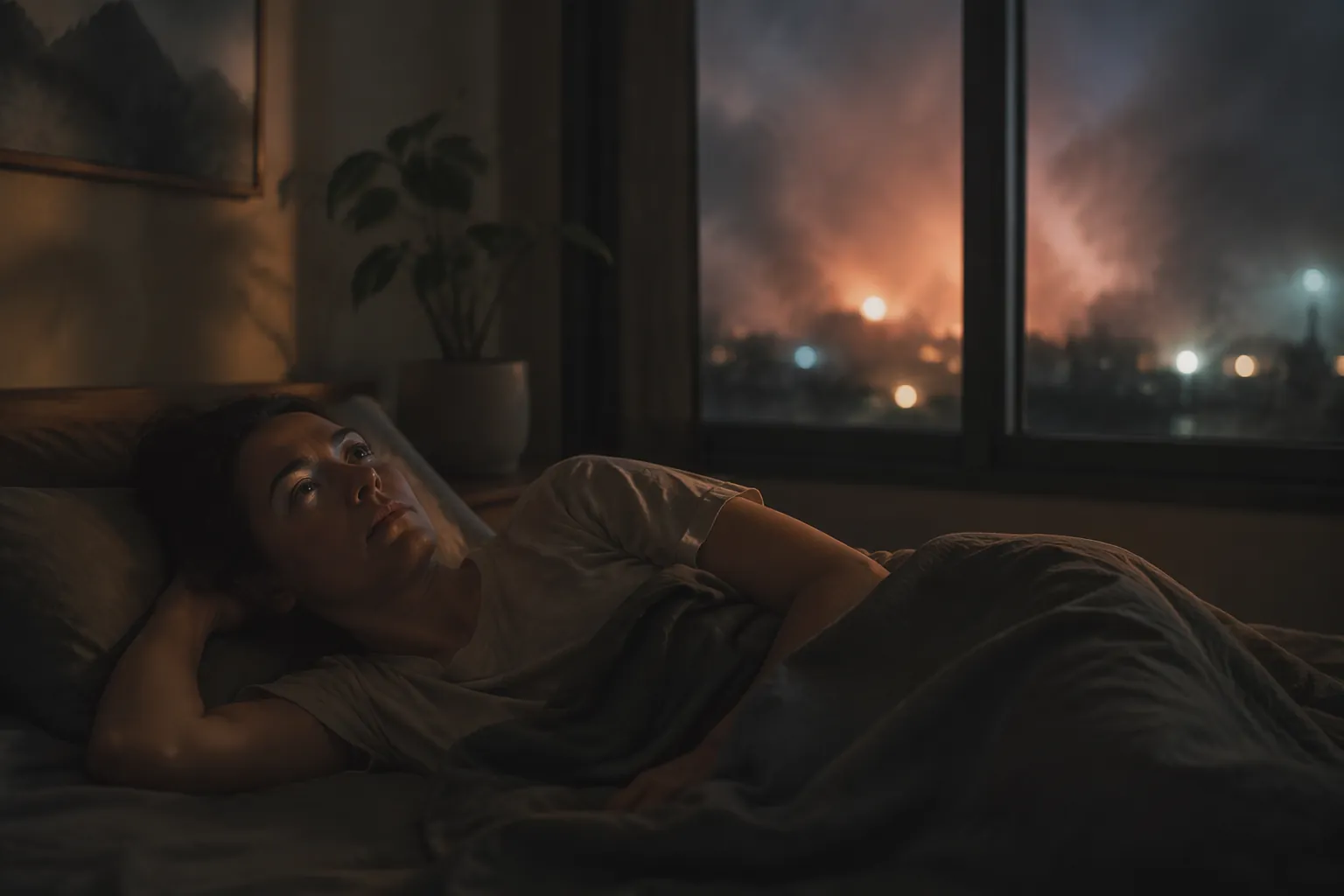
The amygdala, which helps detect threat, does not care that you have a 9 a.m. meeting, a child to get to school, or an older parent to care for. If the last input before bed is a stream of alerts, battlefield footage, missing-person updates, or frightening speculation, the brain may keep checking. That can show up as trouble falling asleep, lighter sleep, more awakenings, early-morning waking, or vivid dreams that feel less like dreams and more like alarms.
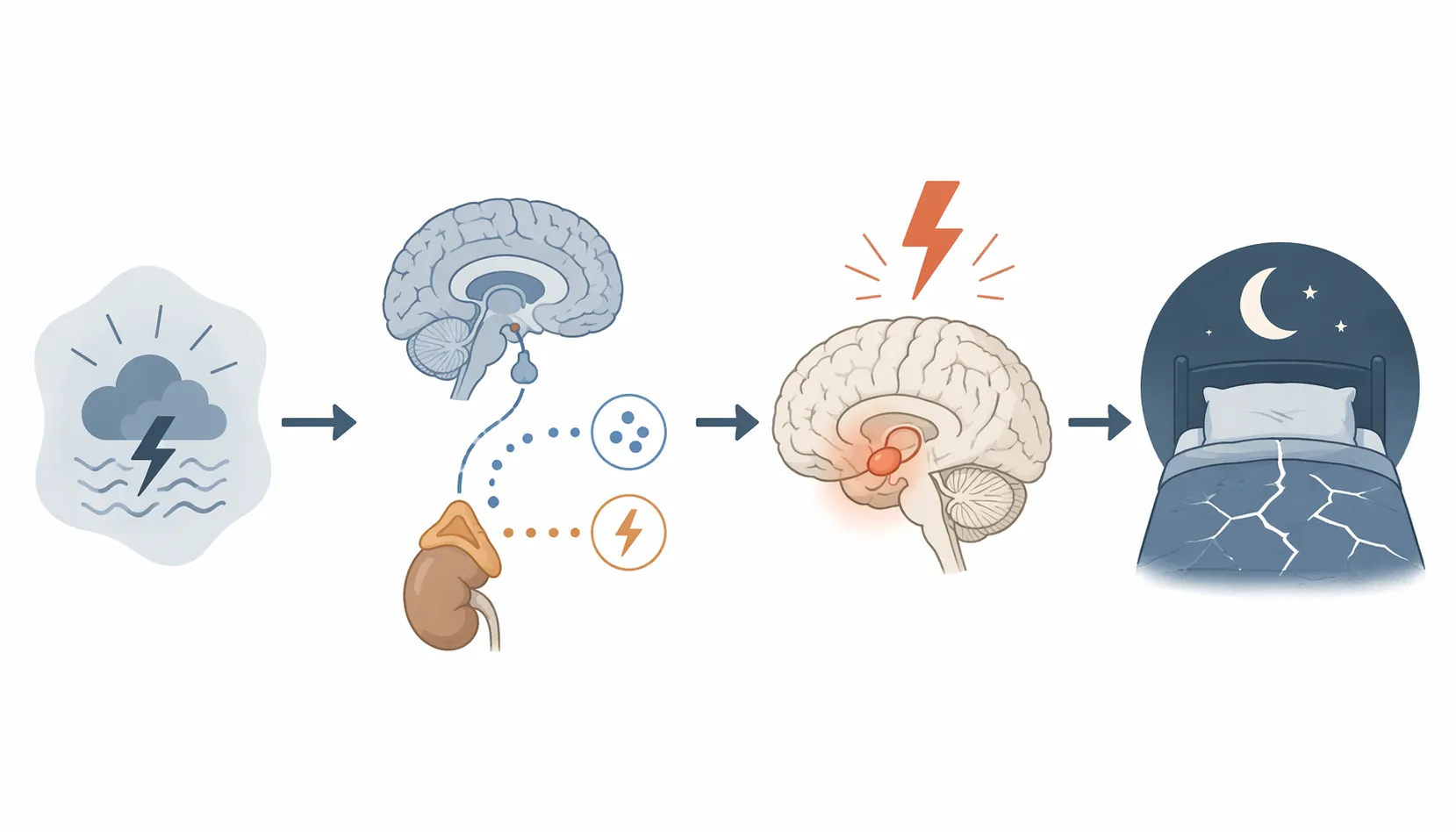
REM sleep can be especially vulnerable when the nervous system is on alert. REM is involved in emotional processing, but when sleep is fragmented, the night may not feel restorative. People often wake with the sense that they have been working all night: monitoring, replaying, preparing, bracing. That is not a character flaw. It is a threat system refusing to clock out.
Acute war stress, insomnia, and PTSD are related — not identical
A bad week of sleep during a frightening event does not automatically mean you have PTSD. Acute stress can disturb sleep in people who have never had a sleep disorder. It can also reactivate older trauma, especially when current events resemble previous danger, displacement, loss, military service, or childhood adversity. Cohen et al. reported in 2024 that childhood adversity predicted greater war-related sleep deterioration through war anxiety, which fits the clinical reality that not every nervous system starts from the same place.[4]
PTSD-related sleep problems deserve a firmer clinical boundary. The VA National Center for PTSD reports that insomnia occurs in 90–100% of veterans with PTSD, and it identifies cognitive behavioral therapy for insomnia, or CBT-I, as a first-line treatment in VA/DoD guidance; imagery rehearsal therapy is also used for nightmares.[5] The Sleep Foundation similarly describes sleep disruption as common in PTSD and reports that CBT-I improves insomnia symptoms in 70–80% of people with primary insomnia.[6]
| What you may notice | What it may suggest | What to do next |
|---|---|---|
| You sleep poorly after alerts, distressing news, or direct fear, then improve when the situation calms | A stress-linked sleep disruption | Use arousal-lowering steps tonight and reduce avoidable threat input before bed |
| You lie awake most nights, dread the bed, and daytime functioning is slipping | Insomnia may be becoming a condition of its own | Consider CBT-I or a clinician trained in sleep treatment |
| Nightmares, flashbacks, avoidance, emotional numbness, or constant startle accompany the insomnia | Possible trauma-related sleep disturbance | Seek trauma-informed clinical support rather than trying to solve it with sleep hygiene alone |
The point of this distinction is not to make you diagnose yourself at 2 a.m. It is to keep two mistakes off the table: minimizing severe symptoms as “normal stress,” and treating every frightening night as proof that something is permanently broken.
What to do tonight
The most useful steps are the ones that interrupt the stress-to-sleep cascade at a specific point. You are either reducing new threat input, lowering body arousal, reorienting the brain after a spike of fear, or preventing the bed from becoming a place where your brain practices being awake.
If you are in immediate danger, make safety the sleep plan
If alerts, evacuation risk, or direct danger are present, the priority is not a perfect sleep routine. It is safety plus recoverable rest. Keep necessary notifications on. Keep essential items reachable. If you are sleeping in shifts with another adult, make the handoff explicit so one person is not half-monitoring all night. In that setting, even short blocks of safer rest matter.
Set a news boundary that still respects reality
A news boundary is not pretending the war is not happening. It is deciding that the bed is not where you will keep proving that it is happening. Harvard Health recommends limiting war-news exposure and using coping tools such as breathing and grounding when war anxiety rises; Sage Clinics gives similar practical advice on interrupting doomscrolling before sleep.[3][7]
- Choose one final news check earlier in the evening, not from bed.
- Separate “urgent alerts” from “updates.” Keep true safety notifications on if needed; silence feeds, commentary, and group threads that can wait.
- Put the phone physically out of reach, face-down, or outside the bedroom if safety allows.
- Write one line before bed: “What I know tonight,” and one line: “What can wait until morning.” This gives the brain a stopping point instead of an open loop.
Use breathing to lower arousal, not to force sleep
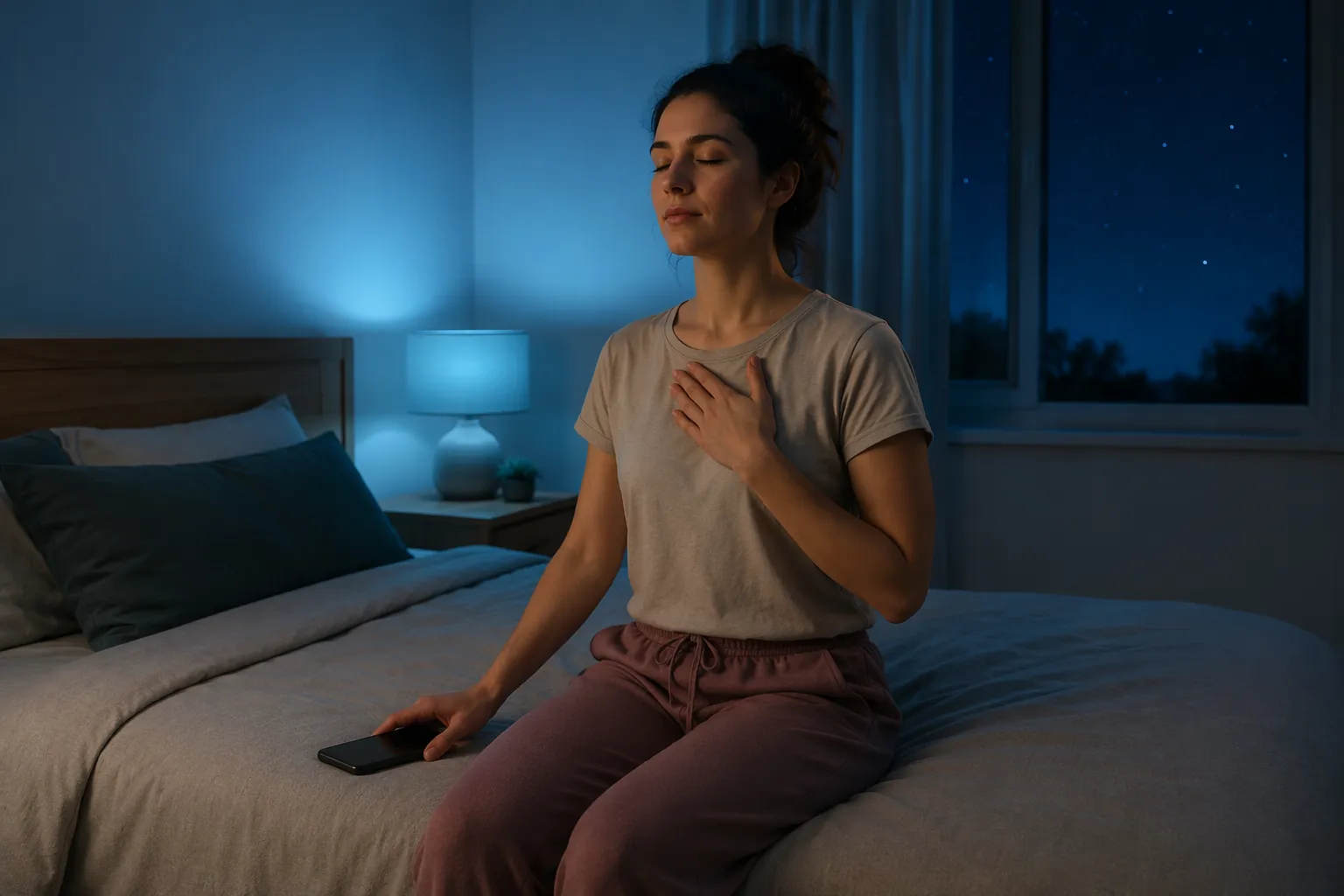
Controlled breathing is useful because it gives the body a repeated signal that it does not need to accelerate. Sage Clinics describes a 4-4-6 pattern: inhale for 4 counts, hold for 4 counts, and exhale for 6 counts.[7] The longer exhale is the important part for many people; it encourages a shift away from fight-or-flight physiology.
- Sit or lie down with your feet, back, or hands supported.
- Inhale gently through the nose for 4.
- Hold softly for 4, without straining.
- Exhale slowly for 6.
- Repeat for a few minutes, then stop trying to measure whether it “worked.” Let the next step be quiet.
If holding the breath feels panicky, skip the hold. Try a simple inhale of 3 or 4 and an exhale of 5 or 6. The technique should make the body feel less cornered, not more controlled.
Ground yourself after a nightmare, alert, or frightening message
After a nightmare or sudden alert, the brain may wake as if the danger is in the room. Grounding works by updating the nervous system: this is the time, this is the place, this is what is true right now. Sage Clinics recommends grounding techniques as part of coping with war anxiety at night.[7]
- Name the date, the room, and one concrete fact: “I am in my bedroom. It is nighttime. I heard an alert / I had a nightmare / I read a message.”
- Press your feet into the floor or your back into the mattress.
- Find five things you can see, four things you can feel, three things you can hear, two things you can smell, and one thing you can taste.
- If needed, turn on a low light briefly. Keep it boring. The goal is orientation, not a full investigation of the night.
Do not let the bed become the command center
When you spend long stretches in bed reading updates, arguing in message threads, replaying clips, or calculating worst-case scenarios, the bed starts to pair with vigilance. CBT-I addresses this kind of learned wakefulness directly, which is one reason it is treated as a first-line insomnia intervention in clinical guidance.[5][6]
If you have been awake for a while and safety allows, get out of bed and do something dim, quiet, and non-news-based until sleepiness returns. Sit in a chair. Read something neutral. Fold laundry slowly. Listen to a calm audio track that does not contain breaking news. Then return to bed when the body is more ready to sleep.
After a bad night, protect the next night
The morning after war-related insomnia is often when people accidentally extend the damage. They cancel all movement, stay indoors in dim light, nap for too long, drink caffeine late, and then arrive at the next bedtime both exhausted and unsleepy. You do not need a heroic reset. Aim for ordinary anchors: daylight, food, some movement if possible, and a caffeine cutoff that will not punish the next night.
If you nap, make it modest and intentional. If you cannot nap because of work, parenting, caregiving, or shelter conditions, that is not a failure of sleep hygiene. Do the next most protective thing: reduce evening threat input and give the body a clear wind-down signal before bed.
What wearable and long-term data can — and cannot — tell us
Real-world wearable data point in the same general direction, but they should be handled carefully. Ultrahuman reported an analysis of about 180,000 Ring AIR users across 46 countries, finding sleep-score declines on nights of geopolitical escalation.[8] That is a manufacturer-conducted wearable study, not independently peer-reviewed clinical evidence. It is useful as a signal that sleep may shift around major conflict events; it should not be treated as proof of diagnosis or as a substitute for clinical sleep assessment.
The longer arc matters, too. Psychology Today’s 2024 overview discusses ways war can affect sleep over time, including in refugees, veterans, and families affected across generations.[9] For a civilian lying awake tonight, the practical takeaway is smaller and still important: repeated nights of hyperarousal deserve attention before they become the new normal.
If you are pregnant, in perimenopause, or older
War stress does not land on a blank body. Pregnancy can already bring nighttime waking, reflux, discomfort, and worry. Perimenopause can add hot flashes, night sweats, and early-morning waking. Older adults may be dealing with lighter sleep, medical conditions, medications, caregiving, grief, or isolation. The same arousal-lowering steps still apply, but the sleep problem may need more specific handling.
For deeper reading, use this FAQ as the broad starting point, then move into Restful Ground’s sleep-science, anxiety-and-insomnia, and CBT-I resources. Life-stage-specific guidance for pregnancy, perimenopause, and older adulthood can add nuance without turning war stress into another optimization project.
When to get more help
Behavioral tools can reduce hyperarousal and protect sleep, but they are not a cure for danger, grief, trauma, or prolonged insomnia. Get clinical support if insomnia persists, nightmares are severe or frequent, you are having flashbacks or panic symptoms, you are avoiding sleep because of fear, your daytime functioning is getting worse, or you are relying more on alcohol, sedatives, or other substances to get through the night.
CBT-I is worth asking about when sleeplessness has become patterned. Trauma-focused care and imagery rehearsal therapy may matter when nightmares and PTSD symptoms are part of the picture.[5][6] If you feel at risk of harming yourself or someone else, seek urgent local emergency or crisis support now.
References
- The impact of ongoing war on sleep health among Israeli civilians, Hebrew University / American Friends of the Hebrew University, 2025, link
- Toward an understanding of the Russian-Ukrainian war impact on university students and personnel, PLOS ONE, 2023, link
- War anxiety: How to cope, Harvard Health Publishing, May 23, 2022, link
- Cohen et al., study on childhood adversity, war anxiety, and war-related sleep deterioration, ScienceDirect, 2024
- Sleep Problems in Veterans with PTSD, VA National Center for PTSD, link
- PTSD and Sleep, Sleep Foundation, link
- Why War Anxiety Makes It Hard to Sleep and What You Can Do Tonight, Sage Clinics, 2026, link
- Impact of Conflict on Sleep and Mental Health, Ultrahuman, 2026, link
- 3 Ways War Affects Sleep Long-Term, Psychology Today, September 2024, link
Read the full guide: Why Heat Disrupts Your Sleep and What to Do About It