
Mechanism explainer
How to Sleep Through a Thunderstorm: A Science-Based Breakdown
Thunderstorms can disrupt sleep through three distinct mechanisms—sound, light, and anxiety—and this article explains how to target each one with evidence-based countermeasures like brown noise, blackout curtains, and weighted blankets. Learn why one-size-fits-all tips fail and how to tailor your approach.
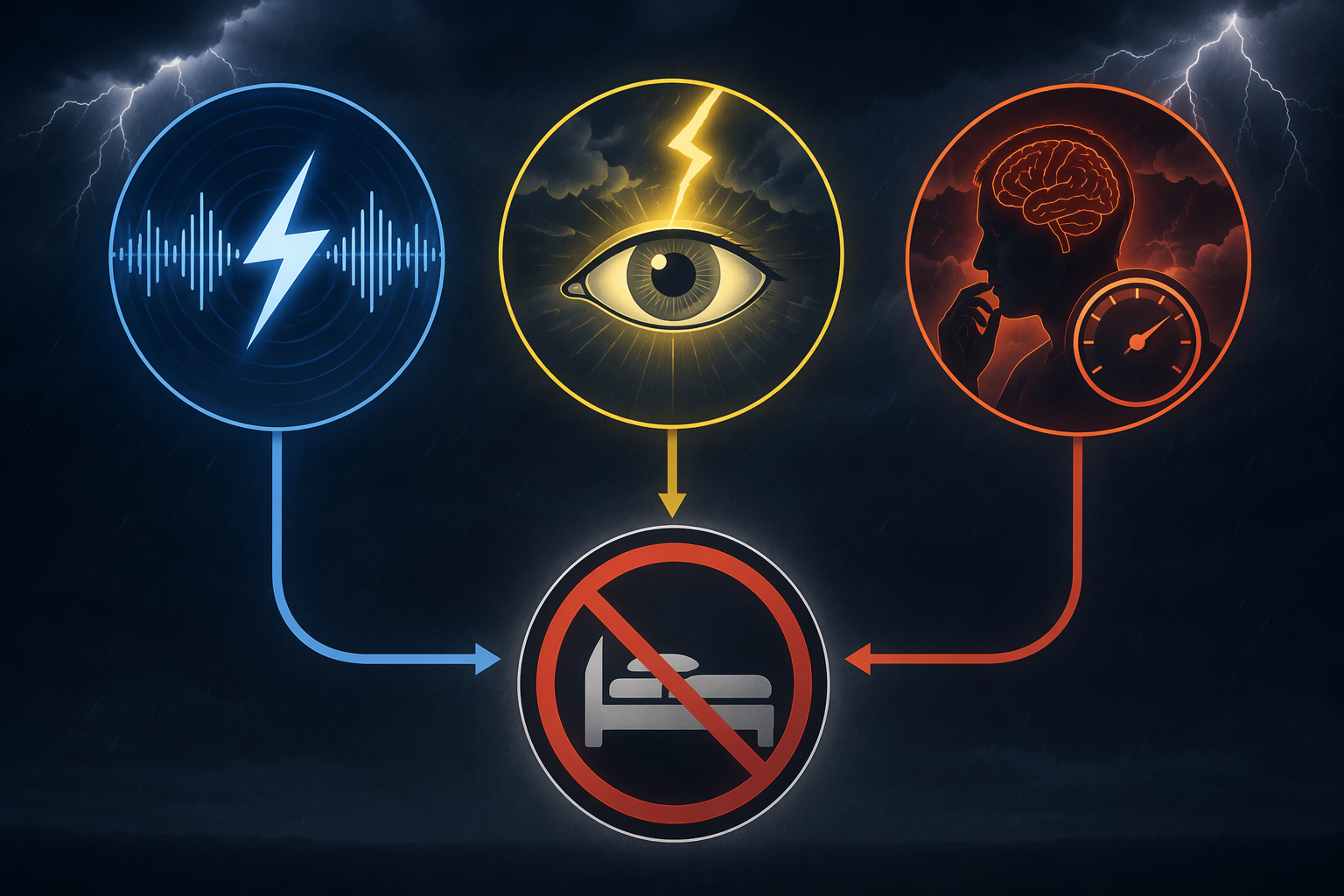
You can do the responsible things—go to bed tired, keep the room cool, put the phone down, close the blinds—and still be upright at 2 a.m. because a thunderstorm is not one sleep problem. It is usually three intrusions arriving together: a sound spike from thunder, a light flash from lightning, and a threat-monitoring loop that keeps checking whether the storm is getting closer.
That distinction matters if you are trying to figure out how to sleep during a thunderstorm tonight. A loud thunderclap is handled by the nervous system differently from a bright window flash. Both are different from lying still while your body acts as if it has been assigned weather duty. A setup that helps one mechanism may barely touch another.
Start With the Intrusion That Wakes You First
If you wake with your heart jumping before you have any clear thought, sound is probably leading. If you wake because the room keeps flashing blue-white through the curtains, light is leading. If you wake before the worst of the storm arrives, keep checking radar, or feel embarrassed that thunder still scares you as an adult, anxiety is doing real work.
| What You Notice | Likely Mechanism | Best First Countermeasure |
|---|---|---|
| A single clap jolts you awake | Acoustic startle and sleep-stage arousal | Raise a steady sound floor; add earplugs if needed |
| Lightning flashes through the room | Light contrast and visual arousal | Blackout curtains, covered windows, or an interior room |
| You feel alert before the storm peaks | Threat monitoring and anticipatory anxiety | Pre-position calming tools; reduce weather-checking |
| You snore, gasp, or have sleep apnea symptoms that worsen in stormy weather | Possible pressure-related breathing contribution | Use prescribed apnea treatment and discuss changes with a clinician |
The table is not a diagnosis. It is a way to stop treating every storm night as a failure of willpower. The body may be reacting to a stimulus before you have a chance to be calm about it.
Thunder Is a Spike Problem, Not Just a Noise Problem
Thunder can range roughly from 60 to 120 decibels depending on distance and conditions, which puts a nearby clap far outside the range of ordinary bedroom sound.[1] The sleeping brain does not judge that sound in a calm, literary way. It responds to suddenness, contrast, and sleep stage.
Arousal thresholds are lower in lighter sleep than in deep sleep; one review places N2 sleep thresholds about 40 to 50 decibels lower than N3 thresholds.[1] That helps explain why the same storm may barely disturb you at one point in the night and feel impossible at another. The storm did not necessarily get louder. You may have been easier to wake.
The worst part is the timing. The acoustic startle reflex can activate within about 30 to 120 milliseconds after an unexpected loud sound, and it remains active during light and REM sleep.[1] That is faster than reassurance, faster than self-talk, and faster than the small lecture many people give themselves about being unreasonable. If the first thunderclap gets through, your body may already be in a higher-alert state before your thoughts arrive.
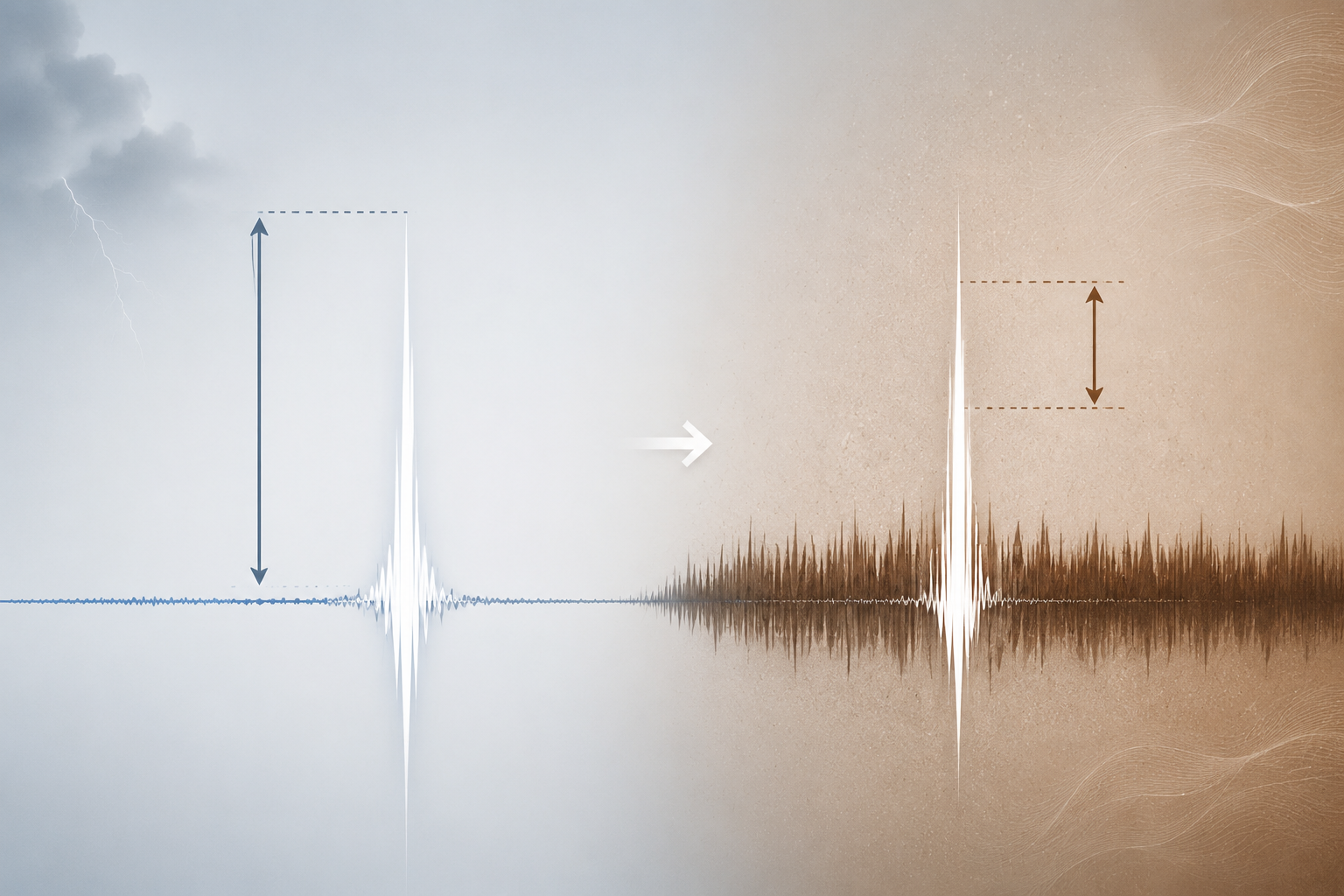
For sound, the practical goal is not to make the storm disappear. It is to reduce the size of the jump between the room’s background sound and the thunderclap.
Why a Steady Sound Floor Helps
A quiet bedroom can make thunder feel more violent because the contrast is so large. If the room sits at 30 decibels and a thunderclap reaches 80 decibels, the perceived jump is about 50 decibels. Raising the ambient sound floor to 50 decibels reduces that jump to about 30 decibels in this example.[1] The thunder is still there, but the nervous system receives a smaller contrast.
This is the real argument for a fan, sound machine, or noise app during a storm. It is not that the sound is magical or inherently calming. It makes the next thunderclap less acoustically abrupt.
White noise has some sleep evidence, but it should be kept in proportion. Sleep Foundation summarizes a study in which people with insomnia fell asleep 38% faster with white noise than with no noise, while also noting that research findings on noise and sleep are mixed.[2] That does not prove white noise solves thunderstorm awakenings. It does support the more modest point that steady background sound can help some sleepers in some contexts.
Brown Noise Is Plausible for Thunder, Not Proven Superior
Brown noise often feels like a lower, heavier version of static. That matters because thunder energy is concentrated largely in lower frequencies, primarily below 500 Hz. Verywell Health describes brown noise as emphasizing lower frequencies more than white noise, which makes it a reasonable candidate when the target sound is thunder rather than a high hiss or chatter.[3]
Reasonable does not mean proven head-to-head. The available material supports a frequency-fit argument, not a direct conclusion that brown noise beats pink or white noise for storm sleep in controlled trials. If brown noise feels too heavy, pink noise or a fan may work better for you. The mechanism you want is steady, tolerable masking that you can sleep beside for hours.
- Try brown noise first if thunder’s low rumble is the main problem.
- Try pink noise if brown noise feels oppressive but white noise feels too sharp.
- Use a fan or air purifier if mechanical sound is easier to ignore than digital noise.
- Start the sound before the storm reaches you, not after the first clap has already startled you awake.
Keep the Masking Sound Safe
The useful sound floor is not the loudest one you can tolerate. The American Academy of Pediatrics recommends keeping sound machines below 50 decibels at ear level, a limit that is especially important around children but still a sensible ceiling for adults who run sound for long stretches.[1] Put the speaker across the room rather than directly beside your head, and increase volume only enough to soften the thunder’s contrast.
Earplugs can add another layer, especially in apartments, bedrooms near exterior walls, or homes with thin windows. Noise reduction ratings commonly range from 22 to 33 decibels.[1] The rating is not a promise that every thunderclap will drop by that exact amount in real life, but properly fitted plugs can reduce the amount of sound that reaches you before masking sound has to do all the work.
For many storm-sensitive sleepers, the best sound setup is boring: earplugs on the nightstand, brown or pink noise already queued, volume tested on a non-storm night, and the device placed far enough away that it fills the room instead of blasting one ear. The point is to make the middle-of-the-night action small enough that you will actually do it.
Lightning Needs Contrast Control
Lightning is simpler than thunder because it does not need a long physiological explanation to be useful. A flash through a dark room is a contrast event. Reduce the contrast and reduce the chance that your brain treats the window as something it needs to monitor.
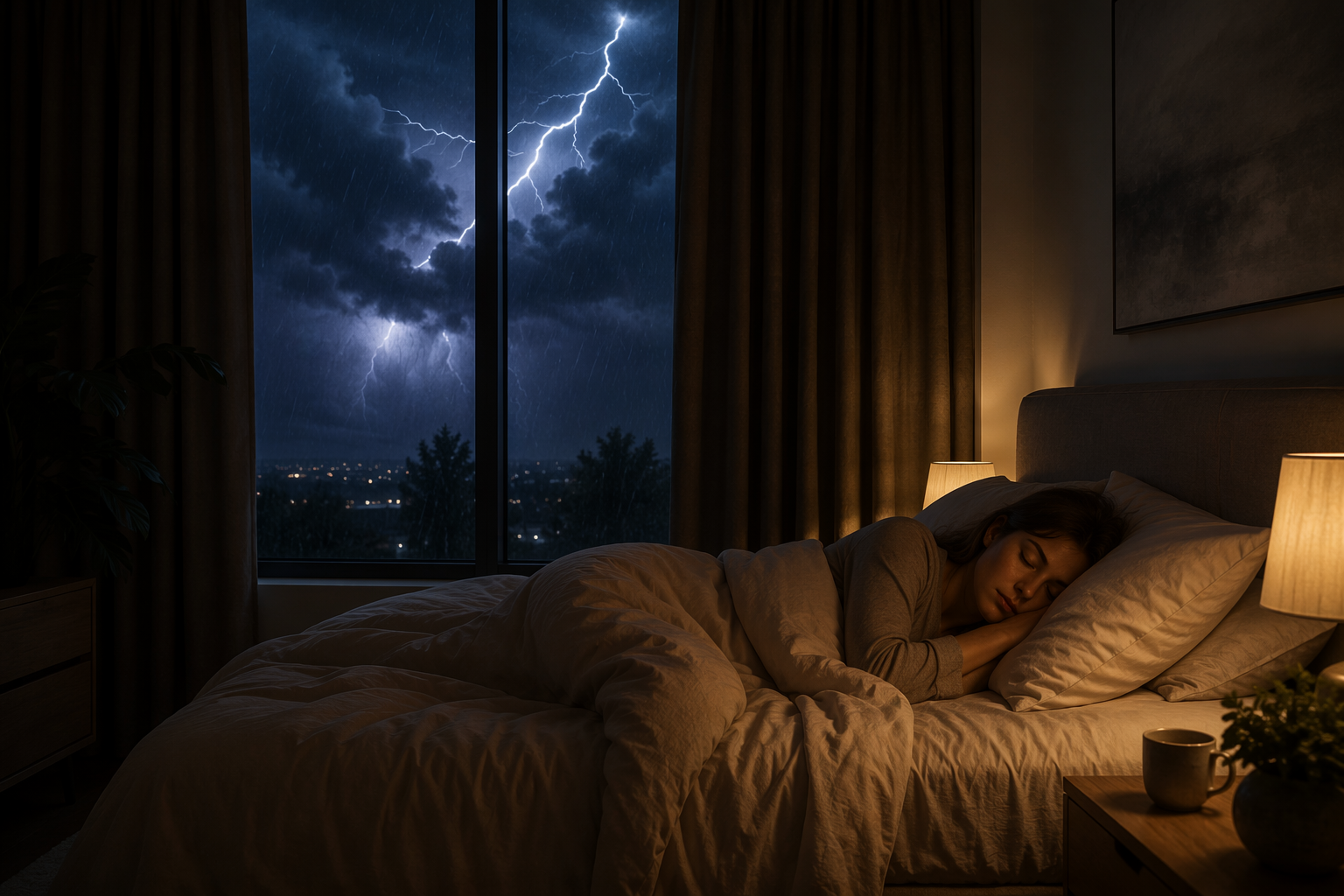
Blackout curtains are the most direct tool. If you do not have them, temporary layers can still help: close blinds fully, pull heavier curtains over them, or sleep away from the window side of the room. A dim, warm night-light can also reduce the difference between total darkness and a sudden flash, especially for people who wake disoriented when lightning fills the room.
If storms are severe or the bedroom has large exposed windows, an interior room may be the better sleep room for the night. That can be a hallway-adjacent guest room, a den, or another space that removes the window from your direct line of sight. This is not elegant sleep hygiene. It is stimulus control.
Storm Anxiety Is Not Solved by Telling Yourself to Relax
Some people are not mainly woken by the loudest clap. They are awake before it, listening for it. The body starts sampling the environment: Was that thunder closer? Did the rain intensify? Should I check the warning again? That kind of monitoring makes sleep fragile even if the room is already dark and the sound machine is running.
Weather checking can be protective when there is real risk, but it can also become the behavior that keeps the alarm system awake. Baylor College of Medicine advises people with pre-storm anxiety to rely on trusted information and practical preparation rather than repeatedly watching storm coverage in a way that escalates distress.[4] The National Weather Service also frames storm anxiety management around having a plan, identifying safe places, and using reliable alerts rather than staying in constant watch mode.[5]
A practical storm plan removes decisions from the worst moment. Before bed, choose the alert source that would wake you for actual danger, identify the safe room if one is needed, charge the phone, set the sound machine, and then stop asking your half-asleep brain to run emergency management from under the covers.
Weighted Blankets Give the Body a Physical Cue
A weighted blanket can be useful because it does not require you to think your way out of fear. Deep pressure touch is described in a 2024 review as activating parasympathetic processes, and the review summarizes earlier work connecting deep pressure touch with endorphins, dopamine and serotonin release, lower heart rate, reduced anxiety, and steadier breathing.[6] That is a more plausible storm-night role than the vague promise that a blanket will make you calm.
The evidence still has boundaries. Weighted blankets have been studied in sleep and mental-health contexts, but not as a definitive thunderstorm treatment. A population-based register study of 1,785 adults found weighted blanket use associated with a 3.3% decrease in sleep medication prescriptions, which is interesting but not the same as proving that the blanket caused better storm sleep for every user.[6]
The common sizing rule is about 10% of body weight, and safety matters. The review notes cautions around use in very young children, including avoiding weighted blankets for children under 3 years old or under 50 pounds.[6] Adults with breathing, mobility, heat intolerance, or circulation concerns should be more cautious than product pages tend to be.
If you use one, put it where you can reach it without turning on lights or starting a search. The same goes for a breathing cue. A slow, steady exhale pattern is not meant to overpower thunder. It is meant to give your body a repeatable rhythm when it wants to keep scanning.
Barometric Pressure May Matter, but Usually at the Edges
Storms bring pressure changes, and there is some evidence that pressure can interact with sleep breathing. In a single-center study of 537 patients, lower barometric pressure was associated with an increase in obstructive apnea index of about 0.3 events per hour for each 1 millibar decrease.[7] That is a modest effect, not a hidden master explanation for every bad storm night.
For someone with untreated or poorly controlled sleep apnea, storm nights may feel worse for more than emotional reasons. The practical response is not a special storm supplement or a new ritual. It is using prescribed therapy consistently and telling a clinician if weather-linked breathing disruptions, gasping, or severe daytime sleepiness are part of the pattern.
When Fear of Thunder Becomes the Main Sleep Problem
There is a point where thunderstorm sleep trouble is no longer mainly an environmental setup problem. Cleveland Clinic reports that astraphobia, fear of thunder and lightning, affects about 8% of adults annually and is about twice as common in women.[8] Feeling afraid of storms is not childish; it is common enough to have a clinical name when it becomes persistent and impairing.
DSM-5-TR-based descriptions require symptoms lasting 6 months or more and causing significant distress or impairment for a specific phobia diagnosis.[9] If storm fear changes where you sleep, makes you avoid normal activities, causes panic-like symptoms, or keeps hijacking nights across seasons, the useful conversation shifts from better curtains and noise masking to treatment.
Cognitive behavioral therapy is described as a first-line treatment for astraphobia by Cleveland Clinic and Verywell Mind.[8][9] That does not mean every storm-sensitive sleeper needs therapy. It means that if the fear itself has become persistent, impairing, or bigger than the weather event in front of you, there is a treatment path more specific than trying another sleep tip.
Build the Smallest Storm Plan That Matches Your Pattern
A good storm plan should be almost disappointingly concrete. If sound wakes you, set the sound floor before the storm arrives and keep earplugs within reach. If light wakes you, block the window or move away from it. If anxiety wakes you, decide in advance which alert source counts as enough information, where you would go for safety, and what physical downshift cue you will use when monitoring starts.
- Sound-led storm night: brown or pink noise across the room, earplugs nearby, volume kept moderate.
- Light-led storm night: blackout layers, dim warm night-light if flashes feel jarring, bed positioned away from the window.
- Anxiety-led storm night: one trusted alert source, safe-room plan, weighted blanket or breathing cue pre-positioned.
- Mixed storm night: combine only the tools that match your actual triggers instead of building an elaborate routine you will abandon at 2 a.m.
Success is not becoming oblivious to severe weather. It is fewer awakenings, a smaller jolt when thunder breaks through, less time spent watching the window or the radar, and a faster return to sleep after the storm moves on. One-size-fits-all thunderstorm advice fails because thunderstorms do not disrupt sleep in one way.
References
- Thunderstorm Anxiety Kids Sleep Guide, Mattress Miracle
- How Noise Can Affect Your Sleep Satisfaction, Sleep Foundation
- Brown Noise vs. White Noise vs. Pink Noise, Verywell Health, 2026
- Navigating pre-storm anxiety, Baylor College of Medicine
- Storm Stress and Anxiety, National Weather Service
- Weighted blankets for sleep problems and related disorders: A systematic review, Frontiers in Psychiatry / PMC, 2024
- The effect of altitude descent on obstructive sleep apnea, Journal of Clinical Sleep Medicine, 2010
- Astraphobia, Cleveland Clinic
- Astraphobia: Fear of Thunder and Lightning, Verywell Mind, 2025
Supports these guides
Spot an error or have clinical feedback?
Because this article covers clinical, medication, or safety information, we use a moderated correction channel instead of open public comments. Let us know if something about “How to Sleep Through a Thunderstorm: A Science-Based Breakdown” needs a closer look.
Send feedback on this article