
Why the Allergy Med Recall Can Ruin Your Sleep
Stopping cetirizine or levocetirizine abruptly can trigger severe itching that destroys sleep. This article explains why it happens and how a simple taper can protect your sleep through the transition.
The allergy medication recall matters for sleep because of what can happen after the bottle leaves the nightstand. A long-term cetirizine or levocetirizine user may stop suddenly because of a recall notice, a refill problem, or a decision to switch brands. Two nights later, the allergy symptoms may not be the main problem. The problem may be itching across the arms, scalp, chest, or legs that becomes loudest in the quiet part of the night.
That is the practical link between an allergy medication recall and sleep disruption: not contamination itself, but abrupt interruption after long-term daily use. The current cetirizine recall gives people a reason to stop quickly, but the rebound itching issue is separate. The FDA had already required warning language in 2025 for rare severe itching after stopping long-term oral cetirizine or levocetirizine use, based on 209 cases in the FDA Adverse Event Reporting System as of May 2025.[1]

The pattern: stop the pill, then the night gets itchy
Cetirizine and levocetirizine are common oral H1 antihistamines, often used daily for chronic allergy symptoms. The concern is not ordinary short-term use. In the FDA’s review, 92% of reported cases involved people who had used the medication for longer than three months before stopping, and the median time to itching after discontinuation was two days.[1]
That timeline is clinically useful because it keeps the symptom from being mislabeled too quickly. If someone has taken cetirizine every night for months or years, stops abruptly, and then develops severe itching within a few days, withdrawal pruritus belongs on the short list. It may still be eczema, hives, a new detergent, menopause-related skin dryness, kidney or liver disease, a medication reaction, or allergy recurrence. But the stop-start timing is not trivial.
The FDA also reported that 48 of the 209 cases described disability, which gives a better sense of why this is more than a nuisance symptom for the people affected.[1] A person who is awake until 3 a.m. scratching her scalp is not having a mild preference problem. She is losing sleep onset, sleep continuity, and the ability to recover the next day.
Rare does not mean imaginary
The number should be held carefully. FAERS reports are spontaneous reports, not a controlled study. They can reveal a signal, but they cannot tell us how often this happens among all users. The FDA specifically noted that the phenomenon appears rare compared with the frequency of use, including more than 60 million packages of these medicines purchased in 2022.[1]
That is the right scale: uncommon, documented, and worth planning around when the person has been taking the medication daily for a long time. It is not a reason for every cetirizine user to panic. It is also not a symptom clinicians should wave away simply because they have not seen it often.
The sex pattern deserves notice without overclaiming. In a 2016 case series from the Netherlands Pharmacovigilance Centre Lareb, 12 cases of unbearable pruritus after stopping cetirizine were described; 92% were female, and the median age was 38.[2] Twelve cases cannot establish prevalence or prove that women are biologically more susceptible. But for midlife women whose itching, insomnia, flushing, and anxiety-like symptoms are too often bundled into “just hormones,” it is enough to justify a more careful medication history.
Why itching becomes a sleep problem so quickly
The proposed mechanism is a rebound effect at the histamine system. Lareb authors described a hypothesis in which long-term antihistamine use may lead to H1 receptor downregulation; when the drug is stopped, circulating histamine may act on a sensitized or imbalanced system, producing intense itching.[2] That mechanism is plausible, not settled. It is not the same as proof from a controlled withdrawal trial.
Still, the sleep consequences are easy to understand. Itching has less competition at night. During the day, conversation, light, work, errands, and movement can partially drown out body sensations. In bed, with the room quiet and the phone finally down, the skin gets the whole stage.
The first injury is sleep onset. A person who is already sleep-fragile may spend the pre-sleep window scanning for the next itch, scratching, applying lotion, changing pajamas, checking whether there is a rash, then starting the same loop again. Even if the skin looks normal, the sensation can feel urgent enough to keep the nervous system activated.
The second injury is sleep maintenance. Scratching can pull someone out of light sleep repeatedly. A few seconds of scratching may not sound like much on paper, but repeated arousals can leave the next morning feeling like no sleep happened. For perimenopausal readers already dealing with temperature swings or early-morning awakenings, this can stack on top of an unstable night rather than replace it. If that is the broader picture, it may help to separate this medication-transition problem from the larger question of perimenopause and antihistamine sleep-aid recalls.
If you stopped because of a recall, separate two decisions
A recall-driven stop has two different questions inside it. The first is product safety: whether the bottle you have should be used, replaced, or discarded. That should follow the recall notice, the pharmacy, the manufacturer, or your clinician.
The second question is sleep-preserving transition: if you have been taking cetirizine or levocetirizine daily for months or years, how do you avoid a sudden drop-off that may trigger rebound itching? Throwing out a recalled bottle may be the correct safety move. Going from daily use to no antihistamine support at all, with no plan for the next week, is where the night can fall apart.
If your medication is part of a recall, do not keep taking a product you have been told not to use just to avoid itching. The safer move is to contact the pharmacy or clinician promptly and ask for a non-recalled replacement or an individualized transition plan. This is especially important if the medication was controlling asthma-adjacent allergy symptoms, chronic hives, severe rhinitis, or another condition where stopping can have consequences beyond sleep.
Who should think about tapering
Tapering is most relevant for people who have taken oral cetirizine or levocetirizine every day or nearly every day for at least several months. The FDA cases were heavily weighted toward use longer than three months, and the Lareb cases included long-term users, with a median duration of 33 months.[1][2]
A taper is also worth discussing if you have tried to stop before and developed whole-body itching without a clear rash, especially if it appeared within days and was worse at night. That history is a useful clinical detail, not an embarrassment and not proof that you are “dependent” in the way people often use that word. It may simply mean your histamine system did not appreciate the abrupt change.
| Situation | Sleep-preserving move |
|---|---|
| You used cetirizine or levocetirizine occasionally | A taper is usually less relevant; monitor symptoms and follow standard label or clinician guidance. |
| You used it daily for months or years and want to stop | Ask about tapering instead of stopping abruptly. |
| You stopped and severe itching began within a few days | Contact a clinician or pharmacist; restarting briefly and tapering may be considered. |
| You stopped because of a recall | Do not improvise with a recalled product; ask for a safe replacement and a transition plan. |
| You are older, medically complex, pregnant, immunocompromised, or taking several medications | Get individualized advice before changing allergy medication. |
What every-other-day tapering means in real life
Cleveland Clinic allergist guidance describes a practical approach: instead of stopping cetirizine or levocetirizine abruptly, take the medication every other day for one to two weeks, then move to every third day before stopping.[3] This is expert guidance, not a taper schedule proven by a randomized trial. But it is simple enough to discuss and use safely with professional input.
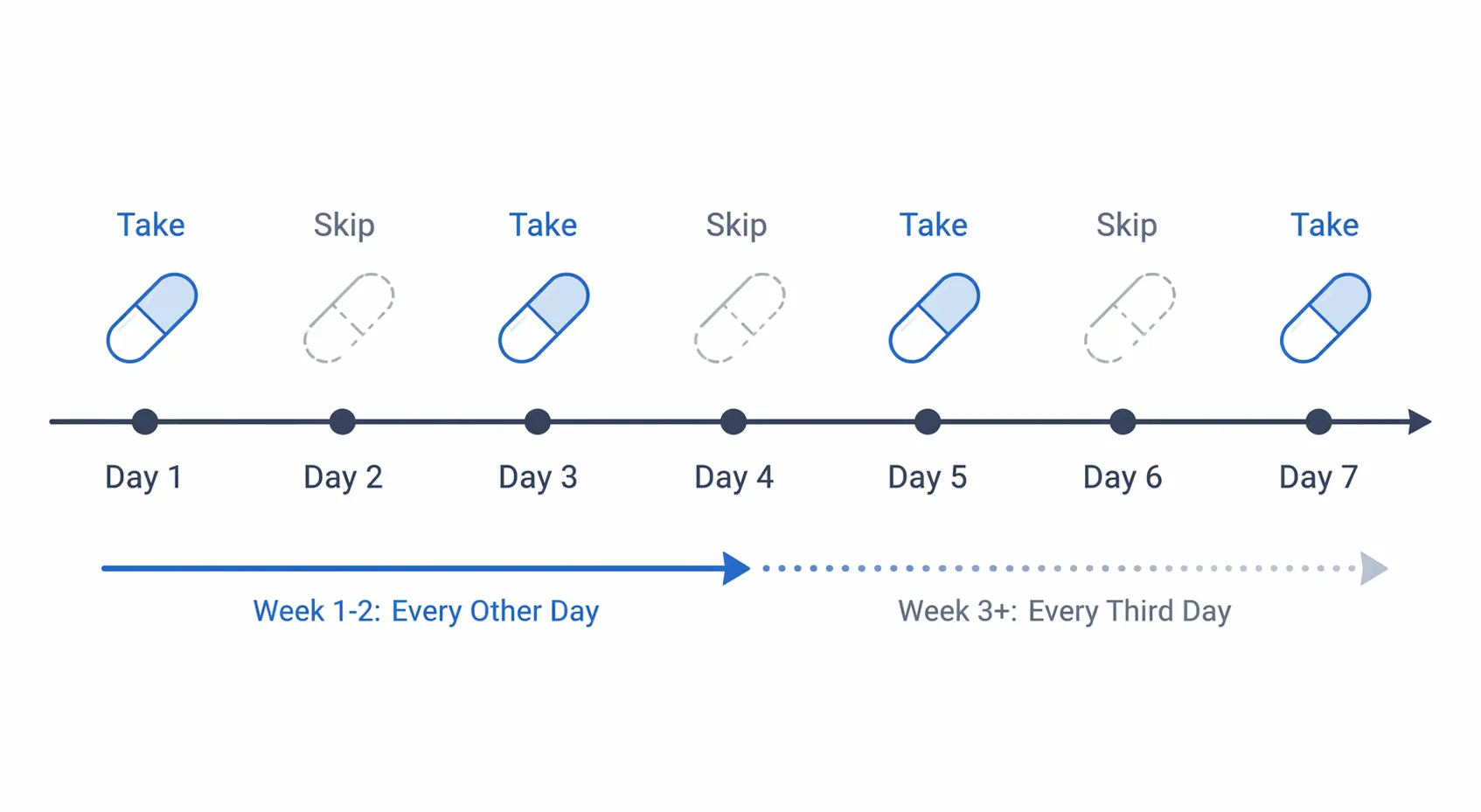
In plain terms, every other day means you take the dose on Monday, skip Tuesday, take it Wednesday, skip Thursday, and continue that alternating pattern. After one to two weeks, every third day means leaving two medication-free days between doses. The goal is not to treat the calendar as sacred; the goal is to avoid a hard cliff after long-term receptor blockade.
For someone who has already stopped and is now miserable, the FDA review gives some support to a restart-and-taper approach. Among cases that reported restarting the medicine and then tapering, 38% described resolution of symptoms.[1] That number should not be read as a guaranteed success rate, because these are still spontaneous reports with incomplete follow-up. It does mean the strategy has appeared often enough in real reports to be clinically relevant.
Do not restart a recalled bottle unless a qualified professional has specifically told you it is safe to do so. In a recall situation, the better question is usually whether a pharmacist can replace the product with an unaffected supply, whether another antihistamine is appropriate, or whether a short clinician-supervised plan is needed to get you through the rebound window.
A switch is not the same as a cure
Some people will switch to another oral antihistamine rather than taper to nothing. An AAAAI Ask the Expert response from Eric Macy, MD, stated that fexofenadine and loratadine have no reported withdrawal pruritus and described them as preferred alternatives in this context.[4] That is a useful contrast, especially when cetirizine or levocetirizine has caused a stop-start itching pattern.
It is not proof that no one can have symptoms with a different medication. “No reported withdrawal pruritus” is an absence of specific reports, not a controlled comparison. The practical takeaway is narrower: if you need ongoing allergy treatment while avoiding another abrupt cetirizine or levocetirizine stop, ask whether fexofenadine or loratadine makes sense for your medical situation.
Protecting tonight while the medication plan gets sorted
The medication transition is the center of the problem, so sleep hygiene alone will not fix severe rebound itching. Still, the next few nights may need triage. Keep the room cool, choose loose breathable sleepwear, trim nails short, and use a bland moisturizer if dry skin is adding fuel. If heat worsens the itch, a cool compress can be more useful than another long, hot shower.
Avoid building a second medication problem while solving the first. Diphenhydramine-containing sleep aids, alcohol, and stacked sedating products can create next-day impairment and can be especially risky for older adults. Readers weighing over-the-counter sleep options can use a broader guide to OTC sleep aids by sleep problem or, for older adults, review which sleep aids are safer after 65.
If itching is severe enough to cause skin injury, near-total insomnia, panic, or missed work, it deserves medical attention. The same is true if there is swelling of the lips or tongue, wheezing, widespread hives, fever, yellowing of the skin or eyes, dark urine, a new medication exposure, or itching that does not fit the stop-within-days pattern. Withdrawal itching can be real and still not be the only possible explanation.
A calmer way to come off cetirizine or levocetirizine
For most long-term users, stopping cetirizine or levocetirizine will not lead to severe withdrawal itching. The FDA signal is small compared with how widely these medications are used.[1] But if you have taken either one daily for months or years, abrupt cessation is not the gentlest sleep-preserving move.
- If you are stopping by choice, ask your clinician or pharmacist about every-other-day dosing for one to two weeks, then every-third-day spacing.
- If you stopped and severe itching has already started, ask whether a supervised restart-and-taper or medication switch is appropriate.
- If a recall prompted the stop, do not keep using a recalled bottle to self-taper; ask for a safe replacement or individualized plan.
- If symptoms are disabling, persistent, medically unusual, or accompanied by allergic warning signs, get clinical help rather than waiting it out.
The point is not to make allergy medication frightening. It is to treat the transition as part of the treatment. For a sleep-fragile person, especially someone already navigating midlife or older-adult sleep changes, a few planned dosing intervals can be the difference between an uneventful switch and a week of scratching through the dark.
References
- FDA Requires Warning About Rare Severe Itching After Stopping Long-Term Use of Oral Allergy Medicines, U.S. Food and Drug Administration, May 2025.
- Unbearable Pruritus After Withdrawal of (Levo)cetirizine, Netherlands Pharmacovigilance Centre Lareb, 2016.
- Safely Switching Allergy Medications, Cleveland Clinic, April 23, 2024.
- Pruritus after discontinuation of cetirizine or levocetirizine, American Academy of Allergy, Asthma & Immunology, 2025.
Safety & eligibility read
Cross-check against other interventionsExplore the mechanism
Next step
Spot an error or have clinical feedback?
Because this article covers clinical, medication, or safety information, we use a moderated correction channel instead of open public comments. Let us know if something about “Why the Allergy Med Recall Can Ruin Your Sleep” needs a closer look.
Send feedback on this article