How the full moon disrupts menopause sleep (and what helps)
Peer-reviewed research confirms the full moon produces small but real sleep disruption, and when combined with menopause-related sleep loss from vasomotor symptoms the effect can become debilitating. This guide separates lunar physiology from astrology and provides evidence-based remedies tailored to menopause.
If your sleep gets worse around the full moon, and menopause has made that pattern harder to brush off, the most useful answer is not “it is astrology” or “it is nothing.” The better answer is smaller and more practical: peer-reviewed sleep studies have found modest, measurable changes around the full moon, and menopause can make modest changes feel anything but modest.
That distinction matters. The evidence does not validate broad astrological claims about personality, fate, or emotional destiny. It does suggest that some people sleep a little later, a little shorter, and sometimes less deeply near the full moon. For a well-rested 28-year-old, that may barely register. For a 52-year-old who is already waking hot, anxious, and soaked through at 3 a.m., another small push can be the night’s tipping point.
What the moon studies actually measured
The strongest modern field study is not a story about people feeling strange under a bright sky. In a 2021 Science Advances study, researchers measured sleep timing across three Indigenous Toba/Qom communities in Argentina and 464 University of Washington students. Sleep tended to start later and run shorter in the three to five days before the full moon. Depending on the community, sleep onset shifted 30 to 80 minutes later and total sleep shortened by 20 to 90 minutes; in the urban student sample, the shortening and delay still appeared despite artificial lighting, with effect sizes of 0.34 standard deviations for shorter sleep and 0.32 standard deviations for delayed sleep onset.[1]
That study is often reduced to “moonlight keeps people awake,” but the finding is more interesting than that. The pattern appeared in settings with very different access to electricity, and it also appeared in an urban environment where the moon is not the main light source. Moonlight may still be part of the story, especially before the full moon when the evening sky is brighter, but it is not enough to explain every signal.
A controlled laboratory study adds another piece. In research summarized by Sleep Foundation, participants studied under conditions without visible moonlight showed about 30% less deep sleep and took about five minutes longer to fall asleep near the full moon.[2] Five minutes is not a crisis by itself. Less deep sleep, however, is the kind of change many midlife women recognize the next day: more fragile concentration, more irritability, and less ability to absorb one more bad night.
A 2014 Sleep Medicine polysomnography study is especially relevant for women. Around the full moon, women in the study had lower sleep efficiency, 74% compared with 82%, less deep sleep, 6% compared with 9–11%, and longer REM latency, 137 minutes compared with 97–98 minutes. Men did not show the same pattern of disruption in that report.[3]
This is not a license to inflate the full moon into a master explanation for insomnia. The overall effect in the literature is usually in the range of minutes, not hours. A large population-based polysomnography study published in 2015 found no association between moon phase and sleep, a reminder that study design, lunar-phase classification, lab conditions, and light exposure can change what researchers detect.[2]
| Claim | What the evidence supports | What it does not prove |
|---|---|---|
| “I sleep worse near the full moon.” | Some studies find later sleep onset, shorter sleep, lower sleep efficiency, or less deep sleep near the full moon. | That the full moon is the cause of every bad night. |
| “It happens even when I block the window.” | Controlled and urban findings suggest moonlight alone may not explain all observed effects. | That a strong internal lunar clock has been proven for everyone. |
| “This feels worse since perimenopause.” | Menopause commonly lowers sleep resilience through vasomotor symptoms and repeated awakenings. | That lunar effects are unique to menopause. |
| “Is this astrology?” | The sleep evidence concerns physiology, timing, light exposure, and measured sleep stages. | It does not validate broad astrological claims. |
Why menopause can make a small lunar effect feel large
The arithmetic is the part that deserves more attention than the moon itself. Menopause does not simply add a new inconvenience to sleep. It often changes the whole sleep baseline: more awakenings, more heat, more anxiety on waking, more time spent calculating how few hours remain before morning.
Sleep disturbances affect 40–70% of women during the menopausal transition, and the SWAN study found that 30.7% of midlife women slept fewer than seven hours, with short sleep becoming more common over 15 years of follow-up.[4][5] Vasomotor symptoms are a central reason. Hot flashes and night sweats can fragment sleep even when a woman does not fully remember each awakening.
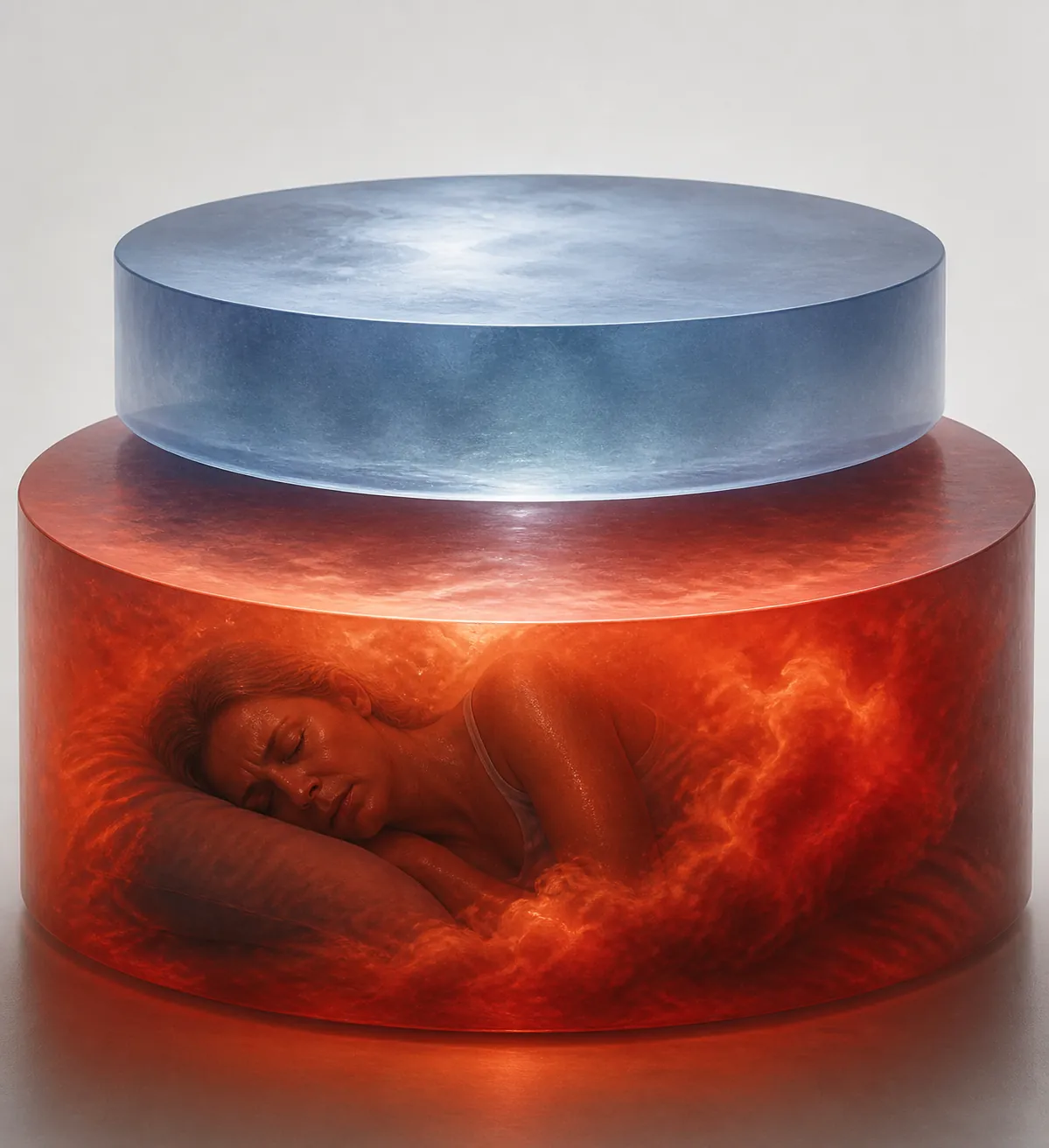
This is where the full moon becomes more plausible as a real-life problem without needing to become a dramatic one. If a lunar-linked effect shortens sleep by 15 to 30 minutes for some people, that may be manageable on a stable baseline. Put the same effect on top of hot-flash awakenings, reduced deep sleep, early-morning cortisol surges, joint aches, bladder trips, or caregiving stress, and the difference between “rough night” and “I cannot function” gets much thinner.
That also explains why a moon-tracking app beside a menopause symptom log is not automatically irrational. The useful question is not whether the moon controls sleep. It is whether your worst nights cluster in a way that can help you prepare, protect the baseline, and know when the real driver is untreated vasomotor sleep disruption.
The menstrual-lunar connection is context, not proof
Many women arrive at this topic through a reproductive-rhythm intuition: periods, ovulation, mood, sleep, the moon. There is some scientific context for why that association persists. A 2025 Science Advances study reported that women’s menstrual cycles can synchronize with lunar cycles, but that synchrony declined after 2010, a change the authors attributed to increased artificial light exposure at night.[6]
For menopause sleep, that finding should stay in its lane. It does not prove that full moons cause menopausal insomnia, and it does not turn lunar timing into a diagnostic tool. It does make it less surprising that reproductive biology, light, circadian timing, and lunar cycles can end up in the same private notebook.
How to test your own pattern without turning it into a belief system
A practical trial should be boring on purpose. Track enough to see a pattern, but not so much that the tracking itself becomes a nightly alarm bell.
- Mark the three to five nights before the full moon and the full-moon night itself.
- Record bedtime, estimated sleep onset, wake time, number of awakenings, and whether you woke hot or sweaty.
- Add alcohol, late meals, travel, stress spikes, illness, and medication changes, because these can swamp a lunar signal.
- Track at least two or three lunar cycles before drawing conclusions.
- Look for clustering, not perfection. A real pattern does not have to appear every month.
If the bad nights cluster near the full moon but also include hot flashes, drenched sheets, or repeated 3 a.m. awakenings, treat that as menopause sleep data first. The moon may be part of the timing. The vasomotor symptoms may be the part you can most effectively treat.
Remedies that fit menopause sleep, ranked by evidence
The safest way to approach remedies is to separate timing from treatment. You can use the lunar pattern to time extra protection around vulnerable nights. But the treatment should still match the physiology: insomnia, vasomotor symptoms, circadian disruption, or a combination.
Tier 1: Treat insomnia and vasomotor symptoms directly
CBT-I belongs at the top because it treats chronic insomnia rather than chasing each trigger. In postmenopausal women, randomized trial evidence supports CBT-I for improving insomnia symptoms, and it can be adapted for women whose sleep has become conditioned around dread, clock-watching, and repeated awakenings.[7]
That does not mean telling a woman with night sweats to “think differently” about soaked pajamas. CBT-I works best when the insomnia loop is one target and the heat burden is another. If vasomotor symptoms are waking you repeatedly, clinician-guided hormone therapy may be appropriate depending on your medical history, age, time since menopause, cancer history, clotting risk, cardiovascular risk, and personal preferences. It should not be started from an article or a supplement aisle.
Newer non-hormonal prescription options, including fezolinetant, may also be relevant for women whose sleep disruption is driven by moderate to severe hot flashes and who are not candidates for hormone therapy or prefer an alternative. This is a medical conversation, not a moon-phase remedy, because liver safety, medication interactions, and individual contraindications need review.[4]
Tier 2: Build a full-moon buffer around a menopause-calibrated sleep routine
Generic sleep hygiene often fails midlife women because it is written as if the main problem is carelessness. Menopause sleep needs a heat plan, a light plan, and a recovery plan.
- For the three to five nights before the full moon, dim indoor light earlier than usual and keep the bedroom as dark as you comfortably can.
- Use layered bedding rather than one heavy cover, so a hot flash does not require fully waking to rebuild the bed.
- Keep a dry sleep shirt nearby if night sweats are common; reducing the cleanup task can reduce the length of the awakening.
- Avoid using the full moon as the week to experiment with late alcohol, heavy dinners, or new sleep supplements.
- Get bright outdoor light early the next morning, especially after a short night, to protect circadian timing.
These steps do not require proving that the moon is the culprit. They are low-risk ways to reduce light, heat, and circadian instability during the window when several studies have found sleep to be more vulnerable.
Tier 2 with caveats: Isoflavones and black cohosh
Nutritional and botanical options need a cooler reading than they usually get online. A 2023 Nutrition Reviews systematic review found that isoflavones showed benefit in four of eight studies, while black cohosh showed benefit in all three studies that examined it. The same review warned that many nutritional studies were low quality, with most scoring only 1–2 out of 5 on the Mixed Methods Appraisal Tool.[8]
That means these are not first-line treatments for severe menopausal insomnia, and they are not astrology-specific remedies. Isoflavones may be reasonable to discuss if you want a lower-risk option and have no contraindications. Black cohosh deserves more caution because supplement quality varies and safety considerations, including liver-related concerns and medication interactions, belong in a clinician or pharmacist conversation.
Tier 3: Magnesium, valerian, and lemon balm
Magnesium is often discussed for sleep, but the menopause-specific evidence remains limited. It may be considered when dietary intake is low or muscle tension is part of the picture, but it should not be presented as a proven fix for full-moon insomnia. Kidney disease, gastrointestinal side effects, and medication interactions matter.
Valerian and lemon balm have somewhat more menopause-specific data, though still not enough to treat them as definitive. In a 2013 study of menopausal women, valerian/lemon balm was associated with a 36% improvement in Pittsburgh Sleep Quality Index scores compared with 8% in the placebo group, as summarized in the menopause nutrition review.[8]
The reasonable use case is narrow: a clinician-cleared, time-limited trial for mild to moderate sleep complaints, not a replacement for treating repeated night sweats, depression, sleep apnea, restless legs, or chronic insomnia.
When to bring this to a clinician
Bring the pattern to a clinician if you are regularly sleeping fewer than seven hours, waking drenched, having daytime impairment, using alcohol or sedatives to get through the night, snoring heavily, waking gasping, or feeling persistently depressed or anxious. The full moon pattern can be part of the history, but it should not distract from treatable conditions that become more common or more disruptive in midlife.
A useful appointment note might be simple: “For the last three cycles, my worst sleep has clustered in the few nights before the full moon. Those nights also include two to four hot awakenings and next-day impairment.” That gives the clinician timing, frequency, symptoms, and consequence. It is much harder to dismiss than “the moon ruins my sleep,” and it points toward treatment rather than debate.
The full moon may be real enough to notice. Menopause is often what makes it matter. The safest response is not alarm and not ridicule, but evidence-tiered, life-stage sleep care: measure the pattern, protect the vulnerable nights, and treat the menopausal sleep baseline first.
References
- Moonstruck sleep: Synchronization of human sleep with the moon cycle under field conditions, Science Advances, 2021
- Do Moon Phases Affect Sleep?, Sleep Foundation
- Lunar cycle effects on sleep and the file drawer problem, Sleep Medicine, 2014
- Menopause and Sleep: What Every Woman Should Know, NCOA
- Effects of Sleep Problems During Menopause, SWAN Study
- Synchronization of women's menstruation with the Moon, Science Advances, 2025
- Treating chronic insomnia in postmenopausal women
- Nutritional interventions in treating menopause-related sleep disturbances: a systematic review, Nutrition Reviews, 2023
Safety & eligibility read
Cross-check against other interventionsExplore the mechanism
Next step
Spot an error or have clinical feedback?
Because this article covers clinical, medication, or safety information, we use a moderated correction channel instead of open public comments. Let us know if something about “How the full moon disrupts menopause sleep (and what helps)” needs a closer look.
Send feedback on this article