Here's why storms disrupt perimenopause sleep and what helps
Perimenopause primes your nervous system for hyperarousal, making storm nights especially disruptive. This guide explains the physiology behind storm-triggered anxiety and offers a tiered plan to prepare for, survive, and recover from storm nights.
The storm may be ordinary for your region: rain against the windows, thunder rolling through, the phone set to receive alerts. What feels new is your body’s answer. A clap of thunder snaps you awake. Your chest is tight. You are hot under the covers, then chilled when you throw them off. You know you checked the forecast, and still your brain keeps listening for the next warning.
That mismatch is the center of storms and sleep anxiety in perimenopause: the weather did not necessarily become more frightening, but your threshold for full-body alarm may have dropped. Perimenopause is associated with anxiety symptoms for some women, and the sleep changes of the menopausal transition can make nighttime stress harder to absorb rather than easier to reason away.[1][2]
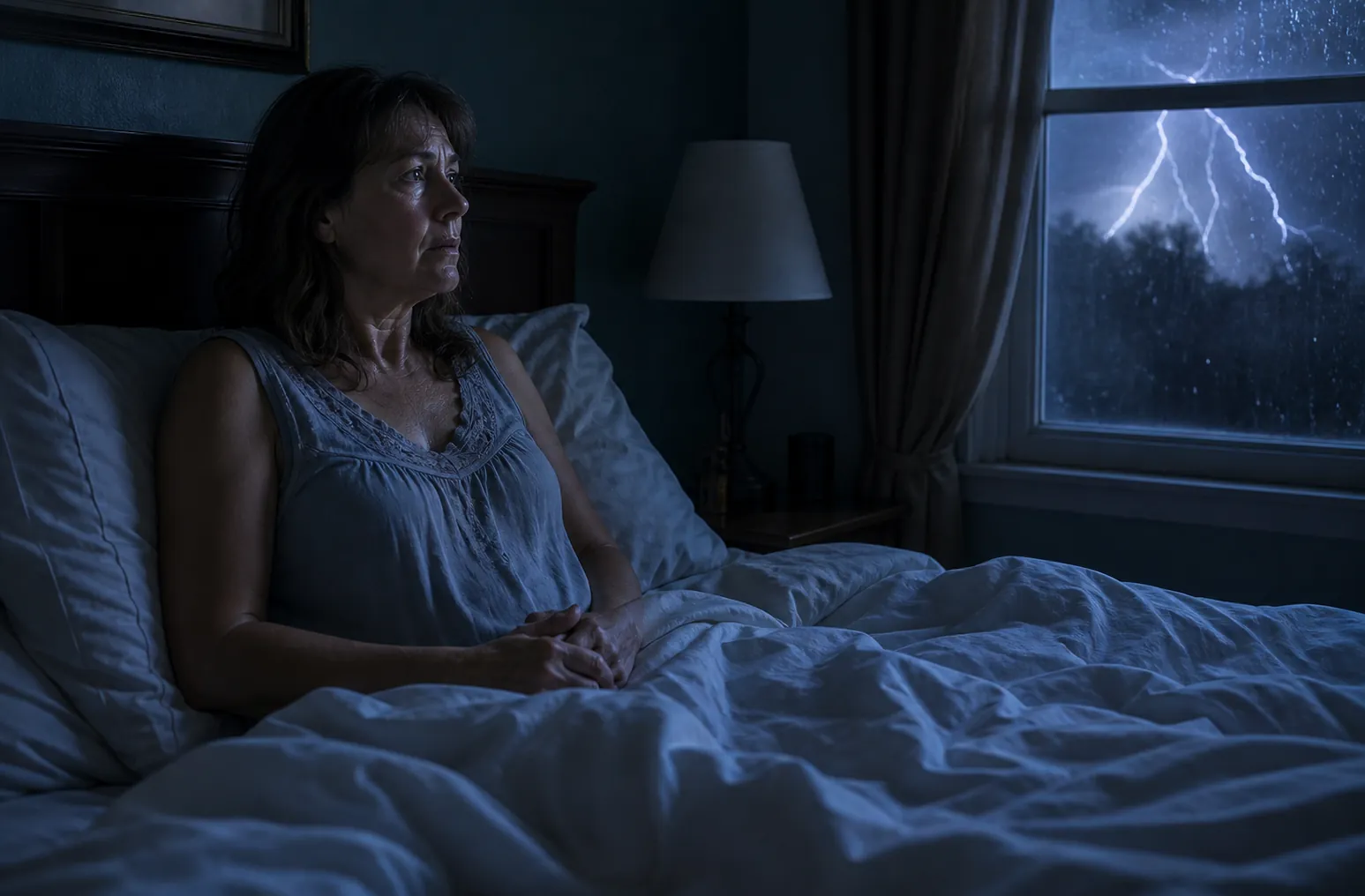
This is not a character flaw, and it is not proof that every storm is an emergency. It is a nervous system problem with several inputs arriving at once: estrogen-related stress-axis instability, less progesterone-related calming activity, and sleep debt from hot flashes or night sweats. On a quiet afternoon, those changes may feel like irritability or fatigue. At 3AM, with wind hitting the house, they can feel like danger.
Why storms can feel louder inside your body now
A storm asks the brain to do real threat monitoring. That is not irrational if you live in tornado country, on a hurricane coast, or in a region where severe thunderstorms knock out power. The trouble starts when the monitoring system cannot downshift after it has checked the facts.
Estrogen helps regulate the hypothalamic-pituitary-adrenal axis, the stress-response system that helps control cortisol. During perimenopause, fluctuating and declining estrogen can make that system more reactive, and some menopause-focused clinical explanations describe cortisol patterns that feel poorly timed: alertness rising when the body should be resting.[1][3] That does not mean estrogen “causes” every anxious thought. It means the body’s stress circuitry may be easier to trigger and slower to settle.
Progesterone matters too. Stanford Lifestyle Medicine describes progesterone metabolites as acting on GABA-A receptors, the same receptor system targeted by benzodiazepines, and notes that progesterone’s decline can remove part of the brain’s natural calming buffer.[4] A woman who used to hear thunder, roll over, and sleep may now hear the same thunder through a less buffered nervous system.
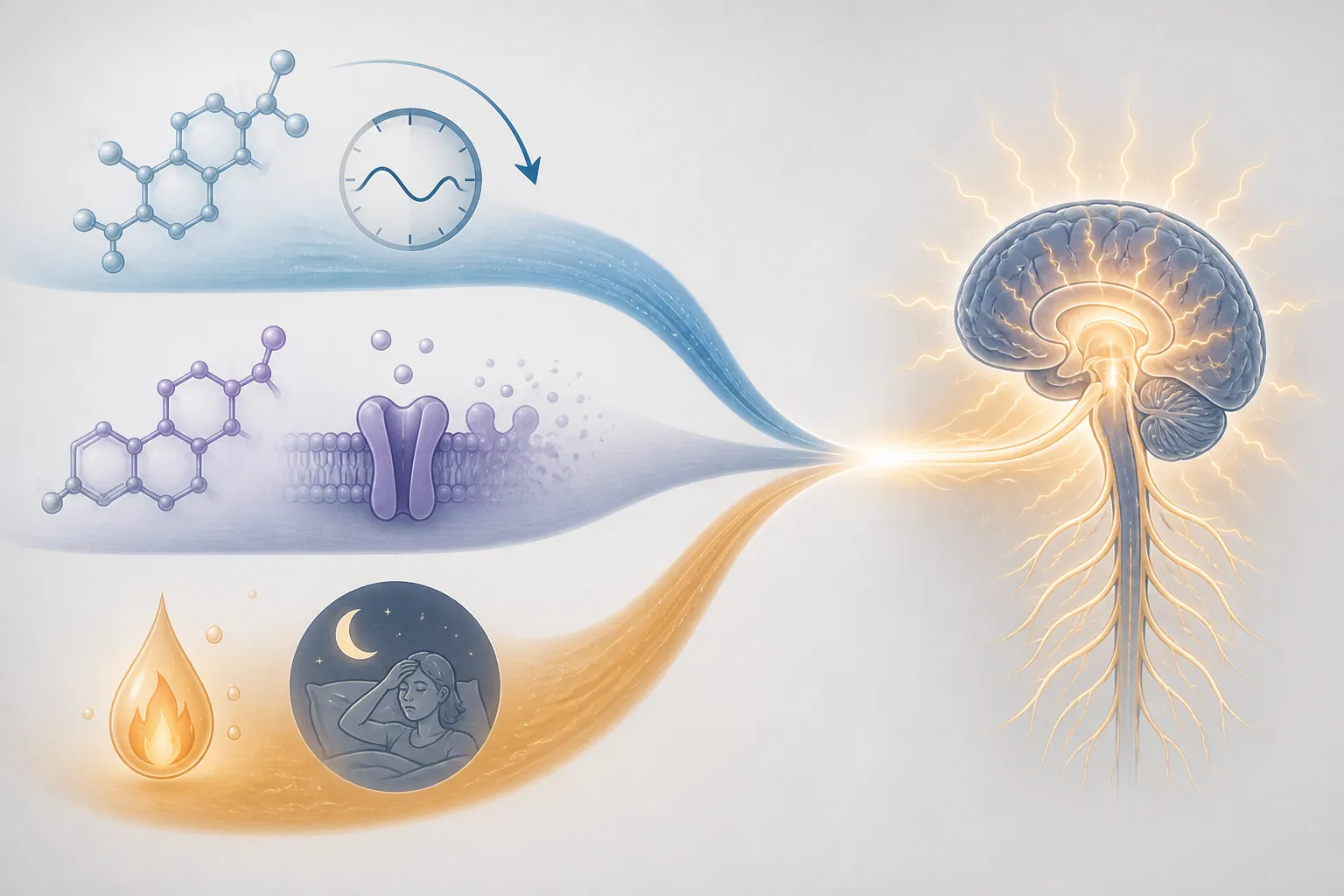
Then there is the sleep debt. The menopausal transition is strongly associated with sleep disturbance, and vasomotor symptoms are not a small nuisance when they fragment the night. In SWAN-related data summarized in a review of sleep during the menopausal transition, women with moderate-to-severe hot flashes had about three times the odds of frequent nocturnal awakenings compared with women without hot flashes.[2]
That point matters. If you have already been woken two or three times by heat, sweat, or the familiar 3AM jolt, the storm does not arrive on a rested system. It arrives on a nervous system that has already spent the night patching itself together.
The 3AM storm trap
Many readers describe the same sequence: they wake hot or startled, check the radar, hear thunder again, then cannot stop scanning. One part of the mind knows the difference between a watch, a warning, and ordinary rain. Another part is counting seconds between lightning and thunder.
Early morning is already a vulnerable sleep window. Cortisol normally follows a daily rhythm, and menopause-focused clinical resources describe perimenopause as a time when stress-hormone regulation can feel more easily disrupted.[3] Add a storm during that lighter, more fragile part of sleep, and the body can interpret normal storm sounds as a reason to move from sleep to surveillance.
Hot flashes can confuse the picture because they overlap with panic-like sensations. Sudden heat, sweating, a racing heart, and a need to throw off the covers can belong to a vasomotor episode, a panic surge, or both. The practical distinction is not perfect, but it helps to ask: did heat rise first, followed by fear, or did a thought or sound trigger fear first, followed by heat? Either way, the next move is the same in the moment: cool the body, orient to actual weather information, and avoid turning the bed into a command center.
One claim deserves caution: barometric pressure sensitivity. Some women are convinced pressure changes affect their sleep or mood. That experience should not be mocked, but the perimenopause-specific evidence is not strong enough to treat pressure changes as an established clinical mechanism. The better-supported explanation is the convergence of hormonal stress reactivity, reduced calming buffer, hot-flash-related sleep fragmentation, and real storm cues.
Set up the night before your brain starts bargaining
Storm preparation is not the opposite of anxiety management. For many people, it is anxiety management. The National Weather Service’s storm-anxiety guidance notes that 97% of dangerous tornadoes rated EF3 or stronger have a warning, with an average lead time of 16 minutes.[5] That fact should not be used to minimize risk. It should be used to decide what deserves attention and what does not.
The goal before bed is to remove decisions from the 3AM version of you. She should not have to remember where the shoes are, whether the phone is charged, or which closet is safest. She should only have to follow the plan.
| Before a forecasted storm night | Why it helps perimenopause sleep |
|---|---|
| Charge the phone, turn on official emergency alerts, and choose one trusted weather source. | Reduces repeated checking while preserving safety. |
| Put shoes, glasses, medications, flashlight, water, and a charger near the bed or safe room. | Prevents a cortisol spike from becoming a scavenger hunt. |
| Cool the sleep environment before bedtime: lighter layers, fan if safe, breathable bedding. | Lowers the chance that heat and thunder arrive together. |
| Write the rule for checking: for example, once before lights out, then only if an alert sounds or conditions clearly change. | Creates a boundary before the anxious brain starts negotiating. |
| Identify the move point: watch, warning, siren, or local instruction. | Keeps preparedness factual instead of open-ended. |
Use official local guidance for the safety details. The sleep plan should never outrank a tornado warning, evacuation order, flash-flood risk, or any instruction from local authorities. If you live outside the most storm-prone regions, your version may be simpler: alerts on, one weather source, basic power-outage supplies, and a clear rule for when to get out of bed.
Do not make radar your sedative
Radar checking feels responsible because it contains information. Past a certain point, it becomes a ritual: open app, zoom, refresh, compare colors, search social media, listen harder. The nervous system learns that sleep is allowed only after one more check, and then another.
A better rule is boring and written in advance: alerts stay on; one trusted source is enough; no scrolling through dramatic storm footage in bed; no switching between five amateur forecasts at midnight. If a warning comes, you act. If no warning comes and your prewritten criteria are not met, you return to the sleep plan.
During the storm: safety first, then arousal control
When thunder wakes you, the first job is not relaxation. The first job is classification. Is there an official warning or local instruction that requires movement? If yes, move. If no, you still have a body in alarm, and that alarm needs a sequence.
- Check only the agreed source or alert screen. Do not begin a search tour.
- Cool first if you are hot: remove a layer, uncover your feet, sip water, use a fan if conditions are safe.
- Slow the exhale. A 4-7-8 pattern can work for some people: inhale for 4, hold for 7, exhale for 8. If holding the breath feels uncomfortable, simply lengthen the exhale.
- Ground attention in the room: name five things you see, four you feel, three you hear, two you smell, and one you taste.
- If you are still wide awake after a reasonable interval, leave the bed for a quiet, dim reset unless safety guidance says to shelter.
Grounding is not magic, and it is not denial. UAB’s storm-anxiety guidance describes sensory grounding as a way to reorient attention when the threat system is dominating the moment.[6] For a perimenopausal body, this matters because the sensation itself can be frightening: the heat, pulse, and startle response become proof, in the anxious brain’s courtroom, that something is wrong. Grounding gives the brain evidence from the actual room.
Breathing works best when it is treated as a brake, not a performance. If counting makes you more alert, drop the arithmetic. Place one hand on the lower ribs, breathe in gently, and make the exhale longer than the inhale. The point is to signal that the immediate physical demand is decreasing.
When the bed becomes the alertness zone
This is where generic sleep hygiene gets thin. You may already have the dark room, the cool sheets, and the caffeine cutoff. The problem is that the bed has become a listening post.
Stimulus control, a core component of cognitive behavioral therapy for insomnia, is useful here because it gives a specific instruction: if you are awake and increasingly alert in bed, get out of bed and do something quiet in low light until sleepiness returns. In a randomized trial of telephone-based CBT-I for perimenopausal and postmenopausal women with vasomotor symptoms, CBT-I improved insomnia symptoms in this population, making it more relevant than generic reassurance for women whose sleep is already disrupted by hot flashes.[7]
On a storm night, stimulus control needs one safety adjustment. If there is an active warning, you go to the safe place. If there is no warning and you are simply awake, leave the bed for a deliberately dull reset: a chair, dim light, no storm videos, no work email, no heated family text thread. Read something unexciting. Listen to a quiet audio track. Keep the phone available for alerts but not in your hand as entertainment.
Return to bed when sleepy, not when you have solved the weather. That distinction matters. Weather may remain unsettled. Your body does not need perfect certainty to attempt sleep; it needs a safe-enough plan and fewer cues that reward wakefulness.
The morning after matters more than it seems
A storm night can damage the next night if you let recovery become panic management by daylight. The common trap is understandable: nap hard, cancel movement, drink extra caffeine, then dread bedtime because last night was so bad. By evening, the body is both overtired and under-sleepy.
The next morning, keep the repair work plain. Get outdoor light if conditions are safe. Eat something with protein. Use caffeine, if you use it, as a morning tool rather than an all-day rescue. If you nap, keep it brief and early enough that it does not steal sleep pressure from the next night. Do not conduct a long postmortem in bed.
If the storm revealed a practical gap, fix the gap in daylight: replace batteries, choose a better alert source, move supplies, clarify the safe room. Do not wait until the next watch is issued. Preparedness done at noon is planning; preparedness improvised at midnight can become fuel.
When it is no longer just storm-night anxiety
Some storm fear is situational and proportionate. Severe weather deserves attention. But if insomnia continues on calm nights, if panic-like episodes feel medically concerning, if hot flashes are severe, or if fear of storms changes where you go and how you live, it is time to bring a clinician into the conversation.
The menopausal transition is a high-risk window for insomnia symptoms. One review reports that about 26% of perimenopausal women met DSM-IV criteria for insomnia in a cited epidemiologic study.[2] That is not a reason to catastrophize a bad storm season. It is a reason not to keep treating repeated 3AM distress as a private failure.
It is also worth separating storm anxiety from a specific phobia when the fear becomes persistent, excessive, and life-limiting. Cleveland Clinic describes astraphobia as an intense fear of thunder and lightning that can affect adults as well as children.[8] A phobia, panic disorder, untreated vasomotor symptoms, thyroid problems, heart rhythm concerns, medication effects, and perimenopausal insomnia do not all need the same treatment plan.
Medical review is especially important if racing heart, chest pain, faintness, shortness of breath, or new neurological symptoms appear. Hot flashes and panic can mimic each other; neither should be used to dismiss symptoms that are new, severe, or frightening.
A workable storm-night plan
Perimenopause can make storm nights harder because the system is already primed: stress hormones more reactive, calming signals less available, sleep already broken by heat. The answer is not to pretend storms are irrelevant. It is to make safety factual, reduce unnecessary checking, cool the body early, use breathing and grounding as brakes, and leave the bed when the bed has become a place for surveillance.
Last reviewed: July 30, 2026. This article is educational and does not replace medical care, emergency guidance, or local weather instructions.
References
- Perimenopause and Anxiety, Johns Hopkins Medicine, https://www.hopkinsmedicine.org/health/wellness-and-prevention/perimenopause-and-anxiety
- Sleep and sleep disorders in the menopausal transition, PMC, https://pmc.ncbi.nlm.nih.gov/articles/PMC6092036/
- Cortisol & Perimenopause, The Menopause Consortium, https://themenopauseconsortium.com/cortisol-perimenopause-understanding-and-managing-your-stress-hormone-during-the-change/
- How Perimenopause Affects Sleep, Stanford Lifestyle Medicine, https://lifestylemedicine.stanford.edu/sleep-perimenopause/
- NWS Storm Stress and Anxiety, National Weather Service, https://www.weather.gov/oun/stormanxiety
- Understanding and managing storm anxiety during tornado season, UAB News, https://www.uab.edu/news/news-you-can-use/understanding-and-managing-storm-anxiety-during-tornado-season
- Telephone-Based CBT-I for Perimenopausal and Postmenopausal Women With VMS, JAMA Internal Medicine, 2016, https://jamanetwork.com/journals/jamainternalmedicine/fullarticle/2526455
- Astraphobia, Cleveland Clinic, https://my.clevelandclinic.org/health/diseases/22101-astraphobia
Explore the mechanism
Next step
Spot an error or have clinical feedback?
Because this article covers clinical, medication, or safety information, we use a moderated correction channel instead of open public comments. Let us know if something about “Here's why storms disrupt perimenopause sleep and what helps” needs a closer look.
Send feedback on this article