
How the Levothyroxine Recall Disrupts Sleep in Perimenopause
A July 2026 recall of subpotent levothyroxine tablets creates a compounded sleep problem for perimenopausal women. This article explains how to recognize the two converging disruptors, verify your lot, track symptoms, and use only safe sleep strategies while your medication stabilizes.
Last reviewed: July 29, 2026.
If your levothyroxine bottle may be part of the July 2026 recall and your perimenopausal sleep has suddenly become worse, do not treat this as a simple pharmacy inconvenience. The recalled tablets were reported as subpotent, meaning some tablets may contain less thyroid hormone than expected. For someone who depends on a stable daily dose, “less per tablet” can translate over time into a rising TSH, heavier fatigue, and sleep that stops feeling restorative.
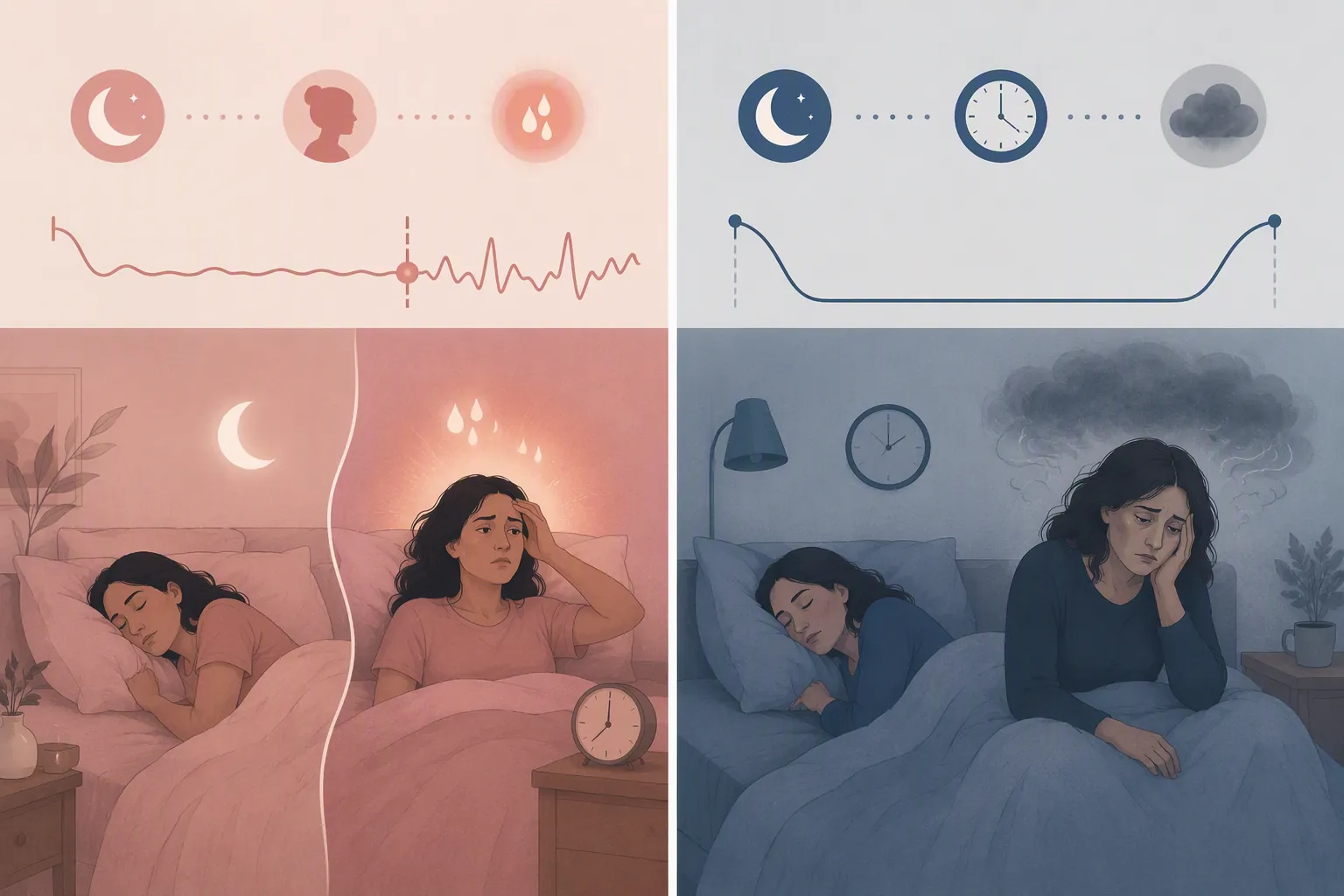
That is happening in a body that may already be dealing with perimenopausal sleep fragmentation: falling asleep reasonably well, then waking around the middle of the night, sometimes hot, damp, alert, and unable to settle again. The problem is not that one condition explains everything. It is that two sleep disruptors can overlap and make each other harder to read.

First, verify the recall without guessing
The recall was reported as a July 2026 FDA Class II recall involving Major Pharmaceuticals levothyroxine sodium tablets in strengths from 25 mcg through 150 mcg, with specific affected lots and expiration dates ranging from July 2026 through January 2027.[1][2] Because this is a recent recall, lot details and distribution information should be checked against the current FDA recall database rather than copied from a social post, an old screenshot, or memory.
The detail that matters for sleep is subpotency. Levothyroxine is replacement hormone; if the dose delivered is lower than prescribed, the body may drift toward undertreatment. That does not usually announce itself with one dramatic night. It can show up as a pattern: more sleep needed, less recovery from sleep, colder or heavier mornings, constipation, low mood, slower thinking, and daytime fatigue that feels different from ordinary poor sleep. Patient-facing recall guidance has emphasized contacting the pharmacy or prescriber and not self-correcting the dose.[3]
- Find the bottle you are actually taking from, not an older empty bottle.
- Compare the manufacturer, strength, lot number, and expiration date with the current FDA recall listing.
- Call the dispensing pharmacy if the label is unclear or if tablets were moved into a pill organizer.
- Tell your prescriber if you have already taken tablets from a possibly affected lot for several weeks.
- Do not double doses, stop levothyroxine, or “make up” for suspected weak tablets unless your clinician specifically instructs you to do so.
Two bad nights can feel similar. The pattern over a week is more useful.
Perimenopause and undertreated hypothyroidism both interfere with sleep, but they often leave different fingerprints. CeMCOR’s clinical guidance from Dr. Jerilynn Prior describes a common perimenopausal pattern as falling asleep, then waking in the middle of the night, often with night sweats. The same guidance contrasts this with a hypothyroid pattern of needing long sleep and still waking unrefreshed.[4] This is not a diagnostic rule proven by a large randomized trial. It is a practical clinical distinction, and in this situation it is useful because it tells you what to watch.
The perimenopause side of the story is common enough that it should not be dismissed. A 2025 narrative review of sleep disturbance in perimenopause cites SWAN data estimating that 37% of women ages 40 to 55 report difficulty sleeping.[5] That number is a population signal, not a way to diagnose your night at 3 a.m. Still, it explains why many women enter a thyroid medication problem already depleted.
| What you notice | Often points more toward | How it sounds in real life |
|---|---|---|
| You fall asleep, then wake in the middle of the night | Perimenopausal sleep fragmentation | “I’m awake at 3 a.m. again, hot and alert.” |
| Night sweats or heat surges come with the waking | Perimenopause-related vasomotor symptoms | “I wake up damp, then I can’t get comfortable.” |
| You sleep longer than usual but still feel unrefreshed | Possible undertreated thyroid pattern | “I slept nine hours and feel like I barely slept.” |
| Daytime fatigue feels heavy, slowed, or unusually hard to push through | Possible rising TSH or hypothyroid undertreatment | “This is not just sleepy. My body feels weighted.” |
| Both middle-of-night waking and unrefreshing long sleep are present | Overlap | “I wake at night, then need more sleep, then still drag all day.” |
That last row is the one to take seriously after a subpotent medication recall. A woman can wake from perimenopausal night sweats and also become progressively under-replaced on thyroid hormone. The result is not a clean symptom label. It is fragmented sleep plus poor recovery from whatever sleep she does get.
Use a sleep-and-dose log that your clinician can actually interpret
A useful log does not need wearable data or elaborate scoring. It needs timing, dose context, and next-day texture. The goal is to show whether the problem is mainly sleep fragmentation, insufficient thyroid replacement, or both while the recalled lot is being replaced and labs are being planned or reviewed.
| Track this | Why it matters |
|---|---|
| Levothyroxine strength, manufacturer, lot status, and whether the tablet came from the suspect bottle | Links symptoms to possible exposure instead of relying on memory |
| Dose time and any missed, delayed, or changed doses | Separates recall concerns from inconsistent dosing |
| Bedtime, estimated sleep onset, wake time, and final rising time | Shows whether total sleep opportunity is shrinking or expanding |
| Middle-of-night waking time and duration | Captures the perimenopause-style fragmentation pattern |
| Night sweats, heat surges, or waking damp | Adds context to awakenings rather than counting them as generic insomnia |
| Total sleep need and whether sleep felt restorative | Helps identify the long-but-unrefreshed pattern associated with hypothyroid sleep complaints |
| Daytime fatigue: wired, sleepy, heavy, slowed, or unrefreshed | Gives the prescriber better information than “tired” |
| Date of TSH and free T4 testing, if ordered or completed | Anchors symptoms to lab timing during restabilization |
Bring that log to the prescriber or send the key points through the patient portal. A short pattern is often more useful than a long complaint: “I confirmed a possibly affected lot, took it for several weeks, now wake at 3 a.m. with sweats three nights a week and need nine to ten hours but wake unrefreshed.” That sentence gives the clinician medication exposure, perimenopause-pattern symptoms, and possible undertreatment symptoms in one place.
Ask about TSH and free T4 rather than trying to read your thyroid from sleep alone
Sleep can alert you that something changed, but it cannot safely set your levothyroxine dose. The next medical question is usually whether your clinician wants TSH and free T4 checked now, repeated after replacement medication has been taken consistently, or interpreted alongside recent results. Sleep Foundation’s thyroid-sleep review notes that hypothyroidism can be associated with fatigue, increased sleepiness, and reduced sleep quality, while thyroid hormone levels require medical evaluation rather than guesswork.[6]
This is also why insomnia alone should not lead to dose improvisation. Too little thyroid hormone can leave you heavy and unrefreshed; too much can push symptoms in the other direction, including feeling overstimulated or unable to sleep. A recall can create anxiety, but the safest correction is still coordinated through the pharmacy, prescriber, replacement medication, and lab follow-up.
What to do while the medication problem is being corrected
The waiting period is the hard part: you may have confirmed the lot, called the pharmacy, messaged the prescriber, and still have several nights before the plan feels stable. During that window, the safest sleep supports are the ones that do not depend on knowing whether the main driver tonight is perimenopause, thyroid undertreatment, or both.
Keep the sleep schedule boring on purpose
Use a consistent wake time and a realistic bedtime rather than chasing sleep after one bad night. If you slept poorly, the temptation is to nap long, go to bed very early, or spend extra hours awake in bed hoping to recover. That can blur the pattern your clinician needs and may train the bed to become a place for wakeful monitoring.
Treat heat as a real sleep trigger
For the woman waking hot, damp, and alert, cooling is not cosmetic. A cooler bedroom, breathable layers, and a plan for changing damp sleepwear without turning on bright lights can shorten the disruption. Sleep Foundation’s perimenopause guidance discusses night sweats and hormone-related sleep disruption as common contributors during this transition.[7]
Use CBT-I principles before reaching for sedating products
Cognitive behavioral therapy for insomnia is a better first-line stabilizer here than a new over-the-counter sleep aid. It does not change thyroid hormone exposure, does not mask a recalled-dose problem, and can help reduce the conditioned wakefulness that builds after repeated 3 a.m. awakenings. The 2025 perimenopause sleep review discusses CBT-I as an effective behavioral treatment for insomnia in this life stage, and NCOA’s menopause sleep guidance also identifies CBT-I as a recommended non-drug approach.[5][8]
- If you are awake and increasingly frustrated, leave bed briefly for a quiet, dim-light activity, then return when sleepy.
- Keep clock-checking out of sight if it turns one awakening into an hour of threat-scanning.
- Avoid using alcohol as a sleep tool; it can worsen later-night waking.
- Keep mornings anchored with light exposure and a stable rise time, even after a rough night.
Be careful with OTC sleep aids
Adding a sedating antihistamine, supplement, or “menopause sleep” blend may feel like the fastest way to survive the week, but it can also muddy the symptom picture or create next-day grogginess that looks like worsening thyroid fatigue. With a recent levothyroxine recall in the background, check with your clinician or pharmacist before adding sedating products, especially if you have other medical conditions or take other medications.
When both patterns are present, do the cleanup in order
The order matters because sleep-deprived people are asked to make too many decisions. Start with the medication fact, then the body pattern, then the lab plan, then the sleep supports.
- Verify whether your current levothyroxine bottle matches the active recall information.
- Call the pharmacy for replacement instructions and documentation of the affected or unaffected lot.
- Notify the prescriber if you have symptoms of undertreatment, a confirmed affected lot, or uncertainty about how long you used it.
- Ask whether TSH and free T4 should be checked or repeated based on your exposure and symptoms.
- Track sleep timing, night sweats, unrefreshing sleep, daytime fatigue, and dose details until the pattern starts to settle.
- Use conservative sleep supports—CBT-I strategies, cooling, consistent timing—while avoiding dose changes or sedating add-ons unless medically cleared.
Once the lot is verified, the pharmacy and prescriber are involved, labs are planned or reviewed, and your log shows whether the nights are changing, you have enough structure to get through the stabilization window. Every bad night does not have to be blamed on menopause alone. Every heavy morning does not prove thyroid failure. The point is to stop guessing while your medication replacement and thyroid levels are brought back into view.
References
- Thyroid medicine levothyroxine recalled nationwide, says FDA — NewsNation
- Commonly Prescribed Thyroid Medication Recalled Nationwide, FDA Warns — Prevention
- Levothyroxine Recall 2026: A Primary Care Guide for Patients — Passion Health
- Perimenopause and Thyroid Problems—common and confusing — CeMCOR UBC
- Sleep Disturbance and Perimenopause: A Narrative Review — Troìa et al., 2025
- Could Your Thyroid be Causing Sleep Problems? — Sleep Foundation
- Perimenopause and Sleep: Causes and Solutions to Disruptions — Sleep Foundation
- Menopause and Sleep: What Every Woman Should Know — NCOA
Safety & eligibility read
Cross-check against other interventionsExplore the mechanism
Next step
Spot an error or have clinical feedback?
Because this article covers clinical, medication, or safety information, we use a moderated correction channel instead of open public comments. Let us know if something about “How the Levothyroxine Recall Disrupts Sleep in Perimenopause” needs a closer look.
Send feedback on this article