
How the Mediterranean Diet Improves Sleep in Perimenopause
Learn how the Mediterranean diet can improve sleep quality during perimenopause through three specific mechanisms—reducing hot flashes, supporting melatonin production, and lowering systemic inflammation—and why alcohol from the traditional diet may need to be adjusted for best results.
Perimenopausal insomnia is not just regular bad sleep arriving at an inconvenient age. The body is changing the rules: estrogen fluctuation, vasomotor symptoms, and inflammatory shifts can make sleep lighter, hotter, and easier to break. In the SWAN data, sleep disturbance affected 39–47% of perimenopausal women, compared with 16–42% of premenopausal women, which matters because it moves the problem out of the “maybe I’m just stressed” category and into a biologically recognizable transition. [1]
That is also why the case for the Mediterranean diet for sleep quality in perimenopause has to be more specific than “eat healthy.” The better argument is that Mediterranean-style eating maps onto several of the forces that commonly wake women in this stage: hot flashes and night sweats, unstable overnight blood sugar, inflammatory load, and the nutrient pathways involved in serotonin and melatonin production. The evidence is promising, but it is not finished. As of July 2026, the strongest support is still observational and mechanistic rather than a perimenopause-specific randomized trial showing that a Mediterranean diet directly treats perimenopausal insomnia.
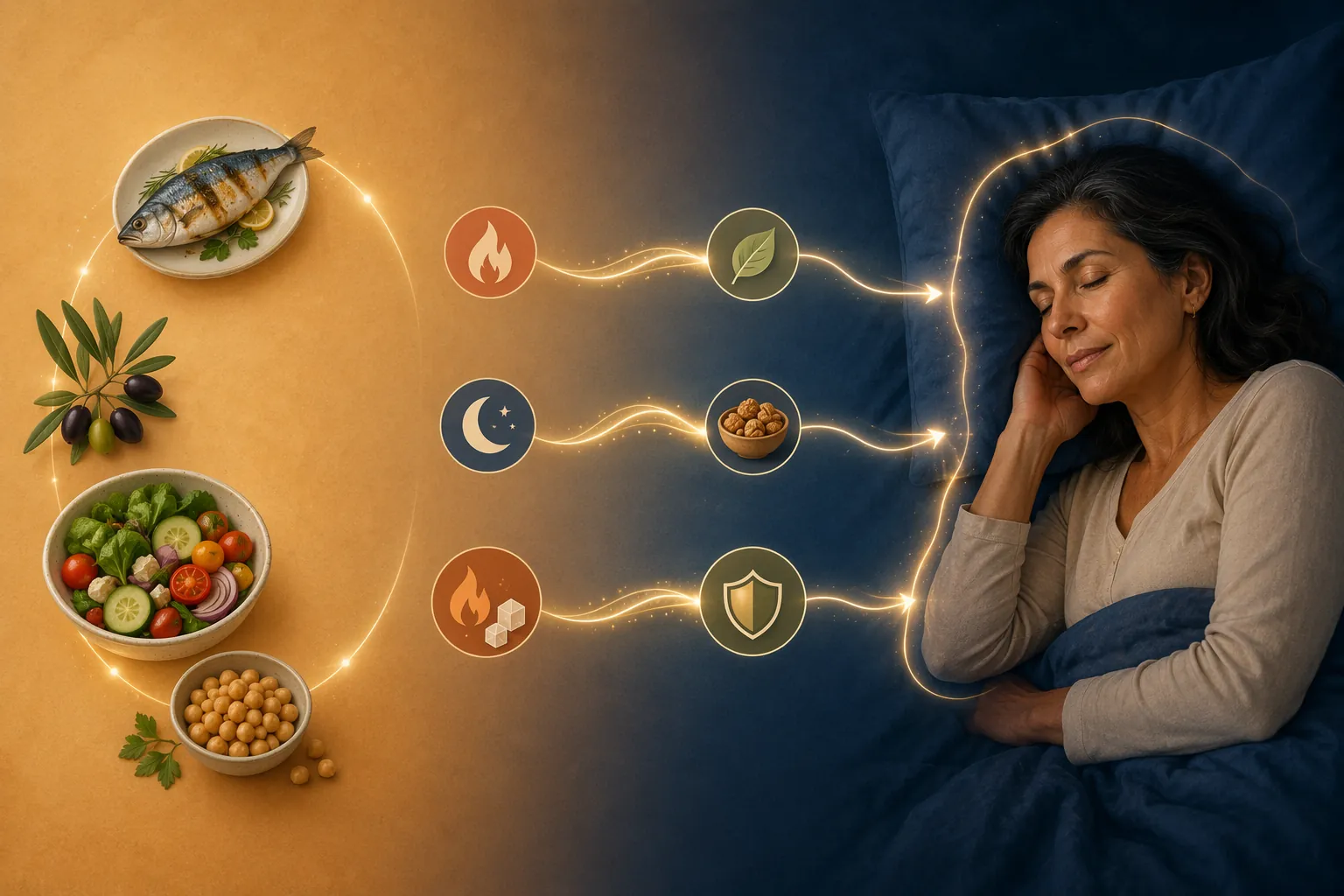
The diet pattern matters because the sleep problem is physiological
A Mediterranean-style diet, in the sleep literature, usually means more vegetables, fruit, legumes, fish, whole grains, nuts, olive oil, and unsaturated fats; less red and processed meat, sweets, and refined carbohydrates; and, in traditional scoring systems, sometimes moderate alcohol. That last part deserves its own scrutiny later. For now, the useful question is not whether this pattern sounds virtuous. It is whether the foods change the conditions under which sleep is trying to happen.
The best prospective evidence in women comes from Zuraikat and colleagues’ study of 432 US women in the American Heart Association Go Red for Women cohort. The sample was broad, ages 20–76, so it was not a perimenopause-only study. Still, it is important because diet quality was assessed before later sleep outcomes. Each 1-point increase in alternate Mediterranean diet score predicted 1.20% higher sleep efficiency at 1-year follow-up and lower Pittsburgh Sleep Quality Index scores, with a beta of −0.30 per point. [2]
Sleep efficiency is not a lifestyle-magazine abstraction. It is the share of time in bed actually spent asleep. A small percentage change can matter to a woman who is technically “in bed for eight hours” but awake at 2:40 a.m., damp from a night sweat, then awake again at 4:15 after a blood-sugar dip or bathroom trip. The Zuraikat findings do not prove that Mediterranean eating fixes perimenopausal insomnia, but they do give a stronger starting point than a loose association between “healthy diets” and “healthy sleepers.”
Hot flashes are not a side symptom when they keep breaking sleep
For many women, the first sleep complaint in perimenopause is not trouble understanding bedtime routines. It is heat. A woman falls asleep, then wakes suddenly overheated, sweating, alert, and annoyed. Even if she cools down quickly, the nervous system may not return to sleep on command. When this repeats across the night, sleep becomes fragmented even if total time in bed looks adequate.
This is where the Mediterranean pattern becomes more interesting. In a 2025 cross-sectional study of 149 women, those with the highest modified Mediterranean diet adherence had 80% lower odds of moderate-to-severe hot flashes and night sweats, with an odds ratio of 0.20. [3] That is a striking number, but it needs to be held carefully: the study was small, conducted in an Iranian population, cross-sectional, and used a modified Mediterranean diet score. It cannot tell us that changing dinner this month will reduce night sweats by that amount.
A larger cohort gives the signal more weight, though still not proof. In an Australian study of 6,040 midlife women, those following a Mediterranean-style diet were 20% less likely to report hot flashes and night sweats. [4] The smaller Iranian study and the larger Australian cohort do not settle causality, and they do not isolate perimenopausal sleepers in the way a targeted trial would. But they point in the same practical direction: a pattern rich in plant foods, legumes, fish, and unsaturated fats is associated with a lower vasomotor symptom burden.
The plausible mechanism is not mystical. Mediterranean-style eating tends to reduce inflammatory and oxidative stress exposures while increasing fiber, polyphenol-rich plant foods, and unsaturated fats. Some components, including legumes and other plant foods, may also contribute phytoestrogenic compounds, though the effect is not equivalent to hormone therapy and should not be described that way. For sleep, the most relevant point is simpler: fewer or less intense nighttime heat surges mean fewer forced awakenings.
This is also why a food strategy can be clinically useful even when it is not dramatic. If a woman is waking five times a night and two of those awakenings are tied to heat, reducing vasomotor burden may improve sleep continuity without needing to act like a sedative. The diet is not “making her sleepy.” It may be removing some of the reasons her body keeps waking her.
Tryptophan and melatonin: plausible support, not a guaranteed knock-out effect
The Mediterranean diet also supplies nutrients involved in the serotonin-to-melatonin pathway. Legumes and fish provide tryptophan, an amino acid precursor to serotonin and then melatonin. Vegetables contribute B vitamins involved in neurotransmitter metabolism. Olive oil, nuts, fish, and other unsaturated-fat sources help build a dietary pattern that supports metabolic and vascular function rather than pushing the body through sharp evening highs and lows.
The closest intervention evidence for the precursor idea is not actually a Mediterranean diet trial. In a randomized trial of tryptophan-enriched cereal in older adults, the enriched cereal improved sleep efficiency by 4.13%, increased total sleep time by 22.97 minutes, and reduced sleep latency by 12.53 minutes. [5] That is useful biologically, but it should not be oversold. An enriched cereal is a specific delivery vehicle in older adults, not proof that a lentil salad or fish dinner will produce the same measurable change in a perimenopausal woman.
Still, this pathway helps explain why Mediterranean-style meals are often a better sleep bet than restrictive evening eating or a high-sugar snack used as a fatigue rescue. The goal is not to chase one “sleep nutrient.” It is to give the brain and body a steady supply of the materials involved in sleep regulation while avoiding a dinner pattern that makes the night metabolically noisy.
The strongest practical leverage may be inflammation and glycemic load
The most useful part of the Mediterranean diet for perimenopausal sleep may be the least glamorous: it replaces high-glycemic, low-fiber meals with meals that digest more slowly and carry more anti-inflammatory compounds. That matters because perimenopause is already a period when sleep can become more sensitive to heat, stress hormones, and metabolic swings. A late plate of refined starches and sweets may not feel like a sleep decision, but it can become one at 3 a.m.
Zuraikat’s food-component findings are especially helpful here because they move beyond the overall Mediterranean score. In that cohort, legumes predicted 1.36% higher sleep efficiency per serving per 1,000 kcal. A higher monounsaturated-to-saturated fat ratio predicted 3.11% higher sleep efficiency per point. Plant protein predicted 0.99% higher sleep efficiency per gram per 1,000 kcal, and fiber predicted 0.33% higher sleep efficiency per gram per 1,000 kcal. Unsaturated fat was also linked with lower PSQI scores and shorter sleep onset latency, while fruit and vegetable intake predicted lower PSQI scores and fewer sleep disturbances. [2]
Those details are more actionable than the instruction to “eat Mediterranean.” They suggest that the sleep-relevant version of the pattern is built around beans, lentils, vegetables, fruit, fish, nuts, seeds, olive oil, and other unsaturated-fat sources—not simply adding olive oil to a refined-carbohydrate dinner and calling it done.
| Diet shift | Why it may matter for sleep |
|---|---|
| Swap a refined-starch dinner base for beans, lentils, or intact whole grains | Raises fiber and plant protein; may reduce overnight glycemic swings |
| Use olive oil, nuts, seeds, avocado, or fish more often than butter or high-saturated-fat meats | Improves the unsaturated-to-saturated fat profile linked with better sleep efficiency in women |
| Add vegetables and fruit consistently, not as a decorative side | Supports lower overall PSQI scores and fewer sleep disturbances in the prospective women’s cohort |
| Treat dessert-like evening snacks as possible sleep disruptors, especially if awakenings cluster after midnight | High-glycemic patterns have been linked with incident insomnia risk in postmenopausal women |
The counterpoint from glycemic research strengthens the case. In analyses from the Women’s Health Initiative, high glycemic index and glycemic load diets were identified as risk factors for incident insomnia in postmenopausal women. [6] Postmenopause is not perimenopause, but the finding is still relevant because it points to a sleep problem many midlife women recognize: the night goes badly after a meal or snack that looked harmless at the time.
A Mediterranean-style plate lowers the odds of that pattern in several ways at once. Fiber slows digestion. Protein and fat change the glucose curve of the meal. Legumes and intact grains usually produce a different metabolic response than white bread, sweets, or a bowl of low-fiber cereal. Vegetables increase volume and micronutrient density without forcing the body through a large refined-carbohydrate load. None of this requires perfection; it requires making dinner less likely to set up a second half of the night that the body cannot stabilize.
Inflammation belongs in the same conversation. A comprehensive review of the Mediterranean diet and sleep describes plausible links through anti-inflammatory, antioxidant, and gut-microbiota-modulating mechanisms, and also notes that higher Mediterranean adherence was inversely associated with insomnia symptoms in women, with an odds ratio of 0.80, but not in men, in the Three City Study. [7] That sex difference should not be stretched into a perimenopause-specific conclusion, but it does fit the broader observation that women’s sleep can be particularly responsive to biological transitions and inflammatory load.

What this looks like at dinner, not in theory
The sleep-focused version of Mediterranean eating does not need to start with an elaborate meal plan. It starts with the parts of the pattern most likely to change the night: legumes several times a week, fish when possible, olive oil or other unsaturated fats in place of heavier saturated-fat defaults, vegetables in real portions, fruit earlier or with meals rather than as a sugar-only evening snack, and fewer refined carbohydrates at dinner.
A practical plate might be salmon or sardines with vegetables and lentils; chickpeas with greens, olive oil, herbs, and a smaller portion of intact grains; or a bean-and-vegetable soup with nuts or yogurt earlier in the evening. These are not magic combinations. They are ways to build the components that showed sleep-relevant signals in women—fiber, legumes, plant protein, unsaturated fat, fruits, and vegetables—without adding another complicated task to an already tired person’s day.
The timing may matter too, though the evidence does not establish a precise perimenopausal dinner cutoff. The reasonable clinical move is to avoid making the last meal of the day both heavy and high-glycemic. If night sweats are the main problem, alcohol and spicy or very heavy meals may deserve attention. If awakenings feel wired, hungry, or shaky, the refined-carbohydrate load at dinner and dessert is worth examining. If sleep onset is the issue, caffeine timing, alcohol, and evening light still matter; Mediterranean eating is not a substitute for every other sleep lever.
The wine problem
The traditional Mediterranean diet is often presented with moderate red wine, usually with meals. For heart-diet conversations, that detail has long been treated as part of the cultural package. For perimenopausal sleep, it is not so tidy.
In the Zuraikat women’s cohort, alcohol showed a trend toward worse PSQI scores and was associated with longer sleep onset latency, with a beta of 0.33 minutes per percent of calories from alcohol. [2] That does not prove that one glass of wine ruins every woman’s sleep. It does mean alcohol should not be treated as an essential Mediterranean sleep food, especially for someone dealing with night sweats, delayed sleep onset, or repeated awakenings.
This is the honest tension: a dietary pattern can be broadly Mediterranean while leaving wine out. For a woman whose sleep has become heat-sensitive or fragmented, alcohol is a reasonable first adjustment rather than a sacred part of the plan. If this is the pattern you notice—wine feels relaxing at 9 p.m. but the night becomes lighter, hotter, or more broken—this deeper discussion of why alcohol before bed can worsen sleep quality in perimenopause is the more relevant guide than any romantic idea of the Mediterranean dinner table.
How much confidence should you put in this?
Enough to treat Mediterranean-style eating as a credible non-hormonal strategy, not enough to treat it as a proven insomnia treatment. The strongest prospective data show that higher Mediterranean adherence predicted better sleep quality in women over 1 year, but the cohort was not limited to perimenopause. [2] The hot-flash studies are encouraging, including one large midlife cohort and one small cross-sectional study with a striking odds ratio, but they cannot prove that the diet caused the symptom differences. [3][4]
That still leaves a useful clinical judgment. Mediterranean-style eating is unusually well matched to perimenopausal sleep because it does not rely on one narrow sedating effect. It may reduce vasomotor burden, support serotonin–melatonin biology, improve the fiber and unsaturated-fat profile of the diet, and lower glycemic disruption. Those are the right targets for a life stage in which sleep is often being broken from inside the body, not merely disturbed by poor habits.
The most defensible version is also the least theatrical: more legumes, vegetables, fruit, fish, olive oil, nuts, seeds, and fiber-rich carbohydrates; fewer refined high-glycemic evening foods; and wine treated as optional, especially when hot flashes, night sweats, or sleep fragmentation are present. The promise is not a perfect night. It is a food pattern that lines up with the physiology of why sleep changed.
References
- Effects of Sleep Problems During Menopause — SWAN Study.
- A Mediterranean Dietary Pattern Predicts Better Sleep Quality in US Women from the American Heart Association Go Red for Women Strategically Focused Research Network — Nutrients, 2020.
- Association between modified mediterranean diet score and menopause-specific quality of life and symptoms — Scientific Reports, 2025.
- Fruit, Mediterranean-style, and high-fat and -sugar diets are associated with the risk of night sweats and hot flushes in midlife — The American Journal of Clinical Nutrition, 2013.
- Tryptophan-enriched cereal intake improves nocturnal sleep, melatonin, serotonin, and total antioxidant capacity levels and mood in elderly humans — Age, 2013.
- High glycemic index and glycemic load diets as risk factors for insomnia: Analyses from the Women's Health Initiative — The American Journal of Clinical Nutrition, 2020.
- Mediterranean Diet on Sleep: A Health Alliance — 2022.
Explore the mechanism
Next step
Spot an error or have clinical feedback?
Because this article covers clinical, medication, or safety information, we use a moderated correction channel instead of open public comments. Let us know if something about “How the Mediterranean Diet Improves Sleep in Perimenopause” needs a closer look.
Send feedback on this article