
Why Terminal Illness Disrupts Sleep and What You Can Do
Sleep disruption affects 60–70% of people with advanced illness, driven by physical symptoms, anxiety, medication effects, and the caregiving environment. This article explains the causes and offers evidence-based strategies for patients and families.
When terminal illness disrupts sleep, the usual advice can feel almost insulting. A person may be exhausted and still unable to rest because pain wakes them, breathing feels uncertain, the bathroom is suddenly too far away, or the quiet hours make unfinished conversations impossible to avoid. A caregiver may be just as tired and still afraid to sleep deeply, because the patient might call out, fall, vomit, become breathless, or die while no one is awake.
This is common, and it is not well explained by poor bedtime habits. In advanced cancer populations, 62% to 70% of patients have poor sleep quality on the Pittsburgh Sleep Quality Index, and up to 60% of hospice patients meet criteria for insomnia.[1] Those numbers come mostly from cancer research, so they should not be stretched too confidently across every terminal diagnosis. But they are enough to make one point plainly: terminal illness sleep issues are not a private failure of discipline.
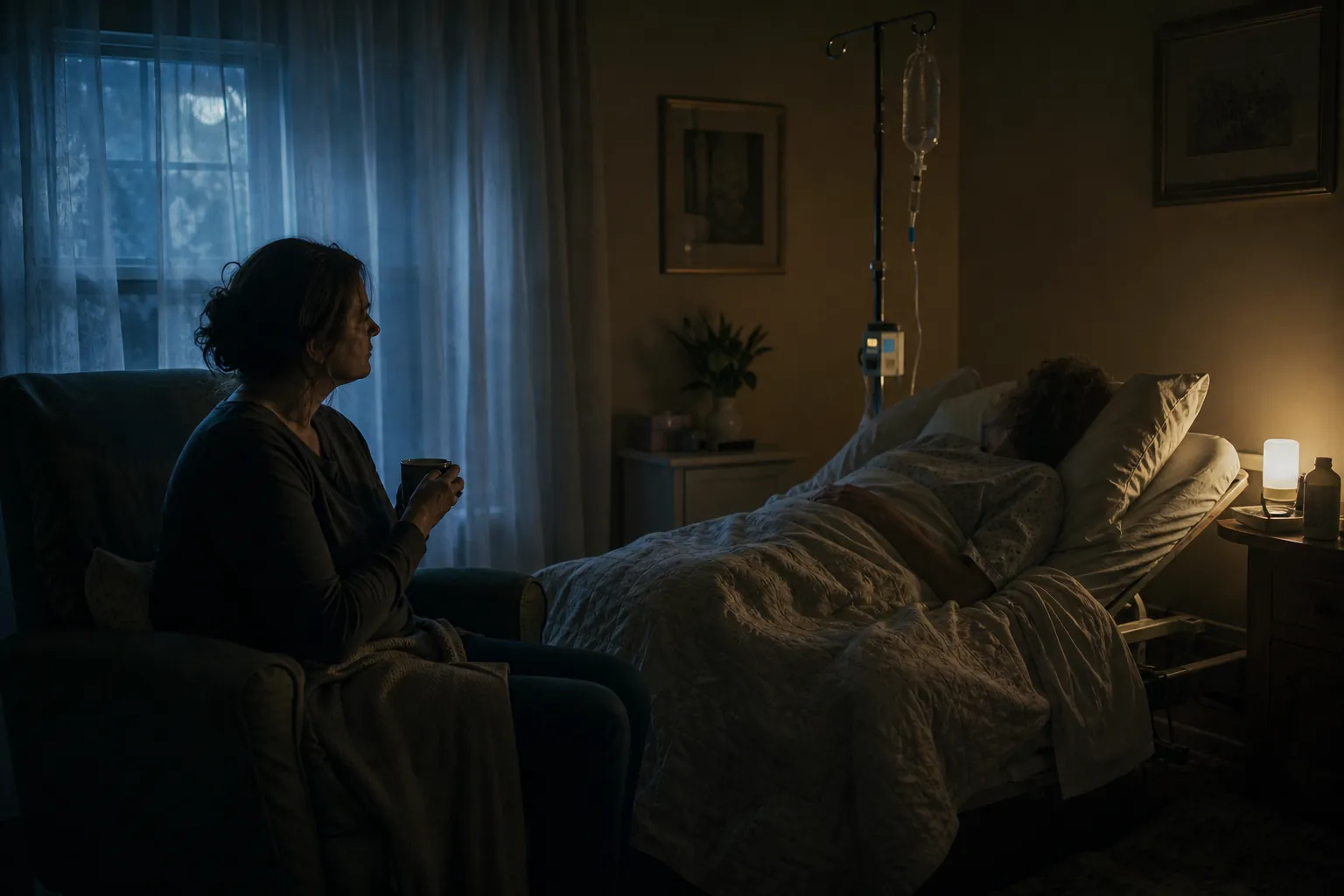
There is also an important boundary families can miss. Near the end of life, increased sleeping can be part of the body’s natural shutting-down process. That is different from distressing insomnia, fragmented sleep, fear-driven wakefulness, or symptom-driven waking that leaves someone suffering through the night. More sleep is not always a problem to fix. Less peace is.
What Usually Breaks Sleep at the End of Life
End-of-life sleep problems tend to cluster into three broad patterns: insomnia, sleep-wake cycle disruption, and excessive daytime sleepiness.[1] The labels are useful only if they lead to a better question: what is actually keeping this person awake, waking them repeatedly, or making their days and nights reverse?
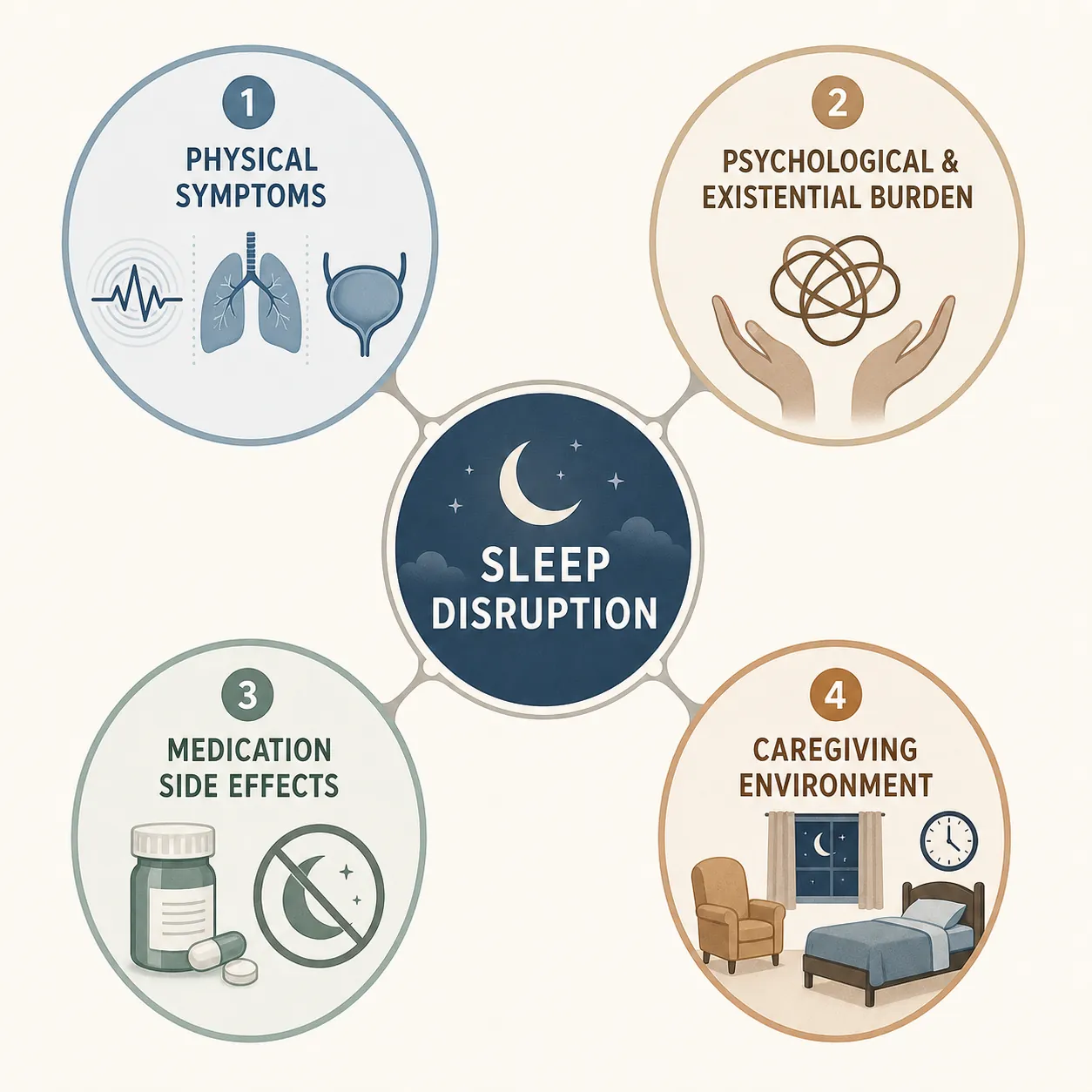
The drivers are often tangled together. Pain makes sleep shallow. Shallow sleep makes fear easier to feel. A new medication changes alertness or urination. A caregiver starts checking every sound. By midnight, nobody in the room is dealing with a simple insomnia problem anymore.
| Driver | How it can show up at night | Who can help |
|---|---|---|
| Physical symptoms | Pain, breathlessness, coughing, nausea, itching, sweating, urinary frequency, difficulty repositioning | Hospice or palliative clinician, nurse, pharmacist, respiratory therapist when involved |
| Psychological and existential distress | Fear, unfinished business, anxiety about dying, guilt, grief, worry about suffering or being alone | Palliative care team, social worker, chaplain, therapist, trusted clinician |
| Medication effects | Daytime sedation, nighttime alertness, nightmares, confusion, frequent urination, drug interactions | Prescribing clinician, hospice nurse, pharmacist |
| Caregiving environment | Alarms, lights, equipment, caregiver checking, patient fear of being unattended, caregiver fear of missing a call | Hospice team, nursing support, family system, respite services when available |
Physical Symptoms Are Often the First Sleep Treatment Target
In one review, 60% of advanced cancer patients attributed insomnia to uncontrolled physical symptoms, predominantly pain and urinary frequency.[1] That finding matters because it changes the task. A person waking every hour to urinate, or lying rigid because turning hurts, does not need a lecture about screens. They need a symptom review.
Pain can become more noticeable at night because there are fewer distractions and longer stretches between medication checks. Breathlessness can worsen with position, anxiety, secretions, or underlying lung or heart disease. Urinary frequency can come from the illness itself, medications, fluids, infection, diabetes, kidney issues, prostate symptoms, or practical barriers such as needing help to reach the bathroom. Nausea, itching, sweating, constipation, diarrhea, restless legs, and pressure discomfort can all turn sleep into a sequence of small emergencies.
A useful overnight log does not need to be elaborate. For two or three nights, if that is tolerable, note the time of waking, what seemed to wake the person, what helped, and whether the problem returned before morning. The point is not to create homework for an exhausted family. It is to give the hospice or palliative team enough detail to adjust the right thing: timing of pain medication, a rescue dose plan, toileting support, a bedside commode, repositioning, oxygen or fan use when appropriate, antinausea timing, bowel management, or a different plan for secretions.
The most important sentence to say to the clinical team is often very plain: “This symptom is waking them.” If the patient is grimacing at 2 a.m., gasping at 3 a.m., or too anxious to lie flat after dark, report that as a symptom-control problem, not merely as insomnia.
The Night Also Holds What People Do Not Say in Daylight
A study of terminal oncology patients with insomnia in a Spanish palliative care unit found that 87.5% reported worries that actively prevented sleep. Every patient in the study expressed concern about “having unfinished business,” and the most intense concern was “possible suffering during the process,” rated 9.3 out of 10.[2] The study population was predominantly older and male, with a mean age of 74.4 years and 68.3% men, so it should not be treated as a universal portrait of all dying people.[2] Still, the finding names something families often feel but cannot easily organize: the dark can become the hour when the future arrives all at once.
These worries are not always abstract. A patient may be afraid of suffocating, losing control, leaving conflict unresolved, burdening a spouse, not saying goodbye, being forgotten, or being alone when death comes. Some of these fears call for medication or symptom planning. Some call for social work, chaplaincy, a family meeting, a letter, a phone call, or a promise that someone will explain what dying is likely to look like.
The same study found a painful perception gap: relatives significantly underestimated patient concerns about dying alone, saying goodbye, and having had a positive effect on others.[2] Loving someone does not automatically make their private fears visible. A family can be present in every practical way and still miss the worry that is doing the most damage at night.
It can help to ask narrower questions than “Are you anxious?” A better opening might be: “Is there one thing that keeps coming back when the house gets quiet?” or “Are you worried about pain, breathing, being alone, or something left unsaid?” If the answer is yes, the next step is not to force reassurance. It is to decide who should be brought into the room: the hospice nurse for symptom fears, the physician or nurse practitioner for medication planning, the social worker for family strain and practical decisions, the chaplain for spiritual distress, or a therapist when available.
General anxiety sleep tools can still be useful, but they need softening. Scheduled worry time, for example, may be adapted into a brief late-afternoon conversation where the patient names the concern most likely to return overnight and the family writes down the plan. Relaxation techniques, such as slow breathing or progressive muscle relaxation, may help some people if they do not worsen breathlessness or pain. For readers looking for a general explanation of nighttime anxiety strategies, this guide to what to do when anxiety keeps you up at night may be useful, but terminal illness changes the stakes and the safety limits.
Medication Can Help or Hurt Sleep
Many people near the end of life take several medications, and any sleep conversation should include a medication review. Some drugs may cause sedation in the day and wakefulness at night. Others may contribute to vivid dreams, confusion, agitation, urinary frequency, dry mouth, constipation, or falls. Even helpful medications can create timing problems if their strongest effect arrives at the wrong hour.
Families should not stop or rearrange prescribed medications on their own, especially opioids, benzodiazepines, steroids, diuretics, antipsychotics, antiseizure drugs, antidepressants, or medications for heart and lung disease. The safer question for the hospice or palliative team is: “Could any medication or dosing time be worsening nights or days?” A pharmacist can be especially helpful when the list is long.
Sometimes the answer is not a new sleeping pill. It may be moving a stimulating medication earlier, adjusting a diuretic schedule if clinically appropriate, treating constipation, clarifying when to use rescue medication, or deciding that daytime sleepiness is an acceptable tradeoff for better pain or breathlessness control. These are individual decisions, and in the United States they need to fit the patient’s diagnosis, prognosis, fall risk, delirium risk, respiratory status, goals of care, and medication labeling.
The Caregiver’s Sleep Is Part of the Clinical Picture
Home hospice can move the center of care into a bedroom, but it also moves night watch into the family. In research on in-home hospice caregivers, 73% reported profound sleep problems, and none rated their sleep as “excellent.”[3] Live-in caregivers had significantly higher depression and anxiety than caregivers who did not live with the patient.[3] The underlying caregiver trial samples were mostly female and majority White, so the findings may not capture every cultural or household pattern.[4] Still, the mechanism is easy to recognize: someone is listening all night.
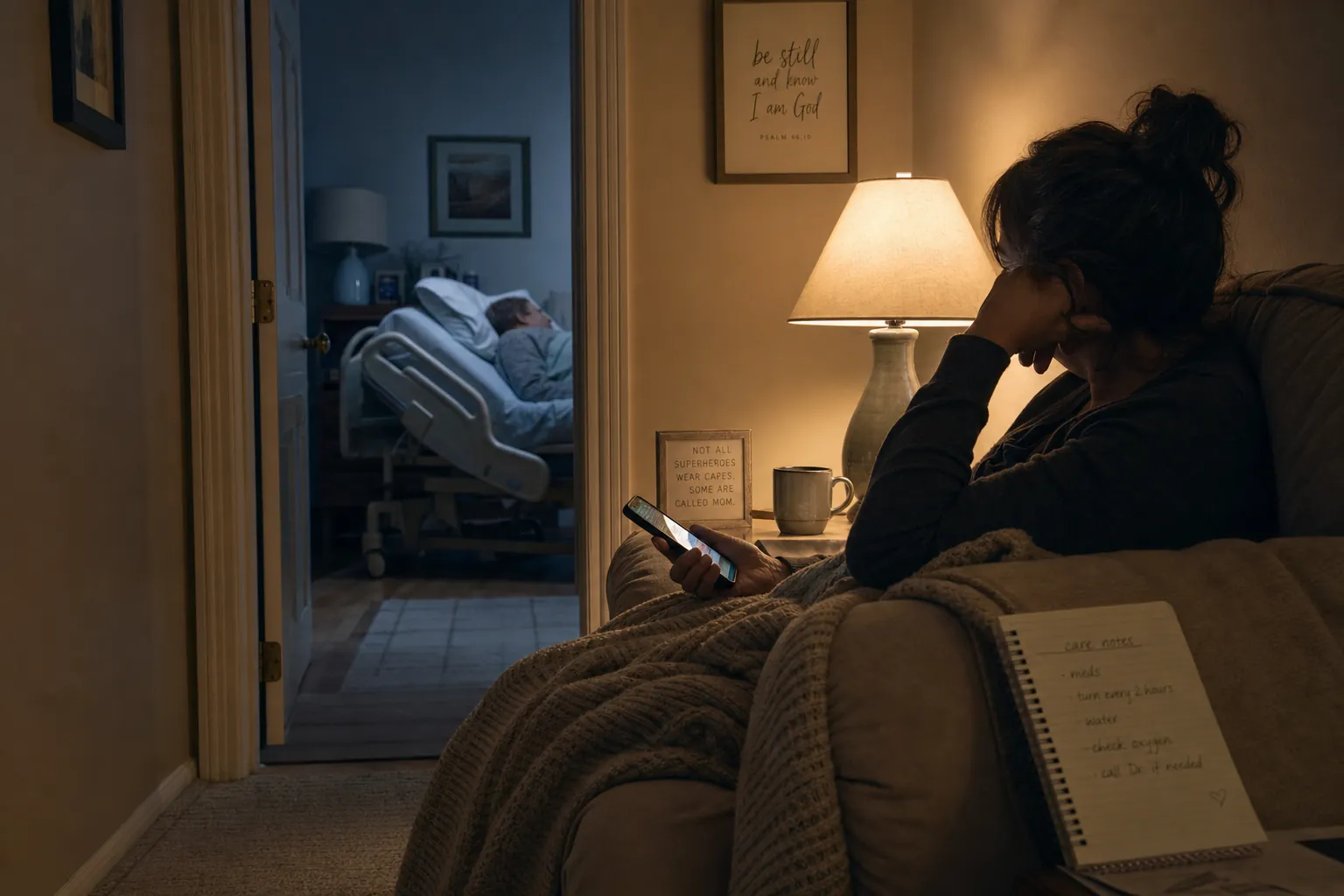
One caregiver in the study put it directly: “I didn’t take any medication because I was afraid my mom would need me and I wouldn’t hear her.”[3] That is not irrational resistance to care. It is a safety calculation made by someone who believes sleep could make them unavailable at the worst moment.
A caregiver’s sleep plan therefore has to address vigilance, not just insomnia. If the only plan is “try to rest,” the person on the couch will keep one ear open until morning. More useful adjustments are concrete: a bell or baby monitor that actually works, a medication schedule written clearly enough that another adult can take a shift, a bedside commode to reduce urgent transfers, a nightlight path, absorbent products if appropriate, and a hospice number placed where no one has to search for it at 3 a.m.
When possible, families should divide the night by responsibility rather than by vague goodwill. One person sleeps from 10 p.m. to 2 a.m.; another covers 2 a.m. to 6 a.m. A relative who cannot provide bedside care may still handle the morning pharmacy call, laundry, meals, insurance paperwork, or sitting with the patient while the primary caregiver naps. The goal is not fairness in the abstract. It is to prevent one person from becoming the silent nighttime medical system.
Sleep disruption may also persist after death. In the same caregiver research, 78.6% of bereaved caregivers reported continued sleep disruption after the patient died.[3] That can be grief, habit, trauma, anxiety, or the body’s difficulty standing down after weeks or months of alertness. If sleep remains severely disrupted in bereavement, it deserves care rather than embarrassment.
What Can Actually Be Done Tonight and This Week
Non-drug approaches are generally treated as first-line for sleep problems in serious illness, but they need to be adapted to the patient’s condition rather than copied from standard sleep hygiene lists.[5][6] A fixed wake time may be irrelevant for someone whose body is shutting down. Strict screen avoidance may matter less than a final video call with a grandchild. The useful version is smaller and more clinical: reduce avoidable awakenings, make symptoms easier to treat, and lower fear enough that rest is possible.
- If pain is waking the patient, ask whether the overnight medication plan matches the timing of the pain.
- If breathlessness is worse lying flat, ask about positioning, fan use, medications, oxygen if prescribed, and what to do during a breathless episode.
- If urination is the problem, ask about fluid timing, medication timing, infection symptoms, bedside equipment, and safer transfers.
- If fear is the problem, ask for a plan that names what suffering might look like and what the family should do.
- If the caregiver cannot sleep because they are listening for trouble, build a call system and a shift plan before discussing sleep aids.
The room can be changed, but not as décor advice. Light should be enough for safe care without making every awakening feel like an alarm. Supplies should be reachable. The path to the bathroom or commode should be clear. The patient should not have to choose between calling for help and preserving a caregiver’s sleep. A written overnight plan can reduce panic: what medication can be used, when to call hospice, what symptoms are expected, and what symptoms are urgent.
Some behavioral insomnia tools can be used selectively. Stimulus control, often taught as leaving bed if unable to sleep, may be unrealistic or unsafe for a weak patient. A modified version might mean changing the mental task while staying safely positioned: listening to a familiar voice recording, a prayer, quiet music, a breathing exercise, or a short reassurance script that names the plan for pain or breathlessness. Relaxation should stop if it increases air hunger, dizziness, panic, or pain.
When to bring in the hospice or palliative team
Call the hospice or palliative team when sleep disruption is new, suddenly worse, tied to uncontrolled pain or breathlessness, accompanied by confusion or agitation, linked to falls or unsafe transfers, or leaving the caregiver unable to function. Also call when the family does not understand what dying may look like. Uncertainty itself can keep a house awake.
Different professionals solve different parts of the night. A nurse may notice that pain medication wears off before dawn. A physician or nurse practitioner may adjust a medication or diagnose delirium. A pharmacist may identify a timing problem or interaction. A social worker may help arrange respite or family coverage. A chaplain may be the right person for fear, guilt, meaning, or goodbye. Sleep care at the end of life is rarely one intervention.
Where Sleep Medication Fits
Medication can be appropriate, especially when insomnia is severe, distressing, and not relieved by treating obvious drivers. Guidance for serious illness commonly places non-pharmacological approaches first and reserves pharmacological options for careful, usually short-term use.[5][6] Options may include melatonin, short-acting benzodiazepines, or non-benzodiazepine hypnotics, but the right choice depends heavily on the person’s condition, other medications, breathing status, delirium risk, fall risk, liver and kidney function, and goals of care.
This is especially important in U.S. care, where prescribing needs to follow FDA labeling, clinical judgment, and hospice or palliative protocols. A medication that is reasonable for one patient may be dangerous for another. Sedatives can worsen confusion, falls, respiratory suppression, or paradoxical agitation in some people. They can also make caregivers more frightened if the patient becomes harder to rouse. The decision belongs with the prescribing clinician, ideally with the family saying clearly what they are trying to solve: sleep onset, repeated waking, panic, breathlessness, pain, agitation, or caregiver exhaustion.
Caregivers also deserve a medication conversation of their own. Some may safely use a sleep aid when another responsible person is covering the patient. Others may not have that backup, or may reasonably decide that medication would make them too unavailable. The better fix may be respite, a night shift from family, clearer hospice instructions, or equipment that makes calling for help reliable.
A Less Punishing Night Is a Real Goal
Sleep may not become normal again in terminal illness. That is a hard truth, but not a reason to accept every bad night as inevitable. If the patient is awake from pain, breathlessness, urination, fear, medication effects, or the terror of being unattended, those are signals. They can be brought to the team. They can be named in the family. They can often be made less severe.
The question is not whether the household can perform perfect sleep hygiene while someone is dying. The question is whether the night can be made less painful, less frightening, and less solitary. That is clinical care. It is also comfort, and comfort is not a small matter.
References
- Sleep disorders in advanced cancer, Clinical Medicine, 2019.
- Nocturnal concerns in patients with terminal cancer and insomnia in a palliative care unit: A cross-sectional study, 2021.
- Family Caregivers of Home Hospice Patients Struggle with Sleep, Penn LDI, 2022.
- Sleep Disturbance in Family Caregivers of Patients Receiving Hospice Care at Home.
- Sleep problems, Marie Curie.
- 7 Ways to Improve Your Sleep When Living with a Serious Illness, GetPalliativeCare.
Explore the mechanism
Next step
Spot an error or have clinical feedback?
Because this article covers clinical, medication, or safety information, we use a moderated correction channel instead of open public comments. Let us know if something about “Why Terminal Illness Disrupts Sleep and What You Can Do” needs a closer look.
Send feedback on this article