
The cruel part of anxiety insomnia is that the more carefully you monitor sleep, the less sleep feels available. You lie still, check whether your body is relaxing, notice that it is not, calculate what tomorrow will cost, and then try harder. To the brain, that effort can look less like rest and more like a problem that needs vigilance.
That is why the useful answer to “what should I do when anxiety keeps me from sleeping?” is not only “make the room cooler” or “avoid caffeine.” Those can matter, but anxiety-driven sleeplessness is often a hyperarousal problem: anxiety keeps wake-promoting systems active, and lying in bed while rehearsing danger can teach the body that bed is a place for alertness rather than sleep.[1]

This is common enough that nobody needs to treat it as a personal failure. In a 2024 American Academy of Sleep Medicine online survey of 2,006 U.S. adults, 68% said they lose sleep because of anxiety and 74% said they lose sleep because of stress.[2] That survey does not mean most people have clinical insomnia; it is self-reported scale-setting. But it does show how many adults recognize the same pattern: the day ends, the threat system does not.
What anxiety is doing to your sleep
Sleep is not something you can force by concentrating. It arrives more easily when the body stops receiving cues that something important is being checked, solved, prevented, or monitored. Anxiety sends the opposite signal. The mind scans for unfinished tasks. The body may stay tense. The heart may feel louder. A harmless noise becomes evidence that sleep is slipping away.
Over time, the bed itself can get pulled into that loop. Cleveland Clinic describes sleep anxiety as fear or worry about going to sleep, staying asleep, or what will happen if sleep does not come; that fear can weaken the bed-sleep connection and strengthen a bed-worry connection instead.[3] This is the reason behavioral insomnia treatment spends so much attention on what you do in bed, not just what you do before bed.
The goal tonight is not to win an argument with every thought. It is to stop giving the anxious brain the exact training conditions it needs: darkness, stillness, pressure, and repeated proof that bed equals struggle.
Before bed: give worry a scheduled place to go
If worry always begins after the lights go out, do not wait until then to handle it. Scheduled worry time is a CBT-I-adjacent technique that moves problem review out of the sleep window. NPR’s 2026 Life Kit feature describes setting aside 10 to 15 minutes during the day or evening to write worries down and separate what can be acted on from what cannot be solved tonight.[4]
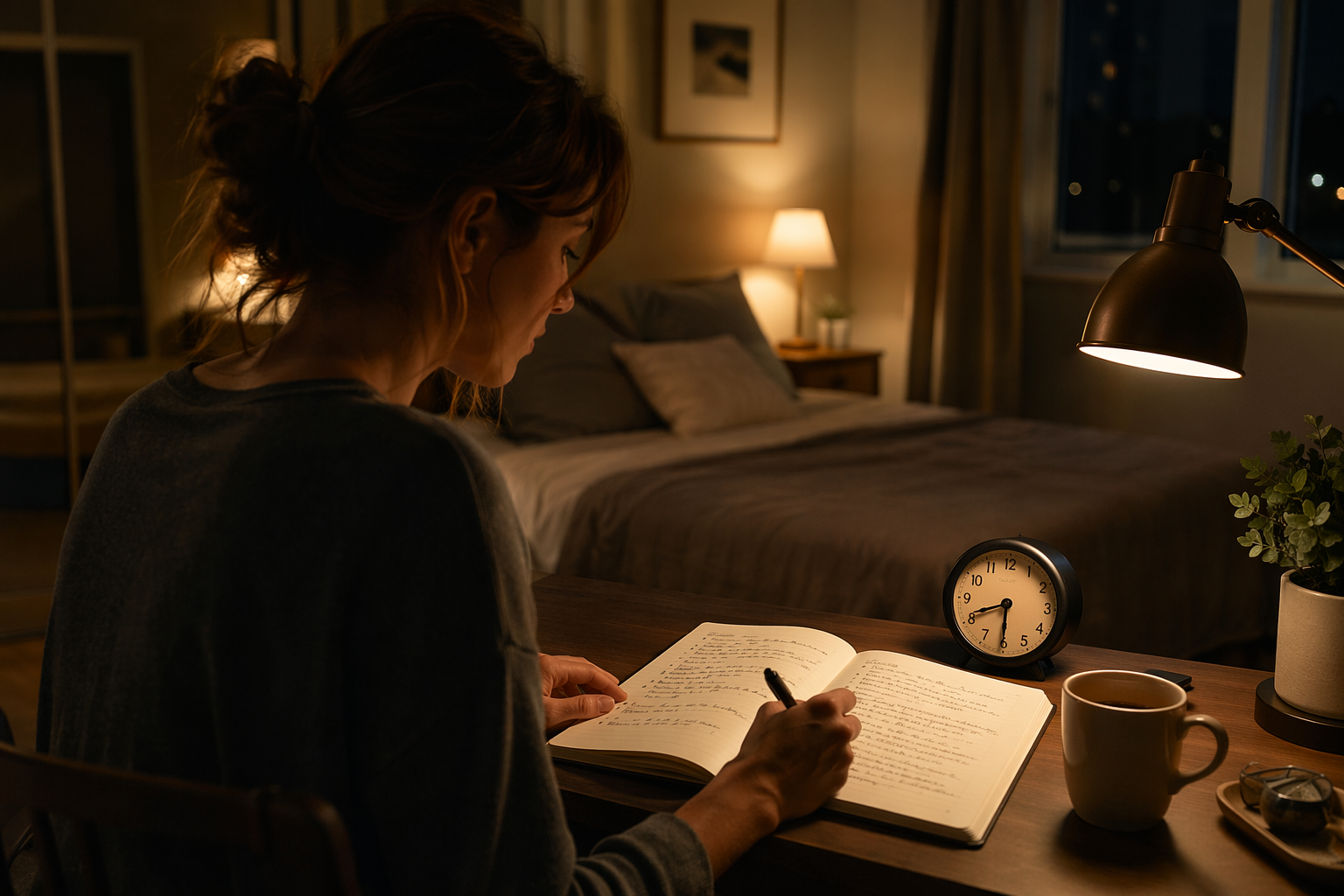
This is not pretending your worries are silly. It is the opposite. It treats them as important enough to receive a defined appointment instead of letting them take over the one part of the night when you have the least practical power.
- Write the worry in plain language: “I’m afraid I’ll miss the deadline,” not “everything is falling apart.”
- Add the next concrete action if one exists: send the file, ask for clarification, make a list, set an alarm.
- If no action exists tonight, label it as something to revisit during tomorrow’s worry time.
- End by closing the notebook, app, or document. The closing matters because it gives the brain a boundary.
The first few nights may feel artificial. That is fine. You are not trying to empty the mind permanently. You are giving it a repeatable cue: this material has a place, and the bed is not that place.
In bed: stop measuring whether sleep is happening
Once you are in bed, the most useful move is often subtraction. Do not keep checking the time. Do not test whether you feel sleepy every few seconds. Do not run a mental audit of how much sleep is left. These behaviors feel responsible, but they keep attention attached to performance.
Sleep scientist Aric Prather has compared sleep to a balloon: hold it lightly and it can stay with you; squeeze it and it slips away.[4] That analogy is useful because it explains why effort backfires without blaming you for making the effort. Of course you are trying. Tomorrow has consequences. The problem is that the sleeping brain does not respond well to being supervised.
If a thought shows up, answer it briefly and return attention to something low-stakes: the feeling of the mattress, a neutral phrase, or slow breathing. If the thought demands a full meeting, remind yourself that it has already been assigned to worry time. You are not refusing to care. You are refusing to hold the meeting in bed.
If you are awake about 20 minutes, leave the bed
This is the instruction people resist most, and understandably so. Leaving bed can feel like admitting defeat. In CBT-I logic, it is closer to protecting the bed. The 20-minute rule is a stimulus control technique: if you are awake and alert in bed for roughly 20 minutes, get up, go somewhere dim and quiet, do something calm, and return only when you feel sleepy again.[4]

Do not turn this into a clock-watching exercise. “About 20 minutes” means you have been awake long enough to feel stuck, frustrated, or wired. The exact minute matters less than the pattern: bed is for sleep and sex, not extended anxious wakefulness.
| If this is happening | Do this | Why it helps |
|---|---|---|
| You are awake, tense, and mentally rehearsing consequences | Leave the bed and sit somewhere dim | It interrupts the bed-worry pairing |
| You are tempted to solve tomorrow’s problem | Write one reminder for scheduled worry time, then stop | It gives the thought a destination without rewarding rumination |
| You feel sleepy again | Return to bed without checking the time | It rebuilds the bed-sleep connection |
| You become alert again | Repeat the same process | Consistency matters more than one perfect night |
Choose the out-of-bed activity carefully. Read something familiar. Fold a small amount of laundry. Listen to something quiet. Keep lights low. Avoid anything that gives your brain a reward for being awake: work email, social feeds, intense news, shopping, or a show that keeps starting another episode.
The first night you do this, you may spend more time out of bed than you expected. That does not mean it failed. The immediate aim is not to manufacture sleep on command. It is to stop spending long stretches awake in the place you are trying to make safe for sleep.
When the thought is catastrophic, make it more accurate
An anxious sleep thought usually sounds absolute: “I’ll never fall asleep.” “Tomorrow is ruined.” “If I don’t sleep now, I won’t function.” You do not have to replace these with cheerful lies. The useful replacement is more accurate and less activating.
Beck Institute gives examples of reframing nighttime thoughts, such as replacing “I’ll never fall asleep” with “I always fall asleep eventually; in the meantime, I can rest my body.”[6] The second thought does not promise a perfect night. It removes the emergency siren.
| Anxious thought | More accurate replacement |
|---|---|
| If I do not sleep soon, tomorrow will be impossible. | Tomorrow may be harder, but I have handled tired days before. |
| I am the only one who cannot do this. | Many people lose sleep when stress or anxiety is high. |
| My body has forgotten how to sleep. | My body is alert right now; sleep pressure can still build. |
| I need to solve this before I can rest. | I have a time set aside to deal with this when I can actually act. |
Keep the replacement short. A long debate at 2 a.m. is still a debate. The point is to reduce threat, not to litigate the entire future.
Use relaxation as a downshift, not a sleep command
Relaxation techniques earn their place when they target arousal. Johns Hopkins Medicine describes stress-relief techniques such as progressive muscle relaxation and gentle breathing as ways to lower stress hormones including cortisol and adrenaline; its progressive muscle relaxation protocol takes about 20 to 25 minutes.[5]
Try this either before bed or during an out-of-bed reset, not as a test you perform under pressure while thinking, “This had better work.”
- Start at your feet and gently tense one muscle group for a few seconds.
- Release the tension and notice the contrast without forcing a special feeling.
- Move upward through calves, thighs, hands, arms, shoulders, jaw, and face.
- Pair the release with slow, easy breathing.
- If you become sleepy, stop the exercise and return to bed.
Breathing can be even simpler: lengthen the exhale slightly and let the next inhale arrive without grabbing for it. If counting your breaths makes you more alert, drop the counting. A technique that turns into performance is no longer serving the night.
The next few days: repeat the pattern at the same points
The same-night protocol is useful because it gives you something to do when anxiety is already loud. The next several days matter because insomnia is learned through repetition, and it is unlearned the same way.
| When | Action |
|---|---|
| Daytime or early evening | Hold 10 to 15 minutes of scheduled worry time. |
| Bedtime | Get into bed when you are sleepy, not just when you are scared of the clock. |
| Awake and wired in bed | Use the roughly 20-minute rule and leave the bed. |
| Catastrophic thought appears | Replace it with a shorter, more accurate thought. |
| Body stays activated | Use progressive muscle relaxation or gentle breathing as a downshift. |
If your main problem is waking in the middle of the night rather than falling asleep, the same stimulus-control logic still applies. A more specific middle-of-the-night routine is covered in what to do when you wake up at 3 a.m. and can’t sleep.
What you are looking for is not a perfect sleep score after one night. Look for smaller signs: less time spent arguing with the clock, fewer hours awake in bed, less dread as bedtime approaches, and a clearer plan when the mind starts escalating.
When self-help is not enough
These techniques come from a larger treatment model, not a bag of tricks. Cognitive behavioral therapy for insomnia, or CBT-I, combines behavioral changes, cognitive work, sleep scheduling, and education. Mayo Clinic describes CBT-I as a treatment that helps replace thoughts and behaviors that cause or worsen sleep problems, and notes that it is often recommended before sleeping pills for long-term insomnia treatment.[7]
The stronger outcomes belong to the full program. A CBT-I primer reports large treatment effect sizes in the range of 1.0 to 1.2 and describes benefits that remain stable for up to 24 months.[8] Sleep Health Foundation states that about 80% of people treated with CBT-I improve their insomnia symptoms and that 90% reduce or stop sleeping medications, though those figures come from its clinical and Australian health context and individual results vary.[9]
That distinction matters. Using scheduled worry time tonight is reasonable. Using stimulus control tonight is reasonable. But if anxiety-driven insomnia is happening repeatedly, lasting for weeks, impairing your work or relationships, or making you afraid of bedtime, it deserves a structured CBT-I plan rather than endless improvisation.
Some CBT-I components also need care. Sleep restriction therapy, for example, can temporarily increase sleepiness. It may need professional adjustment for older adults, people with seizure disorders, people with bipolar disorder, shift workers, and anyone whose daytime sleepiness could create safety risks while driving, operating equipment, or caring for others. If you want to understand why that harder component works, start with this explanation of sleep restriction therapy mechanisms before trying to build a schedule on your own.
If access to a CBT-I therapist is limited, a digital program can provide more structure than scattered advice. The important question is whether the app follows CBT-I principles, tracks sleep consistently, and gives safety guidance rather than simply offering generic meditation. This CBT-I app comparison guide can help you judge that.
When to get medical or mental health support
Get professional help sooner if insomnia is paired with panic attacks, depression, trauma symptoms, suicidal thoughts, substance use, severe daytime sleepiness, loud snoring or breathing pauses, restless legs, or symptoms that suggest mania such as unusually high energy with little need for sleep. Those situations are not just “bad sleep hygiene,” and they should not be treated as a willpower project.
For tonight, the plan is deliberately small: give worry a scheduled place, leave the bed when it has turned into a worry station, answer catastrophic thoughts with accuracy instead of panic, and use relaxation to lower arousal rather than force sleep. That can make the night less helpless. If the pattern keeps repeating, the better answer is not more effort in bed; it is a complete CBT-I program with the right clinical support.
References
- Insomnia symptoms, objective short sleep duration and hypothalamic-pituitary-adrenal axis dysregulation in insomnia disorder: A systematic review, PMC, 2024.
- Stress, anxiety and depression: Survey shows mental health conditions disrupt a majority of Americans’ sleep, American Academy of Sleep Medicine, 2024.
- Sleep Anxiety, Cleveland Clinic.
- How to beat anxiety-induced insomnia and get back to sleep, NPR, 2026.
- Sleepless Nights? Try Stress Relief Techniques, Johns Hopkins Medicine.
- Nighttime Anxiety and Insomnia: CBT Strategies for Better Sleep, Beck Institute.
- Insomnia treatment: Cognitive behavioral therapy instead of sleeping pills, Mayo Clinic.
- Cognitive Behavioral Therapy for Insomnia (CBT-I): A Primer, PMC.
- Cognitive Behavioural Therapy for Insomnia (CBT-I), Sleep Health Foundation.
Comments
Join the discussion with an anonymous comment.