
Magnesium Glycinate for Sleep: A Review of the 2025 Clinical Trial
A detailed review of the first randomized trial testing magnesium bisglycinate specifically for sleep. We break down the modest but real improvements, the limitations, and what this means for anyone considering a magnesium supplement for better sleep.
Why This Clinical Trial Matters
Walk into any pharmacy or browse sleep-related content online, and you will find magnesium glycinate promoted as a natural sleep aid. Social media posts describe it as a “miracle” supplement, and countless product pages promise deeper rest. Yet until 2025, no randomized controlled trial had tested magnesium bisglycinate — the specific form commonly sold as “magnesium glycinate” — directly against placebo for sleep improvement. That gap made it impossible to separate genuine clinical effect from marketing noise.
The Schuster et al. 2025 trial changed that. It is the first placebo-controlled, double-blind study to examine magnesium bisglycinate specifically for sleep in a general adult population. For evidence-verification readers — those who have seen the claims and want to know what the data actually say — this trial provides the most relevant single piece of evidence to date.
Study Design and Methods
The trial enrolled 155 healthy adults aged 18 to 65 who reported poor sleep quality. Participants were randomly assigned to receive either a daily dose of 250 mg elemental magnesium as magnesium bisglycinate (plus 1523 mg of glycine) or an identical placebo for four weeks. The study was double-blind (neither participants nor researchers knew group assignment) and placebo-controlled, and it was conducted at a single center in Germany using a product from the supplement manufacturer Biogena.
The primary outcome was the change in the Insomnia Severity Index (ISI), a validated seven-item questionnaire that assesses the severity of insomnia symptoms. Secondary outcomes included measures of stress (Perceived Stress Scale, PSS), mood (PANAS, PHQ-4), and daytime sleepiness (Epworth Sleepiness Scale, ESS). The researchers also collected sleep diaries, but fewer than 10% of participants completed them, making those data unusable.
| Parameter | Detail |
|---|---|
| Design | 4-week, double-blind, placebo-controlled, parallel-group |
| Participants | 155 adults (18–65 years) self-reporting poor sleep |
| Intervention | 250 mg elemental magnesium as magnesium bisglycinate + 1523 mg glycine, once daily |
| Placebo | Identical capsules without active ingredient |
| Primary outcome | Change in Insomnia Severity Index (ISI) from baseline to week 4 |
| Secondary outcomes | PSS (stress), PANAS and PHQ-4 (mood), ESS (daytime sleepiness) |
| Location | Germany; single-center; product from Biogena |
Primary Results: Modest but Real Improvement
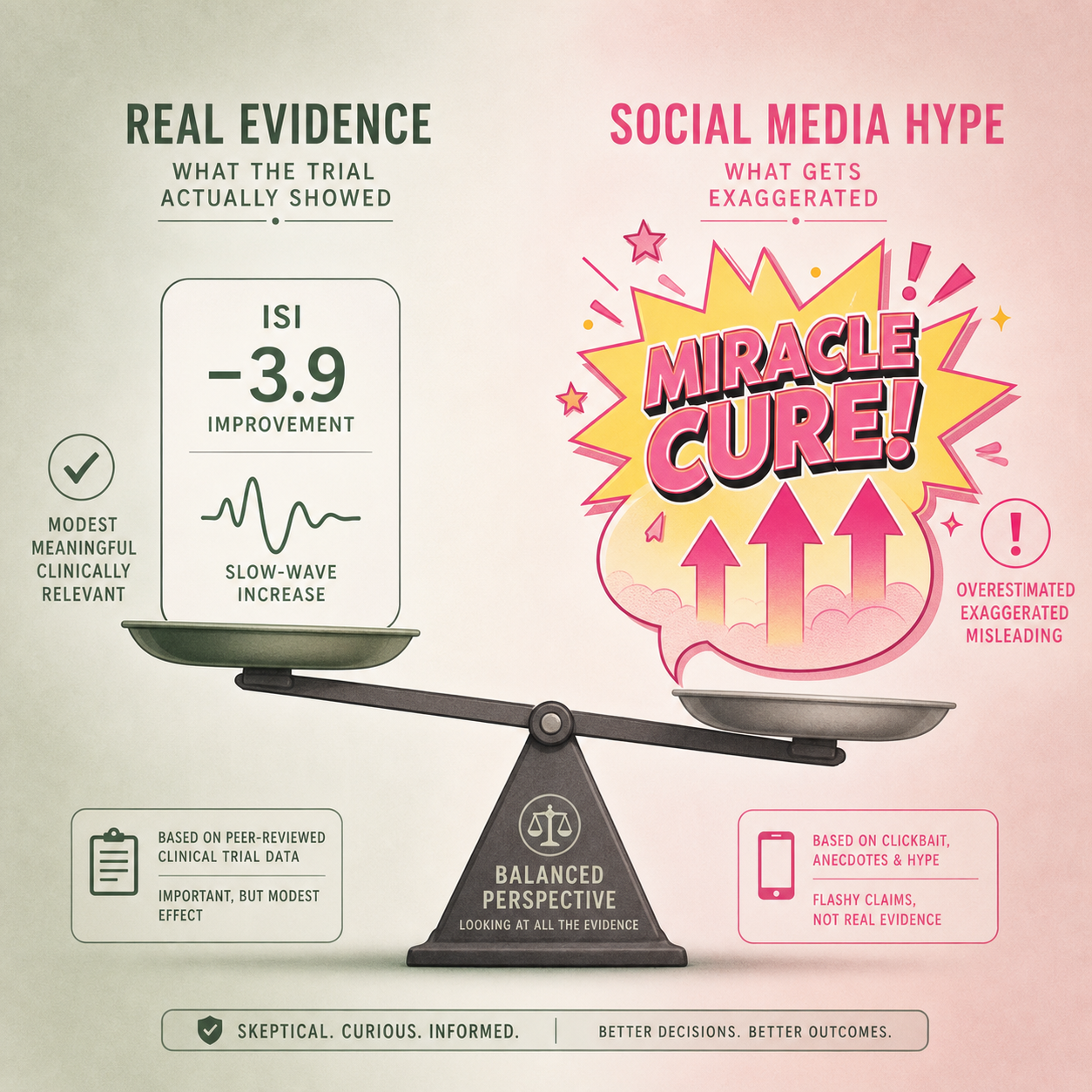
After four weeks, participants in the magnesium group showed a mean reduction in ISI score of –3.9 points (95% CI –5.8 to –2.0), compared with a reduction of –2.3 points (95% CI –4.1 to –0.4) in the placebo group. The difference between groups was statistically significant (p = 0.049), but the effect size was small: Cohen’s d = 0.2, which is considered a small effect.
To put those numbers in context, a change of 6 or more points on the ISI is generally considered a clinically meaningful improvement — a threshold that corresponds to a noticeable reduction in insomnia severity. In this trial, 19% of participants in the magnesium group (26 out of 77) achieved that threshold, compared with 11% in the placebo group (15 out of 78). That means about 8 more people out of every 100 had a meaningful benefit from magnesium over placebo.
An exploratory analysis revealed a small inverse correlation between participants’ self-reported dietary magnesium intake at baseline and the degree of ISI improvement (Spearman’s rho = –0.25, p = 0.036). This suggests that individuals who reported consuming less magnesium in their regular diet tended to experience a larger benefit from supplementation. However, this finding is hypothesis-generating, not conclusive.
What Didn’t Improve — and Why That’s Important
While the insomnia severity score improved, the trial measured several other outcomes that showed no statistically significant difference between the magnesium and placebo groups. These null findings are just as important as the positive one because they define the boundaries of what magnesium glycinate can — and cannot — do.
- Stress (Perceived Stress Scale): p = 0.708 — no effect.
- Mood (PANAS, PHQ-4): no significant improvement in positive or negative affect, nor in depressive or anxiety symptoms.
- Daytime sleepiness (Epworth Sleepiness Scale): no reduction compared with placebo.
These results underscore that magnesium glycinate is not a broad-spectrum sleep panacea. If you are hoping it will also lower your stress levels or improve your mood, the current evidence does not support that expectation. The effect, where it exists, appears confined to sleep-specific measures of insomnia severity.
Tolerability and Safety
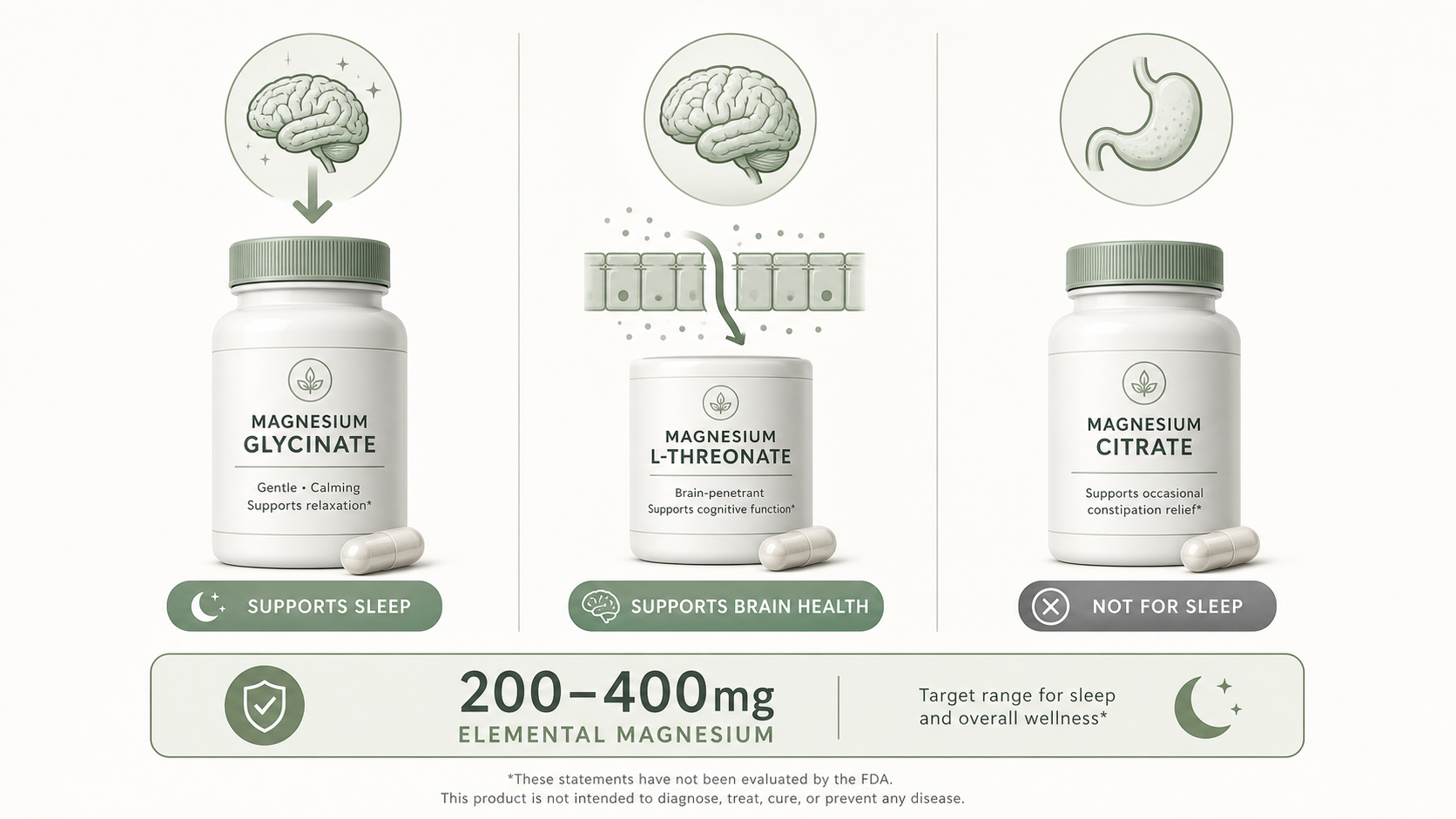
One of the most reassuring findings from the trial is the excellent tolerability profile. 93% of participants reported no adverse events throughout the four-week study. Notably, gastrointestinal side effects — often a concern with magnesium supplements, especially citrate — were actually less frequent in the magnesium group (0 reports) than in the placebo group (3 reports). This is likely because magnesium bisglycinate is well absorbed and less likely to cause loose stools compared with other forms.
How Does This Fit the Broader Evidence?
The 2025 trial is the only RCT to test magnesium bisglycinate specifically, but several earlier studies examined other magnesium forms — mostly citrate and oxide — in older adults. A systematic review and meta-analysis published in 2025 pooled data from three RCTs in elderly participants and found that magnesium supplementation reduced sleep onset latency by an average of 17.36 minutes (p = 0.0006) and increased total sleep time by 16.06 minutes. Those effects are larger than the ones seen in the Schuster trial, but they came from a different population (older adults) and used different magnesium forms.
| Study / Source | Population | Form & Dose | Key Sleep Findings |
|---|---|---|---|
| Schuster 2025 (RCT) | Adults 18–65, poor sleep | Bisglycinate (250 mg Mg + 1.5 g glycine) | ISI –3.9 vs –2.3; 19% vs 11% clinically meaningful improvement |
| Meta-analysis (2025, 3 RCTs) | Older adults (≥65) | Mixed forms (citrate, oxide, etc.) | Sleep onset latency –17.36 min; total sleep +16.06 min |
| Abbasi 2012 (RCT) | Elderly (mean age 70) | Mg oxide 500 mg | Improved ISI and sleep efficiency |
| Nielsen 2010 (RCT) | Adults >51 | Mg citrate 320 mg | Improved PSQI scores, reduced CRP |
Mechanistically, magnesium is thought to promote sleep by potentiating GABA receptors, blocking NMDA receptors, supporting melatonin synthesis, and modulating circadian rhythms through intracellular magnesium ion fluxes. Glycine, which is delivered alongside magnesium in the bisglycinate form, also has calming effects on the central nervous system. However, the precise contribution of each component remains unclear from the available data.
Honest Limitations
No single trial can answer all questions, and the Schuster study has several important limitations that readers should consider before making purchasing decisions.
- Self-report outcomes only: Sleep diary data were unusable (<10% completion), so all results are based on questionnaires. Objective measures like polysomnography or actigraphy were not used.
- Short duration: Four weeks is a relatively brief intervention period. Long-term effects and safety remain unknown.
- Subthreshold insomnia at endpoint: The mean ISI score in the magnesium group at week 4 was still in the subthreshold insomnia range, meaning participants on average did not reach “no insomnia” status.
- Exploratory high-responder analysis: The finding that participants with lower dietary magnesium intake benefited more used a single non-validated question — this is hypothesis-generating, not confirmatory.
- Generalizability: The trial was conducted in Germany using a single brand (Biogena). Whether results apply to other populations, age groups, or supplement formulations is uncertain.
- Form specificity: Most previous research used magnesium citrate or oxide. Comparisons across forms are indirect, and the glycine component in bisglycinate may confound the magnesium effect.
Bottom Line: Should You Try Magnesium Glycinate for Sleep?
If you have seen social media posts calling magnesium glycinate a “miracle” sleep supplement, the clinical data tell a more measured story. The 2025 trial provides evidence of a statistically significant but modest improvement in insomnia symptoms — the effect size is small, and only about one in five people who took it experienced a clinically meaningful benefit. The most promising signal is that those with lower dietary magnesium intake may see the greatest improvement, but that finding is preliminary.
On the positive side, magnesium bisglycinate is extremely well tolerated over four weeks, with no more gastrointestinal side effects than placebo. For someone who is curious about trying it and does not have a medical condition that contraindicates magnesium supplementation, the risk profile is low.
Magnesium glycinate is not a replacement for clinical treatments like cognitive behavioral therapy for insomnia (CBT-I), nor is it a guaranteed fix for everyone. But for the subset of people with suboptimal magnesium intake who are looking for a gentle, low-risk supplement to nudge their sleep in the right direction, the evidence — modest though it is — provides some support. The 2025 trial gives us the first real data point. It is a start, not the final word.
Explore the mechanism
Next step
Spot an error or have clinical feedback?
Because this article covers clinical, medication, or safety information, we use a moderated correction channel instead of open public comments. Let us know if something about “Magnesium Glycinate for Sleep: A Review of the 2025 Clinical Trial” needs a closer look.
Send feedback on this article