
Can Anime Be a Sleep-Safe Part of Your Bedtime Routine?
Yes, anime can be part of an adult bedtime routine without automatically wrecking your sleep. The safer version is narrow: low-arousal episodes, watched passively on a dimmed screen, for a fixed 30- to 60-minute window, outside the bed, with a non-screen step afterward. The less safe version is also familiar: subtitles that keep your brain working, a cliffhanger-heavy show, autoplay, “just one more,” and a tablet that follows you under the covers.
That distinction matters because “anime to fall asleep to” is not a medically tested category. No clinical trial tells us that Laid-Back Camp or Mushishi improves sleep. What we can judge is the shape of the routine: how stimulating the content is, whether the viewing stays time-boxed, and whether you can still fall asleep without needing the screen every night.
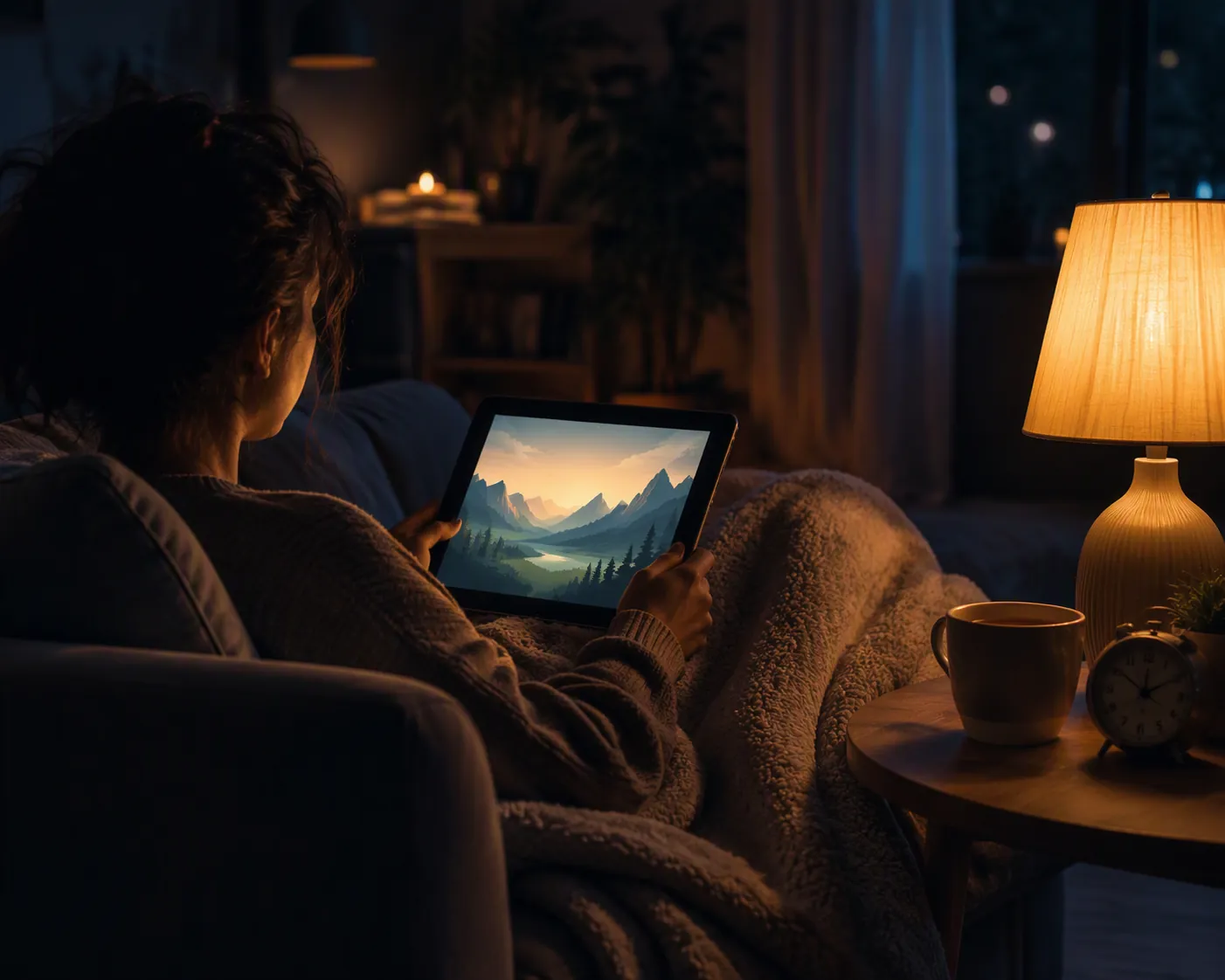
The real sleep question is arousal, not just blue light
Blue light is the usual villain in bedtime screen advice, but adult sleep is not that simple. Stanford sleep researcher Dr. Jamie Zeitzer argues that, for adults, the emotional and cognitive arousal of the content may matter more than the light from the screen. His comparison is useful: phone screens emit roughly 25 to 50 lux, while sunlight is 10,000 lux or more, so a screen is not sunlight in miniature. The bigger practical issue is often what the screen is asking your brain to do right before sleep [1].
That does not make screens harmless. It means a quiet episode you have already seen is different from a plot-twist finale, a comment-thread argument, or a game that rewards rapid response. Anime can fall on either side. A slow slice-of-life episode may function more like passive television; a high-stakes arc with cliffhangers, emotional reveals, or loud action can keep the nervous system leaning forward.

The Sleep Health Foundation takes a similarly measured position on television: it says there is no clear evidence that watching TV in the hour before bed causes sleep problems, while also warning that relying on TV or screens to fall asleep can weaken the ability to self-soothe after waking during the night [2]. That is a helpful line for anime, too. The question is not whether an adult ever watches something before bed. It is whether the show becomes the only way the body knows how to downshift.
The evidence is mixed enough to require guardrails
The adult-screen evidence does not support a free-for-all. A March 2025 JAMA Network Open study summarized by the American Academy of Sleep Medicine found that people using screens before bed had a 33% higher rate of poor sleep and slept about 50 minutes less per week [3]. Another study of about 40,000 Norwegian students found that each additional hour of in-bed screen time was associated with 59% higher odds of insomnia symptoms [3]. Those are not anime-specific findings, and they do not prove that one quiet episode causes insomnia. They do point directly at two failure points: duration and using screens in bed.
The broader habits around screens are not reassuring either. The AASM reports that 87% of people keep a phone in the bedroom and 91% have binge-watched past bedtime [3]. The National Sleep Foundation reported in 2022 that 58% of people use screens within one hour of bed [4]. In other words, bedtime screen use is normal adult behavior, but normal does not mean neutral. The realistic goal is not to pretend every bedroom becomes a device-free retreat tonight. It is to separate a contained wind-down ritual from a sleep-stealing loop.
One older but still useful distinction comes from the 2011 Sleep in America poll framework discussed in Sleep Science: active technology use was associated with longer sleep latency, while passive use was not linked in the same way [5]. Modern streaming complicates that clean split. Subtitles can turn anime into active reading. Episode queues and fandom tabs can turn “watching” into searching, rating, messaging, and arguing. For a bedtime routine, passive means you choose the episode before you start, watch it, and stop.
Anime that is more likely to work as a wind-down
The safest bedtime picks are not necessarily the “best” anime. They are the easiest to stop. Fan-media and community recommendation lists often point toward cozy, low-stakes, episodic shows, and CBR’s anime-before-bed list is one example of that nonclinical consensus [6]. Treat these as candidates, not prescriptions.
| Anime | Why it can fit a bedtime routine | Watch-out |
|---|---|---|
| Laid-Back Camp | Gentle pacing, outdoor comfort, low conflict, easy rewatch value. | Works best when you choose a single episode before starting. |
| Aria: The Animation | Slow, atmospheric, and episodic, with a soft emotional register. | Subtitles may keep some viewers more mentally active. |
| Mushishi | Quiet structure, meditative tone, and self-contained stories. | Some episodes are eerie or melancholy; skip those if they stay with you. |
| Non Non Biyori | Low-stakes rural slice-of-life with familiar rhythms. | Comedy timing can be more engaging than sleepy for some viewers. |
| Natsume’s Book of Friends | Gentle supernatural stories, often reflective rather than frantic. | Some episodes have emotional weight; use familiar rewatches. |
| Yokohama Kaidashi Kikou | Exceptionally calm, quiet, and mood-driven. | Its short OVA format helps, but availability may vary. |
| Horimiya | Familiar romantic slice-of-life can be comforting on rewatch. | First-time viewing may be too emotionally involving. |
| Campfire Cooking in Another World | Repetitive food-and-travel structure, low-stakes progression. | Food content may not be ideal if it makes you hungry at bedtime. |
The common thread is not that these shows are magically sedating. They tend to avoid the machinery that keeps people watching: urgent mysteries, escalating combat, shock reveals, romance crises that demand resolution, and end-of-episode hooks. Rewatch value helps because novelty is arousing. If you already know what happens, the show can become environmental rather than investigative.
Dubs can be more sleep-friendly than subtitles for some people, not because one format is morally better, but because reading is work. If subtitles are part of the pleasure for you, keep them. Just be honest about whether you are relaxing or tracking every line with the attention you would bring to a late-night book club.
A sleep-safer way to watch anime before bed
A good bedtime anime routine removes decisions before your tired brain gets a vote. The decision fatigue is where streaming gets sticky: choosing between shows, checking episode summaries, peeking at the next arc, then drifting into social feeds. Set the container first.
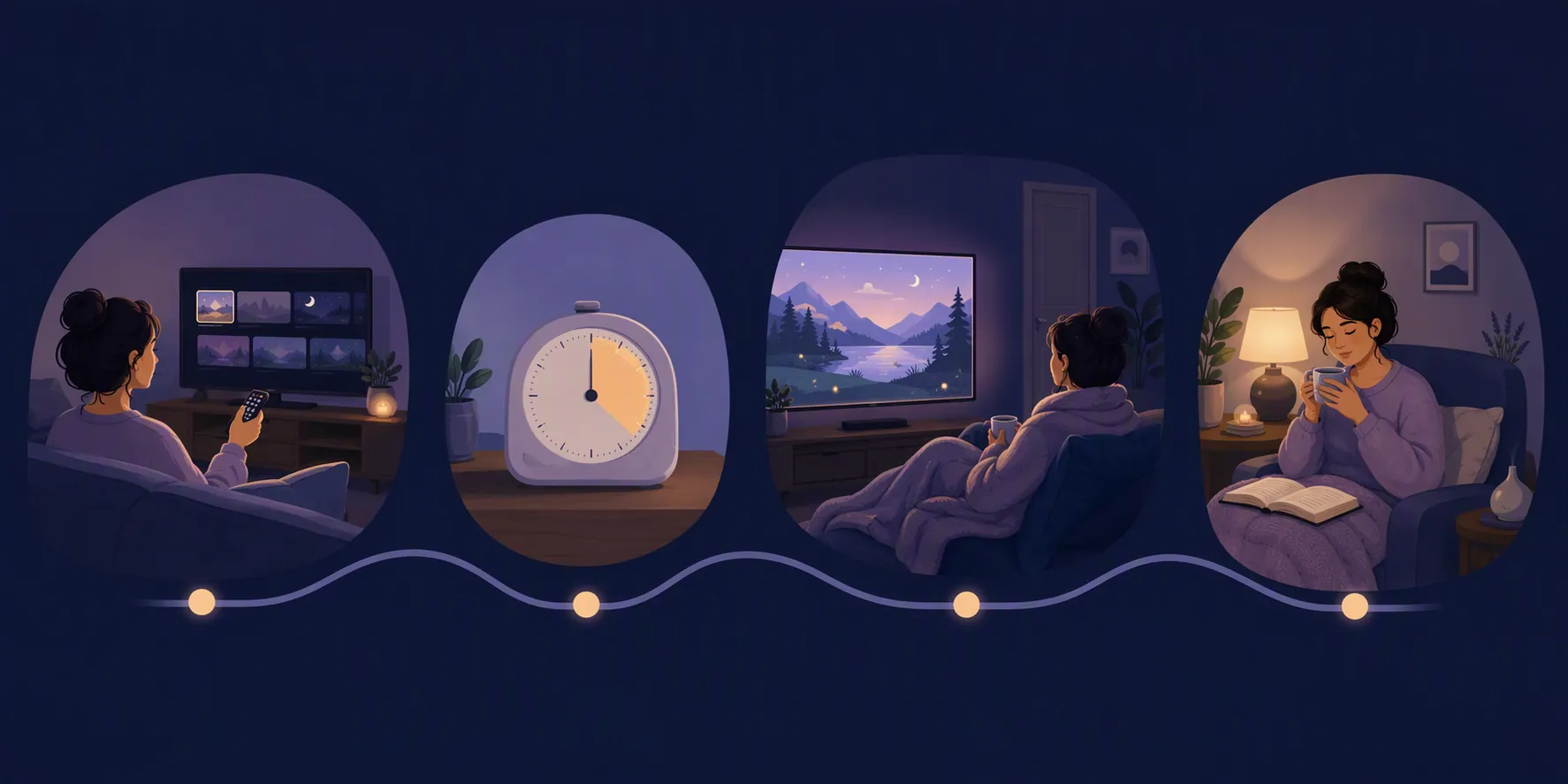
- Choose the episode before you start. Do not browse from bed, and do not decide based on the cliffhanger you just watched.
- Use a fixed short window. For most people, 30 to 60 minutes is a practical ceiling because it usually means one or two quiet episodes, not a season arc.
- Dim the screen and use night mode. This is not because light is the only issue; it is because there is no sleep benefit to making the room brighter than it needs to be.
- Watch outside the bed. Couch, chair, or floor cushion is better. Let the bed remain the place where the episode is already over.
- Turn off autoplay. If the platform makes that difficult, set a timer across the room or use the device’s sleep timer.
- Add a non-screen landing step. Wash up, stretch lightly, make tea, breathe slowly, or read a few pages of something dull enough to put down.
That last step is not decorative. It prevents the screen from being the final object your brain touches before sleep. It also gives you a fallback on nights when you wake at 3 a.m. If the only learned response to wakefulness is “turn on anime,” the routine has started to train dependence rather than flexibility, which is the Sleep Health Foundation’s concern about screen-based self-soothing [2].
Use anime as a swap, not as a sedative
Replacing doomscrolling with one calm episode is a reasonable harm-reduction move. It is more predictable, less socially activating, and easier to time-box than a feed designed to keep refreshing. But that is an extrapolation from the active-versus-passive screen distinction, not proof that anime treats insomnia [5]. The gain comes from reducing stimulation and stopping on time, not from anime as a sleep medicine.
The same show can also behave differently on different nights. A quiet rewatch after a normal day may be fine. The same episode after a stressful argument, with work email open on your phone, may not be a quiet routine anymore. If you notice yourself using the show to avoid going to bed, the problem is no longer the genre.
When anime before bed is probably backfiring
The clearest warning sign is not that you watched anime. It is that the guardrails keep failing. One missed bedtime is ordinary. A pattern is information.
- You regularly watch past the window you set.
- You move from the couch to in-bed viewing because you are “almost done.”
- You choose cliffhanger-heavy or emotionally intense arcs at night.
- You wake during the night and feel unable to settle without restarting a screen.
- You feel sleepy before watching but more alert afterward.
- Your partner’s viewing keeps you awake even if it relaxes them.
If several of those are true, the first fix is not necessarily a total anime ban. Strip the routine down: one familiar episode, no subtitles if reading keeps you alert, no bed, no autoplay, and a landing step that still works when the screen is off. If that still fails, move anime earlier in the evening and build the last part of the night around non-screen cues.
Anime earns its place in a bedtime routine only when it remains easy to stop. If it replaces a more chaotic habit and stays low-arousal, dim, time-boxed, and out of bed, it can be a reasonable adult wind-down tool. If it stretches the night, follows you into bed, or becomes required after every waking, it has become a sleep crutch. At that point, the better next step is not a better anime list; it is a broader bedtime-routine plan and, if needed, a deeper look at screen timing, melatonin, and insomnia patterns.
References
- Screen Time and Sleep—It's Different for Adults — Stanford Lifestyle Medicine, 2024.
- Technology and Sleep — Sleep Health Foundation, January 2024.
- Screen time and sleep: What new studies reveal — Sleep Education, American Academy of Sleep Medicine.
- Screen Use Disrupts Precious Sleep Time — National Sleep Foundation.
- The impact of bedtime technology use on sleep quality and excessive daytime sleepiness in adults — Sleep Science, 2022.
- 10 Best TV Shows To Fall Asleep To (That Are All Anime) — CBR.
Read the full guide: Sleeping during a power outage? Start with safety