
Sleeping during a power outage? Start with safety
The first tips for sleeping during a power outage are not about pillows. Before anyone lies down, make the house safe enough to sleep in: no carbon monoxide source near the home, no open flames, no indoor grilling, no medical device left without a backup plan, no refrigerator being opened every few minutes, and no room so hot or cold that sleep becomes the least important problem.
Carbon monoxide deserves the first check because it is quiet, fast, and repeatedly tied to outage deaths. In a narrative review of power-outage health studies, Casey et al. found that 48% of the studies evaluated carbon monoxide poisoning, and the review identifies generator use near the home as a major preventable source of cases.[1]
Before Bed, Clear the Hazards
Walk the house once with a flashlight before you start building a sleep setup. The goal is not to make the room pleasant yet. It is to remove the choices exhausted people make when they are cold, hot, worried, or trying not to wake children.
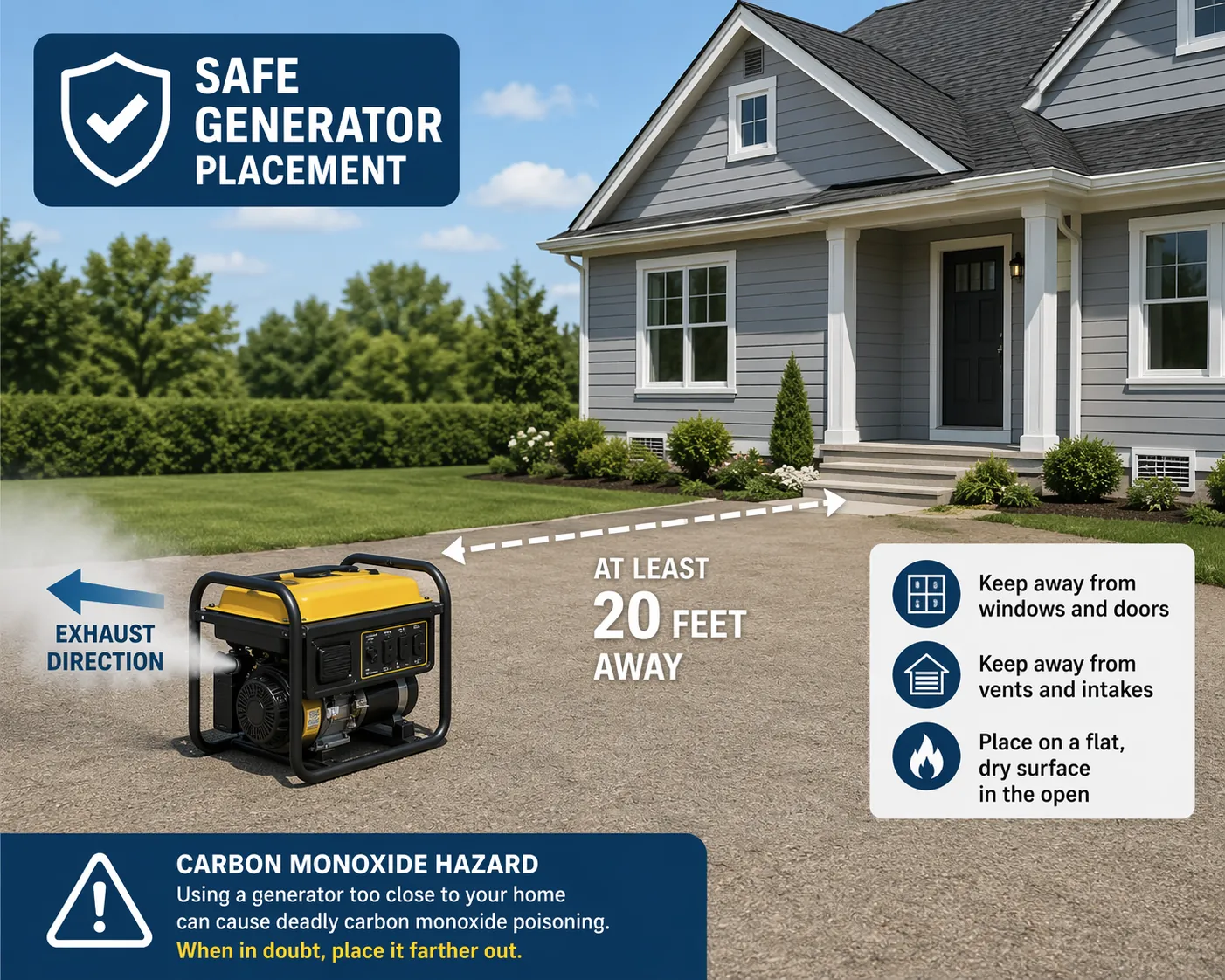
- Put generators outside, at least 20 feet from any window, door, or vent, and keep exhaust pointed away from the home. Never run a generator in a garage, porch, basement, or near an open window.[2][3]
- Do not use a gas stove, oven, charcoal grill, camp stove, or propane heater indoors for heat or cooking. These can create carbon monoxide and fire risk.[2][3]
- Use flashlights, lanterns, or battery lights instead of candles if you have them. If candles are the only option, keep them away from bedding, curtains, pets, and children, and do not leave them burning while people sleep.[3]
- Check anyone who depends on electricity for breathing, mobility, medication refrigeration, or monitoring. If a CPAP, oxygen concentrator, powered bed, refrigerated medication, or charged phone is part of someone’s safety plan, treat that as a medical planning issue, not a comfort problem.
- Keep the refrigerator and freezer closed. CDC guidance says refrigerated food is generally safe for about 4 hours without power if the door stays closed, while a full freezer can hold temperature for about 48 hours if unopened.[2]
- Decide early whether staying is still safe. If the indoor temperature is climbing, a medical device cannot be powered, someone is showing heat or cold stress symptoms, or the home cannot be ventilated safely, the sleep plan is to relocate or seek help.
For households already planning around a CPAP, oxygen, pregnancy, older age, or storm disruption, it may help to keep a separate outage plan rather than rebuild the decision under stress. See our guides to medical device safety during outages and storm sleep room prep if you are preparing before the outage rather than reacting after dark.
Choose the Safest Room, Not the Nicest One
Once the obvious hazards are handled, choose where people should sleep. The safest room changes with the season. In hot weather, lower is usually better because heat rises; a basement or ground-floor room may be cooler than an upstairs bedroom.[4][5] In cold weather, an interior room with fewer exterior walls and fewer windows is usually easier to keep warm.[3]
| Condition tonight | Better room choice | What to avoid |
|---|---|---|
| Hot outage | Lowest safe floor, shaded side of the home, room with safe cross-ventilation | Upper floors, direct sun exposure, sealed rooms that keep getting hotter |
| Cold outage | Small interior room, few windows, door that can be draft-blocked | Large open rooms, rooms over garages, rooms with heavy drafts |
| Severe storm or unsafe outdoor air | Interior room away from windows, even if less comfortable | Open windows during high wind, smoke, flooding, or security risk |
| Medical-device dependence | Room closest to backup power, caregiver, phone, and exit route | Separating the person from the device plan to make the sleep arrangement more convenient |
If the outage is happening during extreme heat, the room decision may also be a stay-or-leave decision. A “cool corner” can buy time, but it does not turn a dangerously hot home into a safe sleeping environment for everyone.[4]
If It Is Hot: Help the Body Lose Heat
Hot-weather outage sleep fails for a physical reason. The body normally cools as sleep approaches; Dr. Michael Breus describes that drop in core body temperature as part of the signal that helps melatonin release and sleep begin.[6] If the room stays hot and the body cannot shed heat, the night can turn into repeated waking, sweating, thirst, and in some cases heat illness.
The threshold that should get your attention is not whether the bedroom feels unpleasant. Ashley Ward of Duke’s Heat Policy Innovation Hub told PBS News that overnight temperatures that do not fall below 75°F are associated with increased heat-illness and mortality risk.[4] That does not mean every 76°F bedroom is an emergency for every person, but it does mean a home that stays above that level overnight deserves a different level of caution, especially for infants, older adults, pregnant people, people with chronic illness, and anyone without reliable hydration or ventilation.
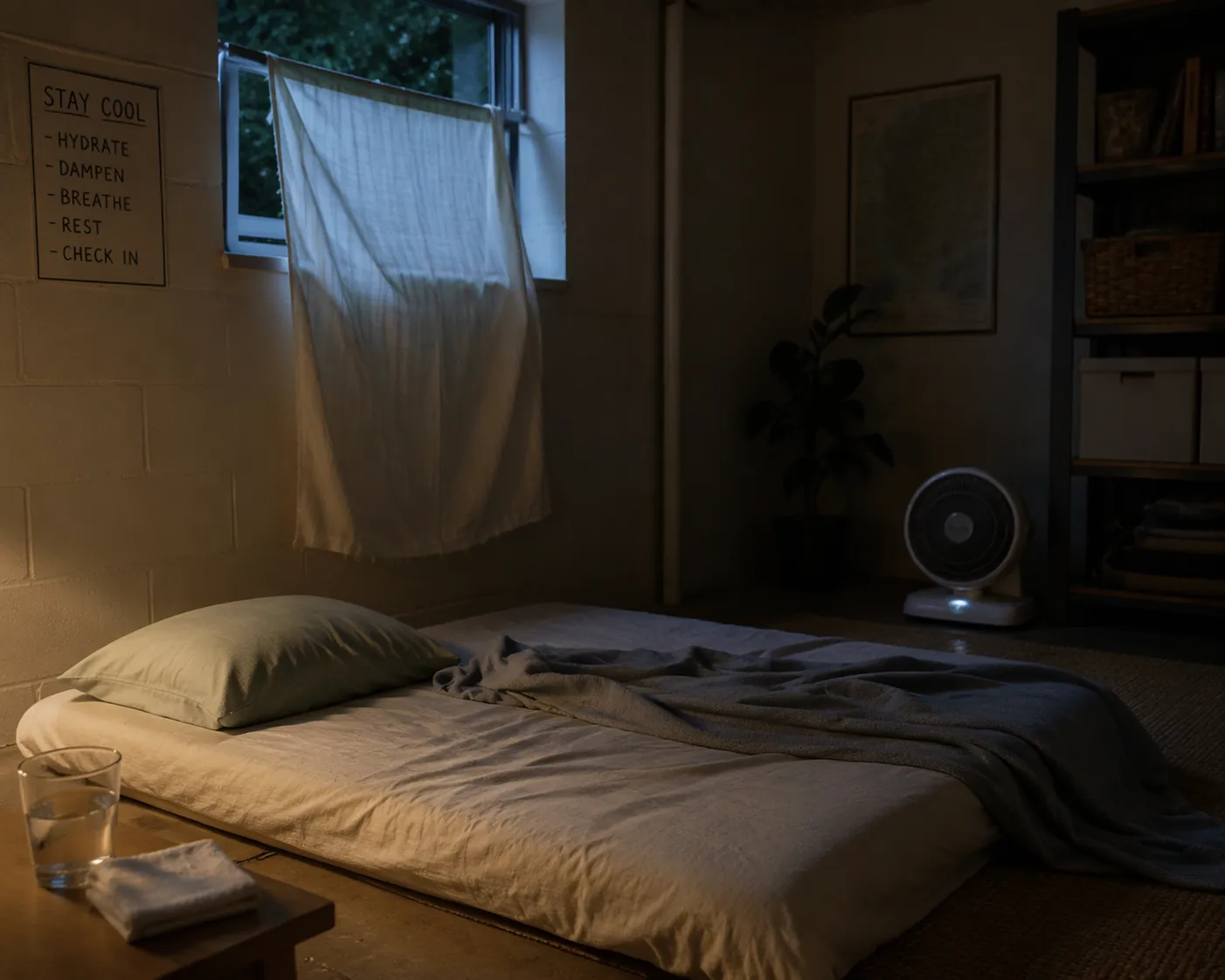
Start by moving sleep to the lowest safe floor. If outdoor air is cooler and safe to bring in, open windows on opposite sides of the home to encourage cross-ventilation. If the air outside is smoky, storm-driven, unsafe, or hotter than the indoor air, do not open windows just because a tip list says “get airflow.”
A damp sheet near an open window is a low-tech evaporative cooling method often recommended in outage guidance, and Amerisleep includes it among practical ways to cool incoming air.[5] Treat it as a modest assist, not an air conditioner. It works best in drier air and with some airflow; in humid conditions, evaporation is limited.
- Use light bedding made from breathable materials such as cotton, linen, or bamboo rather than heavy comforters or synthetic layers that trap heat.[5]
- Sleep lower to the ground if that is safe and practical, because the cooler air in the room is usually closer to the floor.
- Cool pulse points with a damp washcloth or wrapped cool pack at the neck, wrists, ankles, or behind the knees. Sleep Doctor includes pulse-point cooling as a practical way to help the body shed heat.[6]
- Drink enough water earlier in the evening, then taper close to bed if nighttime bathroom trips are a problem. Sleep Doctor’s “3-2-1” hydration framing is one way to think about front-loading fluids without overdoing them right before sleep.[6]
Use a Lukewarm Shower, Not an Ice-Cold One
A lukewarm shower about an hour before bed can help because it nudges heat out through the skin and supports the body’s pre-sleep cooling process. HealthPartners recommends showering 60 to 90 minutes before bed in hot weather, and Sleep Doctor makes the same basic distinction: lukewarm is useful; cold can backfire.[6][7]
The reason is simple enough to matter during an outage. A cold shower can make blood vessels constrict and trigger a rebound warming response, which is the opposite of what you need when the room is already hot.[6][7] If water is available, aim for lukewarm, dry off lightly, and go to the prepared room before the body heats back up from activity.
A Fan Is Helpful Only Within Limits
A battery fan can make sweat evaporate and help a person feel cooler, especially with a damp cloth or a basin of cool water nearby. But CDC warns that fans alone do not prevent heat-related illness when the heat index is very high.[2] If the air is dangerously hot, a fan can move hot air across skin without solving the heat load.
That is the point where advice should stop sounding like sleep coaching. If the room remains hot overnight, someone is confused, vomiting, faint, not sweating normally, breathing hard, or unable to cool down, seek medical help or move to a cooling location. For more detail on hot-weather relocation thresholds, see our guide to sleeping without AC during a power outage.
If It Is Cold: Trap Heat Without Creating a New Hazard
Cold-weather outage sleep is more operational. You are trying to reduce the space that must be warmed, slow drafts, and trap body heat without bringing combustion, flame, or unsafe heaters into the room. Red Cross power-outage guidance emphasizes generator safety, staying warm with layers, and using safer emergency practices rather than improvised indoor heat sources.[3]
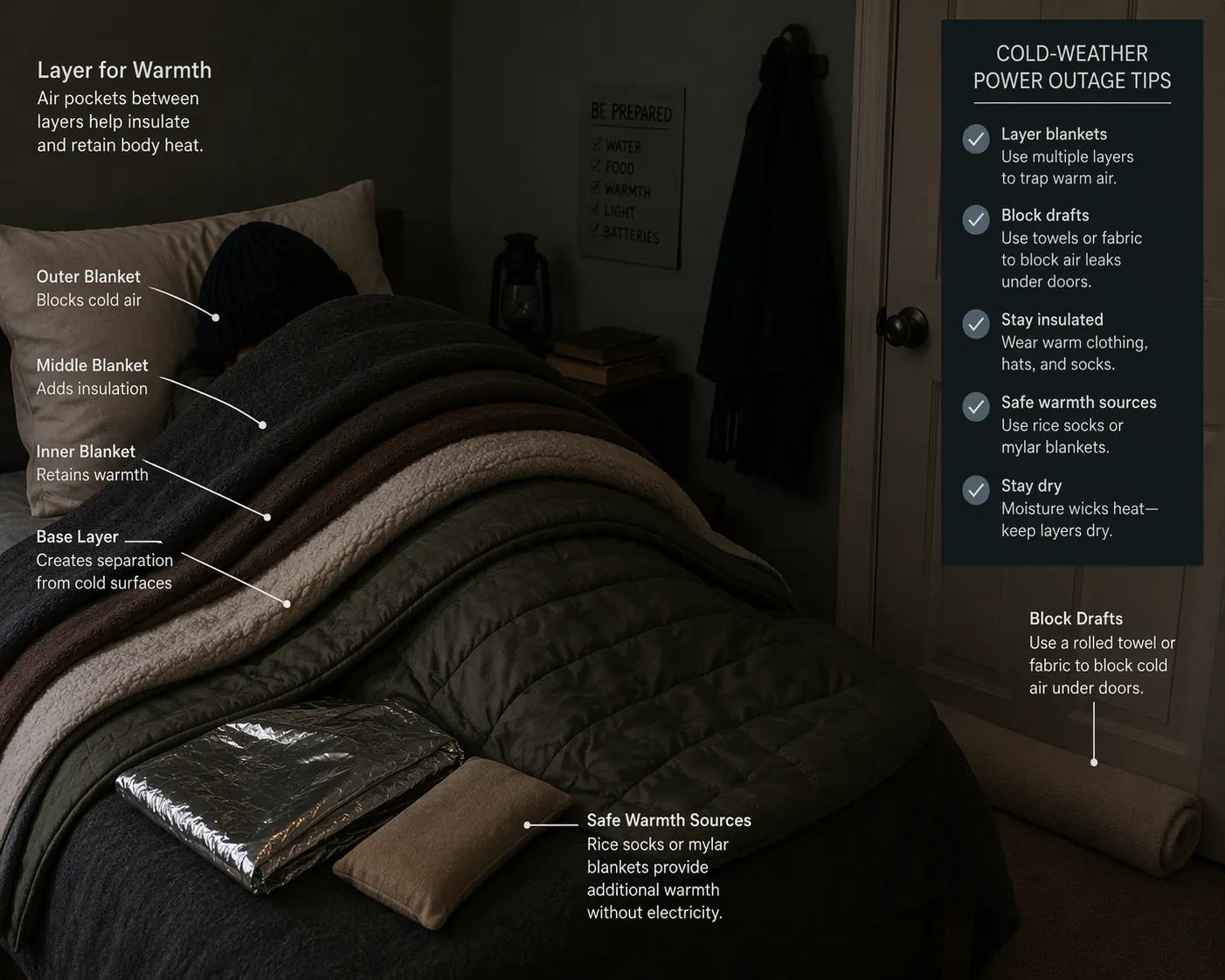
- Move people into a smaller interior room if possible, and close doors to unused areas.
- Block drafts with rolled towels at the base of doors and, where safe, curtains or blankets over drafty windows.
- Layer bedding rather than relying on one heavy blanket. Air pockets between layers help retain warmth.
- Use hats, socks, and warm sleep clothing before adding risky heat sources.
- If you use a passive warmer, such as a warmed rice sock, make sure it is warm rather than hot and cannot burn skin. Mylar emergency blankets can help reflect body heat, but they should be used so they do not cover a baby’s face or restrict safe breathing.
Do not run a gas oven for heat. Do not bring a grill inside. Do not sleep with candles burning. Do not run a portable generator in or near the home to keep an electric heater going. These choices are tempting precisely because people are cold and tired; they are also the choices that turn an outage into a carbon monoxide or fire emergency.[2][3]
Children Need Warmth Without Loose, Risky Bedding
For babies and young children, the winter goal is not simply “more blankets.” HealthyChildren.org, from the American Academy of Pediatrics, advises dressing children in layers and using safe sleep practices during winter power outages, with special caution for infants who should not have loose blankets, pillows, or soft bedding in the sleep space.[8]
An older child can usually be layered with pajamas, socks, and blankets you can check. An infant needs a safe sleep surface and wearable warmth, not improvised loose bedding around the face. If a child is unusually sleepy, hard to wake, shivering uncontrollably, very cold to the touch, or breathing abnormally, the issue has moved beyond sleep comfort.
Who Needs a Lower Threshold to Leave or Get Help
Some people should not wait for the house to become obviously unbearable. The Casey review notes that power outages can affect health through multiple pathways, including disrupted medical equipment, heat and cold exposure, food and water problems, and increased risks for vulnerable groups.[1] In a real home, that means one household may need to leave while another can safely sleep through the same outage.
- A person using CPAP, oxygen, dialysis equipment, powered mobility equipment, or refrigerated medication needs a backup-power and relocation plan before bedtime.
- Older adults, infants, pregnant people, and people with heart, lung, kidney, neurologic, or heat-sensitive conditions need a lower threshold for cooling or warming centers.
- Someone already sleep-disrupted by hot flashes, night sweats, pregnancy discomfort, or medication side effects may cross from “bad sleep” to unsafe heat strain sooner than expected.
- Anyone alone during a storm should keep a charged phone, flashlight, medications, shoes, and keys together before lying down.
For more specific planning, use our guide to pregnancy, older adults, and CPAP during a power outage. Heat-specific readers may also want the pregnancy guide to sleeping in extreme heat or the perimenopause guide to heat-wave sleep disruption.
A Short Bedtime Sequence for the Night
After the safety decisions are made, keep the routine plain. The ideal bedroom temperature often cited by sleep sources is much cooler than many outage bedrooms will be; Sleep Doctor gives 65°F to 68°F, while HealthPartners describes 68°F to 72°F as a useful target range.[6][7] During an outage, those numbers are context, not a standard you can always reach.
- Check the generator, flames, stove, grill, and carbon monoxide risks one more time.
- Set the sleep room for the season: lowest safe room and airflow for heat; interior room and draft control for cold.
- Put water, medications, flashlight, phone, shoes, and keys within reach.
- For heat, use lukewarm shower timing, breathable bedding, pulse-point cooling, and careful fan use.
- For cold, use clothing layers, bedding layers, draft blocking, and passive warmers that cannot burn or ignite anything.
- Recheck vulnerable people before you sleep and any time you wake.
If the home is free of indoor hazards and no one is crossing a heat, cold, medical-device, or vulnerability threshold, low-tech temperature strategies can make sleep possible until power returns. If those conditions are not met, the safest sleep plan is to relocate or seek help.
References
- Power outages and community health: a narrative review — Casey et al., 2020.
- What to Do to Protect Yourself During a Power Outage — CDC.
- Power Outage Safety — American Red Cross.
- How to stay cool and safe in a heat wave, even without air conditioning — PBS News, June 2026.
- How to Sleep Comfortably Without Electricity — Amerisleep.
- How to Sleep When It's Too Hot: Tips for Coping With the Heat — Sleep Doctor.
- Tips for sleeping in hot weather without AC — HealthPartners Blog.
- How can I keep my children safe and warm during a winter power outage? — HealthyChildren.org/American Academy of Pediatrics.
Read the full guide: Why Your Sleep Stays Disrupted After a Power Outage