How to Avoid Sleep Deprivation at Music Festivals
If you are asking how to avoid sleep deprivation at music festivals, the honest answer is that you probably will not avoid it completely. A multi-day festival stacks late sets, campsite noise, morning heat, alcohol, travel, and a schedule that does not care what time you finally got into your sleeping bag. The useful goal is smaller: lose less sleep, protect the sleep you do get, and avoid pretending that one heroic recovery night will wipe the slate clean.
That last point matters most. In sleep-restriction research, people do not simply pay back lost sleep hour for hour. After five nights of 4 hours in bed, a single recovery night of up to 10 hours in bed did not return vigilant attention or mood to baseline. Other lab work found that 4–6 hours of sleep per night across 14 days produced cognitive deficits comparable to two nights of total sleep deprivation, while people’s subjective sleepiness plateaued — they felt as if they were adapting while performance kept getting worse.[1]
That is the festival trap in one sentence: by Sunday afternoon, everyone says they are fine.
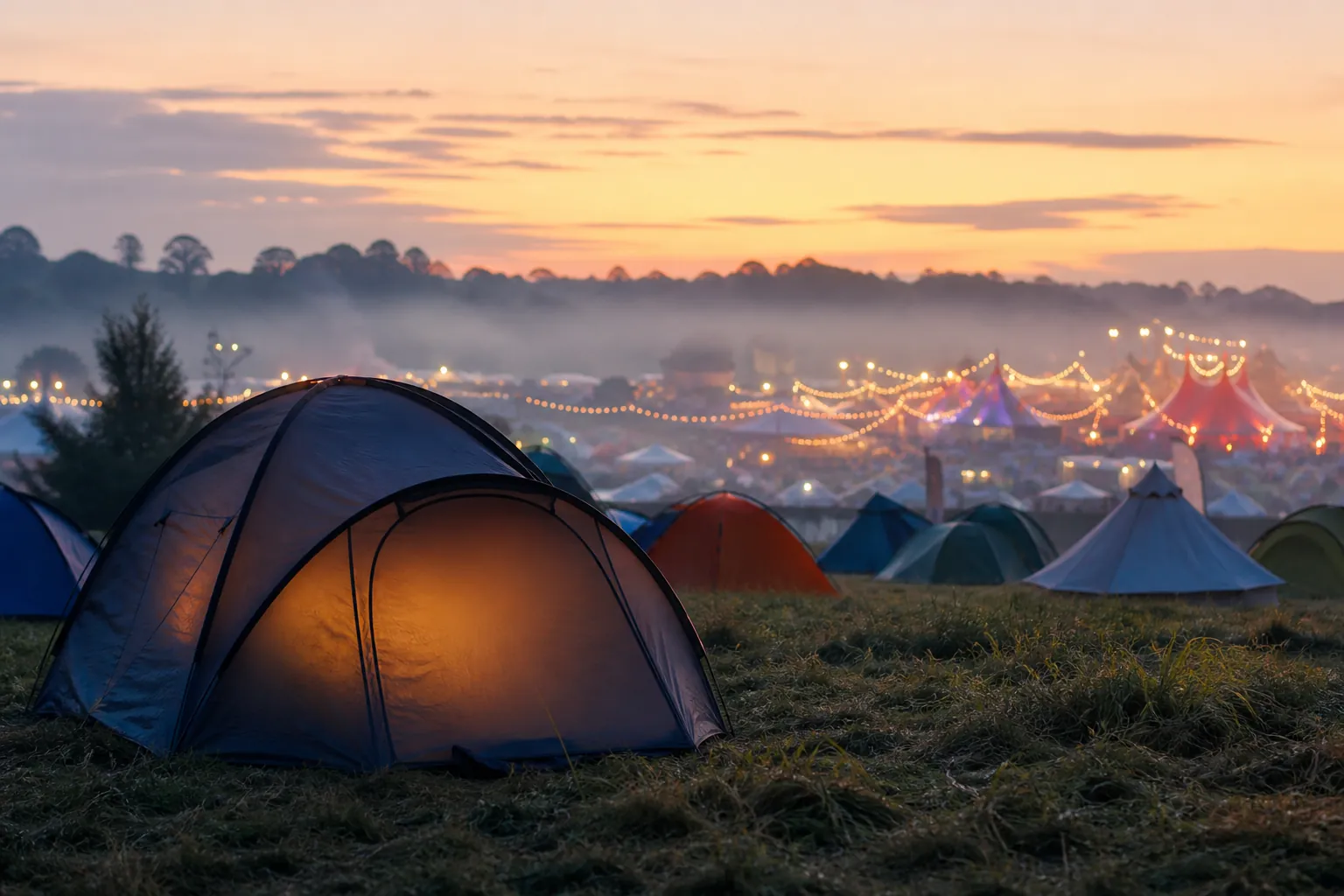
Festival-specific sleep data are thinner than most advice columns admit. One often-cited UK survey from SpaSeekers/Onepoll in 2018, reported by Festival Insights, asked 500 UK festival attendees about sleep and found average festival sleep around 3–4 hours per night, with Bestival lowest at about 3 hours 2 minutes and Download, Reading & Leeds, and Isle of Wight around 4 hours. That is useful scene-setting, not a universal measurement of festival sleep.[2]
| When | Highest-value move | Why it matters |
|---|---|---|
| Before you leave | Bank sleep and reduce pre-festival restriction | It gives you a buffer before the damage starts accumulating. |
| At the campsite | Block noise, light, and heat | These are the things most likely to turn available sleep time into broken sleep. |
| During late nights | Time alcohol instead of using it as a sleep aid | It can make sleep feel easier at first while worsening the second half of the night. |
| During the day | Use short naps and morning light | They help alertness and circadian timing, but they do not replace full sleep. |
| After the festival | Plan recovery without expecting a reset | The deficit can linger even after a long night in bed. |
Bank sleep before the weekend, because prevention beats repayment
The best festival sleep decision happens before the wristband goes on. Sleep extension before restriction has better evidence than most on-site tricks: in a randomized study summarized in a 2022 Sleep Advances review, extending sleep to about 10 hours for a week before a restriction period reduced performance impairment during the restriction and sped recovery afterward.[1]
That does not mean you need to live like an athlete in a sleep lab. It means the week before the festival is the wrong time to “get things done” by shaving sleep. Pack earlier. Finish the travel plan earlier. Do the grocery run before the night before departure. If work allows, add sleep in boring increments: go to bed earlier, sleep later, or protect a nap before the trip. The point is not perfection; it is arriving with less existing debt.
This is also when schedule nudging belongs. If you know your festival nights will run late, avoid making the first night the first time your body sees a much later bedtime. Shift gradually if your life allows it, and keep the last pre-festival night as protected as possible. Showing up already restricted is the easiest way to make the second day feel like the fourth.
If you only do one thing in this article, do this: treat the pre-festival week as part of the event. Sleep lost before you arrive still counts.
Defend the sleep window you actually get
Once you are on-site, you are not trying to create a spa bedroom in a field. You are trying to keep a 4- or 5-hour sleep opportunity from becoming 90 minutes of dozing, waking, sweating, and listening to someone discover acoustic guitar at sunrise.
Noise and light: boring gear, real mechanism
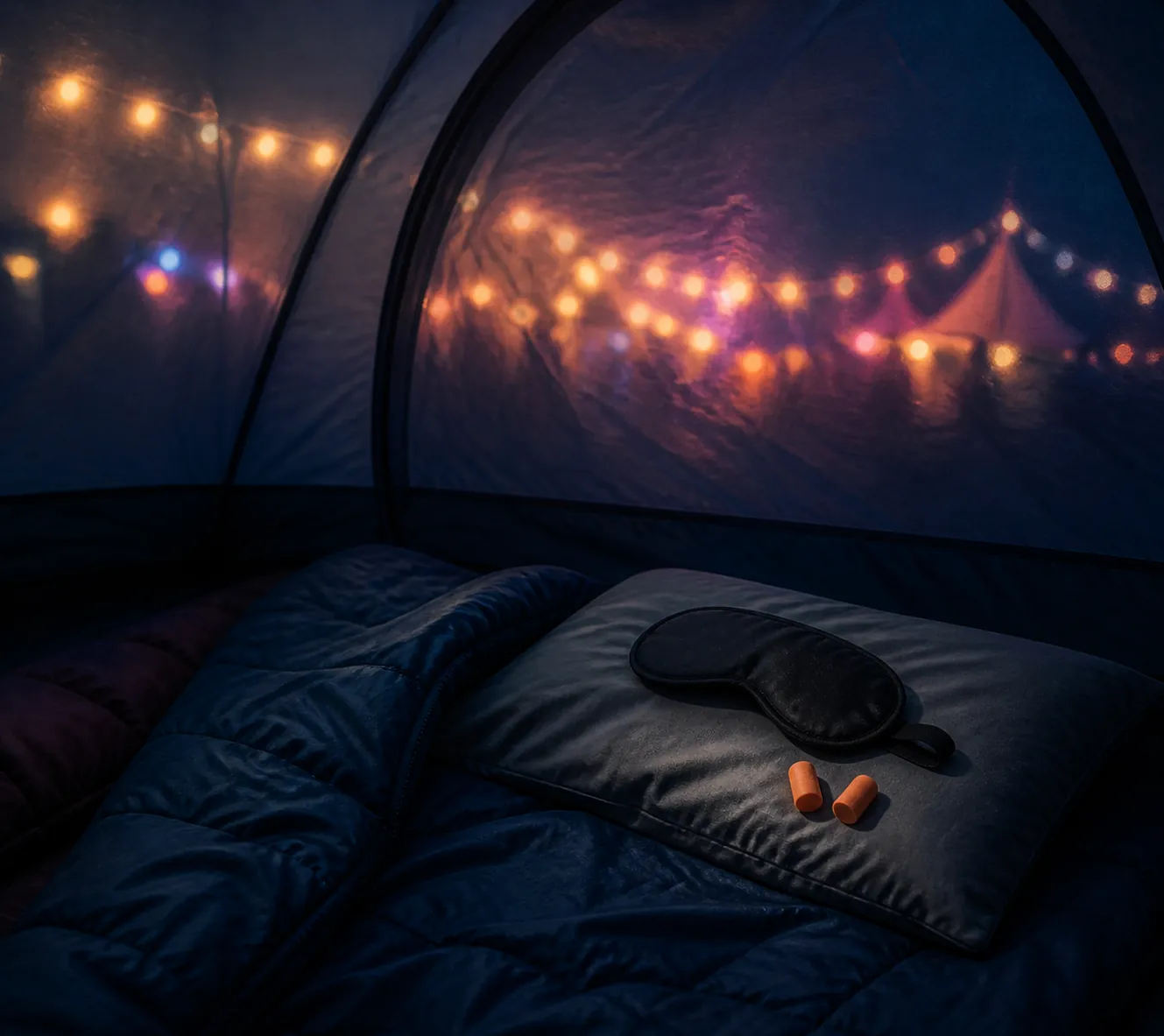
Earplugs and an eye mask are not magic, but they target two things that repeatedly wake campers: sound and light. The most relevant controlled evidence is adjacent rather than festival-specific. In a small simulated ICU pilot study using polysomnography, earplugs plus an eye mask increased REM sleep compared with a noisy and bright condition without them, raising REM sleep from 9.3% to 12.9%, shortening REM latency, reducing arousals, and increasing nocturnal melatonin. The study had only 14 participants, so it is not definitive festival proof, but the mechanism travels well: less sensory interruption gives sleep a better chance to stay consolidated.[3]
For a festival camper, that means packing the unglamorous things and using them before you are desperate: foam or silicone earplugs that fit, a backup pair, and an eye mask that does not press painfully when you roll onto your side. If you hate total silence, use low, steady masking noise only if you can do it safely and without bothering neighbors. Do not rely on earbuds you would be upset to lose in a tent.
Campsite placement is part of the same intervention. When you have a choice, pitch away from paths, toilets, water points, generators, and the people who have clearly brought a speaker larger than their tent. You cannot control every neighbor, but you can stop volunteering for the worst acoustic real estate.
Heat: the hours may be there, but the sleep may not be
Heat is one of the reasons “I was in the tent for seven hours” can still turn into a wrecked morning. A 2024 systematic review in Sleep Medicine Reviews found that 29 of 36 studies, or 81%, linked higher ambient temperature with worse sleep. Related subgroup findings suggest heat-related sleep loss per degree is larger for older adults and larger for women, and a Shanghai field study estimated a 5.10-minute reduction in total sleep time for each 1°C increase in bedroom temperature.[4]
A tent is not a bedroom, and festival fields are not controlled environments, so use that evidence as a warning rather than a precise forecast. The practical issue is simple: hot tents push wake-ups earlier, make sleep lighter, and can ruin the last part of the morning sleep you were counting on after a late set.
- Prioritize shade when choosing a pitch, especially morning shade. A tent that becomes an oven at 7 a.m. cuts off recovery at the exact time many festival campers finally need it.
- Ventilate before sleep. If conditions are safe, use vents and mesh rather than sealing the tent so tightly that moisture and heat build up.
- Sleep on insulation that suits the weather. A heavy bag that made sense in the mountains may be miserable in a summer field.
- Keep water reachable, but do not turn bedtime into a chugging contest that guarantees bathroom trips.
- If you run hot, plan cooling before dark: lighter sleep clothes, a small towel, a safe fan if allowed, and a way to create airflow.
For more detailed hot-weather tactics, see how to fix cooling mistakes for better hot weather sleep and heatwave sleep tips for pregnancy, menopause, and older adults. The festival version is rougher, but the physiology is not different just because there is a wristband involved.
Treat alcohol as a sleep-timing problem
Alcohol advice gets useless fast when it pretends the only realistic options are abstinence or disaster. Many people drink at festivals. The sleep question is what alcohol does to the night you are already struggling to protect.
The pattern is not mysterious: acute alcohol can shorten sleep onset, which is why it feels like it helps, but it suppresses REM sleep and fragments the second half of the night. More than 1 in 10 adults report using alcohol as a sleep aid, even though the same review notes that the later-night disruption is part of the bargain. Women also reach higher blood alcohol levels than men at the same dose, largely because of lower body water, which matters when “same number of drinks” is treated as the same exposure.[5]
The useful move is not moral drama; it is timing. If sleep matters that night, stop drinking alcohol well before the sleep window you are trying to protect. Alternate with water earlier, eat enough, and do not count the first knocked-out stretch as proof that alcohol improved sleep. It may have made the first part easier and the second part worse.
This becomes more important after night one. One rough night plus late alcohol can turn night two into a lighter, more fragmented recovery attempt. If you want a deeper dive into the second-half-of-the-night problem, read what happens to your sleep when you quit alcohol; for perimenopause-specific sleep disruption, see alcohol before bed ruins sleep quality in perimenopause.
Use naps and morning light as tactical tools
Naps are useful at festivals because the main sleep block is often too short. They are also easy to misuse. Short naps of about 10–20 minutes can restore alertness with minimal sleep inertia; longer naps are more likely to leave you groggy when you wake, especially if you are pulled out of deeper sleep.[1]
- Nap before you are falling apart, not after you are already useless.
- Set an alarm for a short nap, and add a few minutes only for settling.
- Choose shade, airflow, and some noise protection instead of hoping you can sleep through anything.
- Avoid long late-evening naps if they will push your main sleep window even later.
Morning light is the other tactical tool, especially if the festival has pulled your timing later. In a small camping study, a weekend of natural light exposure moved melatonin onset about 1.4 hours earlier, roughly 69% of the shift seen after a full week of camping; an earlier week-long camping study found about a 2-hour earlier circadian shift. The samples were small, so this is not a precision prescription, but it supports the basic move: get outdoor light after waking rather than spending the whole morning buried in a dark tent.[6]
There is a tension here. Morning light helps anchor the clock, but morning light through tent fabric can also wake you before you have slept enough. The compromise is practical: use an eye mask while sleeping, then get real daylight once you choose to be awake. If you need to be functional for travel, work, or a long drive the next day, do not let the entire morning disappear in half-sleep.
For a more general event-based approach to light, naps, and schedule protection, the same logic appears in event sleep planning for the eclipse and Perseids and in sleep hygiene for night shift workers. A festival is not shift work, but it borrows some of the same circadian problems for a long weekend.
Down-rank the stuff that promises too much
A fancier sleep mask, a supplement, or a “festival survival kit” can be fine if it solves a real problem. The problem is when gear becomes reassurance. Earplugs help because they reduce sound. An eye mask helps because it reduces light. Shade helps because heat fragments sleep. A supplement does not erase three nights of restriction, alcohol-fragmented sleep, and a tent that turns tropical at sunrise.
Melatonin belongs in the cautious category. It can affect circadian timing, and some people use it for specific sleep-timing problems, but it is not a general festival antidote. If you are considering it — especially if you are pregnant, managing a medical condition, taking other medications, or using it repeatedly — discuss it with a clinician rather than treating it as harmless campsite candy.
The same restraint applies to “festival flu” claims. Sleep and immune function are linked, and sleep deprivation has been associated with immune risk in broader research, but that does not prove that one specific 3-day festival causes a post-festival illness through sleep loss alone.[7] Crowds, travel, shared facilities, dehydration, alcohol, weather, and plain exposure all sit in the same messy pile.
Plan the recovery before you need it
Recovery starts with the trip home. If you know you will sleep badly on the final night, do not build a plan that requires you to be sharp for hours with no margin. Share driving if possible, leave later if that is safer, or build in a real stop. The danger is not only feeling tired; it is feeling adapted while attention is still degraded.
After you get home, one long sleep is worth taking if your body offers it, but do not treat it as a full reset. NIOSH/CDC training material notes that sleep debt is not repaid hour for hour, while Sleep Foundation summarizes research suggesting it may take up to four days to recover from each hour of lost sleep.[8][9] Those estimates are not identical, and they should not be read as a personal stopwatch. They point in the same direction: recovery is slower than the wishful version.
The first two post-festival nights deserve protection. Keep alcohol out of the recovery plan, get morning light, use a short nap if you are dragging, and return to a stable sleep schedule rather than swinging between all-day sleep and late-night revenge scrolling. If you need a deeper explanation of why the debt can linger, see how many nights it takes to recover sleep debt.
The win is not coming home untouched. It is coming home with a smaller deficit, fewer preventable wake-ups, and fewer days of fallout after the last set.
References
- Guzzetti & Banks 2022, Sleep Advances: recovery sleep dynamics
- Research Ranks UK Festivals on Cleanliness and Sleep Patterns of Attendees, Festival Insights, 2018
- The effects of earplugs and eye masks on nocturnal sleep, melatonin and cortisol in a simulated intensive care unit environment, Critical Care, 2010
- Chevance et al. 2024, Sleep Medicine Reviews: ambient heat and sleep systematic review
- Alcohol and the sleeping brain, Handbook of Clinical Neurology, 2014
- Circadian Entrainment to the Natural Light-Dark Cycle across Seasons and the Weekend, Current Biology, 2017
- Sleep deprivation and immune-mediated disease risk, Communications Biology, 2021
- Sleep Debt, NIOSH/CDC
- Sleep Debt and Catching Up on Sleep, Sleep Foundation
Read the full guide: How to sleep during a wildfire evacuation