
How to sleep during a wildfire evacuation
If you are evacuating, displaced, or sleeping with one ear open for alerts, the goal tonight is not normal sleep. The goal is meaningful sleep: a protected block long enough for one adult to think clearly, drive safely, manage medications, care for children or pets, and make the next decision without running on fumes.
Start with a working plan, not a perfect bedtime. Before leaving, put shoes and a flashlight beside the bed, confirm two evacuation routes, and keep sleep essentials in the go-bag. During the evacuation night, assign one adult to be on watch and one adult to be fully off-watch. In a shelter, hotel, car, or spare room, build the least-bad sleep environment you can: reduce light, reduce noise, keep the phone charged, and choose the cleanest available air. After return, pay attention to whether insomnia and nightmares settle or become a clinical problem.
Wildfire sleep disruption is common enough that nobody should be surprised by it. In a Fort McMurray evacuee study, 72.5% of 379 participants reported trouble falling or staying asleep three months after evacuation, and 43.6% met criteria for clinical insomnia disorder; 84% of those insomnia cases were judged definitely or probably fire-related.[1] That does not prove what will happen on the first night in a shelter. Most wildfire sleep data come from the recovery period, not the active evacuation window. But the numbers do make one point hard to dismiss: sleep deserves a place in the evacuation plan, not just in the recovery plan.
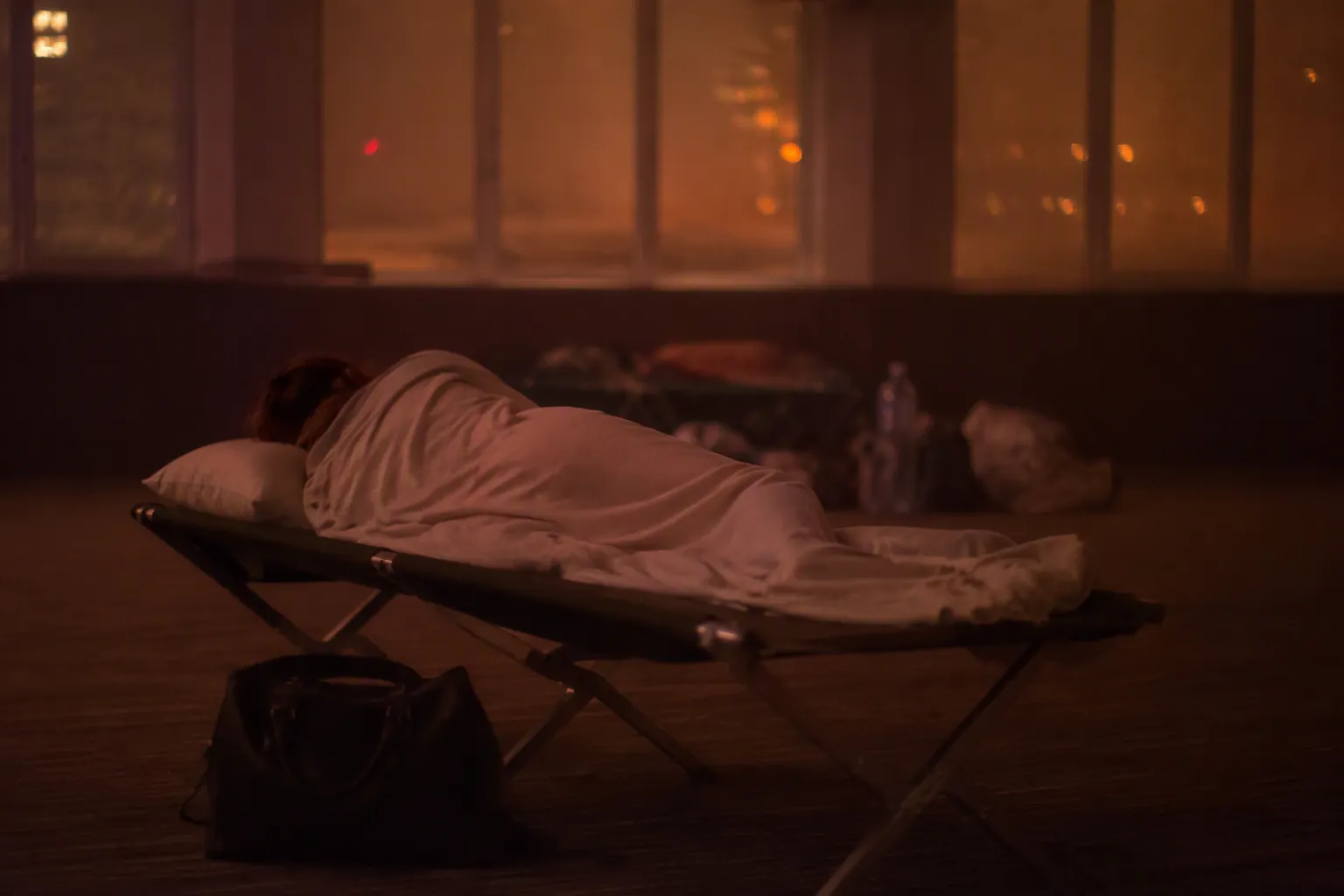
The Fast Plan for Tonight
| Situation | What to do first | Why it matters |
|---|---|---|
| You may need to leave overnight | Put shoes, flashlight, medications, phone charger, eyewear, keys, and go-bag where you can reach them in the dark. | A prepared exit makes it easier for someone to sleep without mentally rehearsing the same emergency every few minutes. |
| Two or more adults are present | Use a shift-sleeping plan: one person is officially on watch, one person is officially off-watch. | Shared vigilance often means nobody sleeps deeply enough to be useful later. |
| You are in a shelter, hotel, car, or someone else’s home | Use earplugs, an eye mask, white noise, a charged phone, and the cleanest available sleeping air. | Small barriers against light, noise, alerts, and smoke can reduce repeated awakenings. |
| Someone uses CPAP or has asthma, COPD, pregnancy, older-adult frailty, or other vulnerability | Prioritize equipment, medications, cleaner air, and backup power before comfort items. | The person with the least physiologic reserve should not be the last person considered. |
| Your mind will not stop running | Set a short daytime worry-and-planning period, then keep the night plan simple. | Night is a poor time to solve the whole disaster; it is a time to follow the next agreed step. |
Before You Leave: Pack for the Night, Not Just the Road
Most evacuation lists focus, correctly, on life safety: routes, documents, prescriptions, pets, fuel, and alerts. For sleep, the missing piece is usually the first night. CAL FIRE’s Ready for Wildfire guidance advises keeping a go-bag ready, maintaining a written evacuation plan with two routes, and placing shoes and a flashlight near the bed when evacuation is possible.[2] Those details are not cosmetic. They lower the number of decisions that have to be made while half-awake.
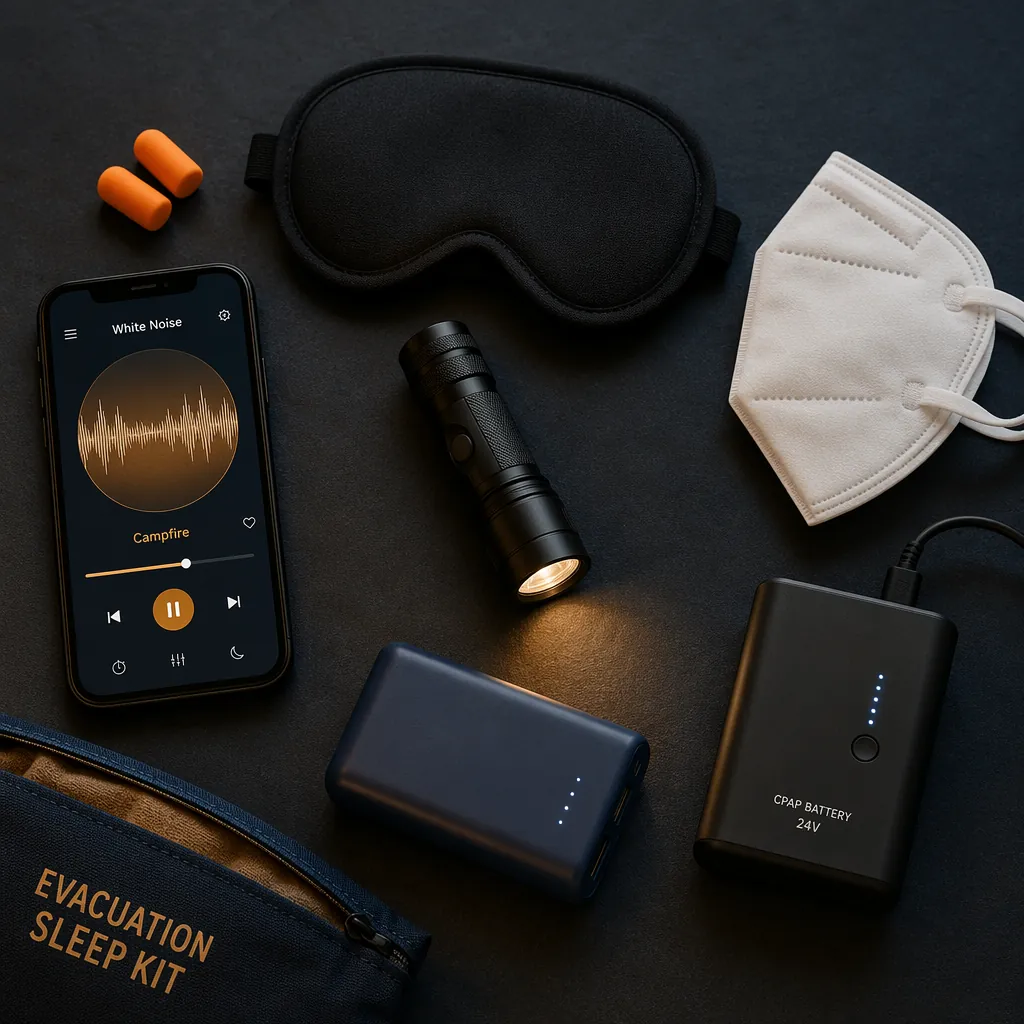
Add a small sleep kit to the go-bag if you can. It should be easy to find by touch, not buried under paperwork.
- Foam earplugs and an eye mask
- Phone charger, power bank, and any needed charging cables
- A small flashlight or headlamp
- Medication list, nightly medications, inhalers, and rescue medications
- CPAP mask, hose, power supply, backup battery, and extra filters if you use CPAP
- A clean face covering or respirator already recommended for smoke conditions in your area
If you are still at home but smoke and alert anxiety are already disrupting sleep, the more detailed at-home guidance is in How to Fix Sleep Disrupted by Wildfire Anxiety and Smoke. Once evacuation is likely, shift the priority from optimizing the bedroom to making a safe departure and protecting whatever sleep is realistically possible.
During Evacuation: Put One Adult on Watch and One Adult Off
Shift-sleeping is not elegant, but it is often the most important sleep tactic in an evacuation. The Sleep Health Foundation recommends planned rotation during bushfire threat so household members can get deeper rest between watch periods.[3] The useful part is not merely taking turns. It is making the off-watch role psychologically believable.
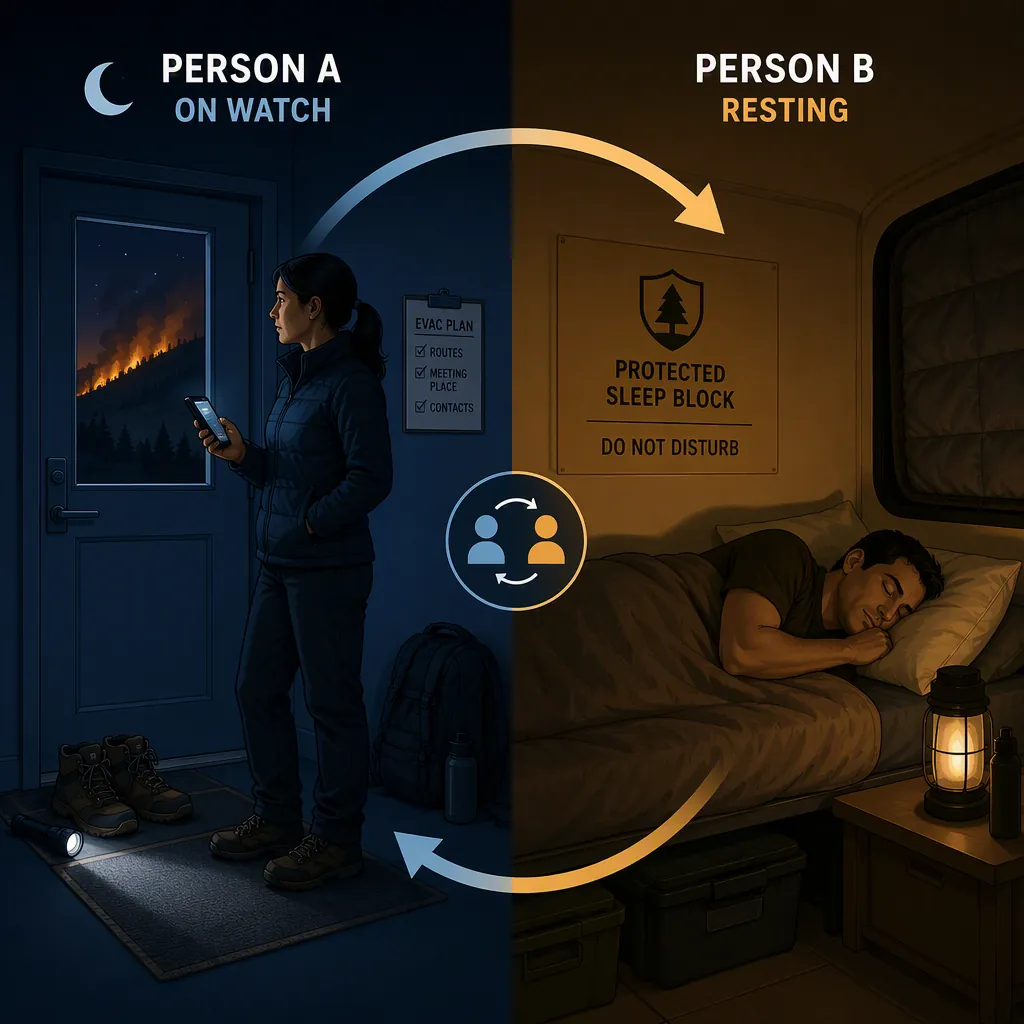
For a household with two capable adults, the on-watch adult keeps the phone charged and audible, monitors official alerts, knows where keys and shoes are, and has the next action written down. The off-watch adult does not keep rechecking maps, refreshing social media, or half-listening from the couch. They put in earplugs if safe, cover their eyes, and sleep in the best available place. If an evacuation order, medical problem, or urgent change occurs, the on-watch adult wakes them.
This matters because “we’ll both stay alert” sounds loving and can fail the whole household. Two adults lightly dozing while both monitor the same alerts may produce no true rest, more irritability, worse driving judgment, and a harder morning for children, older relatives, pets, and medication schedules. A four-hour protected block for one adult can be more useful than eight hours of fragmented semi-vigilance for everyone.
If there is only one adult, do not pretend vigilance can be delegated. Make the monitoring system as simple as possible: official alerts on, phone charging, volume high enough to wake you, shoes and flashlight placed by the exit, and the next step written down. If you are in a shelter, ask staff how overnight alerts or evacuations will be communicated before you try to sleep. The question is not “Can I relax?” It is “What system will wake me if I truly need to act?”
A workable two-adult rotation
- Choose the first off-watch block before everyone is exhausted.
- Write down the exact condition that triggers waking the sleeper: evacuation order, route change, breathing problem, child illness, shelter instruction, or agreed time.
- Put the on-watch phone on power and keep alerts from official sources audible.
- Give the off-watch adult permission to stop checking. This is not abandonment; it is the household’s backup system.
- Switch roles at the agreed time unless conditions make it unsafe.
In a Shelter, Hotel, Car, or Spare Room: Build a Sleep Boundary
A shelter cot or crowded living room will not behave like a bedroom. Treat the sleep setup as a boundary you build around the body: less noise, less light, fewer unnecessary awakenings, cleaner air if possible, and equipment within reach. Disaster sleep guidance from the American Sleep Apnea Association recommends practical tools such as earplugs, eye masks, white noise apps, and keeping sleep-related medical supplies available during displacement.[4]
Use earplugs when it is safe to do so and someone or some system is responsible for urgent alerts. Use an eye mask or a folded shirt over the eyes if overhead lights stay on. A white noise app can be useful in a shelter or shared room, but keep the phone plugged in and do not run the battery down for sound if you need that phone for alerts, maps, or medical calls. If the room is cold, noisy, bright, or full of movement, aim for fewer awakenings rather than comfort.
Air matters, especially when smoke follows people indoors. Smoke-season sleep guidance commonly recommends closing windows, using recirculated air when appropriate, and prioritizing HEPA-filtered spaces for sleep when available.[5] This is best understood as smoke-exposure reduction and practice guidance, not as a trial-proven insomnia treatment during evacuation. Still, if you can choose between two sleeping spots, choose the one farther from open doors, windows, idling vehicles, heavy foot traffic, or visible smoke intrusion.
If you use CPAP
Bring the CPAP if you can do so safely, especially if untreated sleep apnea makes you severely sleepy, worsens blood pressure, or creates driving risk. Pack the mask, tubing, power supply, backup battery, and extra filters. Sleep-clinic and patient-organization guidance notes that CPAP filters may clog faster during smoke conditions and may need more frequent replacement; it also advises keeping the machine away from windows when possible.[4][5] This is practice guidance, not evidence from evacuation-specific CPAP trials, but it is practical and worth following.
If power is limited, decide before nightfall whether the CPAP battery is being used tonight, saved for the next leg of travel, or prioritized for the person with the highest medical risk. That decision is much harder at 2 a.m. with an alarm beeping and everyone awake.
If someone is medically vulnerable
Older adults, pregnant people, and people with obstructive sleep apnea, asthma, or COPD deserve earlier placement in the cleanest available sleeping area. General public-health smoke guidance identifies groups such as older adults, pregnant people, children, and people with heart or lung disease as more vulnerable to wildfire smoke exposure.[6] The sleep consequence is practical: the person most likely to struggle with breathing should not be placed next to the door, window, smoky hallway, or air leak if another option exists.
Keep inhalers, oxygen instructions if prescribed, CPAP supplies, pregnancy-related medications, and emergency contacts next to the sleeping place rather than in the car or at the bottom of a bag. If breathing worsens, chest symptoms appear, confusion develops, or a pregnant person has concerning symptoms, sleep advice stops being the priority; follow emergency or clinician guidance.
Use Worry Time Before Night, Not as a Bedtime Debate
A short worry period can help, but only if it is used as a containment tool. The Sleep Health Foundation recommends setting aside about 15 minutes during the day for worries during bushfire threat, and the VA’s disaster guidance similarly advises limiting repeated exposure to distressing information and using coping steps after fires.[3][7] This is not therapy in miniature. It is a way to keep the bed, cot, or car seat from becoming the planning desk.
During the worry period, write the next few operational decisions: where everyone sleeps, who is on watch, what alert source is being used, where the medications are, what happens if the route changes, and who needs a morning call. Stop when the practical list is done. If the mind brings the same problem back at night, the answer is not to argue with it for an hour. Point back to the written plan and return to the smallest sleep cue available: mask down, earplugs in, phone charging, body still.
For more general disaster-related sleep anxiety, including storms and nighttime threat monitoring, How to Sleep When Storm Anxiety Hits in Hawaii covers related strategies. In an active wildfire evacuation, keep the tool smaller and more operational.
After Return: Know When Bad Sleep Has Become a Clinical Problem
It is expected for sleep to be rough after evacuation: lighter sleep, earlier waking, smoke-triggered coughing, alert dreams, and a strong urge to check news or maps. The line to watch is persistence plus daytime impairment. If insomnia or nightmares continue beyond several weeks and are affecting driving, work, caregiving, mood, safety, or health, it is time to seek professional help rather than waiting for exhaustion to solve itself.
For ongoing insomnia, cognitive behavioral therapy for insomnia, or CBT-I, is recommended as first-line treatment for chronic insomnia by the American Academy of Sleep Medicine.[8] For persistent nightmares, Imagery Rehearsal Therapy has evidence as a nightmare-focused treatment; a meta-analysis by Casement and Swanson evaluated its effects for posttrauma nightmares and sleep disturbance.[9] In the Fort McMurray study, sleep disturbances predicted PTSD symptom severity even after controlling for depression, which is one reason persistent post-fire sleep symptoms should not be treated as a minor inconvenience.[1]
Evacuation sleep is usually imperfect. The clinical goal is to keep short-term disruption from hardening into longer-term insomnia: protect sleep blocks, share the watch when possible, contain planning to daytime, choose cleaner air for sleep, and get treatment when symptoms do not settle.
References
- Sleep disturbances following an evacuation due to a wildfire: prevalence, clinical characteristics, and association with mental health symptoms, Belleville et al., 2019.
- Go! Evacuation Guide, Ready for Wildfire/CAL FIRE.
- Bushfire threat and sleep health, Sleep Health Foundation, 2024.
- How to Manage Your Sleep During a Disaster, American Sleep Apnea Association.
- Wildfires and Your Sleep, Snore MD Canada.
- Wildfire Smoke and Your Patients' Health, CDC.
- Fires: Coping with the Aftermath, PTSD: National Center for PTSD.
- Clinical Practice Guideline for the Pharmacologic Treatment of Chronic Insomnia in Adults: An American Academy of Sleep Medicine Clinical Practice Guideline, American Academy of Sleep Medicine.
- A meta-analysis of imagery rehearsal for post-trauma nightmares: effects on nightmare frequency, sleep quality, and posttraumatic stress, Casement & Swanson, 2012.