
What ayahuasca depression therapy does to your sleep
Ayahuasca depression therapy may help some people sleep better when depression improves, but that is not the same as proving ayahuasca is a sleep treatment. No controlled trial has tested sleep as the main outcome. The strongest depression trial measured mood, not insomnia. And the only sleep-lab study found an acute change that sounds counterintuitive at first: ayahuasca delayed REM sleep and reduced total REM duration, while participants did not report worse sleep quality afterward.
That distinction matters for anyone searching for ayahuasca depression therapy sleep benefits while they are already exhausted, medicated, pregnant or possibly pregnant, or vulnerable to retreat marketing. The honest answer is narrow: sleep may improve downstream if depression lifts, but ayahuasca has not been shown in clinical trials to improve sleep directly.

What the depression trial can and cannot tell us about sleep
The best clinical evidence for ayahuasca in depression comes from a small randomized, placebo-controlled trial in treatment-resistant depression. In that study, a single ayahuasca dose produced a 64% response rate at day 7, compared with 27% in the placebo group, with a reported Cohen’s d of 1.49 for antidepressant effect at day 7.[1]
For a person with treatment-resistant depression, that is not a trivial signal. Rapid mood relief can change the entire night: less early-morning dread, fewer ruminative awakenings, less time lying still while the body is tired and the brain is not. Depression and sleep are entangled enough that a meaningful antidepressant effect can plausibly lead to better subjective sleep.
But the trial does not prove that ayahuasca improves sleep. Its primary concern was depression severity. It was also small, with 29 participants, and the placebo group had a high early response, including a 46% response rate at day 1.[1] Those details do not erase the antidepressant result, but they do keep the sleep claim from growing beyond the measurement.
A sleep outcome is not interchangeable with a depression outcome. If a depression score improves, sleep items inside that score may improve too, but that does not tell us whether total sleep time increased, awakenings decreased, REM timing changed, nightmares shifted, next-day sleepiness improved, or insomnia disorder remitted. Those are different questions, and they require sleep-specific measurement.
Why people may report sleeping better after ayahuasca
Large observational data do show that many people report mood improvement after ayahuasca. In an international cross-sectional study of 11,912 ayahuasca drinkers, 94% of respondents who had depression symptoms reported that those symptoms improved after ayahuasca use.[2] That is a large and clinically interesting pattern, especially because sleep often follows mood.
A 2025 observational study of veterans also reported sleep improvements at 4 weeks, but without a control group, it cannot separate the effects of ayahuasca from setting, expectation, time, or other changes around the experience.
Still, this kind of study is not the same as a controlled sleep trial. People who choose to answer an ayahuasca survey may differ from people who had no benefit, had adverse effects, left a retreat early, or never tried it because of medical risk. Retrospective self-report also asks memory to do a difficult job: reconstruct mood, sleep, expectations, and meaning after an intense experience.
That does not mean respondents are inventing their improvement. It means the study can support a careful statement: many ayahuasca users report improved depression symptoms, and sleep may improve as part of that broader change. It cannot show that ayahuasca reliably treats insomnia, or that the sleep change came from a specific pharmacological sleep effect rather than relief from depression, changes in routine, group support, expectancy, abstinence from other substances, or the passage of time.
The REM finding that complicates the simple sleep-benefit story
The most directly relevant sleep evidence does not come from a depression trial. It comes from a polysomnography study in healthy volunteers. In that study of 22 participants, daytime ayahuasca administration increased REM latency and reduced total REM sleep duration, while subjective sleep quality did not deteriorate.[3]
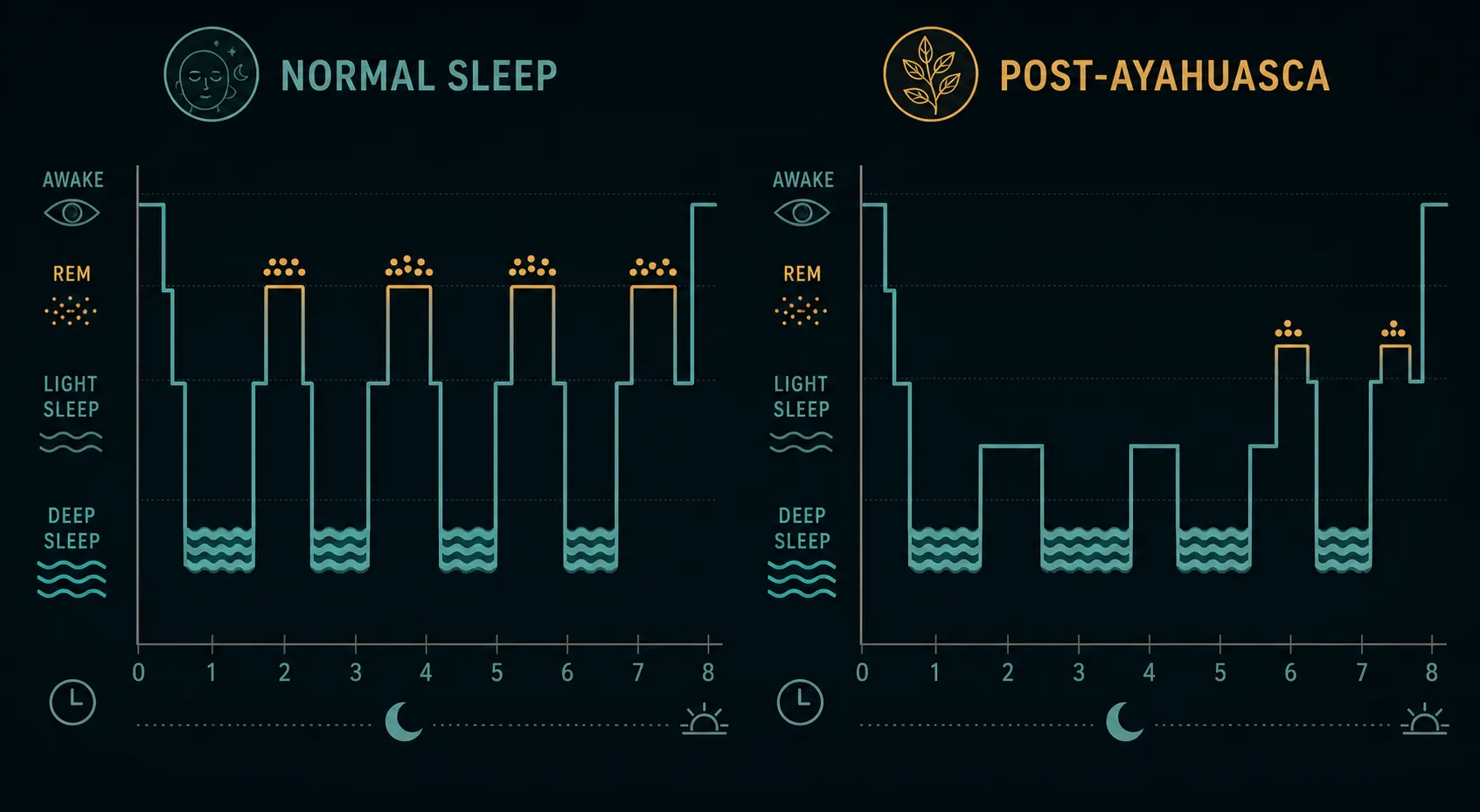
That is the central tension. If someone hears “better sleep,” they may imagine deeper, smoother, more natural sleep architecture. The only direct sleep recording we have points instead to acute REM suppression. The result is not a neat sleep-enhancement finding. It is also not automatically a harm signal.
REM latency means how long it takes to enter the first REM period after sleep begins. Total REM duration means how much time is spent in REM across the sleep episode. Ayahuasca, in that study, pushed REM later and shortened it. Participants did not report that their sleep quality got worse, which is important because sleep architecture and sleep experience do not always move in the same direction.
This is where the usual panic about REM suppression becomes too blunt. REM sleep matters, but less REM on a recording after a drug exposure does not, by itself, prove worse clinical sleep. Many antidepressants, including SSRIs, suppress REM sleep. In antidepressant pharmacology, REM suppression has often been discussed as part of the drug effect rather than simply a side effect to avoid. Ayahuasca’s acute REM pattern may belong in that same conversation, though the mechanism is not settled.
The comparison should stay modest. It does not mean ayahuasca works like an SSRI, and it does not make REM suppression harmless in every person. It means that “reduced REM” is not enough information to decide whether sleep improved or worsened. The clinical question is broader: how did the person function the next day, did insomnia symptoms change over time, did nightmares or mood-linked awakenings improve, and were there adverse effects or unsafe medication combinations?
This same caution applies to other substances people use for sleep. REM suppression can appear in a sleep chart while the person reports easier sleep onset or fewer awakenings. That trade-off is discussed more fully in the Sleep FAQ on THC gummies for sleep, where the same basic problem appears: a substance can change sleep architecture and still feel helpful, at least in the short term.
A better way to read the evidence
| Claim | What the evidence supports |
|---|---|
| Ayahuasca can rapidly improve treatment-resistant depression | Supported by a small placebo-controlled RCT, with a stronger antidepressant response than placebo at day 7 |
| People often report better mental health after ayahuasca | Supported by large observational self-report data, with selection and recall limits |
| Ayahuasca improves sleep as a primary treatment target | Not established; sleep has not been tested as the main outcome in controlled ayahuasca trials |
| Ayahuasca has no sleep-architecture downside | Not supported; the only polysomnography study found acute REM delay and reduced REM duration |
| REM suppression automatically means damaged sleep | Too simplistic; antidepressants can suppress REM, and subjective sleep did not worsen in the ayahuasca PSG study |
A 2025 California Sleep Society review made the broader point even more plainly: across psychedelic research, sleep has not been used as a primary endpoint.[4] That matters because the field is full of plausible sleep stories and short on sleep-specific trials.
A depression trial can tell us whether depressive symptoms moved. A survey can tell us what users remember and report. A sleep-lab study can tell us what happened to sleep stages under a specific condition. None of those alone answers the practical question a sleep-deprived patient is asking: “Will this help my insomnia, and at what risk?”
The most defensible reading is that ayahuasca may improve sleep indirectly in some people whose depression improves. The direct acute sleep signal we have is REM suppression without reported subjective deterioration. Those two observations can coexist. They should not be flattened into either “ayahuasca heals sleep” or “ayahuasca ruins REM.”
Why this is not ready to be called a sleep therapy
A sleep therapy should be tested against sleep outcomes. For insomnia, that could mean sleep onset latency, wake after sleep onset, total sleep time, insomnia severity, daytime impairment, hypnotic use, relapse, or objective sleep architecture. For depression-related sleep disruption, trials would also need to separate mood improvement from sleep improvement rather than assuming one explains the other.
Ayahuasca has not yet cleared that bar. The antidepressant evidence is meaningful but early. The sleep evidence is indirect, observational, or acute-lab based. Retreat reports can be valuable signals, but retreat settings are hard to generalize to ordinary care because the setting changes many things at once: screening, expectations, group context, diet, other substance use, sleep schedule, travel, and follow-up.
Mechanistic findings are interesting, but they do not solve the sleep question either. One study linked ayahuasca’s antidepressant effects with changes in brain-derived neurotrophic factor and inflammatory biomarkers.[7] That helps explain why researchers take the antidepressant signal seriously. It still does not tell us whether a depressed patient’s insomnia improves because of those biological shifts, because rumination decreased, because REM changed, or because the entire care context changed.
The safety boundary is part of the sleep answer
Ayahuasca is not a standardized sleep supplement. It is a psychoactive brew that commonly combines DMT-containing plants with beta-carboline monoamine oxidase inhibitors. That composition is the reason drug interactions matter, and it is also one reason batch-to-batch variability is a real clinical problem rather than a technical footnote.
The clearest medication warning is with SSRIs and other serotonergic drugs. A published report specifically warned about the potential for severe adverse interactions, including serotonin syndrome risk, when ayahuasca preparations are combined with serotonin reuptake inhibitors.[5] A person using an SSRI for depression should not treat ayahuasca as an add-on sleep experiment.
Pregnancy is another hard stop. Animal developmental toxicity research has raised safety concerns for ayahuasca exposure in pregnancy.[6] That evidence does not need to be inflated into human certainty to matter clinically; when a psychoactive preparation has uncertain human pregnancy safety and animal developmental concerns, it does not belong in a pregnancy insomnia plan. Safer routes are covered in pregnancy sleep aid safety and safe sleep aids for pregnancy insomnia.
Age and life stage also matter. There is not enough evidence to make ayahuasca sleep claims for perimenopause-related insomnia, pregnancy insomnia, or older-adult sleep disruption. Those are not interchangeable sleep problems. Hot flashes, circadian phase changes, medication burden, fall risk, pregnancy physiology, and mood symptoms can all change what counts as a reasonable sleep intervention. Readers in those groups are better served by evidence-based life-stage guidance for perimenopause sleep disruption, pregnancy sleep, or older-adult sleep than by extrapolating from small ayahuasca studies.
There is also a legal and quality-control boundary. In the United States, ayahuasca’s DMT component is Schedule I, and ayahuasca has no FDA-approved indication for depression or sleep. The research that exists often comes from Brazil, where religious use is legally recognized, or from settings that do not map cleanly onto routine US medical care. A person who pursues it outside regulated clinical research is taking on legal uncertainty, variable preparation strength, and inconsistent medical screening.
So, does ayahuasca depression therapy have sleep benefits?
Sometimes, possibly, but the benefit is best described as indirect and unproven as a sleep treatment. If ayahuasca rapidly improves depression in a given person, sleep may improve because the depressive drivers of insomnia loosen. That is a plausible clinical pathway, and it is consistent with how many depression treatments help sleep over time.
What has not been shown is that ayahuasca directly improves insomnia, increases restorative sleep, normalizes sleep architecture, or produces durable sleep benefits independent of mood improvement. The only polysomnography evidence points to acute REM delay and reduced REM duration, not a straightforward sleep-enhancing pattern.[3]
For now, ayahuasca should not be treated as an evidence-based sleep therapy. It is an investigational antidepressant intervention with intriguing mood data, indirect sleep reports, acute REM effects, and serious safety constraints. Anyone considering it while taking SSRIs or other serotonergic medication, anyone who is pregnant or could be pregnant, and anyone relying on retreat claims of “better sleep” should stop at that boundary until trials measure sleep as a primary endpoint.
References
- Rapid antidepressant effects of the psychedelic ayahuasca in treatment-resistant depression: a randomized placebo-controlled trial. Psychological Medicine. 2019.
- Ayahuasca use and reported effects on depression and anxiety symptoms: An international cross-sectional study of 11,912 consumers. Journal of Affective Disorders Reports. 2021.
- Daytime ayahuasca administration modulates REM and slow-wave sleep in healthy volunteers. Psychopharmacology. 2008.
- Psychedelics as Therapies. California Sleep Society. 2025.
- Ayahuasca preparations and serotonin reuptake inhibitors: a potential combination for severe adverse interactions. Journal of Psychoactive Drugs. 1998.
- Maternal and developmental toxicity of ayahuasca in Wistar rats. Birth Defects Research. 2018.
- Changes in inflammatory biomarkers are related to the antidepressant effects of ayahuasca. Journal of Psychopharmacology. 2020.
Read the full guide: What to Do Tonight to Sleep Through a Severe Thunderstorm