
What to Do Tonight to Sleep Through a Severe Thunderstorm
If a severe thunderstorm is coming tonight, do the bedroom work in this order: block the storm first, calm your body second, and close the safety loop third. That order matters. A thunderclap can jolt you awake before you have time to reason with yourself, and a phone full of alerts can keep you half on duty even after the room gets quiet.
| Do this tonight | What it solves | How long it should take |
|---|---|---|
| Set up sound and light masking | Reduces thunder and lightning as repeated startle triggers | 5-10 minutes |
| Use one calming script | Gives your body something to do besides brace for the next rumble | 2-5 minutes |
| Make the safety decision before bed | Stops your brain from treating every alert as a new problem to solve | 5 minutes |
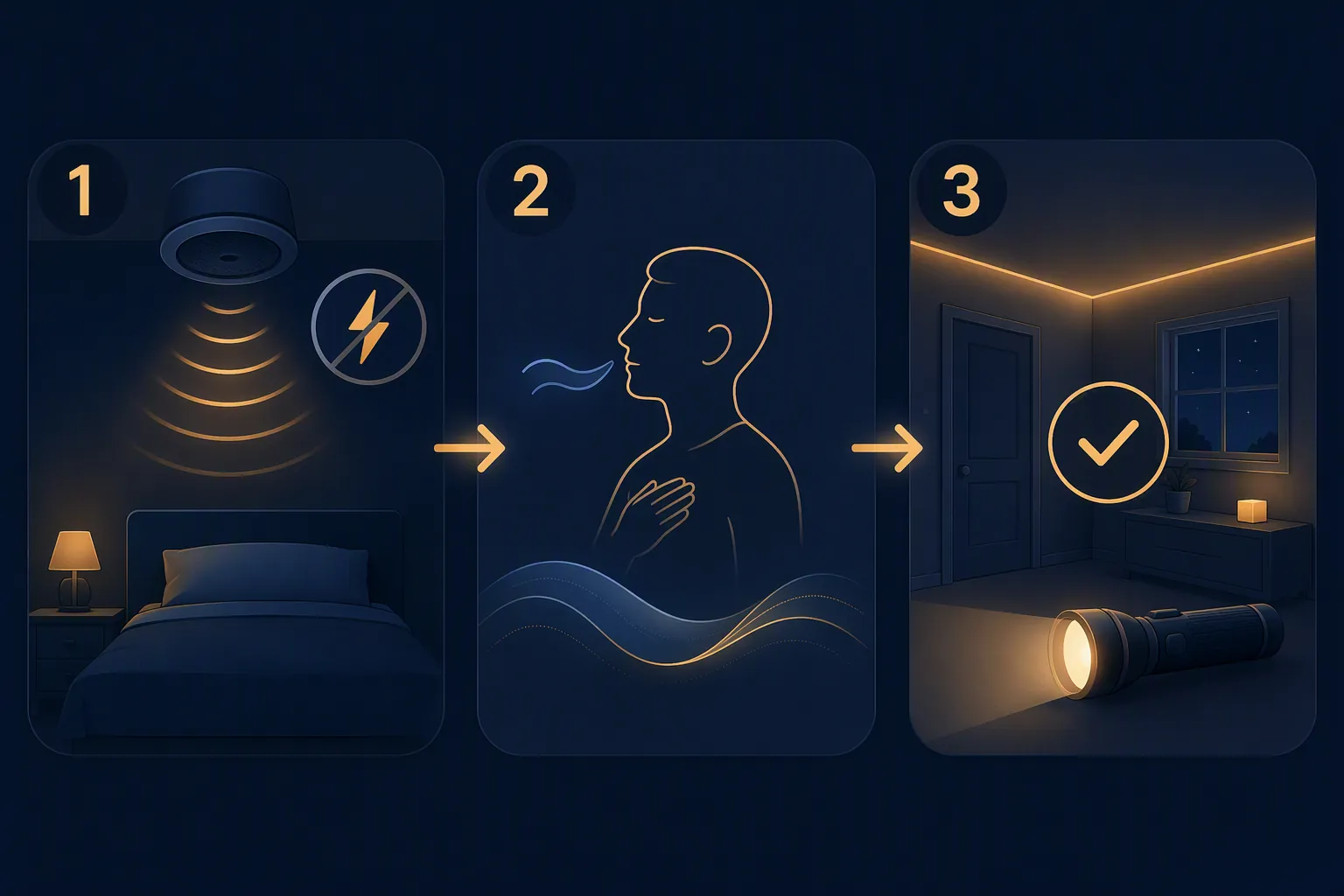
Do not start by lying in the dark trying to be calm while the room flashes white and the window rattles. Give your nervous system some cover first. Then use breathing or grounding. Then make one clear plan for what you will do if the storm status changes.
First, Mask the Thunder Without Blasting Your Ears
Turn on steady background sound before the storm is directly overhead, not after the first crash has already put you on edge. The goal is not to drown out every thunderclap. The goal is to reduce the size of the jump between quiet room and sudden boom.
Brown noise is often a better storm-night starting point than bright white noise because it puts more emphasis on lower frequencies, closer to the low rumble of thunder. White noise can still help, and one study cited by Sleep Foundation found adults fell asleep 38% faster with continuous white noise. That is useful, but it is not a guarantee; the same evidence picture is mixed enough that Harvard Health cautions against treating white noise as settled sleep medicine for everyone.[1][2]
Set the machine or speaker across the room or in a corner, not inches from your pillow. Keep it at a moderate level; Sleep Foundation and Harvard Health both point toward keeping sleep sound below about 50-60 dB rather than turning the bedroom into a test of volume.[1][2] If you have to raise your voice to talk over it, it is probably too loud for sleep.
- Try brown noise, pink noise, a fan, or steady rain audio; avoid tracks with sudden thunder effects.
- Place the sound source away from your head, ideally between you and the window or in a room corner.
- Use enough volume to soften contrast, not enough to overpower the storm.
- If you use earbuds, keep the volume low and avoid sealing yourself off from emergency alerts you actually need.
Handle light at the same time. Close curtains or blinds, turn your body away from the window, and use a sleep mask if flashes keep pulling your attention back outside. This is not the night to perfect the entire bedroom. It is enough to make lightning less dominant and thunder less sharp.
Then Give Your Body One Simple Job
Once the room is less reactive, breathing and grounding have a better chance. If you use them before masking the storm, every crack of thunder can reset the whole exercise. After masking, they become less like a command to relax and more like a script your body can follow.
Use 4-7-8 breathing if your body feels braced
Breathe in through your nose for 4 counts, hold for 7 counts, and exhale slowly for 8 counts. Do a few rounds, then stop counting and let the exhale stay longer than the inhale. If holding your breath feels uncomfortable, shorten the hold. The point is not to perform the numbers perfectly; it is to interrupt the shallow, watchful breathing that tends to come with waiting for the next rumble.
Use 5-4-3-2-1 grounding if your mind keeps scanning
Name 5 things you can see, 4 things you can feel, 3 things you can hear, 2 things you can smell, and 1 thing you can taste. Keep the items ordinary: blanket, pillow, fan, toothpaste, water. You are not trying to prove the storm is harmless. You are reminding your attention that the bedroom is also real.
Skip alcohol as a storm-night sedative. It may make you drowsy at first, but it can fragment sleep later and make the second half of the night more restless. If this is a pattern for you, the sleep effects are explained more fully in what happens to your sleep when you quit alcohol. Tonight, water and a boring routine are better tools.
Close the Safety Loop Before You Try to Sleep
This is the step people skip because it sounds less soothing than breathing. It is also the step that keeps the phone from becoming a bedside threat monitor.
Check the alert status once, using a reliable local source. The National Weather Service distinguishes a watch from a warning: a watch means conditions are favorable, while a warning means hazardous weather is occurring or imminent and you need to take action.[3] That distinction gives your brain a rule instead of a vague assignment to keep listening all night.
| If you see this | Decide this before bed |
|---|---|
| Severe thunderstorm watch | Keep your phone alerts on, finish the bedroom setup, and use scheduled checks rather than continuous monitoring. |
| Severe thunderstorm warning | Follow local instructions and move to your pre-identified safer place if advised or if conditions warrant it. |
| Tornado warning | Do not stay in bed; go to the lowest, most interior available space away from windows. |
Pick the room now: an interior room, hallway, bathroom, closet, or basement area away from windows. Put shoes, a flashlight, a charged phone, necessary medications, and water where you can reach them. The Anxiety & Depression Association of America advises practical preparation for severe storms because it reduces the open-ended uncertainty that feeds anxiety.[4]
Then set a check schedule. If your local risk is active but you are not under a warning, choose a limited interval, such as checking at the top of the hour or only when your weather alert app sounds. Baylor College of Medicine’s pre-storm anxiety guidance, written in a hurricane context, recommends reading updates instead of watching video when possible and limiting storm media rather than keeping coverage running continuously.[5] That applies well on thunderstorm nights: video turns weather into a bedside movie your nervous system has to keep watching.
- Leave emergency alerts audible enough to wake you.
- Silence nonessential notifications.
- Read short text updates instead of watching looping radar and damage footage.
- Put the phone face down or across the room once the next check time is set.
The safety plan does not have to be elaborate. It has to answer the question your brain keeps reopening: if the alert changes, where do I go and what do I bring?
If You Have Extra Sleep Vulnerabilities Tonight
These are practical cautions, not thunderstorm-specific sleep study findings. Use them to adjust the plan without turning the night into a medical project.
- Sleep apnea: use your CPAP as prescribed. Harvard Health, citing a 2010 University of Washington study of 537 patients, reported more apnea events on low-barometric-pressure nights, so storm nights are not the time to skip treatment.[6]
- Perimenopause: hot flashes, lighter sleep, and environmental sensitivity can make a modest disruption feel louder. If this pattern shows up around other environmental triggers too, see why the full moon disrupts perimenopause sleep more.
- Pregnancy: prioritize the safety plan and comfortable positioning. If anxiety, contractions, shortness of breath, or symptoms your clinician has warned you about appear, follow your care instructions rather than trying to sleep through them.
- ADHD: make the plan visible and concrete. Put the flashlight, shoes, phone, and water in one place, then stop adding tasks.
- Older adults: reduce trip hazards before bed. If you may need to move rooms quickly, clear the path now instead of relying on memory in the dark.
If fear of thunder and lightning is a recurring problem outside severe-weather nights, it may be more than ordinary storm unease. Cleveland Clinic describes astraphobia as one of the common specific phobias; the often-cited adult prevalence figure refers to specific phobias broadly, not astraphobia alone.[7] Tonight’s protocol can still help, but repeated panic, avoidance, or loss of sleep is a reason to look for targeted support.
The Bedtime Version
Put on steady low-frequency sound. Block the flashes as much as you reasonably can. Do one breathing or grounding exercise, not five. Check whether you are under a watch or warning, choose your interior room, set your alert rules, and stop watching storm coverage from bed.
You do not have to make yourself unconcerned about the weather. You only have to make the room less startling, give your body a repeatable calming script, and decide in advance what happens if the alert changes. That is enough work for tonight.
References
- What Is White Noise? Sleep Foundation.
- Can White Noise Really Help You Sleep Better? Harvard Health.
- Storm Stress and Anxiety National Weather Service.
- Severe Storms: How to Reduce Your Anxiety Anxiety & Depression Association of America.
- Navigating Pre-Storm Anxiety Baylor College of Medicine, Aug. 2025.
- Thunderstorms and Your Health Harvard Health, 2010.
- Astraphobia (Fear of Thunder and Lightning) Cleveland Clinic.
Read the full guide: Three barriers to sleeping through severe storms at night