
How Student Loan Repayment Stress Disrupts Your Sleep
Yes. Student loan repayment stress can keep you awake at night, and the pathway is not personal weakness or “overthinking.” Financial uncertainty can activate the same bedtime arousal system your body would use for a more immediate threat: faster heart rate, warmer body temperature, cortisol release, tense scanning, and repetitive planning. In a Sleep Foundation survey of 1,000 U.S. adults, 77% said they lost sleep over money worries, so the basic experience is common enough to be almost ordinary, even when it feels lonely at 1:17 a.m. [1]
Student loans add their own kind of fuel because the worry is both emotional and administrative. Borrowers are not just thinking, “I owe money.” They may be trying to choose a repayment plan, understand whether their payment changed, avoid delinquency, call a servicer, or figure out whether a policy update affects them. In a CNBC and Acorns survey published in January 2022, more than 60% of borrowers said student loan debt negatively affected their mental health; in an October 2025 Student Debt Crisis Center survey, 73% of borrowers associated their debt with stress, anxiety, or depression. [2][3]
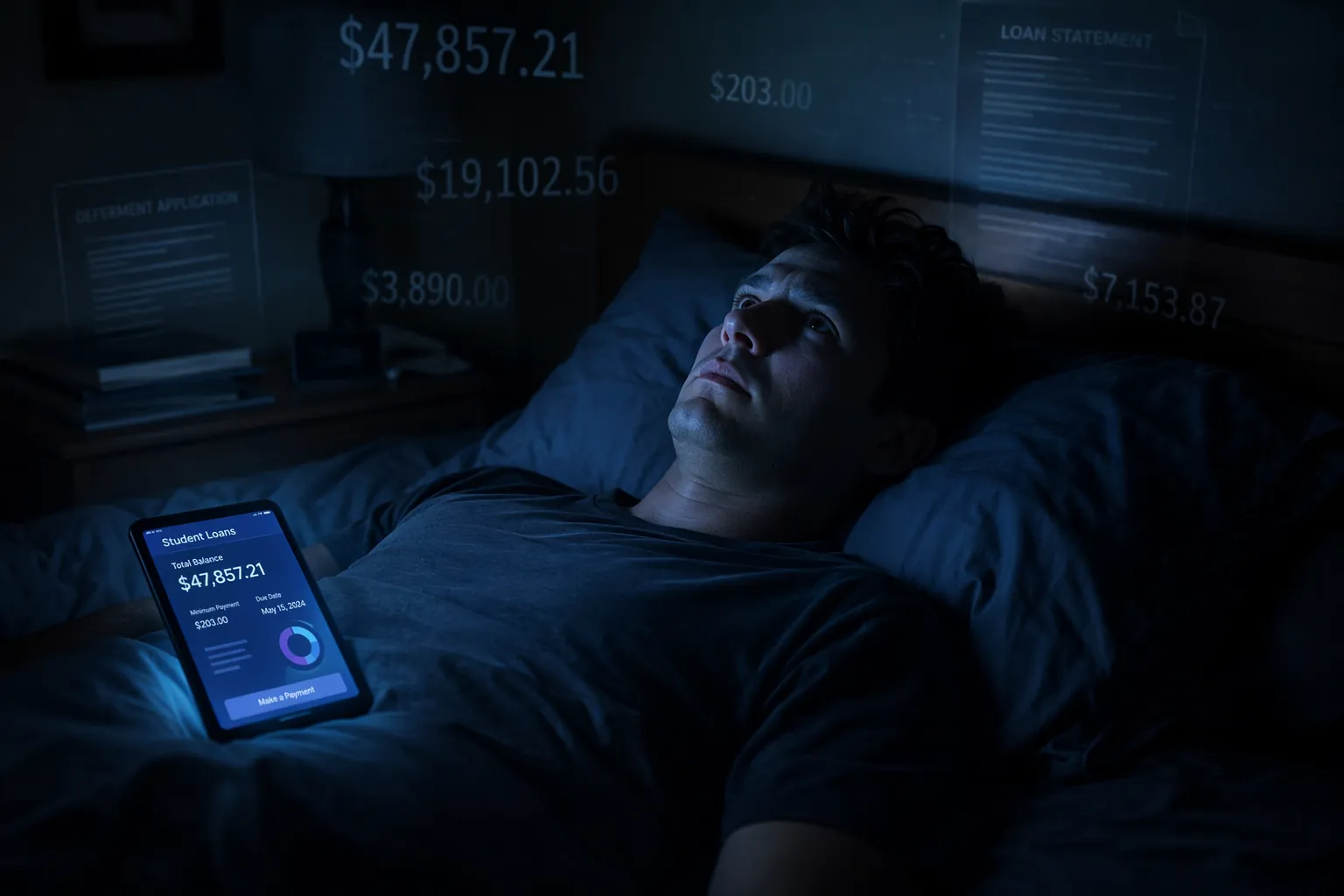
Why does loan stress feel worse at bedtime?
Because bedtime removes the day’s buffers. There is no meeting to attend, no commute to make, no one asking for an answer right now. The body is supposed to downshift into a parasympathetic state, but a repayment portal can pull it in the opposite direction. The American Academy of Sleep Medicine reported that financial worries can raise heart rate and body temperature, both of which work against sleep onset; Dr. Anne Morse described this as a physiological arousal pattern, not just a thought pattern. [4]
That distinction matters. A borrower lying still in bed may look passive from the outside, but internally the system is busy: checking for danger, replaying possible mistakes, rehearsing calls to the servicer, calculating whether a payment will clear, wondering whether a letter was missed. The mind is trying to solve a bureaucratic problem from inside a body that has started behaving as if the problem must be solved immediately.
A Rice University study gives this mechanism a useful shape. Researchers using wrist actigraph data found that economic stress predicted “stress-before-bed” behaviors, including lying awake tense, replaying problems, and mentally planning; those bedtime behaviors then predicted insomnia symptoms and lower sleep satisfaction. The study was conducted with Army and Air National Guard members, not civilian student loan borrowers, so it should not be treated as direct borrower-specific evidence. Still, the pathway it describes is highly relevant: economic stress becomes bedtime cognitive and emotional activation, and that activation makes sleep harder. [5]
What is the sleep-debt cycle?
The cycle usually starts before the night itself. A borrower receives a bill, sees a changed payment, reads a policy update, notices an account status they do not understand, or remembers that they have been avoiding the portal. The uncertainty travels into the evening. At bedtime, the body treats that uncertainty as unfinished danger. Sleep is delayed or broken. The next day, the borrower is expected to make the very choices that sleep loss makes harder.
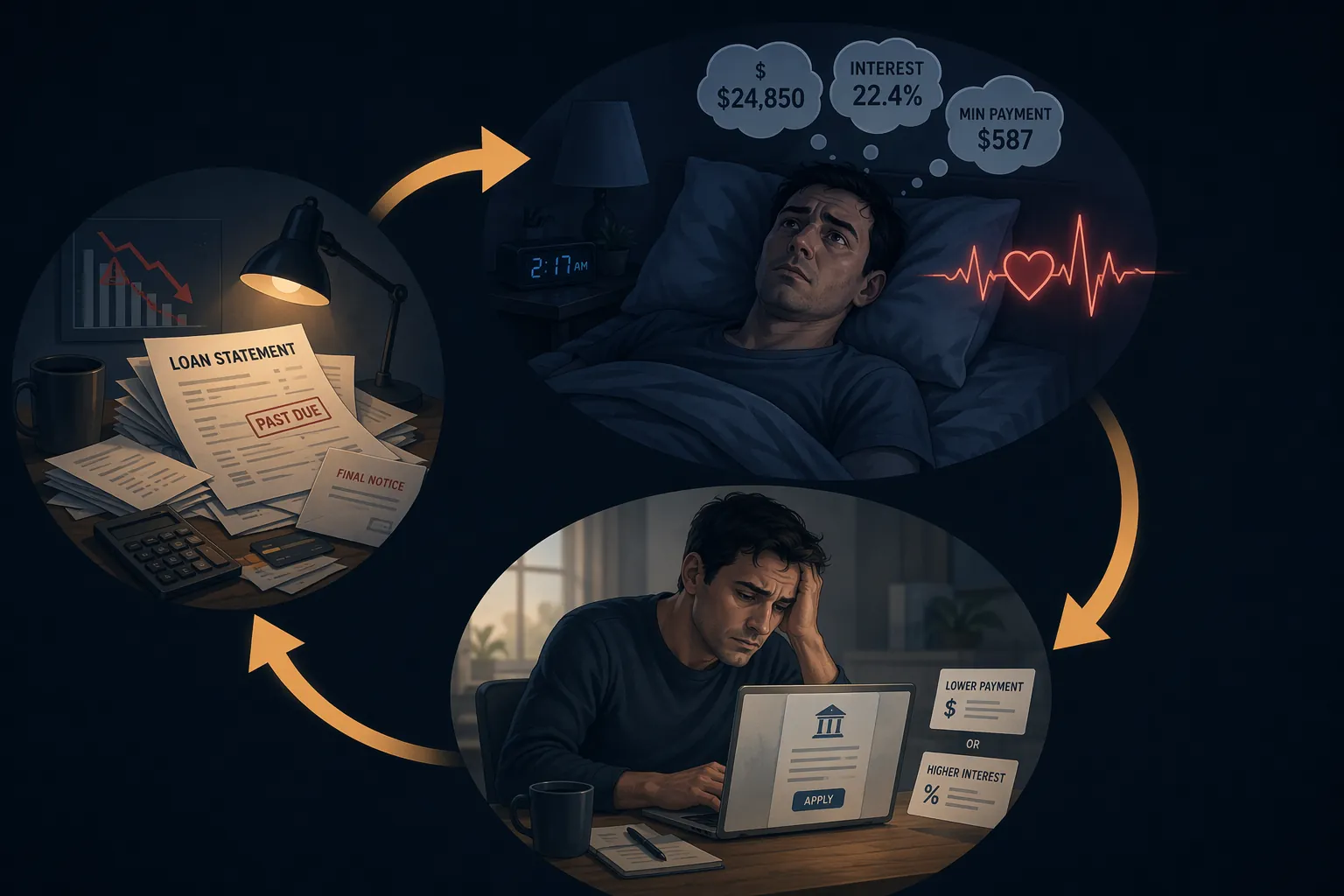
| Part of the cycle | What it can look like |
|---|---|
| Financial uncertainty | A changed payment amount, plan confusion, delinquency notice, or fear of missing a deadline |
| Bedtime arousal | Racing heart, heat, muscle tension, checking apps, replaying conversations, mental math |
| Insomnia symptoms | Trouble falling asleep, waking during the night, or waking too early with the same worry |
| Next-day impairment | More irritability, less patience for forms and calls, poorer impulse control, more avoidance |
| More uncertainty | Delayed decisions, unopened messages, missed information, and another night of threat scanning |
This is where student loan stress becomes more than a nighttime nuisance. Stanford Medicine has summarized evidence that people with insomnia are 10 times more likely to have depression and 17 times more likely to have anxiety, and that poor sleep degrades prefrontal cortex function, which supports emotional regulation and impulse control. [6] That does not mean a bad loan bill causes depression or anxiety by itself. It does mean that once sleep starts to erode, the brain has fewer resources for the calm, sequential work repayment decisions require.
A sleep-deprived borrower may open the same page five times and absorb none of it. They may postpone a call because the hold music feels unbearable. They may pick a plan too quickly just to make the feeling stop, or avoid choosing at all. These are not character flaws. They are predictable consequences of trying to do high-stakes administrative work with a nervous system that did not recover overnight.
Why might this feel especially intense in Q3 2026?
Federal student loan policy has been unusually unsettled. NPR reported that the SAVE plan ended July 1, 2026, new repayment structures including RAP and a new Standard plan launched, graduate borrowing caps changed, Parent PLUS caps changed, wage garnishment resumed, and 5.5 million borrowers were in default. [7] The Federal Reserve’s 2025 report also documented the broader scale of repayment challenges heading into this period. [8]
The sleep claim should stay narrow here. There are not yet peer-reviewed studies showing the specific sleep impact of the July 2026 federal loan changes on borrowers. What the existing sleep research does support is more basic and still important: uncertainty about money can activate the body at bedtime, and bedtime activation can produce insomnia symptoms. When a borrower does not know what plan they are on, whether their payment will rise, or what happens if they are already behind, the uncertainty itself can become the trigger.
Awareness is part of that uncertainty. The Student Debt Crisis Center reported in October 2025 that 1 in 3 borrowers surveyed was unaware of OBBBA-related changes. [3] Not knowing what changed can be just as activating as knowing bad news, because the mind keeps trying to fill the gap.
Should you check your loan account when you cannot sleep?
Usually, no. If you are already awake, tense, and frightened, a loan dashboard is unlikely to become clearer because the room is dark and everyone else is asleep. Nighttime checking often gives the brain a fresh object to rehearse: a number, a warning banner, a due date, a phrase that may or may not apply to you.
A useful boundary is no loan portals, servicer apps, bank apps, repayment calculators, or policy updates after 8 p.m. The exact time can shift for your schedule, but the principle should hold: financial problem-solving belongs in a planned daytime or early evening container, not in bed. Bed is a poor office for threat assessment.
What can you do tonight if repayment stress is keeping you awake?
The goal tonight is not to solve the entire loan problem. It is to teach the body that the bed is not where repayment decisions happen. That is a sleep intervention, not denial.
- Write a brief “worry dump” outside the bed: what you are afraid of, what you need to verify, and the first daytime action. Keep it plain. “Check whether I am on RAP or IBR” is enough.
- Close the notebook or note app deliberately. The closing matters because it gives the brain a physical endpoint.
- If you are awake for about 20 minutes, get out of bed and do something quiet in low light until you feel sleepy. This stimulus-control step helps break the learned link between bed and alarm.
- Do not negotiate with the loan portal from bed. If you remember one more detail, add it to the note and return to the sleep task.
- Use a downshifting cue that does not require belief or optimism: slow breathing, a body scan, a familiar calm audio track, or reading something non-financial.
This is not meant to make a real financial threat imaginary. It is meant to stop the threat from recruiting your bed, your phone, and your exhausted midnight brain into the problem.
What should you do during the day to reduce the real threat?
Sleep techniques work better when the real-world uncertainty is also shrinking. For borrowers, that usually means replacing vague dread with a short list of verified facts: current servicer, current balance, current plan, next due date, delinquency or default status, and whether an income-driven repayment application is needed.
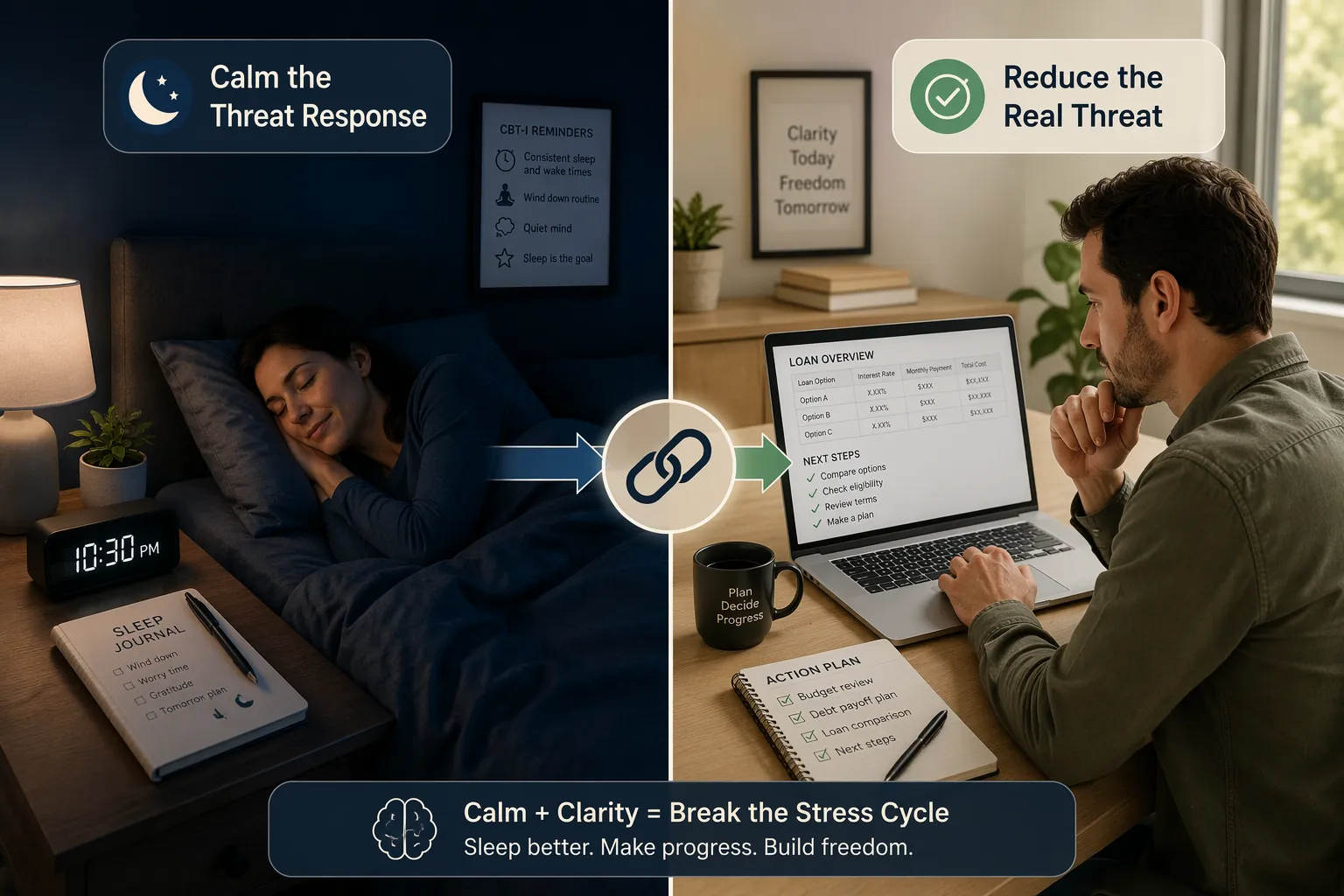
- Use the Education Department’s Loan Simulator during the day to compare repayment options. Treat it as information gathering, not a promise that one plan is automatically best for you.
- Review income-driven repayment options, including RAP or IBR if they apply to your loans and situation. If RAP’s interest-waiver feature may matter for you, verify the rule through official sources or your servicer before relying on it.
- If autopay is safe for your cash flow, check whether the 0.25% interest rate reduction applies. If your account balance is unpredictable, avoiding overdraft risk may matter more than the discount.
- If you are delinquent or in default, prioritize finding out your status and available next steps over comparing every plan. The first task is to reduce immediate consequences.
- Schedule one loan task at a time: one call, one form, one document upload, one verification. Exhausted brains turn giant lists into avoidance.
These are threat-reduction actions, not financial advice. A sleep-health article cannot tell you which repayment plan is optimal. It can say that a borrower who has verified the next concrete step often gives the nervous system less unfinished danger to replay at night.
How does scheduled worry time help?
Scheduled worry time sounds too simple until you notice what it is replacing. Without a container, repayment worry spreads into every quiet space: brushing teeth, turning off the lamp, waking at 3 a.m., checking the phone before sunrise. A scheduled 30-minute window before 7 p.m. gives the mind a place to do the worrying and planning while you are still upright, resourced, and closer to help if you need it.
During that window, write two columns: “worries” and “next actions.” A worry might be “My payment may be higher after SAVE ended.” The next action might be “Use Loan Simulator tomorrow at 11 a.m.” or “Call servicer Tuesday and ask what plan I am currently on.” The action does not need to solve the whole matter. It needs to be specific enough that your brain does not have to keep inventing it in bed.
When is this insomnia, not just a stressful week?
A few bad nights during repayment upheaval can happen without becoming a chronic sleep disorder. It becomes more concerning when trouble falling asleep, staying asleep, or waking too early persists, when you start dreading the bed, or when daytime functioning deteriorates: concentration, driving alertness, work performance, mood, appetite, or impulse control.
Cognitive behavioral therapy for insomnia, or CBT-I, is the treatment to ask about when insomnia has taken on a life of its own. It directly targets the conditioned arousal, unhelpful sleep behaviors, and anxious sleep expectations that financial stress can trigger. If repayment stress is also worsening panic, depression, thoughts of self-harm, substance use, or an inability to function, that deserves clinical support promptly, not another night of trying to reason with yourself alone.
The practical answer
If student loan repayment stress is keeping you awake, treat it as two problems at once: a sleep-arousal problem in the body and a real uncertainty problem in the loan account. Calm the nighttime threat response by moving financial thinking out of bed, using stimulus control, journaling, and protecting the evening from account checking. Reduce the real threat during the day by verifying your status, comparing official repayment options, and taking one concrete step at a time. You do not have to prove that the fear is irrational before you are allowed to sleep.
References
- 77 Percent of Americans Lose Sleep Over Financial Worries, Sleep Foundation, November 2023.
- Student loan debt hurts the mental health of most borrowers, CNBC, January 2022.
- New Report Reveals Alarming Trends Among Americans with Student Debt Amidst a Federal Student Loan System in Crisis, Student Debt Crisis Center, October 2025.
- Financial and health-related worries keeping Americans up at night, survey shows, American Academy of Sleep Medicine, February 2022.
- Losing sleep over money? Rice study reveals how financial stress follows workers to bed, Rice University News, December 2025.
- Sleep, mental health, mood impact science research, Stanford Medicine, August 2025.
- 2026 federal loans student changes SAVE plan, NPR, December 2025.
- Economic Well-Being of U.S. Households in 2024: Higher Education and Student Loans, Federal Reserve, 2025.
Read the full guide: Why Retirement Tax Worries Disrupt Your Sleep