
Why Retirement Tax Worries Disrupt Your Sleep
Retirement is supposed to make sleep easier. One large cohort study of French utility workers found that retirement was associated with a 26% reduction in the odds of sleep disturbance, a result that fits the common hope that leaving work removes one of life’s major sources of strain.[1] But that same comforting story breaks down quickly when the stressor is not a boss, a commute, or a calendar full of meetings. In 2026, 25% of U.S. retirees said they lose sleep over finances, and high taxes appear among the retirement concerns Americans are naming out loud.[2][3]
That is the contradiction at the center of how retirement tax stress affects sleep: leaving work may remove one set of pressures while introducing a different kind of mental load. Required minimum distributions, Social Security taxation, Medicare IRMAA surcharges, taxable account withdrawals, Roth conversions, and bracket management do not feel like ordinary bills. A bill has an amount and a due date. A tax rule has thresholds, interactions, timing questions, and consequences that may not show up until months later.

The important caveat is that most sleep research does not isolate “tax stress” as its own exposure. Studies usually measure broad financial strain, economic stress, or hardship. The tax-specific part of the argument comes from retirement surveys and reporting that name taxes, RMDs, Social Security taxation, and related planning fears as current concerns. So the careful claim is not that RMDs have been proven in a sleep lab to cause insomnia. It is that retirement tax worry behaves like a recognizable subtype of financial stress, and the sleep pathway for financial stress is already well described.
Why Tax Worry Is Harder To Put Down Than A Bill
A fixed expense can be painful and still be cognitively closed. The mortgage is due. The insurance premium increased. The dental bill is sitting on the kitchen table. None of that is pleasant, but the mind can often name the problem.
Retirement tax questions often stay open. If you take more from a traditional IRA this year, you may affect your tax bracket. If provisional income rises, more of your Social Security benefit may become taxable. If modified adjusted gross income crosses an IRMAA threshold, Medicare premiums can rise later. If you delay withdrawals, future RMDs may be larger. If you convert to Roth, you may increase taxes now to reduce uncertainty later. The question is rarely just “Can I afford this?” It becomes “Which future consequence am I accidentally creating?”
That open-endedness matters at bedtime. The brain is poor at distinguishing between a solvable planning task and an unresolved threat when the lights are out. A retiree may not be actively filing a return at 2 a.m., but the mind can still reopen the worksheet: Was that distribution too large? Did the mutual fund capital gain change the estimate? Will next year’s Medicare premium jump? Should withdrawals come from the brokerage account first? The body receives the whole exercise less like arithmetic and more like surveillance.
This is also why “you have enough money” may not be very soothing. The worry is not always about immediate poverty. It may be about making a wrong move in a system that feels opaque. Allianz Life’s 2026 study found that 67% of Americans fear running out of money more than death, but the quieter number may be more relevant for sleep: 48% have no written financial plan.[3] Without a written sequence, the brain has to keep re-running the sequence itself.
The Bedtime Pathway: From Financial Strain To Insomnia Symptoms
The clearest evidence connecting money worry and sleep is work on how economic stress follows people into the pre-sleep period. A 2025 Rice University study led by Danielle Brossoit traced a pathway from economic stress to stress-before-bed behaviors and then to more insomnia symptoms, lower sleep satisfaction, and greater daytime impairment.[4] The sample was Army and Air National Guard members, not retirees, so it should not be treated as a direct study of retired households. But the behavioral chain is highly recognizable: financial stress does not stay in the daytime ledger. It becomes checking, rehearsing, calculating, and scanning before bed.
Tax stress gives that chain unusually durable material. A person can check an account balance and close the browser. It is harder to close a question whose answer depends on income thresholds, future withdrawals, inflation adjustments, market returns, and tax rules that may change. The mind keeps searching for the missing certainty.
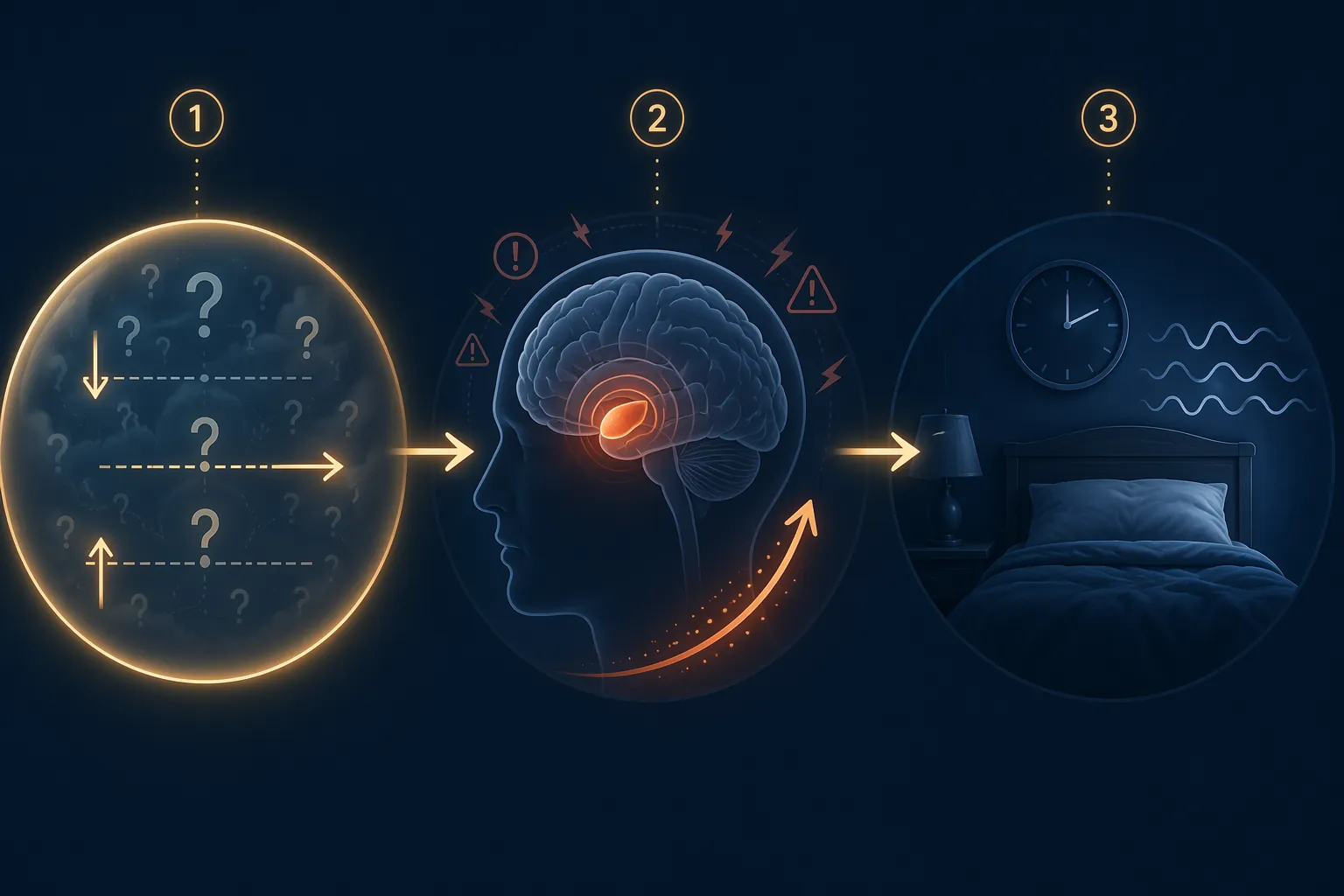
Once that search starts in bed, it competes directly with sleep initiation. Falling asleep requires a shift toward parasympathetic dominance: lower vigilance, reduced threat monitoring, and enough safety for the brain to stop problem-solving. Financial uncertainty pushes in the opposite direction. The amygdala responds to perceived threat, and financial uncertainty can be framed by the brain as danger rather than abstraction.[7] Cortisol and alertness rise when the body decides something important remains unresolved. That is useful if there is a real emergency. It is punishing when the “emergency” is a Medicare surcharge calculation that cannot be completed until morning.
For a deeper look at the broader anxiety-sleep mechanism, Restful Ground’s guide to the anxiety and sleep bidirectional loop covers how worry and sleep loss can begin reinforcing each other. Retirement tax stress fits into that loop because it supplies a recurring, specific trigger.
What The Sleep Data Shows When Money Feels Unsafe
The most concrete sleep numbers come from research on financial strain in older adults. In a 2007 polysomnography study of 75 elders, those reporting financial strain had lower sleep efficiency, took longer to fall asleep, and spent more time awake after sleep onset than those without financial strain. Sleep efficiency was 73.8% in the financially strained group versus 80.9% in the group without strain. Sleep latency was 35.4 minutes versus 23.5 minutes. Wake after sleep onset was 87.9 minutes versus 68.9 minutes.[5]
| Sleep Measure | With Financial Strain | Without Financial Strain |
|---|---|---|
| Sleep efficiency | 73.8% | 80.9% |
| Time to fall asleep | 35.4 minutes | 23.5 minutes |
| Wake after sleep onset | 87.9 minutes | 68.9 minutes |
The study was small and cross-sectional, so it cannot prove that financial strain caused the sleep differences. Still, the pattern is clinically useful because it maps onto what people describe: not only waking up tired, but taking longer to fall asleep and spending more of the night awake. Those are exactly the sleep complaints that thrive when the mind is trying to finish unfinished business.
Another cohort finding points in the same direction. In the Specchio cohort, financial hardship was associated with nearly double the odds of insomnia, with an odds ratio of 2.11 among 4,388 participants.[9] Again, this is not a tax-specific result. It is evidence that when money feels unsafe, sleep is one of the places that unsafety shows up.
The Retirement Sleep Paradox
The GAZEL cohort is useful because it prevents an overly gloomy story. Retirement can improve sleep. In that study of 14,714 French utility workers, sleep disturbance decreased after retirement, and the odds of sleep disturbance were 26% lower after retirement than before it.[1] Work strain matters. Removing it can help.
But the same study has limits for U.S. retirees trying to navigate tax-dependent income decisions. The cohort was French, the mean retirement age was 55, and 80% had a pension.[1] That context is not the same as a U.S. household coordinating Social Security, IRA withdrawals, brokerage gains, Medicare premiums, and possible Roth conversions. The lead author also cautioned that where financial security is lacking, retirement stress may disturb sleep even more than before retirement.[1]
That caveat is the hinge. Retirement itself may reduce one source of sleep disturbance, while financial insecurity introduces another. For many people, tax uncertainty is not the whole financial problem, but it can be the part that keeps reopening because it is technical, consequential, and difficult to settle without a plan.
Restful Ground’s article on how retirement affects sleep quality looks more broadly at that transition. Tax worry is one narrower version of the same larger truth: retirement changes the source of strain as much as it changes the daily schedule.
Why RMDs, Social Security Taxation, And IRMAA Make Good Insomnia Fuel
Some worries are vague because the person has not looked closely enough. Retirement tax worries are often vague because looking closely reveals more moving parts. That is the difference.
- RMD timing can turn a retirement account from a private reserve into a forced taxable distribution schedule.
- Social Security taxation can make the tax impact of an extra dollar of income feel less intuitive than a simple marginal bracket.
- IRMAA surcharges can make retirees worry that one income decision will echo later through Medicare premiums.
- Withdrawal sequencing can make every spending need feel like a choice among future tax consequences.
- Bracket management can turn ordinary life events, such as a home repair or family help, into late-night tax projections.
Current retirement reporting reflects those specifics. Kiplinger named RMDs, ACA subsidies, and Social Security taxation among sleep-disrupting retirement fears in 2026.[6] That does not prove that these rules independently cause insomnia. It does show that the language retirees use for financial worry is not just “the market” or “inflation.” It is also the rule maze around income.
Inflation can do something similar by making the future feel less controllable; Restful Ground covers that neighboring problem in why inflation keeps retirees awake. Tax stress adds a different texture. It is not only “prices are rising.” It is “I may be punished for arranging my own income in the wrong order.”
Why Relaxation Advice Often Misses The Trigger
Breathing exercises, dimmer lights, and fewer late-night screens are not useless. They can lower arousal and protect the sleep window. But if the bedtime trigger is a tax question that has no written answer, relaxation advice may be asking the body to stand down while the mind still believes it is on duty.
This is the practical value of making the worry specific. “Taxes are a mess” is not sleepable. “Ask whether this year’s IRA withdrawal affects next year’s Medicare premium” is at least a task. “Review RMD timing with the planner on Tuesday at 10 a.m.” is even better, because it gives the brain a place to put the problem other than the pillow.
Scheduled worry time is one way to move financial rumination out of bed. In 2026 retirement-stress coverage, CFP Cynthia Kirkpatrick put the planning principle plainly: “Safety is created from building a clear plan.”[8] The sleep relevance is not that a plan guarantees the best tax outcome. It is that a plan reduces the number of unresolved loops the brain has to monitor overnight.
Tax-Aware Planning As A Sleep Intervention
There is a careful line here. Tax-aware withdrawal planning is not a treatment for insomnia in the medical sense, and persistent insomnia deserves appropriate clinical care. It also is not something a sleep article should turn into tax advice. The useful claim is narrower: when tax uncertainty is the recurring bedtime trigger, reducing uncertainty can reduce cognitive arousal.
A sleep-protective tax plan does not need to answer every future scenario. It needs to close the loops that keep reopening at night. For one household, that may mean writing down which account funds monthly spending. For another, it may mean estimating how a planned withdrawal could affect taxable Social Security income. For another, it may mean asking a professional to map possible IRMAA exposure before a large conversion or sale. The sleep benefit comes from turning a free-floating threat into a scheduled, reviewable decision.
Older adults can also be more vulnerable to stress-related sleep disruption because sleep architecture changes with age. That does not mean every sleep change after 50 is financial, or that every night waking has a tax explanation. It means the margin for extra arousal may be smaller. For broader physiological context, Restful Ground’s article on age-related SIRT1 and NAD decline and sleep explains why later-life sleep can become more fragile.
A useful first pass is not a full tax overhaul. It is a bedtime boundary:
- Name the exact tax worry in writing before evening, such as RMD timing, Social Security taxation, IRMAA, or withdrawal order.
- Write the next action beside it, not the whole solution.
- Assign a time to review it when documents, calculators, or professional help are available.
- Keep tax documents and account portals out of the bed routine unless there is a true deadline.
- If the worry returns at night, remind yourself of the scheduled review rather than trying to solve the rule in the dark.
This does not make the tax system simple. It does not promise that a retiree will never get a surprise bill, cross a threshold, or regret a timing decision. It only respects what insomnia already knows: unresolved work belongs in daylight, not in bed.
If retirement tax worry is the thought that reliably arrives after lights-out, the first sleep intervention may not be another breathing exercise. It may be making the tax question specific, written, scheduled, and planned enough that the brain no longer has to keep watch until morning.
References
- Effect of retirement on sleep disturbances: the GAZEL prospective cohort study, PMC, 2009
- 1 in 4 US Retirees Lose Sleep Over Finances, Yahoo Finance, 2026
- Fear Of Running Out of Money Over Death At Record High, Allianz Life, 2026
- Losing sleep over money? Rice study reveals how financial stress follows workers to bed, Rice University, 2025
- Financial Strain is a Significant Correlate of Sleep Continuity Disturbances in Late-Life, PMC, 2007
- Sleep Better: Slay These Four Retirement Fears, Kiplinger, 2026
- Top 5 Causes of Financial Stress and Anxiety in Retirement and How to Overcome Them, ThriveRetire
- How To Overcome Retirement Stress and Sleep Better, Yahoo Health, 2026
- Financial Hardship Linked to Poor Sleep, Short Sleep, Insomnia, SleepWake Advisor
Read the full guide: Why Heat Disrupts Your Sleep and What to Do About It