
How Cheating Rumors Can Disrupt Your Sleep
Yes: cheating rumors can affect sleep quality even when nothing has been confirmed. Suspicion can keep the brain in a state of checking, replaying, and preparing for threat, and that state is not friendly to sleep. No: insomnia does not prove the rumor is true. A sleepless body is evidence of distress, not evidence of infidelity.
There is peer-reviewed research on this exact middle place: suspected infidelity, before certainty. In a 2021 study in the Journal of Social and Personal Relationships, people who suspected a partner’s infidelity reported worse psychological and physical well-being, and insomnia was among the physical symptoms measured; women in the sample were more likely than men to report insomnia specifically.[1]
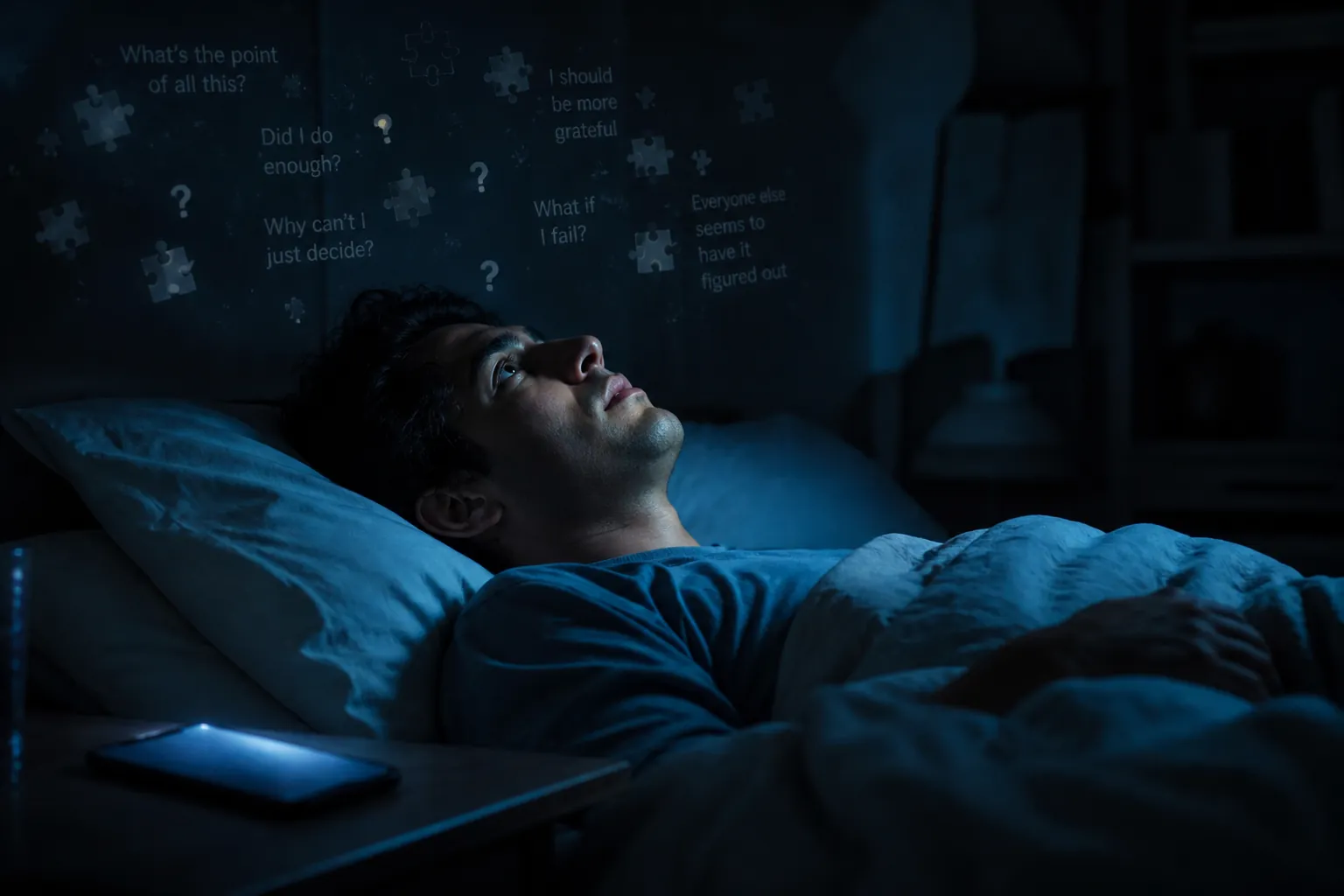
Why suspicion can feel physical before anything is proven
The hard part about suspicion is that it asks the nervous system to live without a clean answer. A person may have a rumor, a changed tone, an unexplained absence, a screenshot, or someone else’s comment. None of that may be enough to know what happened. It can still be enough to make the mind start surveillance.
At night, the usual daytime buffers fall away. There are fewer tasks competing for attention. The phone is close. Memory gets selective. One sentence from earlier in the day starts to carry more weight than it can safely hold. The person trying to sleep is not calmly “thinking it through”; they are often cycling through partial evidence, imagining outcomes, and trying to solve a problem that has no available solution at 2 a.m.
That is one reason advice like “don’t worry until you know” can land so badly. The body does not always wait for verified facts before it reacts. Uncertainty itself can be treated as a possible threat, especially when the uncertainty concerns attachment, safety, housing, family, sexual health, finances, or the future of a relationship.
What the suspected-infidelity study actually found
The central study here is “Suspicious minds: The psychological, physical and behavioral consequences of suspecting a partner’s infidelity,” by Weigel and Shrout. It examined more than 200 participants and focused not only on confirmed betrayal, but on the consequences of suspecting a partner may have been unfaithful.[1]
| Finding | What it means for sleep |
|---|---|
| Suspected infidelity was associated with lower well-being. | The distress of not knowing may be consequential on its own, not merely a weak version of confirmed betrayal. |
| Participants who suspected infidelity reported more physical symptoms, including insomnia. | Sleep disruption can appear as part of the body’s stress response to relational uncertainty. |
| Women in the sample were more likely than men to report insomnia. | This is a study finding, not a universal rule about women, men, or every relationship. |
| The study controlled for relationship length, commitment, and alternative explanations. | The design strengthens the argument that suspicion itself matters, while still falling short of final proof of causation. |
The study matters because it gives a nameable research basis to an experience many people dismiss in themselves. Someone can be suffering before they have confirmation. They can be sleeping worse, feeling physically keyed up, and functioning poorly without being “dramatic” or “making it up.”
The limits matter just as much. The sample was predominantly young, with a mean age of about 21; it was 61% female, and 74% of participants were in dating relationships and not cohabiting.[1] That means the findings should not be stretched into a universal claim about older adults, marriages, cohabiting couples, men, women, or every cultural context.
Insomnia was also one physical symptom among several, not the study’s only or primary sleep endpoint. The authors’ controls make the suspicion-to-well-being pathway more plausible, but the research was not a long-term experiment that can prove, once and for all, that suspicion caused each person’s insomnia.[1] A careful reading is still strong enough for the practical point: if your sleep deteriorated after you began suspecting infidelity, that pattern is recognizable in the research.
The sleep pathway: checking, rumination, hyperarousal
Sleep usually needs some degree of surrender. Suspicion trains the opposite skill. It asks for vigilance: notice the inconsistency, remember the time stamp, compare the story, search the face, review the message, decide whether to ask, decide whether asking will make things worse.
That vigilance can interfere with sleep in several ordinary ways. Rumination can delay sleep onset because the mind keeps returning to the same unresolved material. Hyperarousal can make the body feel too alert for deep rest. Nighttime awakenings can become longer because waking up is quickly followed by another round of checking or replaying. Even if the person is exhausted, the system responsible for threat detection may not be ready to stand down.
Betrayal-trauma resources describe this kind of fight-or-flight activation after trust has been violated, including hyperarousal and difficulty feeling safe.[2] That framework can be useful, as long as it is not used to overdiagnose someone whose situation is still uncertain. In the suspicion stage, the body may be reacting to perceived threat and ambiguity, not necessarily to a confirmed event.
Suspicion is not the same as confirmed betrayal
Confirmed infidelity can bring additional layers: grief, anger, sexual health concerns, financial consequences, family disruption, shame, intrusive images, and decisions about separation or repair. Some popular and clinical-adjacent writing uses the term post-infidelity stress disorder, or PISD, to describe the anxiety, depression, PTSD-like symptoms, and insomnia that can follow betrayal. Verywell Mind reports that 30% to 60% of betrayed individuals experience clinically meaningful anxiety, depression, or PTSD symptoms, including insomnia.[3]
That context is helpful, but the boundary is important: PISD is not a formal DSM diagnosis.[3] It should not be used as a shortcut to label every distressed person who has heard a rumor. It is more useful here as a reminder that relational threat can affect the body and sleep, and that confirmed betrayal may intensify what suspicion has already started.
For the person still in uncertainty, the most honest statement is narrower: suspected infidelity is associated with worse well-being and physical symptoms, including insomnia, and the likely pathway runs through stress, rumination, and hyperarousal.[1] That does not settle what happened in the relationship.
What to do with the sleep problem while the relationship question is unresolved
A sleep article cannot tell you whether your partner cheated. It can say that losing sleep over unconfirmed suspicion deserves care now, not only after proof arrives. The body is already paying a cost.
- Treat the insomnia as real. If sleep has been disrupted for more than a short stretch, or if it is affecting work, parenting, driving, mood, or safety, it is worth addressing directly.
- Reduce nighttime evidence-reviewing where possible. This may mean keeping the phone away from the bed, not rereading messages after a certain hour, or writing down the unresolved question and deciding when, during the day, you will return to it.
- Separate “I am activated” from “I have proof.” The first may be completely true even when the second is still unknown.
- Do not use alcohol as a sleep strategy. Betrayal-recovery sleep guidance warns that alcohol can worsen sleep quality and disrupt REM sleep, which is involved in emotional processing.[4]
- Consider support for the part you can name: anxiety, insomnia, obsessive checking, panic, relationship distress, or the need for a grounded conversation. You do not have to prove betrayal before asking for help with sleep loss.
Some betrayal-recovery sleep guidance uses a practical “three dials” frame: thoughts, habits, and surroundings.[4] In this situation, that might mean noticing the thought loop without treating it as a court proceeding, changing the habit of late-night checking, and making the bedroom less available to investigation. Those steps will not answer the relationship question. They are meant to give your nervous system fewer reasons to keep treating the night as an emergency.
If the insomnia continues, cognitive behavioral therapy for insomnia, anxiety treatment, individual therapy, or couples therapy may be more appropriate than another night of private detective work. The rumor may or may not be true. The sleep disruption is already happening.
References
- Suspicious minds: The psychological, physical and behavioral consequences of suspecting a partner's infidelity, Journal of Social and Personal Relationships, 2021.
- Betrayal Trauma, Healthline.
- Post Infidelity Stress Disorder, Verywell Mind, 2026.
- How To Get More Sleep After Infidelity With Yana Vriesinga, Andrea Giles.
Read the full guide: How to Watch a Blood Moon Without Ruining Your Sleep