
How to Watch a Blood Moon Without Ruining Your Sleep
You do not have to stay awake for the whole lunar eclipse to see the blood moon. The sleep-preserving version is simpler: go to bed at your normal time, check the totality time for your location through NASA, TimeAndDate.com, or a local eclipse timing tool, set one alarm for about 20 minutes before totality begins, keep the room and viewing spot dim, watch the red moon near peak, and get back into bed before your brain decides the day has started.
The trick is not to stay up. Sleep first, wake for the visually important part, and make the interruption short enough that the rest of the night still has a chance.
The Short Version: Sleep First, Watch Totality, Go Back to Bed
Use this as the basic plan for any future total lunar eclipse:
- Go to bed at your usual time instead of waiting through the early eclipse phases.
- Look up the local start of totality, not just the overall eclipse start time.
- Set an alarm about 20 minutes before totality begins.
- Use the dimmest practical light, skip phone scrolling, and avoid turning the outing into a photo project.
- Watch the red moon during totality or near peak, then return to bed within roughly 30–40 minutes if you can.
- If the next day feels heavy, use a 15–20 minute nap rather than a long afternoon sleep.
The March 2026 total lunar eclipse is a useful example, even though it has already passed. NASA described totality for that eclipse as lasting about 58 minutes, while the whole eclipse took much longer from first subtle shading to final exit.[1] Some U.S. viewers had sample totality timing around the middle of the night or early morning, which is exactly the kind of schedule that tempts people into a bad all-nighter.[2] The next total lunar eclipse after March 2026 is December 31, 2028, so the useful habit is not memorizing the 2026 clock time; it is learning to plan around totality for your own location.[2]
Why Totality Is the Part Worth Waking For
A total lunar eclipse has several phases, but they are not equal from a tired human’s point of view. The penumbral phase can be so subtle that a casual observer may mostly see a normal-looking moon with slight shading. The partial phase is more obvious. Totality is the part where the moon sits fully in Earth’s shadow and can take on the copper, rust, or red color that gives “blood moon” its nickname.
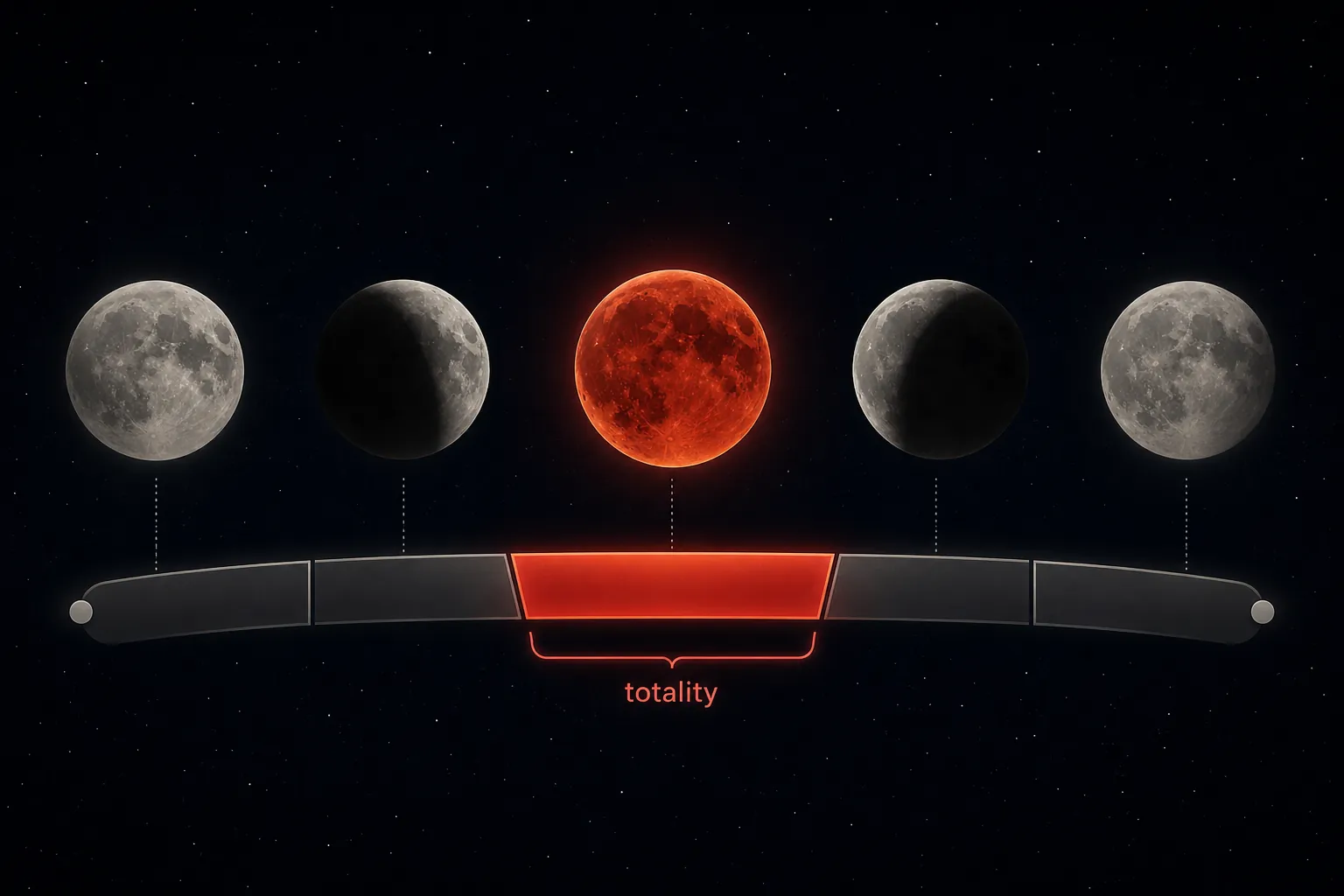
This distinction matters because many eclipse guides list the entire event from penumbral start to penumbral end. That can make the night look like a five-hour assignment. For sleep, it is not. If your goal is to see the blood moon rather than document every stage, totality is the appointment.
For the March 2026 eclipse, NASA’s roughly 58-minute totality window was long enough to wake, orient yourself, look outside, catch the red moon, and return to bed without treating the whole night as lost.[1] Future eclipses will have their own local timing and duration, so check the specific totality window before setting an alarm.
| Eclipse phase | Sleep-preserving choice |
|---|---|
| Penumbral phase | Usually skippable unless you are intentionally observing the full sequence. |
| Partial phase | Interesting, but not necessary if sleep is the priority. |
| Totality | Plan around this window; it is when the blood moon effect appears. |
| Post-totality phases | Go back to bed unless you have no morning obligations. |
Set the Alarm So It Does Not Become a Second Morning
The alarm should wake you before totality, not before the eclipse begins. About 20 minutes gives you enough time to get up, use the bathroom if needed, put on a coat, step outside or reach a window, and let your eyes adjust without rushing. It also protects you from the classic mistake of waking too early, getting bored, opening your phone, and accidentally moving from “brief viewing” into “I guess I am awake now.”
Before bed, decide exactly where you will view from. If you need shoes, a robe, glasses, binoculars, or a key to a balcony or yard, place them together. The fewer decisions you make at 3 a.m., the less alert you become. This is not about being precious; it is about keeping the waking narrow.
Set one alarm if you trust yourself. If you need a backup, set it a few minutes later rather than half an hour earlier. Use a quiet alarm tone if that is enough to wake you. A blaring alarm, bright bathroom light, and immediate group-chat check are a very efficient way to convince your nervous system that the night is over.
A worked example from March 2026
For the March 2026 eclipse, some U.S. timing examples placed totality around 2:45 a.m. PST and 5:45 a.m. EST.[2] A sleep-preserving version would have looked like this: go to bed at the normal time, set the alarm roughly 20 minutes before local totality, watch through the most vivid part of the red moon, and return to bed without staying through every later phase.
Do not reuse those clock times for a future eclipse. Lunar eclipse visibility and timing depend on your location. For the next one you plan to watch, use NASA, TimeAndDate.com, or another local timing tool and anchor your alarm to the start of totality, not to a national headline time.
Prepare the Night Like a Planned Interruption
If you know the eclipse date in advance, the best preparation is not heroic endurance. It is shaving down your sleep deficit before the event. Mayo Clinic recommends extending sleep by about 30–60 minutes in the 2–3 nights before a planned late night.[3] For a blood moon, that might mean getting into bed earlier for a few nights so the eclipse waking lands on a less depleted system.
Think of this as deficit reduction, not a magic shield. Extra sleep beforehand does not make a middle-of-the-night waking invisible. It simply gives you more margin. If you already use sleep banking for races, travel, or late matches, the same lower-intensity principle applies here; the site’s sleep banking guide goes deeper on that strategy.
The day of the eclipse, keep the plan boring. Eat normally. Avoid turning the evening into a pre-eclipse vigil. Charge your phone if you need it for the alarm, then put it away. If you want binoculars or a camera, set them up before bed. The more ceremony you add after the alarm, the harder it is to keep the waking short.
Keep Light Low, Especially From Screens
Light is the part people underestimate. You can wake briefly and still feel sleepy; you can also wake briefly, blast your eyes with bathroom LEDs and a phone screen, and become annoyingly alert. For this kind of viewing, use the minimum light needed for safety. No overhead lights if a dim hallway light, night-light, or small warm lamp will do.
Try not to use your phone as the viewing companion. Checking the eclipse time is fine if necessary; scrolling photos, messages, weather threads, or social posts is the problem. It adds light, emotion, decisions, and time. If you need a screen, lower the brightness before bed and use it only for the task.
Your bedroom should also be ready for re-entry. Keep it cool, dark, and quiet before you leave so you are not fixing the sleep environment after the eclipse. If temperature, light, or noise are common reasons you wake up fully, handle them before the alarm; the site’s sleep environment guide can help with that setup.
Be Careful With Caffeine
Caffeine is a poor tool for a 30-minute eclipse waking. It may help you feel alert, but it is also good at lingering past the moment you need it. General all-nighter guidance discusses caffeine as a wakefulness aid, but for a blood moon the goal is the opposite: wake just enough to look at the sky, then become boringly sleepy again.[4][5]
If you are watching near your normal wake time, ordinary morning coffee may be fine. If you intend to return to bed, skip caffeine if you can. If you choose to use it anyway, stay conservative: keep total intake within the commonly used 200–400 mg range and stop at least 4–6 hours before the sleep period you are trying to protect.[4][5] For more detail on why timing matters, see the site’s guide to how coffee interferes with sleep.
The funny little discipline here is accepting that you are supposed to be a bit groggy. That is not a failure of eclipse viewing. That is the mechanism that lets you get back under the covers.
Get Back to Bed Before the Wake-Up Expands
Set a return limit before you stand up. For many people, the useful target is to be back in bed within about 30–40 minutes. Verywell Health’s all-nighter recovery guidance discusses how sleep architecture and recovery sleep matter after missed sleep, and the practical point here is that a short waking leaves more of the night available than a drifting, open-ended one.[4]
Once you are back in bed, do not audit your sleep. Do not calculate how many hours remain. Do not open a sleep tracker. If you are awake for a while, use the same low-stimulation routine you would use for any nighttime waking: comfortable position, slow breathing, dim room, no clock-checking spiral. The goal is not to force sleep; it is to stop feeding wakefulness.
If you live with other people, plan the logistics kindly. Put the alarm near you, not across the room if it will wake everyone. Close doors quietly. Keep pets out of the plan if they are likely to interpret 3 a.m. movement as breakfast. The person who shares your bed may not find your lunar enthusiasm as charming at that hour as the internet promised.
Use a Short Nap the Next Day If You Need One
Even a well-managed eclipse waking can leave a little residue the next day. If you feel foggy, a short nap is the safer repair than sleeping for two hours in the late afternoon. Sleep Foundation and Mayo Clinic both describe brief naps in the 15–20 minute range as useful for alertness without the same risk of grogginess or interference with the next night’s sleep.[5][6]
Keep the nap early enough that it does not steal pressure from bedtime. Set an alarm. Treat it as a reset, not a second sleep episode. If you cannot nap, bright daytime light, a normal meal schedule, and a reasonable bedtime are usually more useful than trying to punish yourself awake until midnight.
Does the Blood Moon Itself Affect Sleep?
The honest answer is narrower than the folklore. A blood moon occurs during a full moon, and some research has looked at sleep around the full moon. A 2013 study by Cajochen and colleagues reported about a 30% reduction in deep-sleep brain activity around the full moon under controlled laboratory conditions.[7] A 2021 Science Advances study by Casiraghi and colleagues found later sleep onset and shorter sleep duration on nights leading up to the full moon in the populations they studied.[8]
That does not prove that a lunar eclipse has its own special sleep-disrupting effect. The more defensible explanation is a combination of possible full-moon-related sleep changes, bright moonlight in some settings, and the very ordinary behavioral disruption of setting an alarm to go look at the sky. If you want the deeper evidence layer, read Does a Full Moon Affect Sleep? or the practical full moon sleep protocol.
No peer-reviewed studies specifically test sleep during a lunar eclipse as a separate exposure. So it is better not to blame the eclipse for everything. The part you can control is the plan: timing, light, caffeine, and how quickly you return to bed.
Who Should Skip the Live Alarm
A short planned waking is a reasonable compromise for people whose sleep is fairly stable. It is not automatically wise for everyone. If you are in a stretch of severe sleep restriction, dealing with an insomnia disorder, managing a rigid medication schedule, recovering from illness, or responsible for safety-sensitive work early the next morning, the healthier choice may be to skip the live viewing.
That is not a failure of enthusiasm. It is risk management. Watch a recording, look at a photo recap, ask a friend to send one decent image, or wait for an eclipse with kinder local timing. If you are perimenopausal and full-moon nights already seem to hit your sleep harder, the site’s piece on perimenopause and full moon sleep disruption may be more relevant than a generic eclipse plan.
The decision rule is simple. If your sleep is reasonably stable, use a timed alarm for totality and keep the waking dim, short, and bounded. If your sleep is already fragile, let the blood moon be something you see after sunrise on someone else’s camera roll.
References
- March 2026 Total Lunar Eclipse: Your Questions Answered — NASA
- Blood Moon 2026: Times For The Last Eclipse Until 2029 — Weather.com
- How to prepare for a late night — Mayo Clinic
- 9 Tips on How to Stay Up All Night — Verywell Health
- How to Pull An All-Nighter — Sleep Foundation
- Napping: Do's and don'ts for healthy adults — Mayo Clinic
- Evidence that the Lunar Cycle Influences Human Sleep — Current Biology, 2013
- Moonstruck sleep: Synchronization of human sleep with the moon cycle under field conditions — Science Advances, 2021
Read the full guide: How to Sleep Cool Without Air Conditioning Tonight