
What a computer-free lifestyle actually does for sleep
A computer-free lifestyle can help sleep, but usually not because the computer is a uniquely toxic object in the room. The better question is what the screen is doing in the last hour before bed: adding light, raising emotional or cognitive arousal, or simply pushing sleep later.
The evidence does not support the neatest version of the advice—quit computers at night and sleep will reliably improve. It does support a more useful version: screen use before bed is associated with worse sleep, and the people most likely to benefit from firmer limits are those whose evening screen time is stimulating, hard to stop, or happening after the time they meant to be asleep.
In a 2025 JAMA Network Open study of 122,058 adults, daily screen use before bed was associated with a 33% higher prevalence of poor sleep quality and about 50 fewer minutes of sleep per week. The pattern was not identical for everyone: evening chronotypes lost more sleep on workdays, about 8.36 minutes per night, compared with 5.64 minutes for morning types. The study was cross-sectional, so it cannot prove that screens caused the poorer sleep, but it is large enough to make the association worth taking seriously.[1]
Is a computer-free lifestyle better for sleep?
Sometimes. If going computer-free after dinner removes work email, competitive games, late shopping, social feeds, news, and the “one more thing” loop, sleep may improve. If it only swaps a laptop for a phone, a television, or a paperback thriller that keeps you awake until midnight, the rule is tidier than the result.
That distinction matters because major sleep guidance is more cautious for adults than popular advice often sounds. A 2024 National Sleep Foundation consensus panel reached agreement that screen use impairs sleep in children and adolescents, but it did not reach consensus for adults on the effects of light, content, or screen use overall. The same panel did agree that behavioral strategies can reduce negative effects.[2]
So the practical answer is not “computers never matter” or “computers ruin sleep.” For adults, the first move is usually targeted screen boundaries around timing and content. A strict computer-free evening can be one of those boundaries, especially for people who do better with a bright line, but it is a tool rather than the central sleep mechanism.
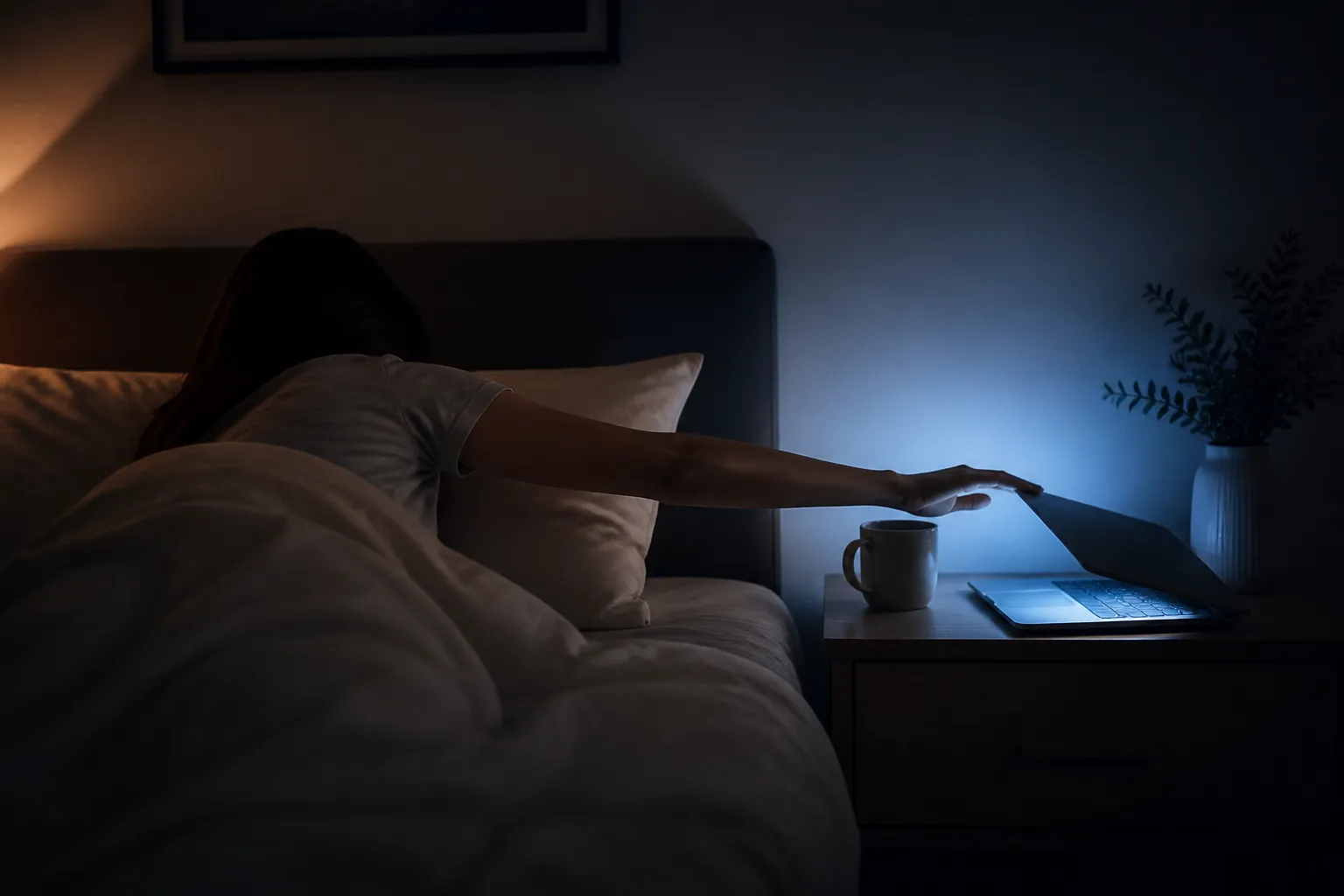
What are screens actually doing before bed?
Three mechanisms tend to get blended into one warning label. They are not equally supported, and they do not call for the same solution.
| Mechanism | What it means | What the practical fix targets |
|---|---|---|
| Light exposure | Screen light may shift circadian timing or suppress melatonin, especially when bright and close to the eyes. | Brightness, distance, timing, and overall daily light exposure |
| Content-driven arousal | The material on the screen keeps the brain emotionally, socially, or cognitively activated. | News, conflict, gaming, work, social comparison, shopping, and any content that is hard to stop |
| Time displacement | Screen use takes over the time that was supposed to become sleep. | Stopping points, bedtime protection, app friction, and moving recreational screen use earlier |
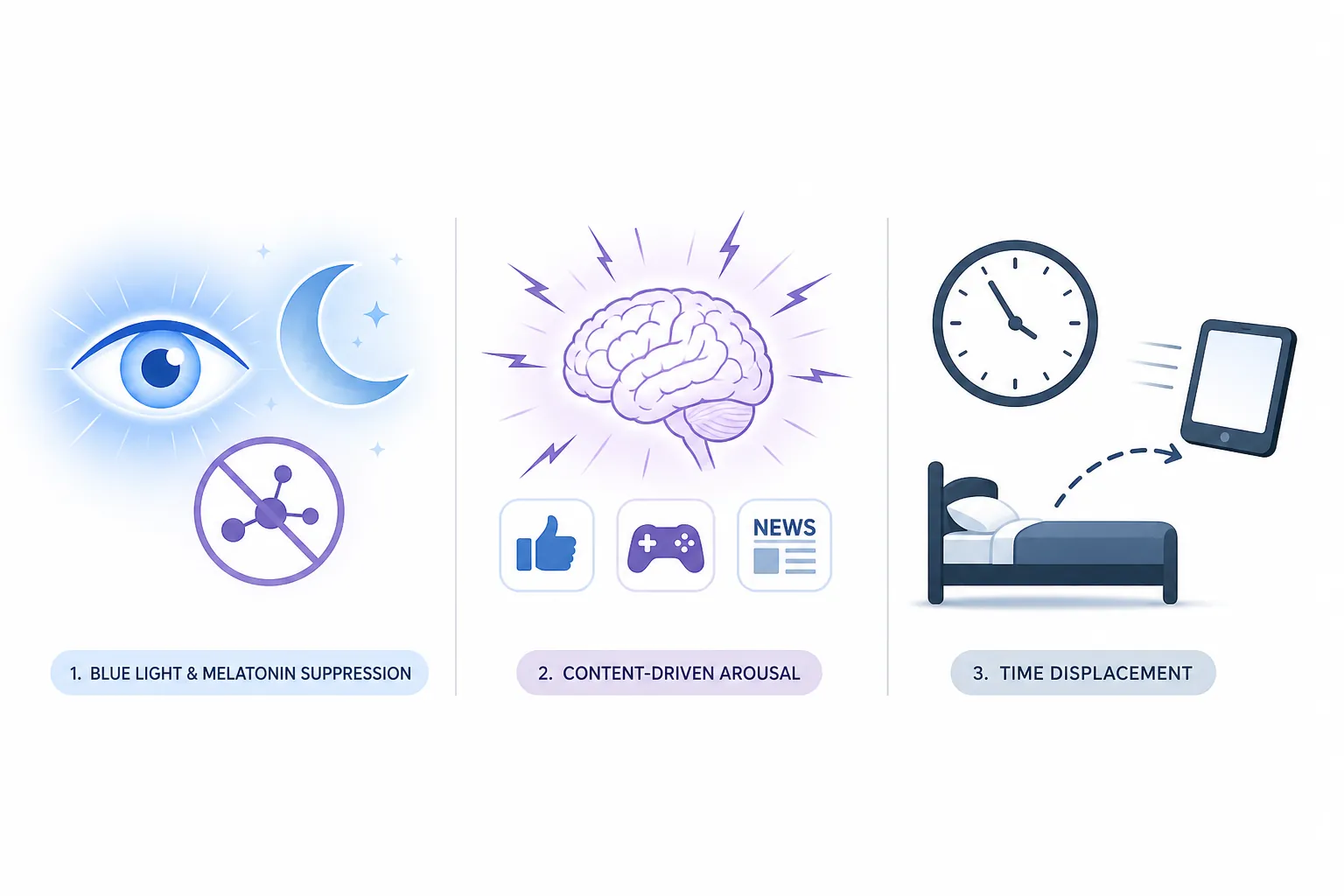
A computer-free lifestyle addresses all three at once, which is why it can work for some households. But if the main problem is time displacement, blue-light glasses are a weak answer. If the main problem is work stress, a dimmed monitor does not make the spreadsheet less activating. If the main problem is a child or teenager sleeping with a device nearby, an adult-style compromise may be too soft.
Is blue light the main reason screens disturb sleep?
Probably not for many adults, at least not in the dramatic way the older warnings implied. Blue light is biologically relevant; light can influence circadian timing, and anyone trying to understand that pathway should treat light as a real sleep input, not folklore. But the size of the screen-light effect in ordinary evening use appears smaller than many people assume.
A 2026 BBC Future article reported that a review of 11 studies cited by Stanford sleep researcher Jamie Zeitzer found light from screens delayed sleep by roughly nine minutes at worst. The same article described Zeitzer’s comparison that 24 hours of blue light from digital screens amounts to less than one minute outdoors, suggesting that real-world screen light may be modest compared with daytime light exposure.[3]
That is a corrective, not a license to blast a bright laptop in bed and declare physiology canceled. The conclusion is narrower: for many adults, the light emitted by a screen may be less important than the thing the screen is delivering and the bedtime it is quietly consuming. If you want the broader physiology, see this guide to circadian rhythm and light exposure; the key point here is that light exposure is a 24-hour pattern, not only a morality play about the last screen you touched.
This is why screen settings can help without solving the problem. Lowering brightness, using warmer display settings, and keeping the screen out of bed may reduce one input. They do not stop a tense work exchange, a late-night argument thread, or a game designed around the next round.
Why content often matters more than the device
A laptop used to submit a necessary form at 8:30 p.m. is not the same sleep exposure as a laptop used for work triage at 10:45 p.m. A tablet showing a quiet recipe is not the same as a phone serving news, outrage, gambling-like rewards, or social comparison. Sleep advice loses precision when it treats all glowing rectangles as identical.
Content-driven arousal has a plain bedside signature: the body is tired, but the mind has not landed. The screen has supplied something to solve, resist, reply to, buy, monitor, fear, or win. Once that happens, the problem is no longer just the wavelength of light reaching the retina. It is attention being recruited at the wrong hour.
This is also where adult guilt about sleep hygiene becomes unhelpful. Many people are not failing because they lack a sufficiently pure analog identity. They are failing because the most stimulating part of the evening has been placed immediately before the only part of the day that asks the nervous system to stand down.
A better rule sorts evening screen use by arousal, not by device category. Necessary, low-emotion computer tasks belong earlier and should have an endpoint. High-arousal content belongs outside the wind-down window. If it reliably produces anger, urgency, competition, or unfinished loops, it is not bedtime material, even when the screen is dim.
The quietest culprit is often time displacement
Time displacement is less glamorous than blue light and less psychologically rich than doomscrolling, but it may explain a large share of ordinary screen-related sleep loss. The person meant to stop at 10:00. At 10:38, nothing catastrophic has happened. At 11:17, tomorrow has already been borrowed from.
Young adult data make this mechanism hard to ignore. In a 2025 Frontiers in Psychiatry study of 45,202 young adults, each additional hour of screen use after bedtime was associated with 59% higher odds of insomnia symptoms.[4] This still does not prove that the extra hour caused insomnia in every person. It does show why “after bedtime” is a more meaningful category than “screen use” in general.
A 2026 American Academy of Sleep Medicine survey also framed bedtime screen use as a displacement problem, reporting that Americans are doomscrolling at bedtime and prioritizing screen time over sleep.[5] Survey language should not be stretched into a biological mechanism, but it matches what many sleep clinicians hear in less formal language: the night was not ruined by a single exposure; it was extended in small, defensible increments.
What should adults try before going fully computer-free?
Start with the smallest rule that protects the sleep period. A full computer-free lifestyle is easier to praise than to maintain, and for adults with work, caregiving, school administration, or household logistics, it may be the wrong first target.
- Set a screen stopping point, not a vague intention. “Laptop closed at 9:30” works better than “less screen time tonight.”
- Move high-arousal content earlier. Put news, gaming, work conflict, shopping decisions, and social media outside the final wind-down period.
- Separate necessary computer use from recreational drift. Pay the bill, send the form, close the device; do not let the necessary task become the doorway to feeds.
- Keep screens out of bed when possible. The bed is a poor place to negotiate with autoplay, notifications, and unfinished work.
- Create friction for “one more thing.” Log out, charge the laptop outside the bedroom, use app limits, or place the device where reopening it requires a deliberate choice.
- Dim the screen if you must use it late, but do not mistake dimming for winding down. Brightness reduction is a supporting move, not the main treatment for an activated evening.
This approach is less elegant than “no computers after 9,” but it is usually closer to the evidence. It asks what part of the screen habit is stealing sleep and changes that part first.
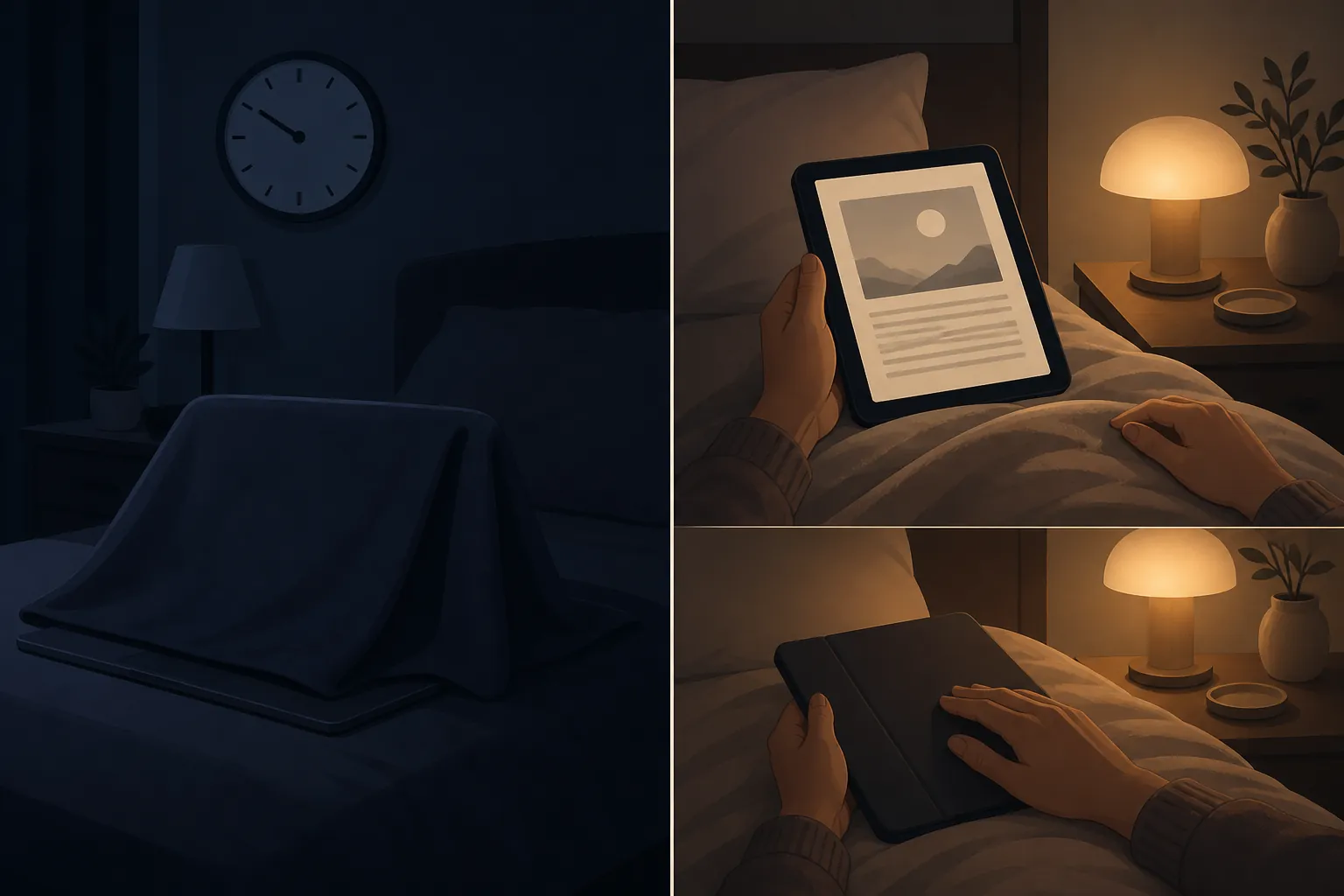
When a stricter no-computer rule makes sense
Some people sleep better with a clean symbolic rule. There is no need to argue them out of it. If a computer-free evening lowers household friction, removes work from the bedroom, or makes bedtime automatic, it is doing useful work.
Firmer limits are also more defensible for children and adolescents, where the National Sleep Foundation panel found stronger agreement that screen use impairs sleep.[2] Young people are not just smaller adults with worse discipline. Their sleep timing, social pressure, school schedules, and device ecosystems can make bedtime displacement especially easy to disguise as choice.
A stricter rule is also reasonable when the pattern is obvious: the laptop repeatedly stays open past bedtime, the person wakes unrefreshed, and softer boundaries have failed. In that case, the computer-free rule is not a lifestyle virtue. It is environmental design.
What if you need to use a computer at night?
Then reduce the damage rather than pretending the evening can be perfectly screenless. Decide in advance what must be done, how long it should take, and what counts as finished. Use the computer at a desk or table rather than in bed. Keep the brightness comfortable, close unrelated tabs, and avoid beginning tasks that create open loops.
The distinction between necessary use and discretionary use is not moral; it is operational. A required work task may still delay sleep, but it should not become a portal into optional stimulation. When the task is finished, the next sleep intervention is not another setting. It is closing the machine.
The most useful computer-free sleep tips
Use “computer-free” as a boundary where it solves a real sleep problem, not as a total identity. The strongest practical tips are the ones that protect bedtime from stimulation and drift.
- If sleep is being delayed, set a hard device-off time and place the laptop outside the bedroom.
- If your mind is racing, remove the activating content first: work, news, conflict, gaming, and social feeds.
- If the evening disappears without a decision, add friction: logout, charger location, app limits, or a visible bedtime alarm.
- If screen use is necessary, make it task-bound, seated away from bed, and finished before the wind-down period resumes.
- If the sleeper is a child, adolescent, or young adult with after-bedtime screen use, use firmer limits sooner.
Adults do not need to turn the laptop into a villain to take sleep seriously. The more accurate target is the last hour before bed: what enters it, what it asks of the mind, and whether it keeps taking minutes after the day should be over.
References
- Daily Screen Use Before Bed and Sleep Quality, JAMA Network Open, 2025
- The National Sleep Foundation’s consensus recommendations for the time course of sleep health in children and adolescents, Sleep Health, 2024,
- The blue light from your phone isn't ruining your sleep, BBC Future, April 2026,
- Screen use after bedtime and insomnia symptoms among young adults, Frontiers in Psychiatry, 2025,
- Americans are doomscrolling at bedtime, prioritizing screen time over sleep, American Academy of Sleep Medicine, 2026,
Read the full guide: Do THC Gummies for Sleep Actually Work?