
Do THC Gummies for Sleep Actually Work?
THC gummies for sleep may help some adults fall asleep faster, especially when the problem is sleep onset rather than waking through the night. That is the honest short answer. The longer answer is less product-friendly: the published evidence is mixed, the dose matters more than most labels imply, and the trade-offs include REM sleep suppression, rebound insomnia when stopping, dependence risk, and medication interactions.
The best broad evidence check is not nearly as reassuring as the gummy shelf. A 2024 AASM scoping review summarized in Mayo Clinic Viewpoints found that only 21% of published studies reported sleep improvement with cannabis, while 48% reported worsening sleep. [1] A 2022 systematic review in Sleep also found no significant difference between THC and CBD for sleep outcomes, and many of the more positive findings came from people with pain rather than from people with primary insomnia. [2]
That distinction matters. “I fell asleep faster after a gummy” is a real experience. It is not the same as proof that THC is a reliable, low-risk insomnia treatment, especially if the next question is what happens to sleep quality, dream sleep, next-day function, and your ability to sleep without it.
What Do THC Gummies Actually Help With?
The most plausible benefit is shorter sleep latency: the time it takes to fall asleep. THC can feel sedating, reduce pre-sleep tension for some people, and make the first part of the night feel easier. That is why patient reports should not be dismissed.
But a gummy working once does not answer the clinical questions that matter over weeks or months. Did total sleep time improve? Did awakenings decrease? Was REM sleep reduced? Was the next morning foggier? Did the dose creep upward? Did sleep get worse when the person skipped it?
This is where commercial language often gets too smooth. “Supports relaxation” can be true and still leave the most important sleep questions unanswered. For chronic insomnia, CBT-I remains the benchmark first-line treatment; THC gummies sit in a much less certain category than that.
The Dose Problem: A Sleep Dose Is Often Smaller Than a Retail Gummy
If an adult is going to try THC for sleep, the most practical safety question is not flavor, strain language, or whether the package says “nighttime.” It is milligrams of THC.
Several clinical sources converge around a very low starting dose: about 2 to 2.5 mg THC, especially for people who are new to cannabis, sensitive to sedatives, older, or taking other medications. Northwell Health’s 2025 clinical guide discusses starting at 2.5 mg THC, while the 2021 modified Delphi consensus on medical cannabis dosing supports a cautious approach that begins with CBD-predominant treatment and adds THC only if needed. [3][4]
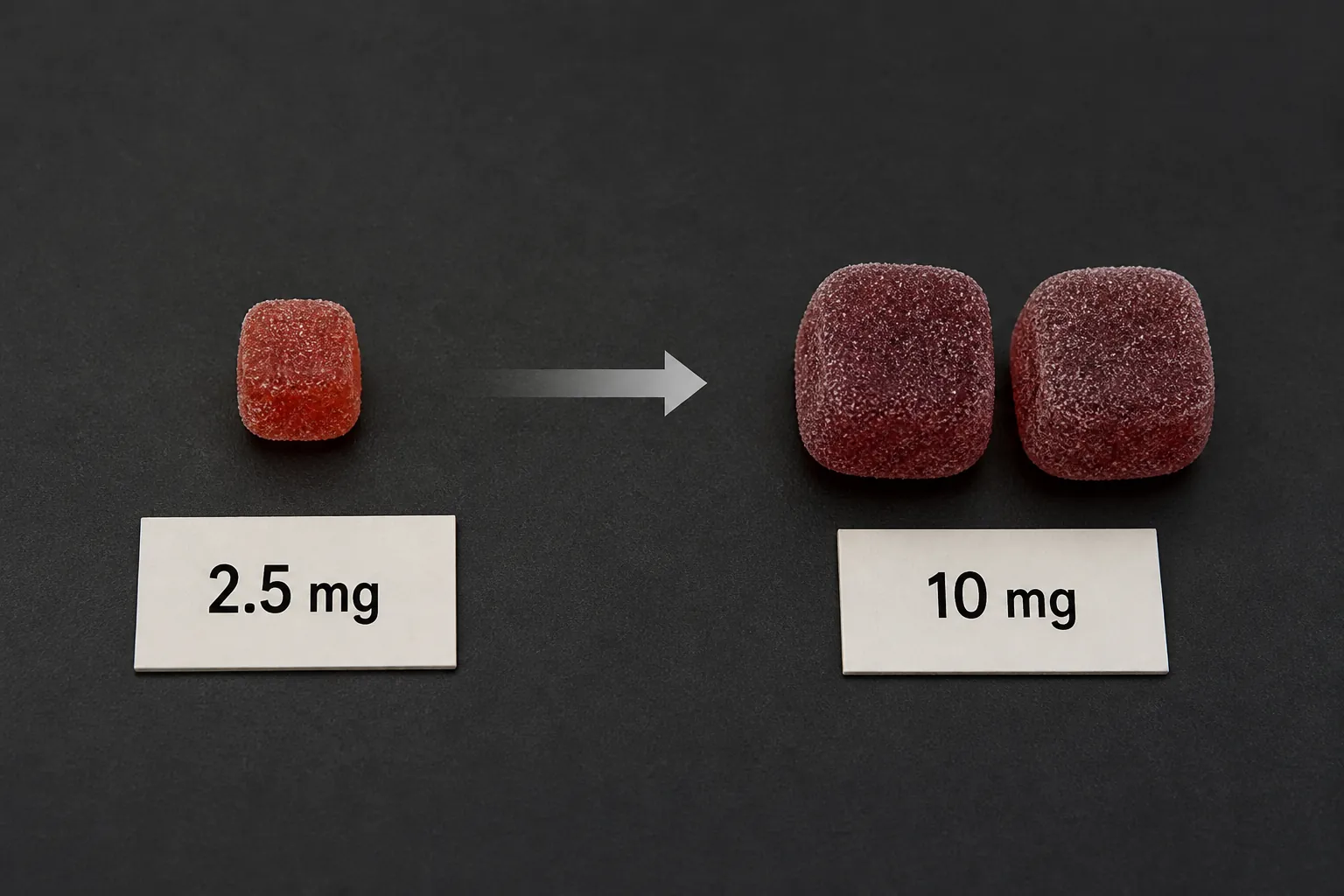
That is well below many commercial gummies, which commonly contain 5 to 10 mg THC per piece. Splitting a gummy may sound fussy until you remember that edibles are easy to overdo: the effect is delayed, the dose is fixed by the product, and the next morning still belongs to you.
| THC amount | Practical meaning for sleep use |
|---|---|
| 2 to 2.5 mg | A cautious starting range discussed in clinical dosing sources, especially for THC-naive or higher-risk adults |
| 5 mg | Still a low retail dose, but already double the 2.5 mg starting point |
| 10 mg | Common in commercial gummies; may be too much for many people using THC only as a sleep aid |
| 25 mg or more | A high dose range where impairment becomes a much more serious concern |
Dose-response data make the caution less abstract. In a 2020 study by Schlienz and colleagues, 10 mg THC produced subjective drug effects without cognitive impairment, while 25 mg and 50 mg produced pronounced impairment. [5] That study was not a “best dose for insomnia” trial, but it is useful because it shows why more THC is not a neutral choice.
For sleep, the practical rule is simple: if a person decides to try THC despite the evidence gaps, starting low is not cosmetic caution. It changes the risk profile.
How Long Before Bed Should You Take a THC Gummy?
Edibles do not behave like inhaled cannabis. They take longer to come on, can last longer, and are harder to adjust once swallowed. For sleep, that makes timing part of safety: taking another gummy because “nothing is happening yet” is one of the easiest ways to turn a sleep experiment into a too-high dose.
A cautious approach is to test a low dose on a night when there is no early drive, shift, caregiving handoff, or medication change the next morning. That is not because everyone will be impaired. It is because the person who is impaired discovers it after the dose is already in their system.
What Happens to REM Sleep?
THC consistently reduces REM sleep, the stage associated with most vivid dreaming. [1] Some people like this at first, especially if dreams are intense or distressing. But REM suppression is not the same thing as better sleep. It means the architecture of the night has changed.
The stopping pattern is where many people get caught. After abrupt cessation, REM rebound can bring intense dreams and insomnia for about 2 to 5 nights. [1] The person may reasonably conclude, “I can’t sleep without THC,” when part of what they are feeling is rebound from stopping THC.
That does not mean every occasional user becomes dependent. It does mean nightly use deserves more respect than it usually gets in wellness copy. If you are using THC gummies mainly to mute dreams or manage menopause-related sleep disruption, the REM question is worth reading in more depth in Does Cannabis Suppress REM Sleep in Menopause? For a broader explanation of why sleep can feel worse after stopping a substance, see Why Sleep Disruption Persists After Stopping Drugs.
Can You Become Dependent on THC Gummies for Sleep?
Yes. The risk is not limited to smoking, and it is not erased because the product is a gummy.
Stanford Medicine reported in 2025 that up to 30% of regular cannabis users develop cannabis use disorder. [6] For sleep users, the most clinically important detail is that sleep disturbance is commonly cited as a reason people return to cannabis after stopping. [6]
The loop can be subtle. A gummy helps with sleep onset. The person uses it more often. Sleep without it becomes harder for several nights. The next dose then feels like proof that the gummy was necessary all along.
If use has become nightly, if the dose keeps rising, or if stopping brings anxiety, irritability, insomnia, or intense dreams, that is no longer just a casual sleep-aid question. It is a good moment to involve a clinician, especially before replacing one sedating substance with another.
Are THC Gummies Safer Than Prescription Sleep Medication?
Not automatically. A gummy can feel gentler than a prescription pill, but “natural” does not mean low-risk, and “nonprescription” does not mean clinically simple.
Prescription sleep medications have their own risks, including next-day sedation, falls, tolerance, and complex sleep behaviors depending on the drug. THC has a different risk profile: variable edible absorption, impairment at higher doses, REM suppression, rebound sleep disruption, dependence risk, and drug interactions. The safer option depends on the person, the sleep problem, the dose, the duration, and the medication list.
If the real issue is circadian timing, melatonin may be a more relevant comparison than THC. If the issue is occasional short-term sleeplessness, an OTC product may or may not fit. Those comparisons belong in more targeted guides, such as What You Should Know About Melatonin Gummies, The Best Sleep Gummies for Adults Depend on Your Sleep Problem, and OTC Sleep Aid by Sleep Problem.
Who Should Be More Cautious?
The people most likely to be targeted by sleep-gummy marketing are not always the people with the simplest risk profile. Age, hormones, attention symptoms, pregnancy, and medication metabolism all change the decision.
Older Adults
Older adults deserve more caution than the packaging usually suggests. Cannabis use among adults 65 and older rose to 7% in 2023, and emergency department visits for cannabis poisoning among older adults nearly tripled after legalization in one study. [7][8]
The concern is not that every older adult will have a bad reaction. It is that slower metabolism, fall risk, cognitive vulnerability, and polypharmacy can turn a “small” edible into a bigger clinical event. A 10 mg gummy is not a neutral starting point for a 70-year-old taking multiple medications.
Perimenopausal Women
Perimenopausal women are often trying to solve a real sleep problem: night sweats, early-morning waking, mood volatility, pain, or a nervous system that no longer settles predictably. In a 2022 study, 67.4% of perimenopausal cannabis users cited sleep as their reason for use. [9]
That number explains the demand. It does not prove effectiveness. The evidence gap is especially important here because controlled trials of THC gummies for perimenopause sleep are lacking. If you are using cannabis for menopause-related sleep symptoms, What the 2025 Research Says About Cannabis for Menopause Sleep goes deeper into that narrower evidence base.
Adults With ADHD
Adults with ADHD may be especially drawn to THC at night because racing thoughts and delayed sleep timing can make bedtime feel adversarial. Survey data show that 67% of ADHD cannabis users reported that cannabis improved sleep. [10]
That is subjective benefit, not a controlled THC-gummy insomnia trial. It also sits beside evidence that chronic cannabis use was associated with worse inattention in men in objective measures. [11] For ADHD adults, the short-term feeling of “my brain finally shut off” should be weighed against attention, motivation, next-day function, and the possibility of nightly reliance.
Pregnancy or Trying to Conceive
Pregnancy is not the place to self-experiment with THC gummies for sleep. The available evidence does not support a pregnancy-specific safety claim for THC gummies; it supports the more conservative clinical position that cannabis use is contraindicated in pregnancy. [4]
People Taking Interacting Medications
This is one of the easiest risks to miss. THC and CBD can inhibit CYP3A4 and CYP2C9, two liver enzyme pathways involved in the metabolism of many medications. [12][13] That does not mean every interaction will be dangerous, but it does mean a gummy is not pharmacologically invisible.
Warfarin is the clearest example to take seriously. Case reports and pharmacokinetic evidence document clinically relevant interactions between cannabinoids and warfarin, including elevated INR. [12][13] For an older adult on anticoagulation, the risk conversation should happen before the dose is increased, not after bruising, bleeding, or an abnormal lab result.
So, Should You Try THC Gummies for Sleep?
A reasonable adult might try a very low dose THC gummy and find that it helps them fall asleep. The evidence does not require pretending that never happens. It does require being clear that THC gummies are not a first-line treatment for chronic insomnia and not a risk-free substitute for medical care.
- Consider avoiding THC gummies for sleep if you are pregnant, trying to conceive, have a history of cannabis use disorder, or need to be unimpaired overnight or early the next morning.
- Talk with a clinician first if you are over 65, take warfarin or other narrow-therapeutic-index medications, use other sedatives, or have complex medical conditions.
- If you do try THC, do not treat 10 mg as a casual starting dose; clinical sources point closer to 2 to 2.5 mg for cautious initiation.
- If you are already using THC nightly and feel unable to sleep without it, do not simply escalate the dose; rebound insomnia and REM rebound may be part of the pattern.
- For chronic insomnia, prioritize CBT-I and a sleep-focused evaluation over product rotation.
The useful stopping point is not a product recommendation. It is a clearer decision: THC gummies may help sleep onset for some people, but the evidence is mixed, the dose threshold is lower than many commercial products imply, and higher-risk groups should not self-escalate without clinical guidance.
References
- AASM scoping review on cannabis and sleep, Mayo Clinic Viewpoints, 2024
- Cannabinoids for treating sleep disorders: a systematic review, Sleep, 2022
- Cannabis for Sleep: What to Know, Northwell Health, November 2025
- Consensus recommendations on dosing and administration of medical cannabis to treat chronic pain: results of a modified Delphi process, Journal of Cannabis Research, 2021
- Pharmacodynamic dose effects of oral cannabis ingestion in healthy adults who infrequently use cannabis, Drug and Alcohol Dependence, 2020
- Cannabis use disorder and dependence risk, Stanford Medicine, October 2025
- National Survey on Drug Use and Health, Substance Abuse and Mental Health Services Administration, 2023
- Emergency department visits involving cannabis poisoning among older adults in Ontario, Canada, JAMA Internal Medicine, 2024
- Patterns of cannabis use among midlife women: a survey of perimenopausal and postmenopausal women, Menopause, 2022
- Cannabis use in attention-deficit/hyperactivity disorder: a scoping review, Journal of Psychiatric Research, 2024
- Impact of ADHD and cannabis use on executive functioning in young adults, Drug and Alcohol Dependence, 2013
- Warfarin and cannabis interaction, Basic & Clinical Pharmacology & Toxicology, 2019
- The clinical significance of drug interactions between warfarin and cannabis, Journal of Cannabis Research, 2023
Read the full guide: What a computer-free lifestyle actually does for sleep