Can't Sleep After a Storm? Here's What to Do Tonight
If you cannot sleep after the storm tonight, that does not mean something is wrong with you. In the first few weeks after a traumatic or frightening event, sleep problems are an expected stress reaction, and most people recover without treatment, according to sleep specialist Anne Germain, PhD, in guidance from Sleep Education and the American Academy of Sleep Medicine.[1]
That reassurance is not meant to wave away what is happening at 1:40 a.m., when the house is quiet again but your body is still listening. Your nervous system may be doing a reasonable job too aggressively: checking for danger, waking at small sounds, replaying the moment the wind changed, or reaching for the weather app even though the warning has passed.
Coping with sleep disruption after a storm works best when you treat the night as a sequence, not as a test of willpower. The goal is to lower danger cues, stop feeding the alert loop, and keep the bed from becoming the place where your brain practices being afraid.
What to do tonight, in order
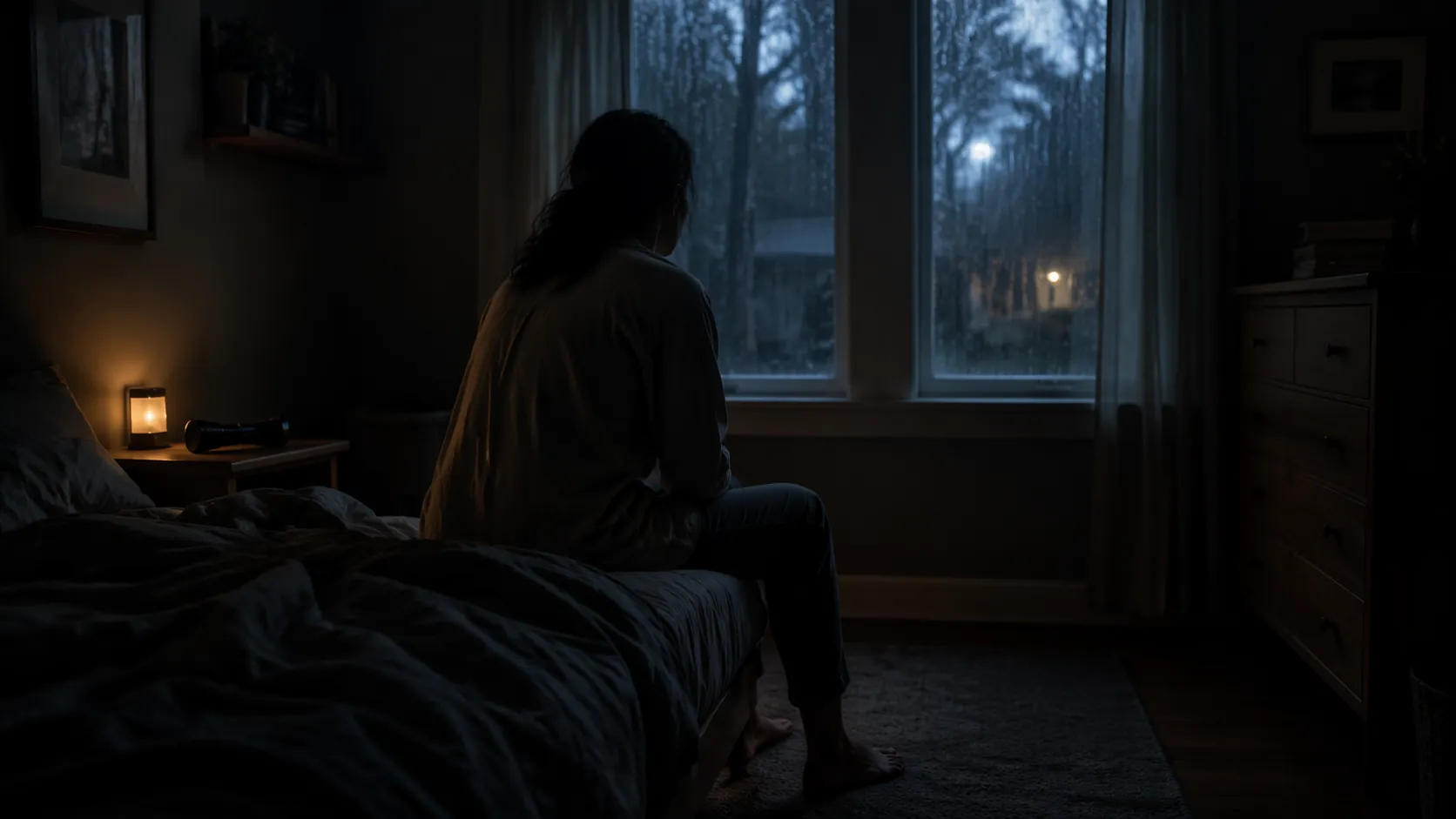
Start with the room you are actually in. You do not have to create a perfect sleep environment; you are trying to make the next few hours feel less like an emergency drill.
| When | What to do | Why it helps |
|---|---|---|
| Before getting into bed | Make the room feel physically checked and settled. | Your brain gets fewer reasons to keep scanning. |
| Before the final weather check | Choose one trusted weather source and set a cutoff time. | Repeated checking keeps the threat system active. |
| As you wind down | Use a short, repeatable routine: dim light, warm shower, calm sound, slow breathing. | The routine tells the body that the active response phase is over. |
| When fear spikes | Ground your attention in the present room. | Grounding gives the nervous system current evidence of safety. |
| If you are awake in bed about 20 minutes | Get up and do something dull in another room until sleepy. | This protects the bed from becoming linked with rumination. |
1. Make the room signal safety
A post-storm bedroom can still feel like a lookout point. Before bed, do one brief, practical pass through the things your mind keeps returning to: close the window if it is rattling, move the flashlight where you can reach it, plug in your phone if you need it for alerts, put shoes or glasses in a known place, and check that the door or window you are worried about is secure.
Then stop. Rechecking the same latch five times usually does not make the room safer; it teaches your brain that safety is still undecided. If you are responsible for children, pets, an older adult, or medical equipment, make the necessary check once and make it visible: a note on the nightstand, a packed bag by the door, the charger in the outlet. The point is not to pretend nothing happened. The point is to close the loop your mind keeps reopening.
2. Pick one weather source and a cutoff
Weather checking is useful until it turns into a stimulant. Anxiety guidance for hurricane season recommends choosing reliable sources and limiting repeated exposure, while National Weather Service storm-anxiety guidance also points people toward having a plan and using trusted weather information rather than spiraling through updates.[2][3]
Tonight, choose one source: your local National Weather Service office, your county emergency alert system, or another official local channel. Decide what alert actually requires action. Then choose a cutoff, such as after the last scheduled check before bed, unless an emergency alert sounds.
- Keep emergency alerts on if conditions still require them.
- Turn off nonessential push alerts, social feeds, radar loops, and storm videos.
- Do not compare five apps in bed; disagreement between models often creates more alarm than clarity.
- If rain itself is the trigger, use the same cutoff rule instead of checking each time the sound changes.
If hurricanes or flood warnings are the specific trigger, it may help to read more targeted guidance on hurricane anxiety and sleep or flash-flood anxiety at night. The mechanism is similar: the brain keeps treating new information as protection, even when the checking itself is keeping sleep out of reach.
3. Use a short wind-down ritual, not an elaborate routine
After a frightening weather event, a wind-down ritual is not decoration. It is a repeated signal that the response phase has ended. Weather-anxiety guidance commonly recommends calming routines such as dim lighting, calming music, breathing, and warm showers to help settle the nervous system after the threat has passed.[2][4]
Keep it short enough that you will actually do it while tired. Ten to 20 minutes is plenty for many people: lower the lights, take a warm shower if that sounds comforting, put on quiet audio, and do the same few steps in the same order. Avoid making the ritual another project you can fail.
If you are pregnant, in perimenopause, managing ADHD, or an older adult, the storm may be landing on top of other sleep vulnerabilities: temperature shifts, bathroom trips, medication timing, pain, sensory sensitivity, or a lighter sleep window. That does not change the basic post-storm sequence, but it may mean you need more tailored adjustments than a general FAQ can cover.
4. When fear spikes, ground the body in the current room
Fear after a storm often arrives as a body event before it becomes a thought: tight chest, fast pulse, clenched jaw, the urge to listen harder. Grounding techniques such as slow deep breathing and the 5-4-3-2-1 method are recommended in storm-anxiety resources because they can reduce nervous-system arousal in the moment.[2][4][5]
Try this without turning it into a performance: name five things you can see, four things you can feel, three things you can hear, two things you can smell, and one thing you can taste. If counting feels annoying, place both feet on the floor and lengthen the exhale for several breaths. You are not trying to convince yourself that the storm was harmless. You are giving your body evidence that this room, at this moment, is different from the moment of danger.
5. If the bed becomes a watch station, leave it for a while
This is the part many exhausted people resist because it feels unfair: if you have been in bed for about 20 minutes and cannot fall asleep, get up. Sleep Education’s trauma-sleep guidance and the VA National Center for PTSD both describe this kind of stimulus-control approach: leave the bed, do a quiet low-stimulation activity, and return when sleepy.[1][6]
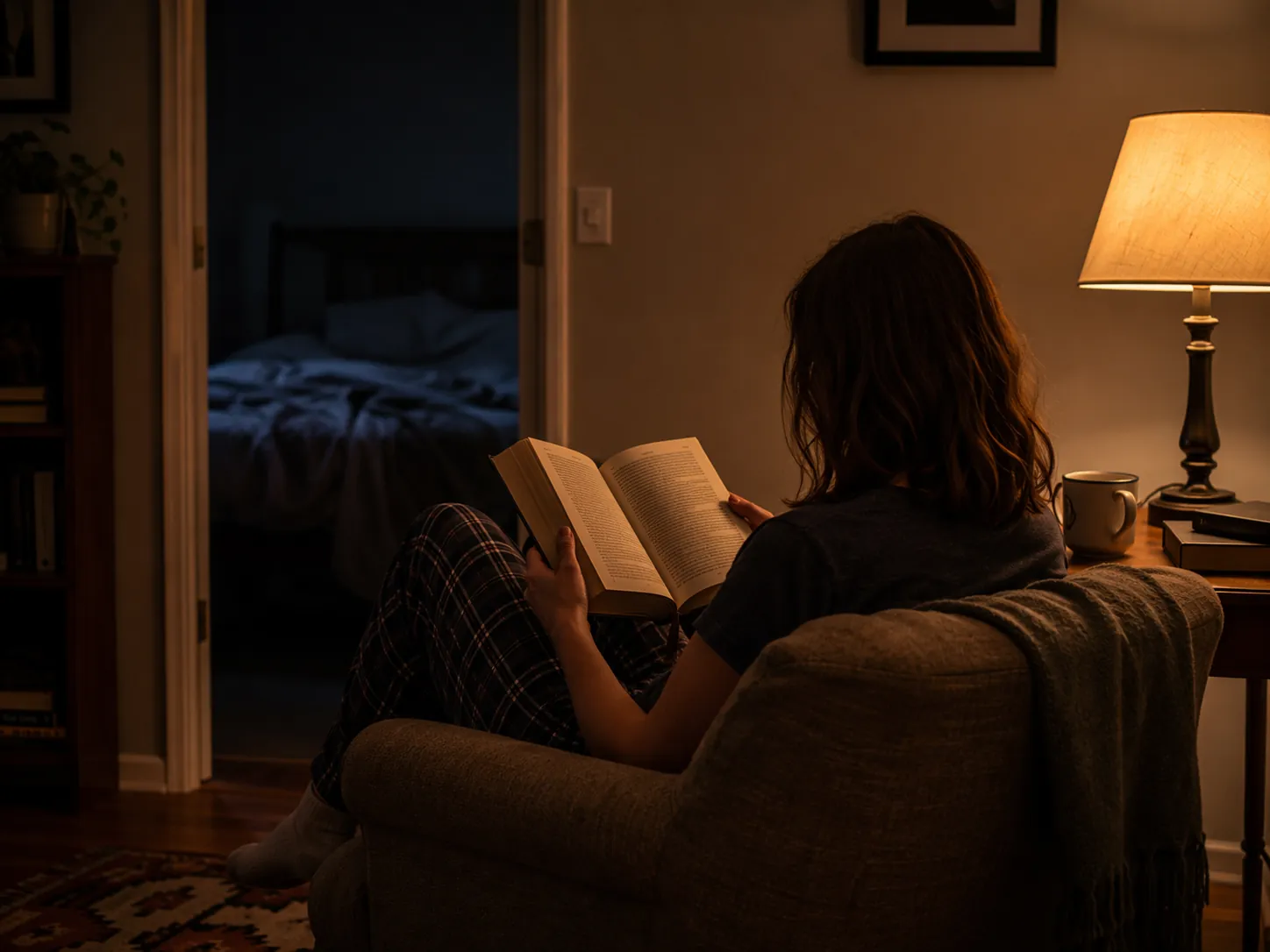
The activity should be boring on purpose: a dull book, calm audio, folding a small stack of laundry in low light. Do not start storm footage, cleanup planning, insurance forms, group chats, or work email. Those may be necessary tomorrow; they are not neutral at 2 a.m.
You are protecting the bed. If the bed becomes the place where you scan the ceiling, replay the siren, and wait for the next alert, your brain can start treating bedtime itself as a cue for alarm. Leaving the bed briefly is not giving up on sleep. It is interrupting the pairing between bed and threat monitoring.
Why your body stays on watch after the storm
During a serious storm, alertness is useful. You listen for branches, sirens, water, glass, roof sounds, phone warnings, and people moving in the house. The problem is that the body does not always stand down the moment the radar clears. It may keep running a partial night watch.
That partial watch can feel like insomnia, frequent waking, shallow sleep, vivid dreams, or a sudden jolt at a normal house noise. It can also make ordinary weather sound threatening. Rain on the window becomes something to interpret. Wind in a vent becomes a signal to check. A distant truck sounds enough like thunder to wake you fully.
This is why nighttime app checking is so sticky. It offers a tiny hit of certainty, then creates another question: What about the next cell? What about the warning two counties over? What if the model changed? The brain learns that wakefulness is the price of staying safe. For some people, disaster-related sleep disruption after an earthquake follows the same pattern of body-based vigilance even when the danger type is different; the common thread is a nervous system that has not yet updated its threat map. Readers dealing with that parallel can see guidance on sleep after earthquake anxiety.
People also differ in sleep reactivity: some nervous systems are more likely to develop insomnia during stress, while others sleep normally under the same conditions. The Ford Insomnia Response to Stress Test is one research tool used to measure that tendency, but a rough night after a storm is not, by itself, a diagnosis.
At the more severe end of trauma physiology, people with PTSD have been found to have a faster heart rate while sleeping, reflecting an enhanced fight-or-flight response and persistent hypervigilance.[7] That fact is useful because it shows how physical nighttime vigilance can be. It does not mean everyone awake after a storm has PTSD.
If the storm involved injury, a near miss, evacuation, loss of housing, or a terrifying moment you keep replaying, the sleep problem may be tied to a broader trauma pathway rather than only weather anxiety. This article on sleep recovery after an accident may be a better fit for that piece of the experience.
What to expect over the next few weeks
For many people, the first nights are the roughest. Sleep may come in fragments. You may feel tired but keyed up. You may sleep better one night and worse the next, especially if cleanup, power outages, insurance calls, school closures, or more rain keep bringing the storm back into daily life.
A reasonable aim is not perfect sleep immediately. It is less time spent feeding the alert loop. Each night, repeat the same sequence: one safety pass, one trusted weather source, one cutoff, one wind-down ritual, grounding when needed, and the 20-minute rule if bed becomes a place for scanning.
Medication is outside the scope of this FAQ. If you are considering a sleep aid because you are frightened or exhausted, that is a conversation for a clinician who knows your health history, other medications, pregnancy status if relevant, and safety needs overnight. The non-drug steps here are still worth using because they address the arousal and conditioning loop that often keeps post-storm insomnia going.
When to get help
Do not wait a month if you are unsafe, unable to function, having panic that feels unmanageable, using alcohol or medication in risky ways to force sleep, or having thoughts of harming yourself. Severe impairment deserves earlier help.
For sleep difficulty that is distressing but not an immediate crisis, the AASM guidance gives a useful boundary: if sleep problems continue beyond one month despite consistent healthy sleep practices, consider seeking help from an AASM-accredited sleep center.[1]
For the first few nights and weeks, disrupted sleep after a storm is usually a stress response, not a personal failure. Tonight’s job is smaller than recovery as a whole: reduce cues of danger, stop the checking loop, calm the body when it spikes, and leave the bed before it becomes a fear-conditioning site. If that is not enough over time, there is a clear point to hand the problem to professional care.
References
- Sleeping After Trauma — Sleep Education / American Academy of Sleep Medicine
- Hurricane Season is Here: How to Reduce Your Anxiety — Anxiety and Depression Association of America
- Storm Anxiety — National Weather Service
- Finding Calm in the Storm: How to Cope with Weather-Related Anxiety — Nashville Psych
- Coping with Storm Anxiety — CoxHealth
- Sleep Problems and PTSD — VA National Center for PTSD
- PTSD and Sleep — Sleep Foundation
Read the full guide: Why You Can't Sleep Your First Night in the Boundary Waters