
Why You Can't Sleep Your First Night in the Boundary Waters
The first night in the Boundary Waters can feel unfair. You paddled hard, ate dinner, crawled into a decent bag on a decent pad, and expected the kind of sleep people promise after a long day outside. Instead, you are awake at 2 a.m., listening to water touch rock, wind move through pine needles, and something small investigate the edge of camp.
That does not automatically mean you packed wrong, and it does not mean you are bad at wilderness. If you are trying to figure out how to sleep while camping in Boundary Waters, the most useful answer usually starts after the gear checklist is already good enough: your brain may still be treating the campsite as an unverified place.
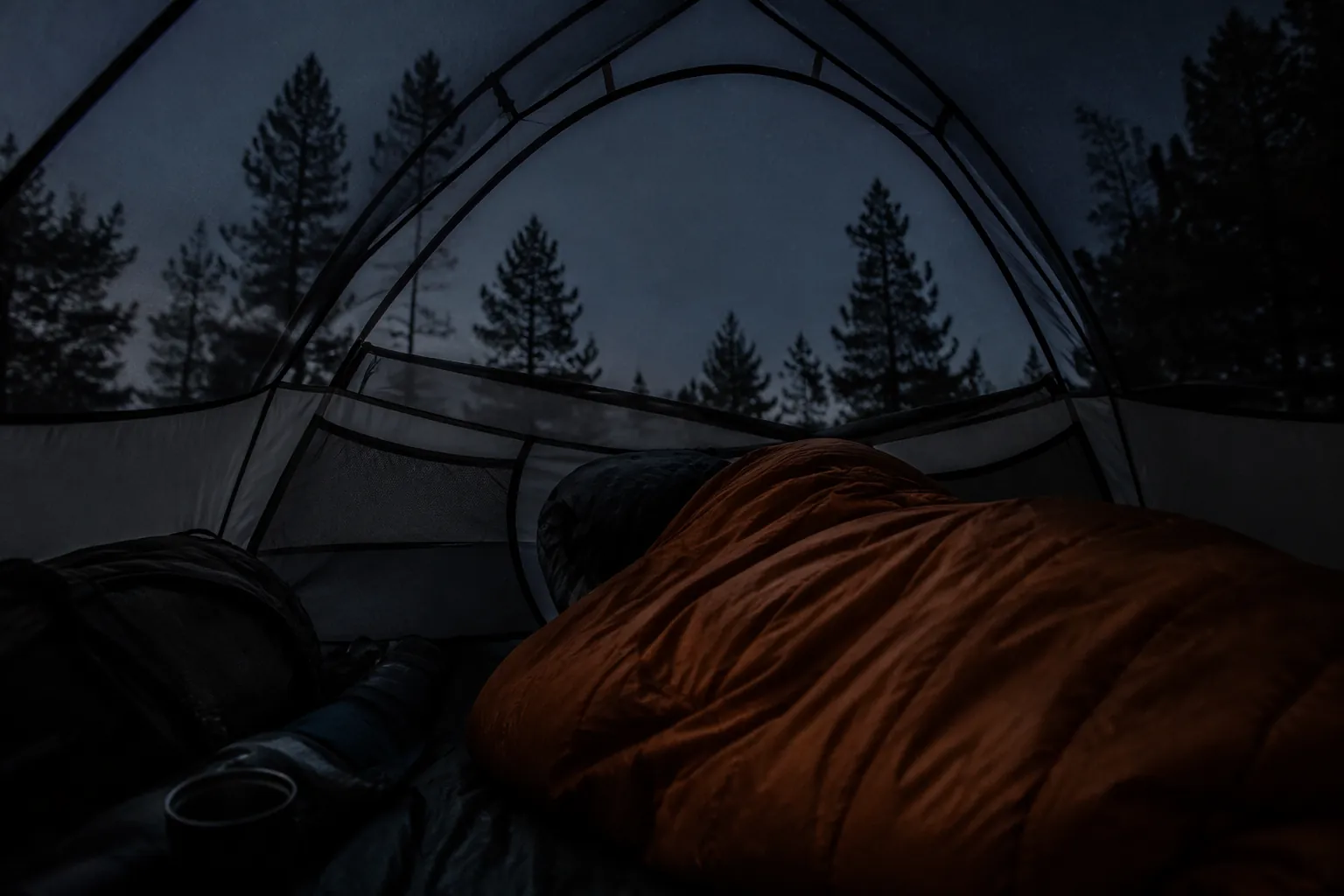
There is a gear floor, of course. A thin summer pad on cold ground, a bag that is clearly not matched to the night, wet sleep clothes, or a tent pitched where water pools can keep anyone awake. Fix those first. But once you are dry, insulated, and reasonably comfortable, chasing one more upgrade can miss the actual problem.
The first night is different because your brain keeps watch
Sleep researchers and wilderness-medicine doctors often describe a “first-night effect”: in an unfamiliar place, part of the brain behaves as if it is still on duty. Backpacker’s interview with Dr. David Schulman of the Emory Sleep Disorders Lab frames it as an evolutionary night-watch response, and the same article draws on Dr. Mary Susan Esther, then president of the American Academy of Sleep Medicine, to explain why unfamiliar sleep settings can mean lighter, less settled sleep rather than instant recovery.[1]
That matters because the first night in canoe country is rarely just “camping.” It is a new bed, new walls, new smells, new dark, new sounds, and a new job list that your brain is not sure you completed correctly. Even if you are tired, tired is not the same thing as convinced.
This is why many experienced campers do not talk about sleep as one magic trick. In a BWCA.com thread with more than 40 comments about sleeping tips, the useful advice is often small and repeatable: one earplug instead of two, a familiar audiobook at low volume, a journal entry by headlamp, the same sleep clothes every night, or a mental routine that answers the brain’s “what was that?” loop without feeding it.[2]
Boundary Waters nights give vigilance plenty to work with
At home, you know which noises belong. A refrigerator hums. A furnace clicks. A car passes. In the Boundary Waters, the same part of the mind that ignores familiar house sounds may start sorting every splash and scratch into categories: harmless, unknown, maybe important.
Some of those sounds are beautiful in daylight and rude at night. The Cable Natural History Museum’s “Listening to a Boundary Waters Night” describes the nocturnal soundscape in practical terms: loons, beaver tail slaps, mice poking around, and wind in the trees all belong there.[3] The problem is not that these sounds are dangerous. The problem is that, on a first night, your brain has not yet filed them as ordinary.
A beaver tail slap is a good example. If you know it, you may roll over. If you do not, it can sound like a branch snapping beside the tent. A mouse near a pack can sound far larger than it is. A loon call that thrilled you from the canoe can become, through tent fabric and half-sleep, a reason to open your eyes again.
Darkness adds its own pressure. On a moonless night, the tent can feel like a small room suspended inside a much larger unknown. Then, in the northern summer, dawn can arrive early enough to turn the tent wall gray before your body is ready to call the night finished. One part of the night is too dark for certainty; another part becomes light before you are done sleeping.
Bear anxiety deserves an actual protocol, not reassurance
Telling a nervous camper “don’t worry about bears” is not very useful. The worry is not imaginary; it is just often vague. Vague fear is the kind that keeps asking for one more check, one more listen, one more mental replay of where the food went.
The better move is to turn bear anxiety into a completed task. In January 2026, MPR News reported that the Boundary Waters had tougher food-storage rules requiring visitors to store food either in an approved bear-resistant container or by hanging it at least 12 feet above the ground and 6 feet horizontally from the tree trunk or supporting limb.[4] That rule is easy to read as bureaucracy. At bedtime, it is something more useful: a clear endpoint.
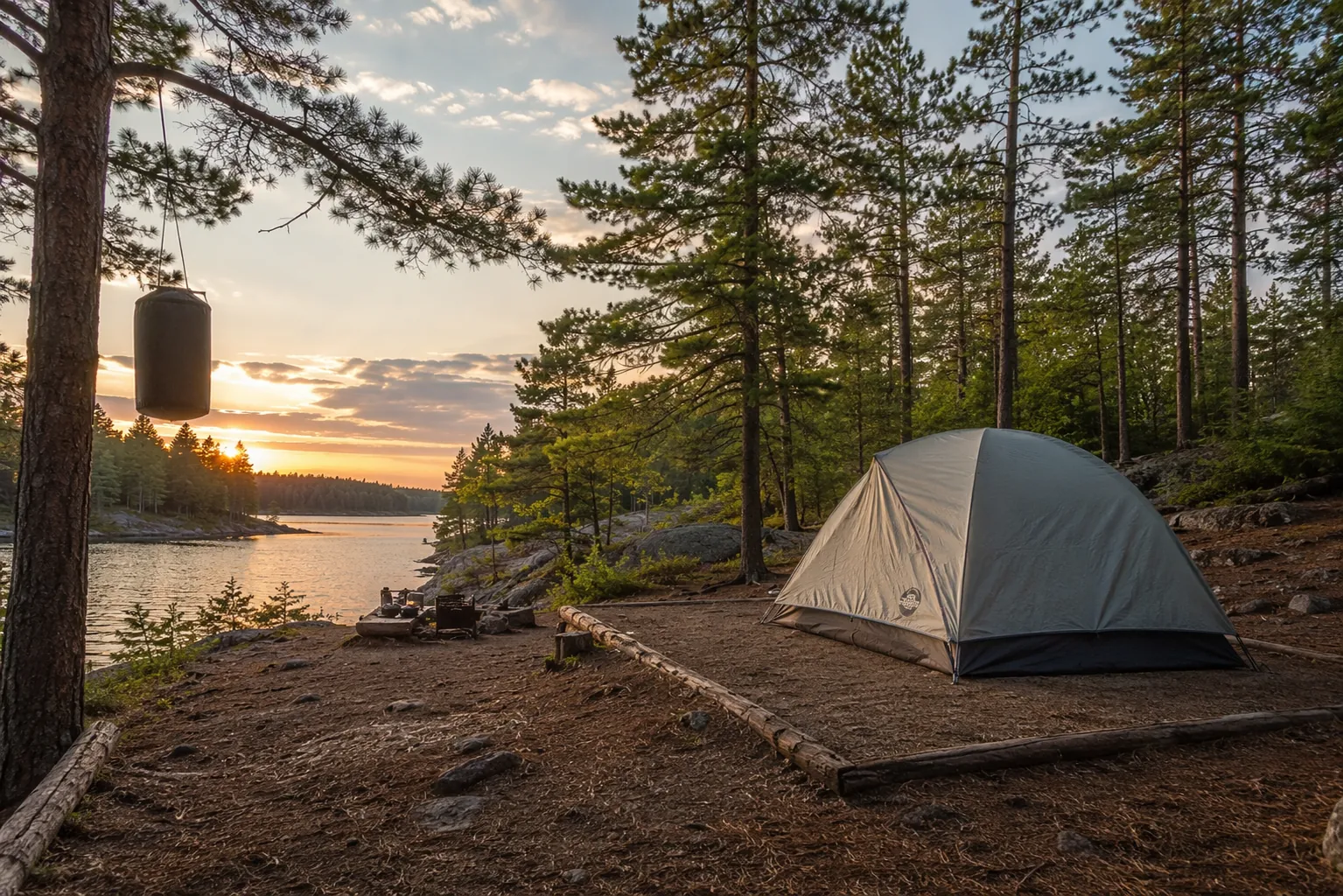
A clean-camp protocol gives the nervous system a record it can believe. Food is secured. Smellables are not in the tent. The cooking area is separated from sleeping space. The last snack wrapper is not in a pocket. The bear canister is closed, or the hang is done correctly. When the mind asks later, “Did we do enough?” you are not trying to soothe it with optimism. You are answering with a finished sequence.
That is also why the order matters. Do not save the food question for when you are exhausted, cold, buggy, and already half in sleep clothes. Make it part of camp closing, not bedtime panic.
- Clean the cooking area before the group drifts away from dinner.
- Secure food, trash, toothpaste, sunscreen, and other scented items by the required method.
- Keep the tent boring: no snacks, no wrappers, no “I’ll deal with it in the morning” pocket leftovers.
- Say the protocol out loud if it helps: food is secured, smellables are out, cooking is closed.
The out-loud part can feel silly until the first night your mind starts circling. A spoken checklist gives you something to return to that is more concrete than “probably fine.”
Build one routine that survives a tired camp evening
Backpacker cites Dr. Michael Zimring of the Center for Wilderness and Travel Medicine on the value of a consistent pre-sleep routine: same order, same sleep clothes, same wind-down timing.[1] The point is not to import a polished bedroom ritual into a wet campsite. It is to reduce the number of open loops your brain has to monitor.
A Boundary Waters routine should be simple enough to do when the mosquitoes are bad and someone cannot find the headlamp. It might look like this:
| Part of the routine | What it does |
|---|---|
| Close camp | Turns food and bear anxiety into a completed task |
| Change into sleep clothes | Tells the body the workday is over |
| Set tomorrow’s essentials | Prevents late-night rummaging and morning panic |
| Soften sound | Reduces startling noises without pretending the woods are silent |
| Block early light | Protects sleep when the tent brightens before you want to wake |
| Use a mental script | Gives the mind a rehearsed answer when it starts scanning |
The sequence matters more than the objects. If you journal by headlamp, keep it short and repeatable. If you listen to an audiobook, choose something familiar enough that you will not stay awake to follow the plot. If you change into dry socks and a base layer, make that the cue that camp chores are finished, not the beginning of another round of rearranging.
A good routine also prevents the common first-night trap of lying down before camp feels resolved. Once you are horizontal, every unfinished question becomes larger. Where is the mug? Did the barrel latch? Is the rainfly tensioned? Is the paddle still at shore? Handle what truly needs handling, then stop negotiating with the rest.
Soften sound without cutting yourself off
Some campers sleep best with earplugs. Others hate the feeling of being sealed off. The middle-ground tactic that shows up in experienced-camper discussion is one earplug: enough to blunt the sharp edge of mouse rustling, wind gusts, and sudden splashes, while leaving one ear open to the world.[2]
That small compromise is more realistic than telling an anxious person to block everything. The goal is not sensory deprivation. The goal is to keep ordinary sounds from landing like alarms.
Protect the morning side of sleep
A sleep mask is not glamorous, but it earns its place in canoe country. Early light through tent fabric can shorten a night that was already lighter than usual. Put the mask where you can find it before dawn, not buried in a stuff sack you will not want to open at 4-something in the morning.
This is one of the rare “sleep accessories” that directly matches the Boundary Waters problem. It does not ask you to sleep harder. It simply keeps the tent from announcing morning too soon.
Have an answer ready for “what was that?”
The most useful mental game is not forced positivity. It is a plain “then what?” sequence. If the mind says, “What if that was something in camp?” the next move is not to argue. It is to ask what would actually happen next.
If there were a real problem, someone would hear more than one ambiguous sound. If food were the concern, the food has already been secured. If a small animal is moving around outside, the tent is still not a pantry. If the sound repeats and clearly needs attention, you can wake fully and respond. Until then, the job is to stay down and let the sound pass through the “ordinary night noise” category.
A forum member also described using a so-called U.S. military sleep technique and repeated a claim of 96% effectiveness after six weeks, with steps such as relaxing the face, dropping the shoulders, breathing out, clearing the mind, and imagining lying in a canoe on a calm lake.[2] Treat that as a reported tactic, not clinical proof. The parts worth keeping are the concrete cues: relax one muscle group, slow the breath, give the mind a low-stakes image, and repeat.
Be careful with the campfire-nightcap solution
Alcohol can make sleep onset feel easier, which is why it shows up in camper conversations as a practical aid. The trouble is the second half of the night. Backpacker cites Dr. Thomas Reilly and National Sleep Foundation research in warning that alcohol can worsen later-night sleep quality even when it helps people fall asleep at first.[1]
That is a poor trade for the exact Boundary Waters problem. If your first-night issue is lighter sleep, early waking, and a brain already scanning for signals, anything that fragments the back half of the night can leave you with more of the problem you were trying to solve.
What experienced sleepers are really doing
People who sleep well in the Boundary Waters are not necessarily braver. Many have simply repeated the same pattern enough that their brains recognize it. They know which sounds are normal. They trust their food system because they did it correctly. They know dawn comes early. They know a light first night is not a verdict on the whole trip.
For a newer camper, the first job is to borrow that pattern before it feels natural. Close camp in the same order. Change into the same sleep layer. Put tomorrow’s water, headlamp, and rain gear where they belong. Use one earplug if full silence feels wrong. Start the familiar audio or write the short journal entry. Put the sleep mask within reach. When the first strange sound arrives, answer it with the protocol instead of with a new investigation.
This will not guarantee eight clean hours. It should not have to. Big-mountain guide Dave Hahn’s reminder, cited by Backpacker, is useful here: rest is still rest, even if you are awake at 2 a.m.[1] That line is not an excuse to skip the routine. It is permission to stop turning wakefulness into failure.
If your camp is secured, your body is warm enough, the light is managed, and the soundscape has been softened, lying awake for a while is not proof that you cannot sleep in the Boundary Waters. It may only be your brain finishing its first night of orientation.
References
- How to Fall Asleep While Camping — Backpacker
- Share your super secret sleeping tips! — BWCA.com Forum
- Listening to a Boundary Waters Night — Cable Natural History Museum
- Boundary Waters gets tougher rules on food storage to keep out bears — MPR News, January 18, 2026
Read the full guide: Where Can You Legally Sleep While Camping in Tennessee?