
Is It Normal to Have Sleep Changes After the COVID-19 Vaccine?
Yes. Sleep changes can happen after a COVID-19 vaccine, and for most people they are mild and short-lived. The most common sleep-adjacent complaint is not dramatic insomnia; it is fatigue, heavy sleepiness, or wanting more rest than usual. Insomnia and unusually vivid dreams are reported too, but they are less firmly established and usually pass quickly.
A useful anchor comes from a South Korean national survey in which 10.9% of healthcare workers reported sleep disturbance after CoronaVac vaccination. In that same survey, 41.3% of the sample reported any vaccine side effect, and those with side effects had shorter sleep duration and poorer sleep efficiency than those without side effects.[1] In a clinical interview about sleep and COVID, Dr. Indira Gurubhagavatula described vaccine-related sleep symptoms as transient; for most mild-to-moderate reactions, the practical window to expect is about 1 to 2 days.[2]
What Sleep Changes Are Usually Normal?
The first question is not whether the vaccine can touch sleep at all. It can. The better question is what kind of change you are having, how intense it is, and whether it is already starting to fade.
| Sleep change | What it usually means | Usual pattern |
|---|---|---|
| Fatigue or sleepiness | A common immune-response symptom | Often appears the day of or day after vaccination and improves within 1 to 2 days |
| Restless sleep or mild insomnia | Can happen with soreness, feverishness, stress, or immune activation | Usually short-lived; persistent or severe insomnia deserves medical advice |
| Vivid dreams | Plausibly indirect, often tied to longer sleep or feeling feverish | Anecdotally reported, but not well proven as a direct vaccine effect |
Fatigue and Sleepiness
Fatigue is the sleep side effect that fits most cleanly with what vaccines are designed to do: wake up the immune system. That can feel like a heavy afternoon, an unusually early bedtime, or sleeping longer than you planned. It may also show up as poor concentration, a nap that feels unusually necessary, or the sense that your body is asking for a quieter day.
This is not the same thing as the vaccine “damaging” sleep. In the Korean survey, sleep disturbance was reported by a minority, not most people, and it clustered with other side effects rather than standing alone as a separate disease process.[1] That distinction matters when you are lying in bed wondering whether to worry: tired after a shot is common; unable to function, worsening, or not improving after the expected window is a different situation.
If you can, treat the next day like you would treat the day after a hard workout or a mild viral immune response. Keep the schedule lighter, drink normally, eat something steady, and let a nap be a nap rather than evidence that something has gone wrong.
Insomnia or Restless Sleep
Some people have the opposite experience: they feel tired but wired. The arm is sore, the body feels warm, the mind is monitoring every sensation, and sleep becomes lighter than usual. One poor night after vaccination is unpleasant, but it is still within the range of short-lived vaccine-related sleep disruption described by sleep clinicians.[2]
The line changes when insomnia is severe, persistent, or escalating. A published case report described severe sleep-onset and sleep-maintenance insomnia after a Moderna COVID-19 vaccination, and the authors presented it as a rare, treatment-resistant case rather than a common reaction.[3] That kind of report should not make every restless night feel dangerous. It should keep us honest: most insomnia after vaccination is brief, but prolonged insomnia is real enough to deserve evaluation.
For a short-lived rough night, the most helpful move is often to avoid turning it into a sleep emergency. Keep the next morning ordinary if you can: get light exposure, avoid spending the whole day in bed unless you are truly ill, and do not keep checking the clock to prove that the night is ruined. If insomnia lasts beyond the usual short window or comes with other concerning symptoms, contact a clinician.
Vivid Dreams
Vivid dreams after vaccination are harder to pin down. People do report them, and the timing can feel convincing when a strange dream follows a shot. But the evidence is not the same as it is for fatigue. The more cautious explanation is indirect: if you sleep longer because you are tired, you may get more opportunity for REM sleep, and if you feel feverish, dreams may take on the intense quality people often describe with fever.[4]
So a night of odd, bright, or emotionally loaded dreams after vaccination is not automatically alarming. It is also not something current evidence proves as a direct vaccine-to-dream pathway. If the dreams are brief and your daytime functioning returns to normal, they belong in the same practical bucket as many other temporary post-shot experiences: noticeable, sometimes annoying, usually self-limited.
Why an Immune Response Can Make You Sleepy
The body does not keep the immune system and sleep system in separate rooms. When a vaccine prompts immune signaling, the body releases inflammatory messengers, including cytokines. Some of these cytokines, such as IL-1β, TNF-α, and IFN-γ, are involved in promoting non-REM sleep and can inhibit orexin, also called hypocretin, which is one of the brain’s wakefulness systems.[5]
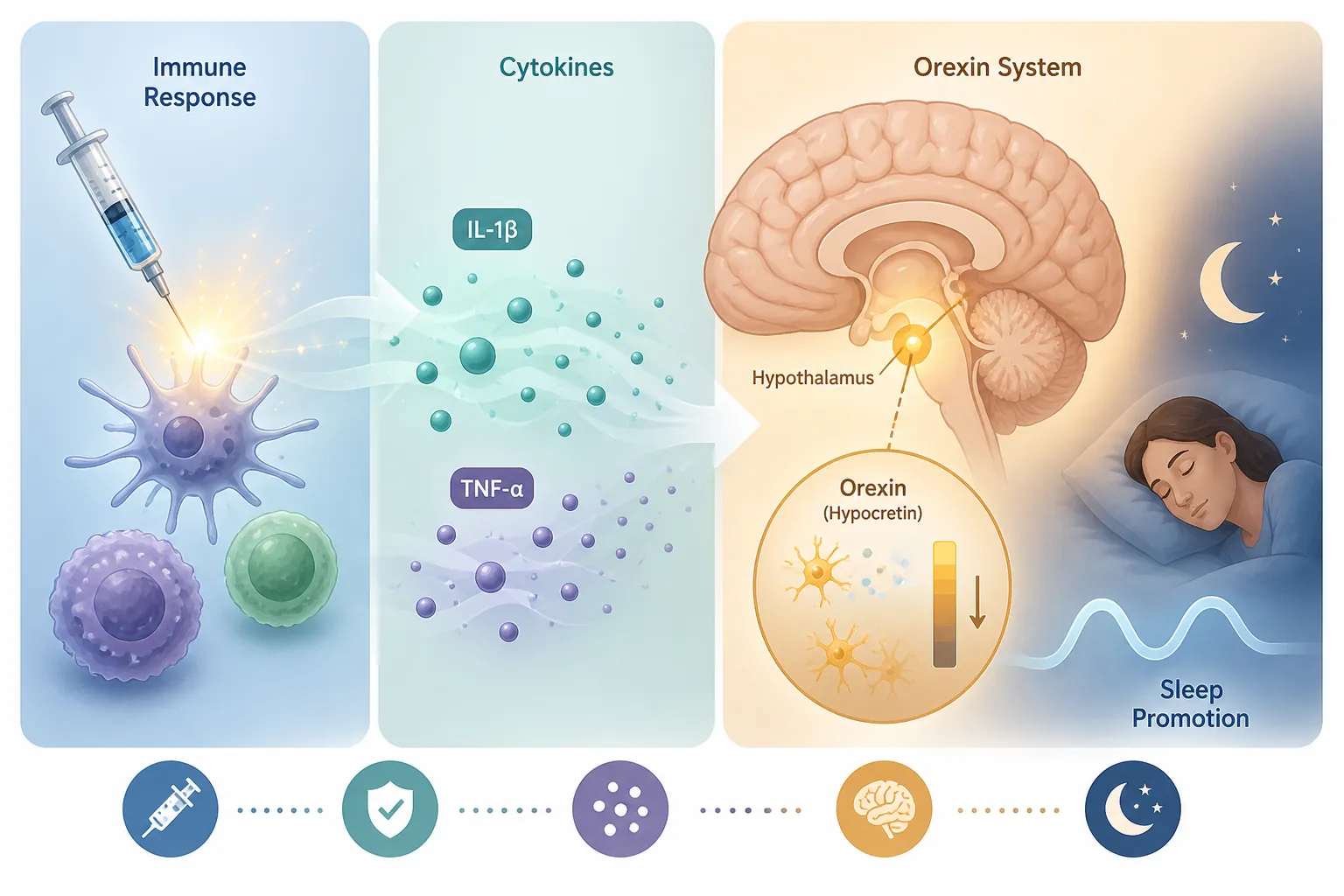
Put plainly: immune activity can press gently on the brain’s sleep-promoting side and ease off the wakefulness side. That does not mean every post-vaccine nap is medically significant. It means the fatigue has a biologically plausible reason, which is often more reassuring than being told to ignore it.
This mechanism also explains why brand-by-brand sleep comparisons are not very useful for a reader in 2026. The studies most often cited for these questions were conducted in earlier vaccine periods and with specific products or populations. They can help answer “can this happen?” and “what is the usual pattern?” They cannot support confident claims that one current formulation is clearly better or worse for sleep for a particular person.
What Helps Before and After the Shot
If you are planning a vaccine appointment, the simplest sleep strategy starts the night before. A 2022 study reported that poor sleep quality before vaccination was associated with a significantly higher risk of mild adverse reactions.[6] That does not mean one perfect night prevents side effects, and it does not mean a bad sleeper has done anything wrong. It does make sleep the night before a reasonable place to put your effort.
- Schedule the shot when the next day can be a little flexible, if your work and caregiving responsibilities allow it.
- Prioritize a steady bedtime the night before rather than trying to “catch up” with an unusual sleep schedule.
- Hydrate normally and avoid using alcohol as a sleep aid after vaccination, especially if you already feel feverish or achy.
- If you nap, keep it practical: rest because your body is asking for it, not because you are testing whether something is wrong.
- After one bad night, return to your usual wake time as much as possible; this helps keep short-term insomnia from becoming a learned pattern.
Sleep aids require more individual judgment. Pregnant readers, older adults, people taking sedating medications, and anyone with sleep apnea, bipolar disorder, seizure history, or complex medical conditions should not add over-the-counter sleep medication casually. If your main issue is life-stage sleep vulnerability rather than the vaccine itself, it is more useful to read within that context: pregnancy insomnia, perimenopause sleep disruption, ADHD-related sleep timing, and older-adult daytime sleepiness each have different patterns and safety considerations.
What the Evidence Does Not Yet Tell Us
There is no good reason to invent subgroup-specific certainty where studies have not measured it. The available evidence does not directly answer whether COVID-19 vaccination changes sleep differently in pregnancy, perimenopause, ADHD, or older adulthood. Those groups may already have more fragile sleep for other reasons, but that is not the same as proving a distinct vaccine sleep side-effect pattern.
The same caution applies to narcolepsy-like symptoms. A 2024 Jordanian cross-sectional survey reported post-vaccination narcolepsy symptoms, but that design can identify reported symptoms and timing; it cannot prove that vaccination commonly causes narcolepsy.[7] Persistent episodes of overwhelming sleepiness, sudden muscle weakness with emotion, sleep paralysis, or hallucinations at sleep-wake transitions deserve specialist evaluation. They should not be folded into ordinary “I was tired for a day after my shot” fatigue.
When to Be Concerned
Most COVID vaccine sleep side effects are expected, short-lived immune responses. A sleepy day, an early bedtime, a restless night, or a brief run of strange dreams can fit the usual pattern, especially when they improve within 1 to 2 days.[2]
Reach out for clinical advice if the sleep change is severe, worsening, paired with concerning neurologic symptoms, or lasting beyond the usual short window. Also seek help if insomnia becomes persistent, daytime sleepiness is unsafe for driving or caregiving, or symptoms look less like vaccine fatigue and more like a new sleep disorder. The reassuring answer is true for most people; the careful answer is that duration and severity still matter.
References
- Impact of COVID-19 and Vaccination on Sleep: A Nationwide Cross-Sectional Study in South Korea, 2023, link
- Sleep and COVID: Sleep-related symptoms, transient vaccine-related side effects, and more, Healio, January 17, 2023, link
- Severe Relapse of Insomnia After COVID-19 Vaccination: A Case Report, 2022, link
- Why Does the COVID-19 Vaccine Give Some People Strange Dreams?, Healthy Debate, 2021, link
- COVID-19 Vaccines and Sleep Disturbances: A Possible Link with Orexinergic System?, 2022, link
- Poor Sleep Quality Increases Adverse Reactions to COVID-19 Vaccination, Frontiers, 2022, link
- Narcolepsy Symptoms Following COVID-19 Vaccination: A Cross-Sectional Study in Jordan, Clinical and Experimental Vaccine Research, 2024, link
Read the full guide: How to Manage Sleep Pain After Spinal Cord Injury: Tips That Work