
How to Manage Sleep Pain After Spinal Cord Injury: Tips That Work
If the usual sleep advice has failed after a spinal cord injury, that does not mean you are doing sleep wrong. A lot of standard guidance assumes a body that can get up easily, regulate temperature normally, feel early pressure warnings, delay bladder care, and move away from pain without planning a transfer. SCI changes those assumptions. In one large study of 1,172 people with SCI, 68% reported poor sleep quality, so a bad night is not a personal oddity or a simple discipline problem.[1]
Sleep pain after SCI is rarely one thing. Neuropathic pain may burn or shoot below the level of injury. Shoulder, neck, back, or wrist pain may come from transfers, wheelchair use, or positioning. Visceral pain may come from bowel, bladder, or abdominal problems. On top of that, insomnia can become conditioned: the bed starts to mean pain, waiting, catheter timing, pressure worry, and watching the clock. The useful question is not which single tip will relieve sleep pain after spinal injury. It is which layers need to be coordinated so the night becomes safer, less painful, and repeatable.

Start by naming the pain you are trying to quiet
Pain after SCI is commonly grouped into neuropathic, musculoskeletal, and visceral pain, and the distinction matters because the same nighttime response will not fit all three.[2] Neuropathic pain may respond to nerve-pain medications. Musculoskeletal pain may point toward seating, transfer mechanics, shoulder overuse, spasticity management, or pillow support. Visceral pain can be a warning that bowel, bladder, infection, constipation, or another internal issue needs medical attention rather than another sleep routine.
A practical sleep-pain log does not need to be elaborate. For one or two weeks, track the time pain worsens, where it is felt, what it feels like, what happened earlier that day, medication timing, bladder or bowel interruptions, turns or repositioning, and morning grogginess. The point is to give the rehab physician, pain clinician, or primary care team something better than “nights are bad.” Patterns often show up in ordinary details: pain flares after late transfers, burning intensifies when the room gets warm, shoulder pain follows a day with extra propulsion, or sedation helps sleep but makes morning care unsafe.
| Nighttime clue | What it may suggest | What to bring to the care team |
|---|---|---|
| Burning, electric, shooting, or pins-and-needles pain | Neuropathic pain | Location, timing, current nerve-pain medications, side effects |
| Aching in shoulders, wrists, neck, back, or hips | Musculoskeletal strain or positioning problem | Transfer routine, wheelchair day, pillows, mattress, sleep position |
| Abdominal, bladder, bowel, or cramping pain | Possible visceral source | Bowel program changes, catheter issues, urinary symptoms, constipation |
| Waking with headache, choking, gasping, or heavy daytime sleepiness | Possible sleep-disordered breathing | Snoring reports, witnessed pauses, morning symptoms, sedating medicines |
| More pain after short or broken sleep | Pain-sleep cycle becoming self-reinforcing | Sleep timing, awakenings, mood, medication timing, caregiver interruptions |
Medication can help, but the morning still has to work
For SCI-related neuropathic pain, gabapentinoids are the medication group with the clearest quantified evidence in the available research. A 2025 meta-analysis of 5 randomized controlled trials involving 682 participants found that gabapentin and pregabalin reduced pain intensity, with a mean difference of -1.75, and reduced pain-related sleep interference, with a mean difference of -0.99.[3] That is meaningful evidence, especially when pain is repeatedly waking someone or keeping them from falling asleep.
The same evidence also shows why these medications should be handled with care rather than treated as a permanent answer after a short trial. In that analysis, gabapentinoids were associated with higher risks of somnolence, dizziness, and peripheral edema; somnolence had a reported risk ratio of 3.77 and dizziness 2.83.[3] Long-term safety and effectiveness data in SCI remain limited.[3]
Those side effects are not small inconveniences in SCI care. Somnolence can make morning catheterization, skin inspection, bowel routines, transfers, driving, work, or caregiver handoffs harder. Dizziness may increase transfer risk. Edema can complicate positioning, footwear, and skin monitoring. A medication that improves pain but makes pressure checks unreliable may still need dose adjustment, timing changes, or a different plan.
Medication timing is often as important as medication choice. A clinician may adjust evening dosing to cover the worst pain window while trying to avoid a heavy morning hangover. The person living with SCI and the caregiver should report not only pain scores, but also whether the dose changes overnight safety: missed turns, harder transfers, confusion, worsened swelling, constipation, falls, or delayed bladder care.
Be especially cautious with opioids, benzodiazepines, and alcohol
Opioids and benzodiazepines are not casual sleep tools in SCI. The concerns include habit-forming risk, constipation, respiratory depression, interactions with other sedating medicines, and the added danger of sleep-disordered breathing.[4] Constipation is not just uncomfortable; it can disrupt bowel programs, increase pain, and turn the next night into another round of symptoms.
Alcohol deserves the same seriousness. It may feel sedating at first, but it can disrupt sleep architecture, act as a diuretic, complicate bladder management, and interact dangerously with muscle relaxants and pain medications.[5] For someone already balancing catheter timing, spasticity medication, pain medication, and overnight positioning, alcohol adds another variable that is hard to control.
Adapt insomnia strategies to the body that is actually in the bed
Cognitive behavioral therapy for insomnia, or CBT-I, is generally recommended as a first-line treatment for insomnia disorder, and SCI sleep reviews discuss behavioral treatment as part of insomnia care.[4] The uncomfortable limitation is that the available research identified no formal CBT-I trials conducted specifically in SCI populations. So the best use of CBT-I here is careful adaptation, not pretending the standard script has already been proven for every SCI situation.
The most obvious mismatch is stimulus control. Many insomnia handouts say to get out of bed if you are not asleep after about 20 minutes. That can be reasonable for someone who can stand up, walk to a chair, and come back without help. It can be unsafe or unrealistic for someone who needs a lift, slide board, caregiver, bracing, catheter setup, or careful pressure protection. The goal behind the advice is still useful: reduce the time spent lying in bed awake, frustrated, and alert. The method has to change.
- If independent transfers are not safe at night, create an “awake but resting” option in bed: dim light, eyes off the clock, quiet audio, breathing practice, or another low-stimulation activity that does not require repositioning beyond the agreed plan.
- If a caregiver is needed, decide in advance which awakenings justify a transfer, medication check, catheter help, or repositioning, and which can be handled with a lower-effort routine.
- If pain spikes when lying still, use planned position changes rather than waiting until pain is severe enough to force an urgent move.
- If the bed has become a place for long daytime scrolling, worry, and symptom monitoring, move as much of that activity as possible to a chair, desk, or daytime setting that is safe and accessible.
Sleep restriction, another CBT-I tool, also needs caution. Restricting time in bed may increase sleep drive, but after SCI, time in bed can also be part of pressure relief, fatigue management, caregiving logistics, and pain control. Any attempt to compress the sleep window should be discussed with a clinician if pressure injury risk, severe fatigue, autonomic symptoms, unsafe transfers, or heavy sedation are present.
Sleep hygiene changes when bladder, bowel, and temperature are part of the night
Generic sleep hygiene is usually too vague for SCI, but a few parts become useful when they are tied to bodily logistics. Craig Hospital’s SCI-focused sleep guidance includes attention to routine, caffeine, nicotine, alcohol, exercise timing, evening meals, and a sleep-friendly environment.[5] For SCI, those points need to be translated into a plan that does not sabotage catheterization, bowel timing, pain medication, or temperature control.
- Fluids: ask the care team how to time evening fluids around bladder management instead of simply “drinking less,” especially if urinary health, medications, or heat regulation are concerns.
- Catheter supplies: keep the needed supplies reachable from the actual nighttime position, not just somewhere in the room.
- Caffeine and nicotine: move them earlier when possible, but also notice whether cutting back changes bowel routine, headaches, or mood.
- Evening activity: avoid turning every night into a full rehab session, but do not remove helpful stretching, range of motion, or spasticity routines that the clinical team has recommended.
- Screens: reduce bright, activating use when feasible, but prioritize safe access to call devices, environmental controls, alarms, and caregiver communication.
Mood belongs in this same loop, not in a separate “mental health” box at the end. Depression and anxiety affect about 40% of the SCI population and can worsen both pain and insomnia.[4] Treating psychological comorbidities may improve sleep more than a stricter bedtime routine alone, especially when worry, grief, trauma reminders, or pain anticipation are keeping the nervous system on duty all night.
Build the bed area for pressure, temperature, and reach
A sleep plan after SCI is partly furniture, partly skin protection, and partly choreography. If the only advice is “make the room dark and cool,” it misses the bedside table that is too far away, the call button behind the pillow, the blanket that traps heat, the mattress that bottoms out, or the caregiver who cannot safely turn someone in the available space.
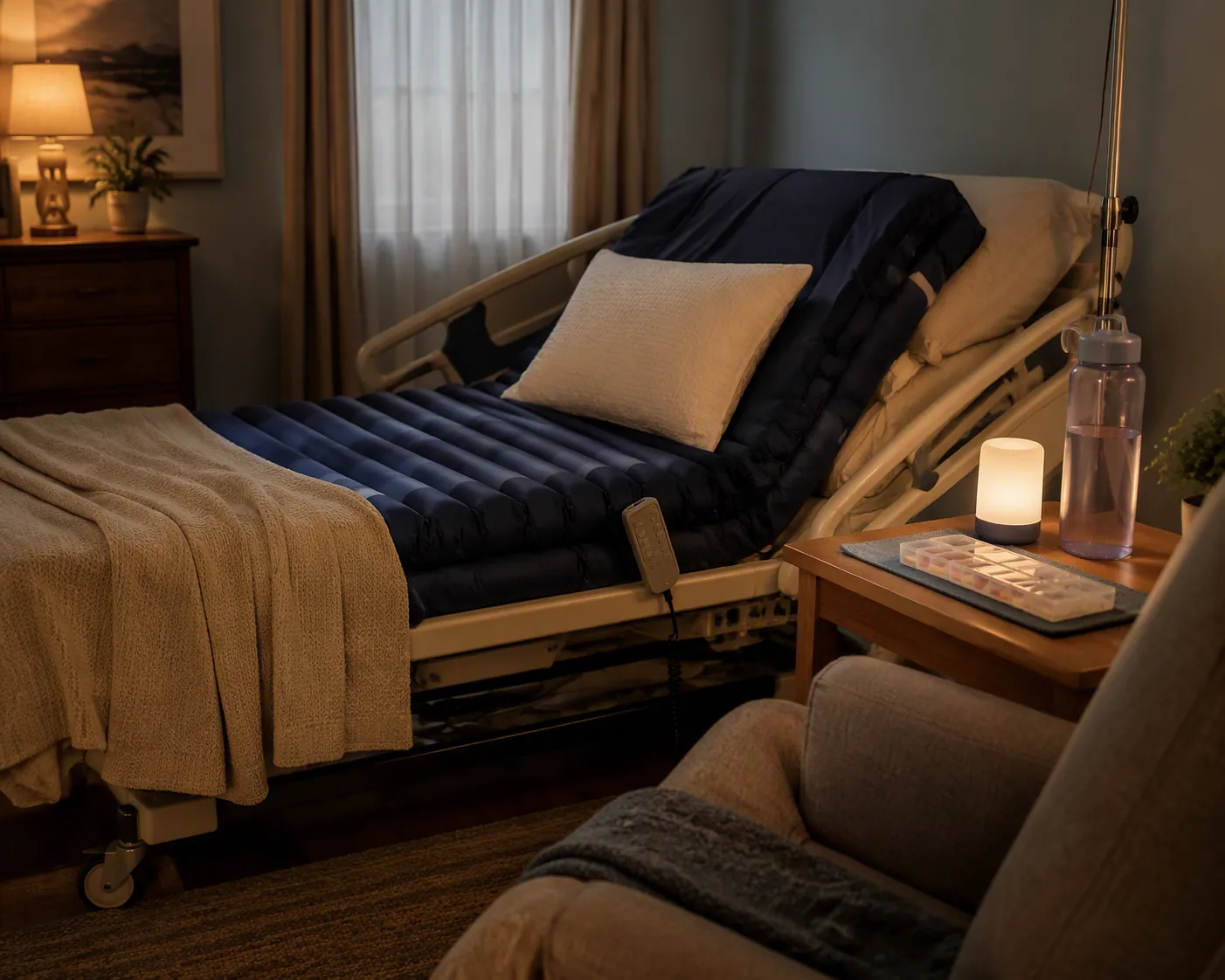
Pressure care is not a comfort upgrade. Craig Hospital’s mattress guidance emphasizes matching the bed and mattress to skin risk, mobility, moisture, transfer needs, and whether the person can reposition independently.[6] QSCIS similarly frames lying posture, mattress choice, repositioning, and skin inspection as part of pressure management for people with SCI.[7] If pain relief comes from staying still for hours, but the skin cannot tolerate that stillness, the plan needs changing.
The right surface depends on the person, not on the price tag. A pressure-redistributing mattress, overlay, or adjustable bed may help, but only if it fits the person’s weight, posture, transfer method, moisture risk, and turning schedule. A surface that makes transfers harder may increase caregiver strain or shoulder pain. A surface that feels soft but allows bony areas to sink through may fail where it matters.
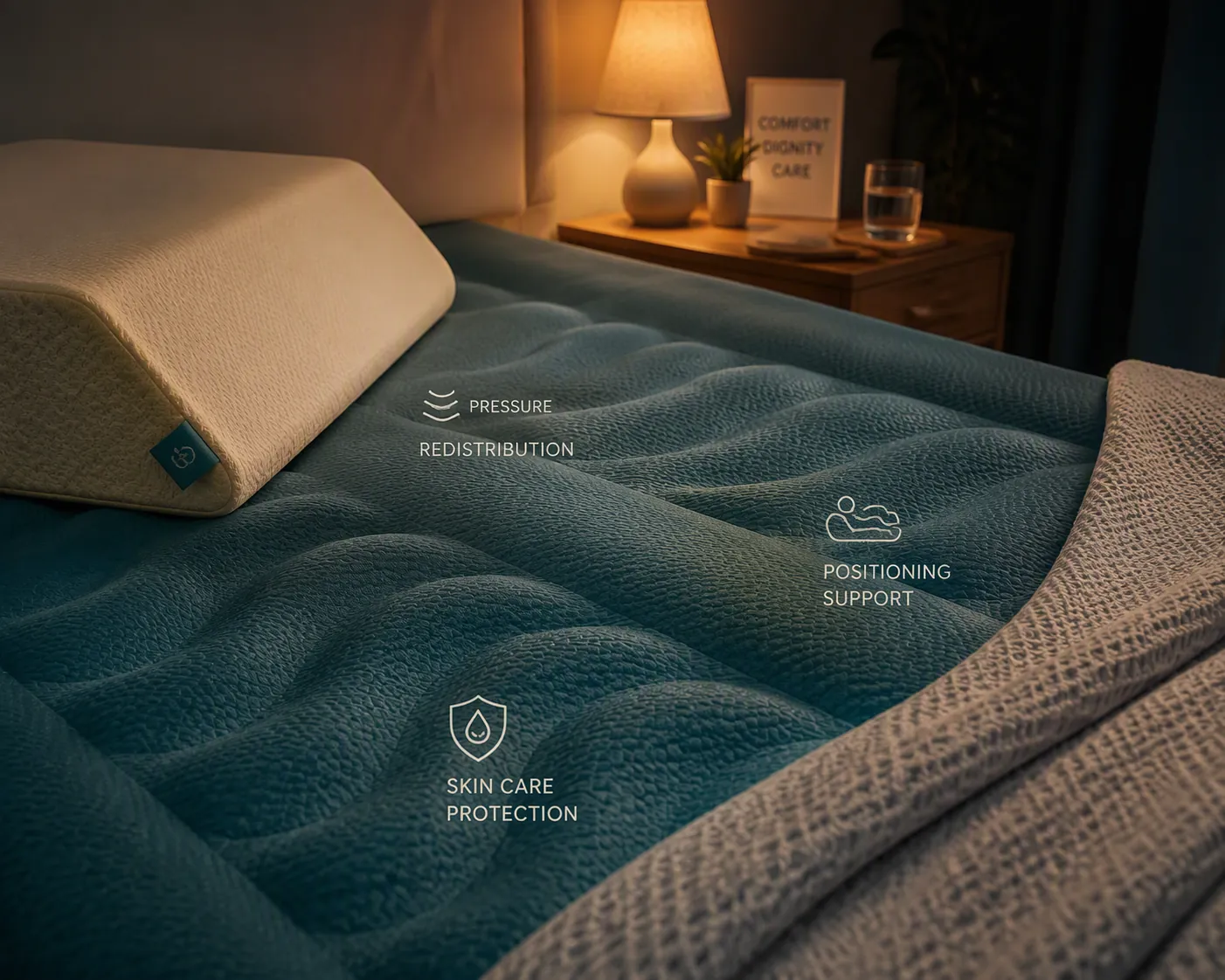
Positioning should be specific enough that another person can repeat it at 2 a.m. Shepherd Center describes padding and positioning methods such as pillow placement, foam pads, and bridging techniques to reduce pressure between body surfaces and support safer alignment.[8] In real life, that may mean labeling pillows, photographing a successful setup for caregivers, or writing down which wedge goes under which leg. The best position is not the one that looks clinically tidy; it is the one that protects skin, reduces pain, allows breathing, and can actually be maintained.
- Keep pain medication, water if allowed, catheter supplies, phone, call device, glasses, and environmental controls within reach from the nighttime position.
- Check whether the bed height works for transfers and caregiver body mechanics, not just for appearance.
- Use a nightlight bright enough for skin, catheter, or transfer safety but dim enough that it does not fully wake the room.
- Make the turning plan visible: times, positions, skin areas to inspect, and what changes require calling the clinician.
- Reduce heat traps: heavy bedding, plastic-backed pads, and poorly ventilated surfaces can matter more for someone with impaired temperature regulation.
Temperature deserves more respect in cervical and higher-level injuries. Sleep reviews report that circadian melatonin can be near-abolished in complete cervical SCI, and circadian disruption may contribute to sleep-onset insomnia in tetraplegia.[4] Appropriately timed exogenous melatonin may offer benefit for sleep-onset insomnia in this group, but timing and medication interactions should be discussed with a clinician rather than added casually to an already sedating nighttime mix.[4]
Do not miss sleep-disordered breathing
Pain is not the only reason someone with SCI wakes unrefreshed. Sleep-disordered breathing is common after SCI, with chronic prevalence estimates ranging from 40% to 91% depending on the population and methods studied.[4] One review reports that sleep-disordered breathing develops in 62% of SCI patients within 4 weeks of injury.[4] Those numbers should not be flattened into one universal risk, but they are high enough that persistent poor sleep deserves more than another pillow adjustment.
Severe obstructive sleep apnea after SCI has been associated with cognitive deficits equivalent to 31 additional years of aging.[9] That kind of effect can look like poor motivation, bad memory, irritability, or trouble following a care routine, when the night itself is repeatedly interrupting oxygen and sleep continuity.
A sleep study is worth discussing if there is loud snoring, witnessed breathing pauses, gasping, morning headaches, heavy daytime sleepiness, resistant insomnia, unexplained cognitive changes, or sedating medication use that raises concern. It is also worth discussing when pain treatment keeps escalating but the person still wakes exhausted.
Diagnosis is only one piece. Positive airway pressure treatment can be difficult to sustain after SCI; the COSAQ trial reported that only 21% of participants achieved more than 4 hours per night of CPAP use.[4] Mask fit, hand function, caregiver availability, nighttime catheterization, skin tolerance, anxiety, and transfer logistics can all interfere. That does not make a sleep study pointless. It means the sleep center needs to understand SCI care before the appointment is booked.
- Ask whether the lab has wheelchair access from entrance to testing room and bathroom.
- Ask whether lifts, transfer help, or space for a caregiver are available if needed.
- Ask whether the bed and mattress can accommodate pressure-relief needs.
- Ask whether staff are comfortable with SCI-related positioning, catheter needs, autonomic symptoms, and skin precautions.
- Bring medication lists, usual nighttime routines, pressure-care instructions, and equipment needs rather than assuming the lab can improvise safely.
When the plan needs a specialist
Some nights are hard because the plan needs tuning. Others are hard because the current plan is no longer safe enough. A rehab physician, pain clinician, sleep specialist, psychologist, seating specialist, wound-care clinician, or primary care clinician may need to be brought in depending on the pattern. The referral threshold should be lower when the consequence of waiting is skin breakdown, unsafe sedation, uncontrolled pain, or a caregiver reaching the edge of what can be done safely.
- Pain clinic or rehab physician: neuropathic pain remains severe despite first-line treatment attempts, side effects limit dosing, pain type is unclear, or multiple sedating medications are being combined.
- Sleep specialist: snoring, witnessed pauses, gasping, morning headaches, daytime sleepiness, cognitive changes, or persistent insomnia suggests sleep-disordered breathing or another sleep disorder.
- Wound-care or SCI skin specialist: redness, pressure marks, moisture injury, new skin breakdown, or pain relief requires positions that compromise skin protection.
- Mental health clinician familiar with disability or rehabilitation: anxiety, depression, trauma symptoms, grief, or pain fear is driving long awake periods or making routines impossible.
- Occupational therapist, physical therapist, or seating specialist: bed access, transfers, pillows, wedges, mattress height, or caregiver mechanics are making nights unsafe.
The workable plan usually looks layered rather than elegant: a medication strategy that reduces neuropathic pain without making morning care unsafe; adapted CBT-I principles that respect transfer and catheter realities; a bed area arranged for reach, pressure protection, temperature, and caregiver feasibility; and a clear path to sleep study or specialty pain care when symptoms point beyond ordinary insomnia. That is less tidy than a bedtime checklist, but it is much closer to the night a person with SCI is actually trying to get through.
References
- The Impact of Sleep Quality on Health, Participation and Employment Outcomes in People with Spinal Cord Injury — Graco et al., 2023. https://www.sciencedirect.com/science/article/pii/S187706572300009X
- Chronic Pain After Spinal Cord Injury (SCI) — MSKTC Factsheet. https://msktc.org/sci/factsheets/pain-after-spinal-cord-injury
- Gabapentinoids Show Efficacy for Neuropathic Pain in Patients with Spinal Cord Injury — Clinical Pain Advisor, 2025. https://www.clinicalpainadvisor.com/news/gabapentinoids-neuropathic-pain-spinal-cord-injury/
- Impact Of Spinal Cord Injury On Sleep: Current Perspectives — Sankari et al., PMC6800545. https://pmc.ncbi.nlm.nih.gov/articles/PMC6800545/
- Five Tips for Better Sleep — Craig Hospital. https://craighospital.org/blog/five-tips-for-better-sleep
- Beds for Spinal Cord Injuries (Skin Care: Bed and Mattress) — Craig Hospital. https://craighospital.org/resources/skin-care-bed-and-mattress
- Skin Considerations in Lying — Queensland Spinal Cord Injuries Service (QSCIS). https://qscis.health.qld.gov.au/resources/skin/key-principles-of-bed-and-mattress/
- Padding & Positioning — Shepherd Center. https://myshepherdconnection.org/living-with-injury/body-functions/skin-care/padding-and-positioning/
- Sleep Disorders in Patients With Spinal Cord Injury — Neurology Advisor. https://www.neurologyadvisor.com/features/sleep-disorders-in-patients-with-spinal-cord-injury/
Read the full guide: How do I sleep during an orange heat alert in Spain?