Does a Full Moon Affect Sleep? Here's What the Evidence Shows
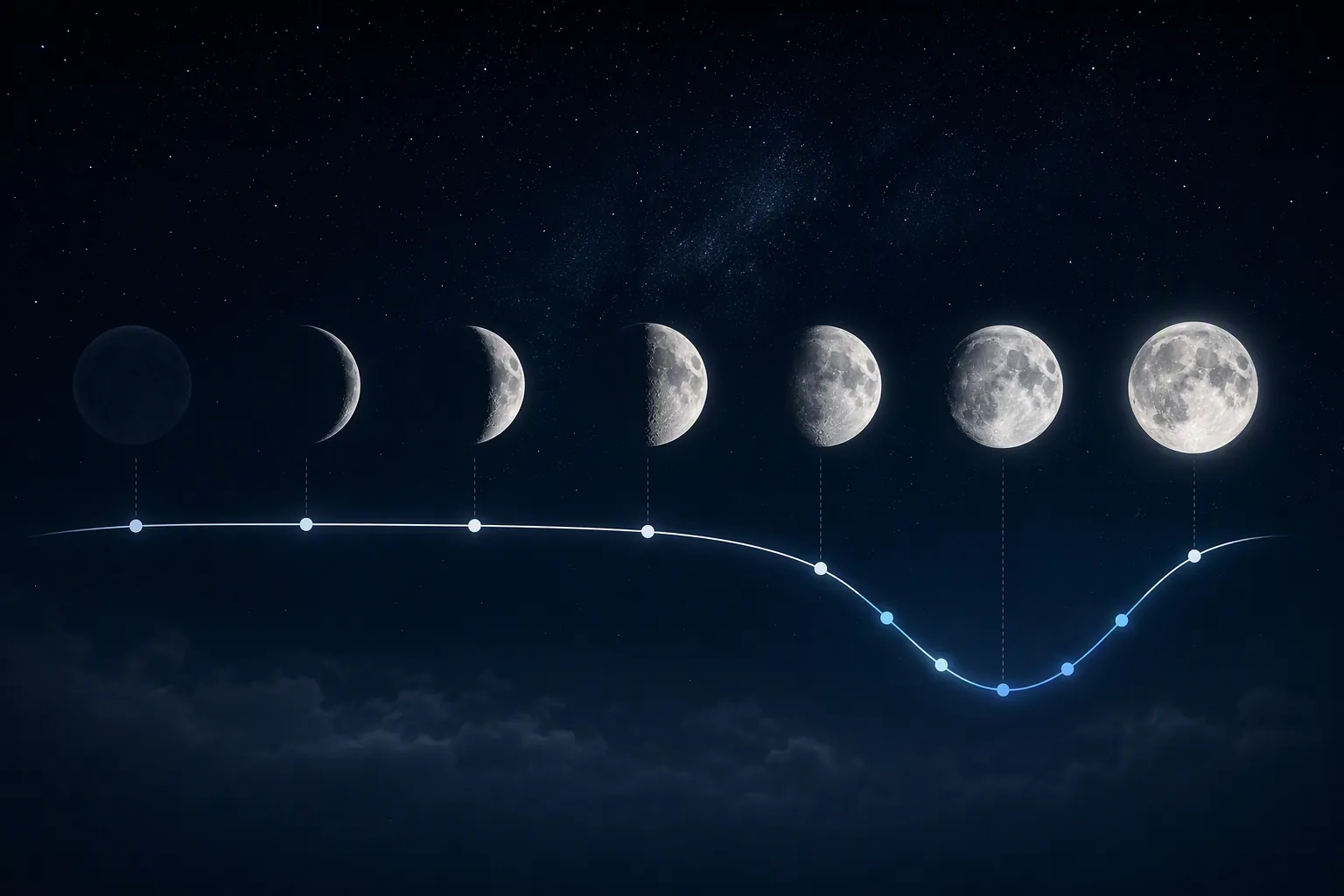
Yes, a full moon can affect sleep quality, but the effect is usually modest. The best-supported pattern is a slightly later sleep onset and a shorter night of sleep, often in the range of about 15 to 30 minutes rather than hours. In one controlled lab study, participants took 5 minutes longer to fall asleep, slept 20 minutes less, and had 30% less deep sleep around the full moon; in a larger field study, sleep started later and total sleep time shortened most clearly in the 3 to 5 days before the full moon rather than only on the full-moon night itself.[1][2]
That distinction matters. If your tracker shows that you drift off later before a full moon, or you feel a little less restored for a few nights, that is plausible. If you are losing several hours of sleep, waking repeatedly, needing unsafe sleep aids, or feeling unable to function, the moon is probably not the main explanation. Something else deserves more attention.
How Much Sleep Does the Full Moon Actually Cost?
The clinically useful answer is: enough to notice if your sleep is already fragile, but not enough to explain chronic insomnia by itself. A 20-minute loss can matter. It can be the difference between feeling merely tired and feeling foggy the next morning, especially if you are already short on sleep. But it is still a small burden compared with common sleep disruptors such as late caffeine, evening screen exposure, alcohol, pain, hot flashes, pregnancy discomfort, medication effects, untreated sleep apnea, or a delayed circadian rhythm.
| What you notice | How well it fits the lunar evidence |
|---|---|
| Falling asleep 15 to 30 minutes later for several nights before the full moon | Plausible |
| A slightly shorter night without another obvious trigger | Plausible |
| A single bad night only on the full-moon date | Possible, but less specific |
| Losing several hours of sleep every month | Too large to assign mainly to the moon |
| Repeated awakenings, gasping, severe restlessness, or needing sedatives | Look for another cause |
The phrase "sleep quality" also needs some sorting. In the controlled study, the signal was not just that people said they slept worse. Their sleep was measured with EEG in a dark laboratory, and deep sleep decreased around the full moon.[1] In the field study, the main pattern was behavioral and circadian: people went to sleep later and slept for a shorter amount of time.[2] Those are related, but they are not identical. A later bedtime can make sleep feel worse even if the sleep you do get is not dramatically fragmented.
The Best Evidence Points to the Nights Before the Full Moon
The most helpful update from newer research is timing. People often compare the full-moon night with an ordinary night and then conclude that nothing happened. But the larger field study found the strongest sleep delay and sleep shortening in the 3 to 5 days before the full moon.[2] That is exactly the kind of detail that can make older, simpler comparisons look contradictory.
Casiraghi and colleagues studied three Toba/Qom communities in Argentina using wrist actimetry in 98 people, then compared the pattern with 464 University of Washington students. Across both settings, sleep began 30 to 80 minutes later and total sleep was 20 to 90 minutes shorter in the days before the full moon. The effect was strongest where electric light was absent, but it was still detectable in urban Seattle.[2]
That does not mean every person loses 90 minutes of sleep before every full moon. Field studies capture real life: community routines, work, social activity, lighting, weather, and individual habits all travel with the measurement. The safer practical estimate is still closer to a small monthly nudge than a dramatic biological event.
The controlled lab study adds a different kind of support. Cajochen and colleagues studied 33 participants sleeping in a completely dark lab with EEG monitoring, and the participants were not told that lunar phase was the question. Around the full moon, sleep onset took 5 minutes longer, total sleep was 20 minutes shorter, and slow-wave sleep fell by 30%.[1] The sample was small, so it should not carry the whole argument alone. Its value is that it found a physiological signal under unusually controlled conditions.
Why Moonlight Is the Most Plausible Mechanism
The simplest mechanism is also the most useful one: light. In the nights before the full moon, moonlight is present during the early part of the night, when many people are trying to wind down. The full moon provides only about 0.1 to 0.3 lux of illumination, but the circadian system is exquisitely sensitive to light timing, especially when evenings are otherwise dark.[2]
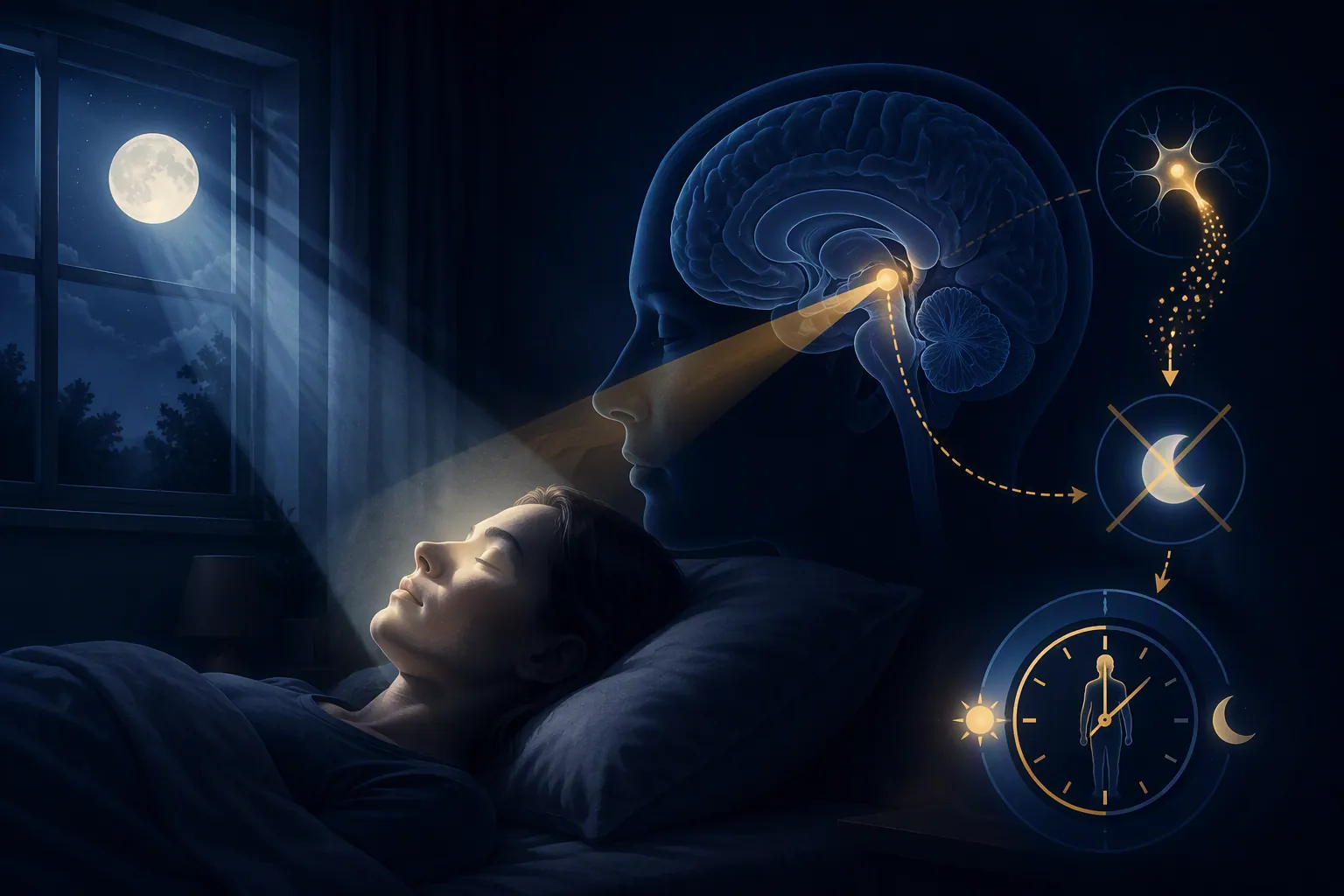
Melatonin is part of that story. As evening light exposure increases, melatonin timing can shift later, and the body may receive a weaker signal that night has begun. That does not make moonlight equivalent to a bright tablet screen held close to the face. It means that, in a dark environment, even a small natural light cue may be enough to delay sleep for some people.
There is one awkward detail: the dark-lab study still found a lunar pattern even though participants could not see the moon.[1] That keeps the door open to a second mechanism or some kind of endogenous lunar rhythm, but it does not prove one. Geomagnetic explanations are sometimes raised because the moon passes through Earth's magnetotail around the full moon, and geomagnetic events have been linked with physiological changes in other contexts. That is interesting, but much less direct than the light-and-circadian explanation.
Gravity is not a good explanation for sleep changes. The gravitational argument sounds intuitive because people associate the moon with tides, but the pull on a human body is tiny, and it does not explain why sleep effects would differ between full and new moons. Supernatural explanations add nothing useful for deciding what to do at bedtime.
Why Some Studies Find No Full-Moon Effect
Conflicting results are not surprising here. If a study compares only the full-moon night with the new-moon night, it may miss the window when sleep disruption is most likely to peak. The larger field study suggests that the more important period is the 3 to 5 days before the full moon, not necessarily the calendar night when the moon is technically full.[2]
Study design also matters. A dark sleep lab can control noise, light, schedule, and measurement, but it may include too few people to estimate a small effect confidently. A field study can show patterns in real homes and communities, but it cannot prove that the moon caused every change it records. This is why the evidence is best described as moderate: more than a story, less than a settled clinical rule.
There are also limits to who has been studied. The strongest evidence here comes from a small Swiss laboratory sample, communities in Argentina, and students in Seattle.[1][2] That does not automatically generalize to every latitude, season, housing type, work schedule, or health status. Moonrise timing differs by geography, and electric light can blur natural light cues.
What About Perimenopause, Pregnancy, ADHD, and Older Adults?
No source material in this evidence set directly tests whether full-moon sleep effects are larger in perimenopause, pregnancy, ADHD, or older adults. That gap is important. It would be easy to write a neat story in which each group has its own lunar vulnerability, but the available studies do not show that.
The more responsible interpretation is simpler: if your sleep is already unstable, a small lunar delay may be easier to feel. A person who usually sleeps well may not notice losing 20 minutes. Someone who is already waking from hot flashes, reflux, fetal movement, pain, anxiety, medication timing, or a delayed circadian rhythm may experience the same 20 minutes as the final nudge that makes the next day harder.
Perimenopause
For a perimenopausal reader, the main sorting question is whether the pattern is sleep-onset delay or repeated waking. The lunar signal is more consistent with going to sleep later and sleeping a little less. Hot flashes, night sweats, mood changes, menstrual-cycle variation, alcohol sensitivity, and possible sleep apnea can all create larger and messier sleep disruption. If the difficult nights cluster before the full moon but include drenching sweats or repeated awakenings, do not let the moon take the blame for symptoms that deserve their own plan.
Pregnancy
During pregnancy, a small delay from moonlight may sit on top of a very crowded sleep picture: bladder pressure, hip pain, reflux, fetal movement, nasal congestion, anxiety, and changing sleep positions. If a full-moon week looks worse on a tracker, it may be real enough to note. But repeated awakenings, snoring, pauses in breathing, severe restless legs, or daytime sleepiness need a pregnancy-specific explanation rather than a lunar one.
ADHD
For adults with ADHD, the full-moon question often overlaps with delayed sleep onset. If your baseline pattern already leans late, a few nights of extra early-night light exposure may be noticeable. But the bigger levers are usually evening stimulation, inconsistent wake time, medication timing, revenge bedtime procrastination, and screen exposure. A lunar pattern may explain why one week feels a little harder; it does not replace the circadian work.
Older Adults
Older adults often have lighter, more fragmented sleep and may spend more time managing medication effects, pain, nocturia, caregiving schedules, alcohol sensitivity, or untreated sleep disorders. A small lunar effect can be real and still be secondary. If the response to a full-moon week is to add stronger sleep aids, that is the wrong scale of response for a modest signal. Safety, fall risk, breathing disorders, and medication interactions matter more.
What Your Sleep Tracker Can and Cannot Tell You
A tracker can be useful here if you ask it the right question. Do not look only at the full-moon date. Mark the 5 nights before the full moon, the full-moon night, and a few nights after. Then compare sleep onset time, total sleep time, and how you felt the next day across several lunar cycles.
- Track at least a few cycles before deciding you have a pattern.
- Focus on sleep onset and total sleep time rather than a single sleep score.
- Note caffeine, alcohol, late exercise, stressful events, travel, illness, and menstrual or pregnancy symptoms.
- Treat a 15- to 30-minute shift as plausible, but be skeptical of assigning severe insomnia to lunar phase.
The most common tracking mistake is confirmation by memory. People remember a terrible full-moon night and forget the equally bad Tuesday after a stressful meeting or the night after wine. A simple calendar note can protect you from both overbelieving and dismissing the pattern too quickly.
What to Change If the Pattern Seems Real for You
The practical response should match the size of the effect. If you seem sensitive to the days before a full moon, reduce early-night light exposure. Close curtains earlier. Keep the bedroom dark. Avoid bright overhead light in the last hour before bed. Be especially careful with screens, because artificial light is a much stronger and more controllable exposure than moonlight.
It is reasonable to protect your sleep window more deliberately during that pre-full-moon stretch: keep wake time steady, avoid late caffeine, be cautious with alcohol, and do not schedule demanding evening tasks if you already know your sleep onset tends to drift. That is not because the moon is powerful. It is because small predictable burdens are easier to absorb when the rest of the night is boring and consistent.
Melatonin supplements are a separate question. The mechanism makes melatonin sound tempting, but a lunar sleep shift is not, by itself, a reason to start taking gummies or increase a dose. Timing, dose, age, pregnancy status, other medications, and next-day grogginess all matter. If the problem is mild and predictable, light control is the cleaner first experiment.
A Note on Sex Differences
One re-analysis of 850 polysomnography recordings reported that men showed greater sleep disruption around the full moon than women.[3] That finding is worth noting, not building around. The recordings came from research originally designed for sleep apnea, not a study built from the ground up to test lunar sleep effects. Until it is replicated, it should stay in the provisional column.
It also should not be used to reassure women that the moon cannot affect them, or to tell men that it will. The better question remains individual and practical: does your own pattern repeat, is the size of the change modest, and are larger sleep disruptors being addressed?
So, How Much Should You Care?
Care enough to track it if you are curious. Care enough to darken the room and protect your evening routine if the pattern repeats. Do not care so much that every bad night near a full moon gets filed under fate.
The evidence supports a modest lunar effect on sleep, especially in the nights before the full moon. It does not support using the moon as an explanation for ongoing insomnia, repeated awakenings, unsafe sleep-aid use, breathing symptoms, severe daytime sleepiness, or life-stage sleep problems that already have more direct causes. Track the pattern if it helps you understand your nights more calmly, reduce light exposure if you seem sensitive, and put most of your effort toward the larger sleep disruptors you can actually change.
References
- Evidence that the Lunar Cycle Influences Human Sleep, Current Biology, 2013, doi.org/10.1016/j.cub.2013.06.029
- Moonstruck sleep: Synchronization of human sleep with the moon cycle under field conditions, Science Advances, 2021, pmc.ncbi.nlm.nih.gov/articles/PMC7840136/
- Lunar cycle appears to affect men more strongly than women, ScienceNews.dk, sciencenews.dk/en/lunar-cycle-appears-to-affect-men-more-strongly-than-women
Read the full guide: Can't Sleep After a Storm? Here's What to Do Tonight