
The Mandalorian has not been studied by name as a sleep disruptor. But it does fit a kind of evening viewing that can plausibly cause sleep problems for some adults: suspenseful, cliffhanger-driven streaming watched late, especially in bed or in a binge. The issue is less “Star Wars is bad for sleep” than “your brain may not downshift just because the credits rolled.”
That distinction matters. A single episode earlier in the evening may be harmless for one viewer and too activating for another. The more sleep-unfriendly version usually has several ingredients at once: a tense ending, an autoplay countdown, a screen close to your face, and the quiet little bargain that one more episode will not matter.
The show is not the whole sleep problem
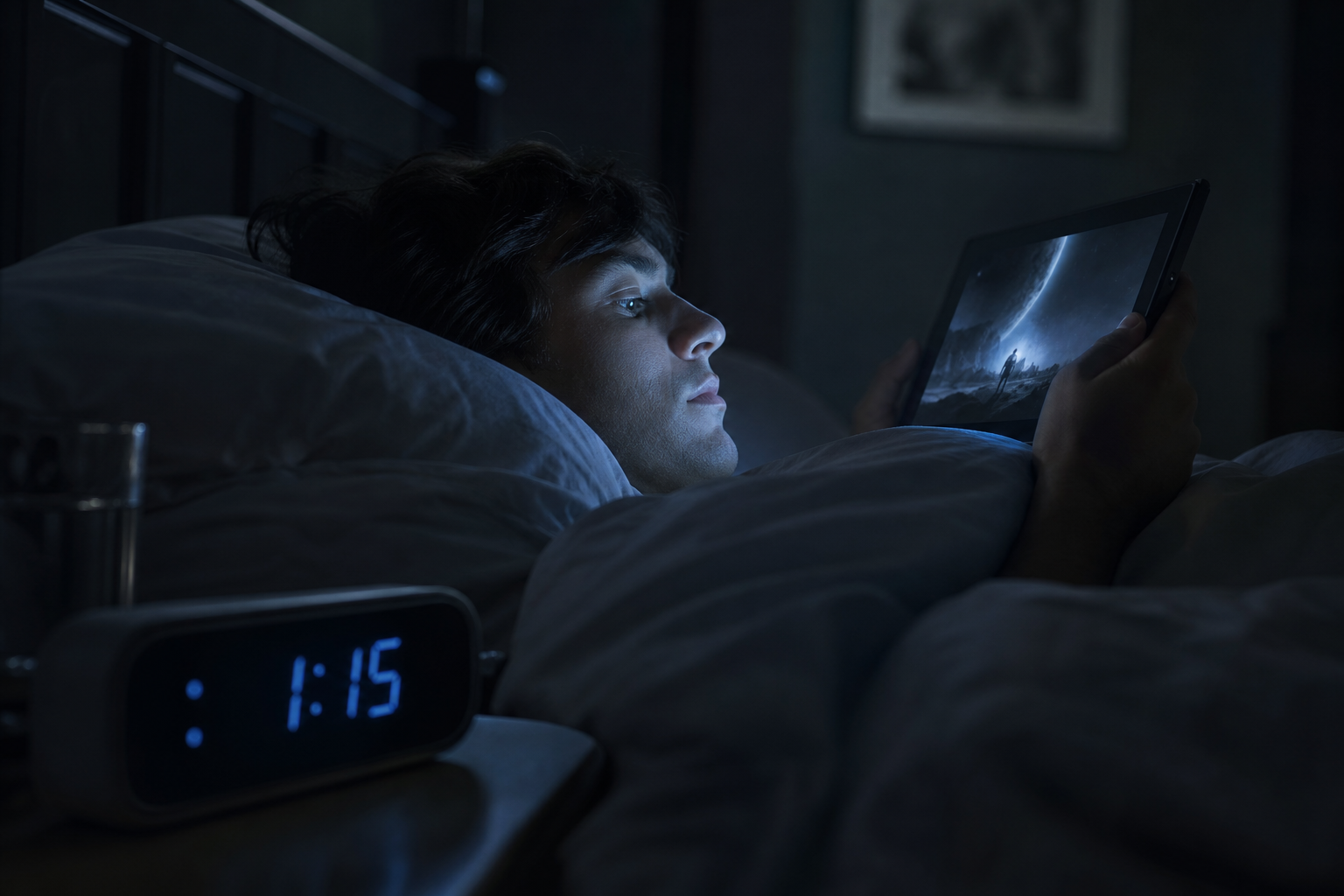
If you watch The Mandalorian and then have trouble falling asleep, there are at least two separate questions tangled together. One is about content: action, suspense, threat, reveals, and unresolved storylines. The other is about the viewing situation: how late it is, whether you are already in bed, whether autoplay is on, and whether the episode becomes part of a longer binge.
This is why blanket “no TV at night” advice often feels both smug and unhelpful. The same episode can land differently at 8:30 p.m. on the couch than it does at 12:40 a.m. under the covers, with work in the morning and the next episode already loading.
The most useful evidence does not prove that The Mandalorian itself causes insomnia. It points to a mechanism that makes shows like it more likely to interfere with sleep: cognitive pre-sleep arousal.
The bigger culprit may be mental replay, not just blue light
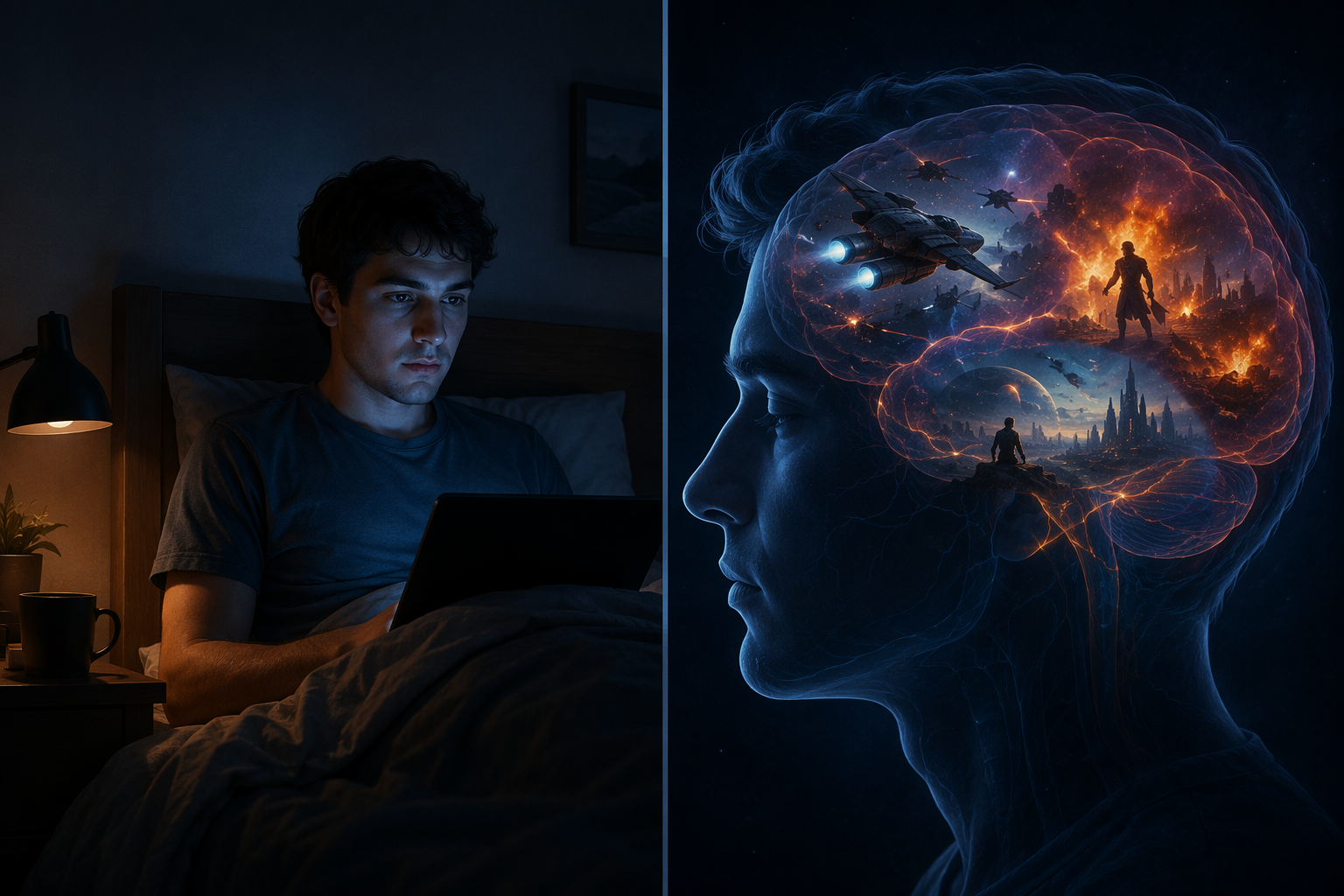
In a 2017 Journal of Clinical Sleep Medicine study of 423 young adults, Liese Exelmans and Jan Van den Bulck found that cognitive pre-sleep arousal fully mediated the relationship between binge-viewing and sleep outcomes, while somatic arousal did not. In plainer terms: the sleep problem was linked to the mind staying active before bed, not mainly to the body feeling physically keyed up.[1]
That is the part many viewers recognize. You are tired. Your body is not asking for a workout. But your attention is still in the episode: who knows what, what the reveal means, whether that ending is a fake-out, whether the next installment will resolve it. A well-built cliffhanger is supposed to create that itch. It is doing its job; it just may be doing it at the wrong hour.
The Exelmans and Van den Bulck study was cross-sectional, so it cannot settle causation. Poor sleepers may also be more likely to binge-watch, and the authors acknowledge that direction remains possible. Still, the mechanism is compelling because it matches the lived timing of the complaint: the episode ends, the room is quiet, and the brain keeps working.[1]
For The Mandalorian, this does not require a frantic episode every time. The series often trades on pursuit, secrecy, sudden reversals, creature danger, and end-of-episode momentum. If those elements leave you pleasantly alert at 9 p.m., fine. If they leave you running mental post-credits analysis after midnight, that is a different sleep environment.
Binge architecture turns a planned episode into lost sleep opportunity
The other problem is simpler and less mysterious: sleep cannot happen during time you are still watching. Streaming platforms make that trade feel small. The next episode appears before you have fully decided what you are doing. The countdown gives the evening a default direction.
The American Academy of Sleep Medicine reported in 2019 that 88% of U.S. adults said they had lost sleep because they stayed up past bedtime to watch multiple episodes of a TV show or streaming series; among adults ages 18 to 44, the figure was 95%.[2]
That survey is self-reported and older than the newer sleep-screen studies, so it should not be treated as a clinical measurement of what The Mandalorian does to people. It is still useful because it captures the ordinary behavior: not a dramatic addiction story, just adults repeatedly pushing bedtime because the next episode is right there.
More recent work makes the sleep relevance harder to shrug off. In a 2023 study of binge-watching and sleep quality, Forte and colleagues reported that 86.4% of problematic binge-watchers scored above the clinical threshold for poor sleep on the Pittsburgh Sleep Quality Index, compared with 33.3% of non-viewers.[3]
Again, that does not mean every fan who watches two episodes is a “problematic binge-watcher.” It means that when binge-watching becomes difficult to control or regularly displaces sleep, poor sleep is common enough to take seriously.
Watching after you get into bed raises the stakes
There is a practical difference between watching a show before bed and watching it after you are already in bed. Once the bed becomes the theater, the boundary between entertainment time and sleep time gets blurry. The device is close, the room is dark, and the easiest next action is usually to keep watching.
A 2025 Frontiers in Psychiatry study based on 45,202 people found that each additional hour of screen time after getting into bed was associated with 59% higher odds of insomnia symptoms and 24 minutes less sleep duration.[4]
That finding is not about The Mandalorian specifically, and it does not isolate whether the damage comes from light, content, displacement, habit, or all of them together. Its value is practical: if the viewing happens after you have entered the place where sleep is supposed to begin, each extra hour matters.
| Viewing condition | Why it can matter for sleep |
|---|---|
| One episode earlier in the evening | More time remains for arousal to fade before bed |
| One episode in bed | Screen use overlaps with the sleep attempt itself |
| Autoplay left on | The next episode becomes the default instead of a fresh decision |
| Stopping on a cliffhanger | Unresolved story tension can keep attention active |
| Watching when sleep is already fragile | Arousal and delayed bedtime have less margin for error |
Blue light still matters, but it is not the whole story
Screen light can contribute to sleep disruption, especially when a bright device is close to your face in a dark room. But for this particular question, blue light alone is too small an explanation. It does not account for why some shows are easier to turn off than others, or why a viewer can feel exhausted and still keep negotiating with the next-episode button.
The more realistic picture is layered. Light exposure may make the timing less sleep-friendly. The episode may keep the mind engaged. Autoplay may stretch the session. Bedtime viewing may remove the buffer that would normally let your attention settle. None of these has to be huge on its own to make sleep worse on a given night.
This is also why a dimmer screen is useful but not magical. Lower brightness, warmer display settings, or a TV across the room may reduce one source of stimulation. They do not resolve the cliffhanger, turn off autoplay, or give back the hour that disappeared.
How to keep watching without donating your bedtime
The most useful fixes change the conditions around the show rather than treating enjoyment as the enemy. If The Mandalorian is part of a relaxing evening for you and your sleep is fine, there is no need to invent a problem. If you are noticing delayed sleep, lighter sleep, or a pattern of staying up later than intended, start with the points where the mechanism is most obvious.
- Watch earlier when you can, especially on work nights. The goal is not purity; it is giving your brain time to stop processing the episode before lights-out.
- Avoid starting an episode in bed. If you want a firmer boundary, make the bed the place where the show is already over.
- Turn off autoplay. Make the next episode require an active choice, not a countdown you have to resist while tired.
- Stop before the cliffhanger when possible. With serialized shows, that may mean ending mid-arc on purpose rather than at the platform’s most tempting stopping point.
- Build a short decompression buffer. Ten or twenty quiet minutes of low-stakes activity can be enough to mark the difference between “I’m still in the episode” and “I’m going to sleep.”
- Use lower brightness or warmer screen settings if you watch late. Treat this as support, not the entire fix.
On nights when sleep is already shaky, the better swap may not be “no screen ever.” It may be choosing something familiar, slower, or less cliffhanger-dependent. Some people genuinely find familiar sci-fi calming; if that is your nervous system, the evidence does not require you to argue with it. The test is what happens afterward: whether you fall asleep reasonably well and whether bedtime stays intact.
So, does The Mandalorian cause sleep problems?
It can, for some adults, under the wrong viewing conditions. The strongest case is not that The Mandalorian has uniquely sleep-ruining powers. It is that suspenseful streaming, watched late and allowed to roll into another episode, can keep the mind active and cut into sleep opportunity.
If your pattern is one episode, earlier in the evening, followed by normal sleep, the show probably does not need to be on trial. If your pattern is “just one more” in bed while your brain keeps replaying the ending, the fix is to change the viewing setup first: earlier, out of bed, autoplay off, with a small buffer before sleep.
Comments
Join the discussion with an anonymous comment.