Sleep Tracking Devices

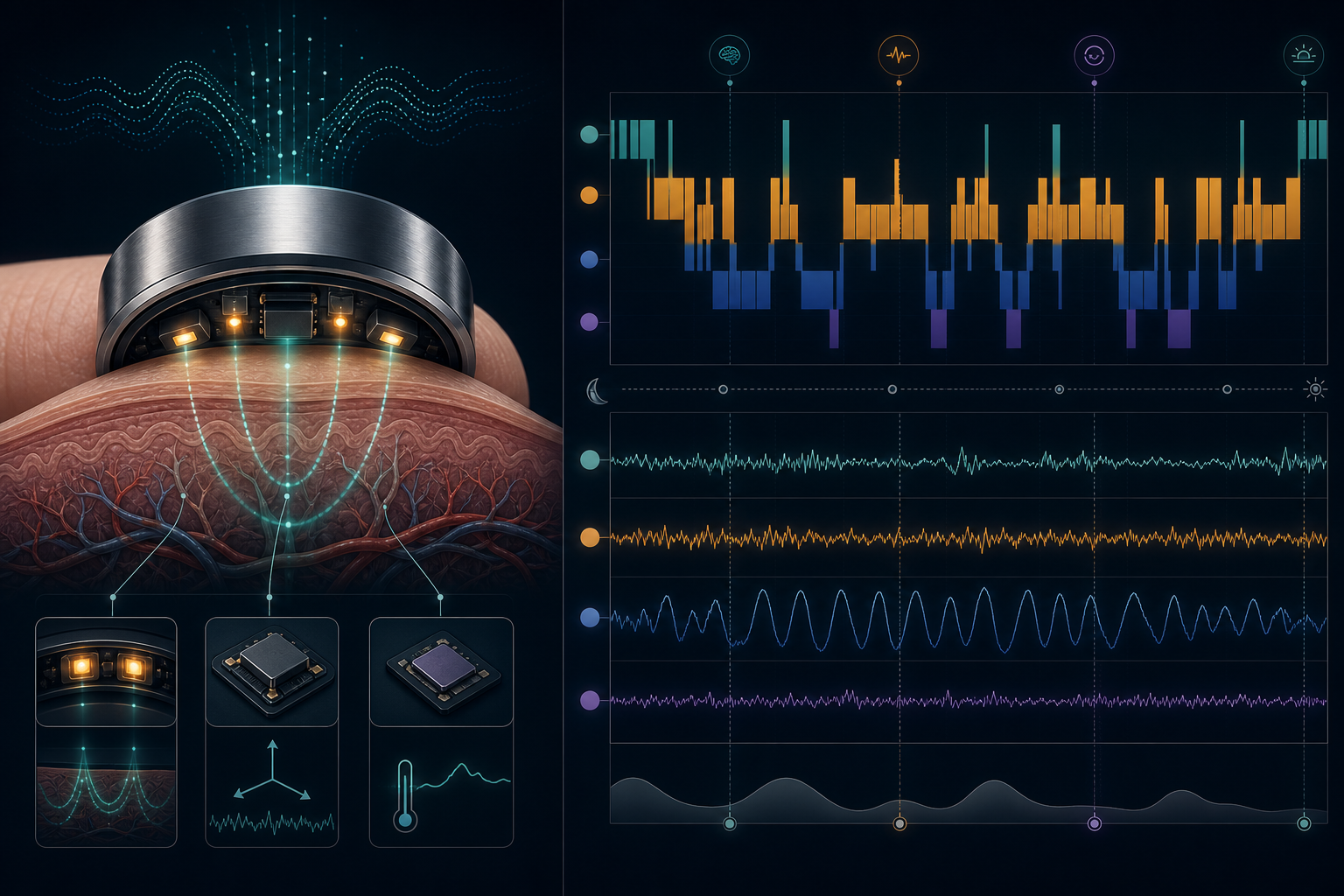
Standardized explainer and comparison pages for consumer sleep tracking hardware — wearables (Oura Ring, Apple Watch, Fitbit, Garmin, Whoop), smart beds (Sleep Number 360, Tempur-Pedic adjustable), and dedicated sleep monitors. Each device profile covers: tracked metrics, sleep stage methodology, accuracy study summary, subscription cost, form factor, ideal user profile, and known limitations. Comparison pages present side-by-side specification tables for decision-stage readers. Data interpretation guides (what a sleep score or HRV reading means, and what to do with it) are included here. This group does not contain generic wearable fitness content unrelated to sleep. OTC aids and supplement products belong in Sleep Aids.

Each device profile covers tracked metrics, sleep stage methodology, accuracy study summary, subscription cost, form factor, ideal user profile, and known limitations. We distinguish evidence-backed claims from marketing.

Oura RingApple WatchFitbitGarminWhoopsmart bedsleep ringsleep scoreHRVsleep stageswearableaccuracysubscription costdata interpretationorthosomnia

Device Profiles

  • Apple Watch Sleep Tracking Review: How Accurate Is It Compared to Polysomnography?
    Sleep TrackingsmartwatchNo subscription

    Apple Watch Sleep Tracking Review: How Accurate Is It Compared to Polysomnography?

    A data-driven review of Apple Watch sleep staging accuracy, comparing it to gold-standard polysomnography (PSG). Learn where the Apple Watch excels (sleep/wake detection) and where it falls short (deep sleep estimation), based on the 2024 Brigham & Women's Hospital study and Apple's own validation data.

    Tracks: sleep stages, sleep/wake timing, heart rate, respiratory rate, HRV, sleep apnea screening, sleep score
    Reviewed: Jun 12, 2026
    Accuracy: 97% sleep/wake sensitivity, 50.5% deep sleep sensitivity vs. PSG (Brigham & Women's Hospital 2024 study); Apple's own validation reports ~62% deep sleep accuracy
    View device profile →
  • Apple Watch vs. Whoop Sleep Tracking: Accuracy, Metrics, Cost, and How to Choose
    Sleep Trackingsmartwatch, fitness bandNo subscription

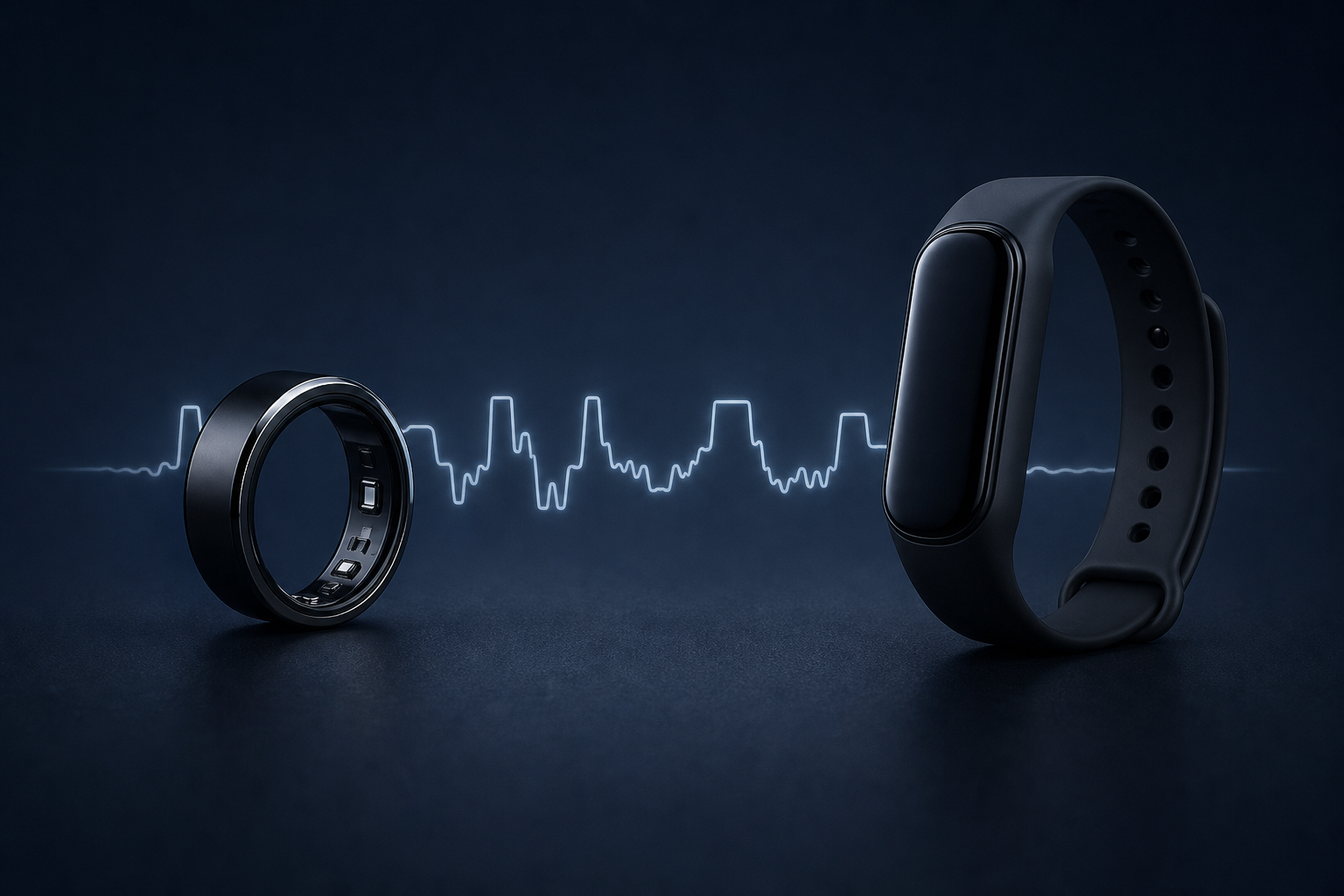
    Apple Watch vs. Whoop Sleep Tracking: Accuracy, Metrics, Cost, and How to Choose

    A PSG-validated accuracy comparison of Apple Watch and Whoop for sleep tracking, covering sleep stage classification data, HRV and recovery scoring differences, subscription cost over time, and a profile-based decision guide for sleep-focused buyers.

    Tracks: sleep stages, HRV, resting heart rate, respiratory rate, sleep score, sleep latency, total sleep time, sleep debt, SpO2
    Reviewed: Jun 6, 2026
    Accuracy: Miller et al. 2022 (PSG, n=53): Whoop 3.0 60% multi-stage agreement κ=0.44 vs Apple Watch S6 53% κ=0.20; two-stage sleep/wake comparable (Apple Watch 88%, Whoop 86%). Miller et al. 2020: Whoop 64% 4-stage agreement κ=0.47, REM sensitivity 70%, SWS 68%. Robbins et al. 2024 (Oura-funded, n=35): Apple Watch S8 underestimated deep sleep by 43 min, overestimated light sleep by 45 min. Whoop 5.0/MG accuracy improvements are internal claims without peer-reviewed validation as of Q2 2026.
    View device profile →
  • Fitbit Sleep Tracking Review: Accuracy, Sleep Stages, and How It Compares to the Oura Ring
    Sleep Trackingfitness band / smartwatchNo subscription

    Fitbit Sleep Tracking Review: Accuracy, Sleep Stages, and How It Compares to the Oura Ring

    A PSG-validated look at what Fitbit sleep data actually measures reliably — and where it falls short — for adults who want evidence-based guidance on trusting their sleep stage readings or deciding between Fitbit and the Oura Ring.

    Tracks: sleep stages (N1/N2/N3/REM), total sleep time, sleep efficiency, sleep latency, WASO, HRV, SpO2, sleep score
    Reviewed: Jun 6, 2026
    Accuracy: Robbins et al. 2024 (BWH, n=35 healthy adults): Fitbit Sense 2 Kappa 0.55 (moderate), deep sleep ICC 0.36 (poor), overestimates light sleep ~18 min and underestimates deep sleep ~15 min vs. PSG. Schyvens et al. 2025 (Antwerp, n=62): Fitbit Sense Kappa 0.42, Charge 5 Kappa 0.41. Sleep/wake sensitivity 91–99% across studies (Park et al. 2024 review).
    View device profile →
  • Fitbit Sleep Tracking Review: How It Works and How Accurate It Really Is
    Sleep Trackingfitness band / smartwatchNo subscription

    Fitbit Sleep Tracking Review: How It Works and How Accurate It Really Is

    A mechanistically grounded review of how Fitbit detects and classifies sleep — covering the sensors, the Sleep Score anatomy, and what peer-reviewed PSG validation studies say about per-stage accuracy — written for adults who want an honest answer about whether their Fitbit sleep data is trustworthy.

    Tracks: sleep stages (Light/Deep/REM), total sleep time, Sleep Score, SpO2 breathing variation, HRV balance, skin temperature trend, restoration
    Reviewed: Jun 8, 2026
    Accuracy: Overall sleep/wake accuracy 86.5–88% (Park et al., J Sleep Med 2024). Per-stage sensitivity: light sleep 53–81%, deep sleep (N3) ~49% (range 27.9–59%), REM 54–74%. Fitbit systematically overestimates light sleep and underestimates deep sleep vs PSG. Google 2026 algorithm update improved four-stage Cohen's kappa from 0.56 to 0.63 and accuracy from 71% to 77% (preprint, not yet peer-reviewed). Performs materially worse in insomnia populations with roughly doubled error bias.
    View device profile →
  • Garmin Sleep Tracking and Insomnia: When the Data Helps and When It Makes Things Worse
    Sleep TrackingsmartwatchNo subscription

    Garmin Sleep Tracking and Insomnia: When the Data Helps and When It Makes Things Worse

    For adults managing chronic insomnia or sleep anxiety, checking Garmin sleep data every morning carries a clinically recognized risk of deepening the problem—yet certain Garmin metrics, used selectively, can still support recovery. This article maps exactly when to engage with Garmin sleep data and when to step away from it entirely.

    Tracks: sleep stages, HRV Status, sleep score, Body Battery, breathing disturbances, SpO2, sleep latency, awake time, restlessness
    Reviewed: Jun 9, 2026
    Accuracy: Chinoy et al. 2021 (PSG): Garmin specificity for wake detection 0.18–0.19, worst of seven devices; ~50 min waking time missed per night; accuracy worsened proportionally on disrupted nights. Garmin KUMC 2019 (Sleep Profiler reference, not full PSG): overall accuracy 69.7%; worst-case participant with self-reported sleep disorder achieved 49.9% accuracy, kappa 0.18. Schyvens et al. 2024 systematic review: Garmin Vivosmart 4 specificity for wake 30%, REM sensitivity 34%, kappa 0.20.
    View device profile →
  • Garmin Sleep Tracking: Accuracy, Metrics, and How It Compares
    Sleep Trackingsmartwatch, fitness bandNo subscription

    Garmin Sleep Tracking: Accuracy, Metrics, and How It Compares

    An evidence-anchored breakdown of how Garmin's sleep tracking works, what each metric actually measures, and what independent PSG research reveals about its accuracy — including where Garmin leads and where it falls short compared to Oura, Fitbit, and Apple Watch.

    Tracks: sleep stages (light/deep/REM), sleep duration, WASO, sleep score, Body Battery, HRV status, SpO2, breathing variation
    Reviewed: Jun 7, 2026
    Accuracy: Chinoy et al. 2021 (PSG, Fenix 5S/Vivosmart 3): TST overestimation ~43.7 min, WASO underestimation ~49.5 min, wake-detection specificity 0.18–0.19 (lowest of 7 devices). Garmin-sponsored 2019 study (home EEG reference): ~69.7% stage accuracy, Cohen's kappa 0.54. Terra 2025 (5,000 nights): lowest outlier rate and tightest standard deviation of any platform tested. PSG data applies to older hardware; current Forerunner 970 shows improved alignment with Oura Ring 4 in 2025 Wareable testing.
    View device profile →
  • How Accurate Is the Oura Ring for Sleep Tracking? A Data-Driven Analysis of PSG Validation Studies
    Sleep TrackingringNo subscription

    How Accurate Is the Oura Ring for Sleep Tracking? A Data-Driven Analysis of PSG Validation Studies

    This article provides an evidence-based analysis of Oura Ring sleep tracking accuracy, drawing on peer-reviewed polysomnography validation studies from Brigham & Women's Hospital and the University of Tokyo. It examines epoch-by-epoch performance, head-to-head comparisons with Apple Watch and Fitbit, and the critical distinction between strong group-level accuracy and weaker individual-level concordance for deep and REM sleep.

    Tracks: sleep stages, HRV, SpO2, sleep latency, sleep score, body temperature
    Reviewed: Jun 12, 2026
    Accuracy: Peer-reviewed PSG studies show >94% sleep/wake sensitivity and 76–79.5% stage sensitivity; Cohen's kappa 0.65; individual-level ICCs for deep (0.32) and REM (0.27) are poor.
    View device profile →
  • Oura Ring Sleep Tracking Accuracy and Features: What the Research Actually Shows
    Sleep TrackingringNo subscription

    Oura Ring Sleep Tracking Accuracy and Features: What the Research Actually Shows

    A research-anchored review of the Oura Ring Gen 4 for adults evaluating whether the device is worth buying or trusting — covering validated accuracy figures, how each feature works, where the data is reliable, and where it falls short, particularly for people with sleep disorders.

    Tracks: sleep stages (Light, Deep, REM, Awake), total sleep time, sleep efficiency, WASO, sleep onset latency, HRV (RMSSD), resting heart rate, skin temperature deviation, SpO2, sleep score, readiness score
    Reviewed: Jun 6, 2026
    Accuracy: Khan et al. 2025 meta-analysis (6 studies, n=388): no statistically significant difference vs. PSG for TST, SE, WASO, SOL, or any sleep stage in healthy adults. Robbins/BWH 2024 (funded by Oura): stage sensitivity 76.0–79.5%, outperforming Fitbit and Apple Watch; SOL overestimated by ~5 min (p<0.001); individual-level ICC poor for deep sleep (0.32) and REM (0.27). Herberger/Charité 2025 (no competing interests): only 53.18% four-stage accuracy (Kappa=0.31) in 45 patients with diverse sleep disorders; wake sensitivity 46.19%. All strong healthy-adult studies tested Gen 3 (OSSA 2.0); no independent peer-reviewed Gen 4 sleep staging validation available as of June 2026.
    View device profile →
  • Oura Ring vs. WHOOP for Sleep Tracking: What the PSG Validation Evidence Actually Shows
    Sleep Trackingring, wrist bandNo subscription

    Oura Ring vs. WHOOP for Sleep Tracking: What the PSG Validation Evidence Actually Shows

    A evidence-first comparison of Oura Ring and WHOOP for adults deciding between the two devices for sleep tracking — covering published PSG validation study findings, sensor technology differences, scoring system distinctions, total cost of ownership, and the shared accuracy limitations both devices carry.

    Tracks: sleep stages, HRV, total sleep time, sleep efficiency, sleep latency, body temperature deviation, SpO2, respiratory rate, sleep score
    Reviewed: Jun 8, 2026
    Accuracy: Oura Ring Gen3 (OSSA 2.0): four-stage kappa 0.65, overall accuracy 91.7–91.8%, stage sensitivity 76–80% (Robbins et al. 2024, industry-funded; Svensson et al. 2024). WHOOP (3.x era): kappa 0.44–0.47, stage sensitivity 60–67%, systematic REM overestimation averaging 21 min (Schyvens et al. 2024 systematic review). WHOOP 5.0 has no published independent PSG validation as of June 2026.
    View device profile →
  • Sleep Score Explained: What the Number Actually Means and How Trackers Calculate It
    Sleep Trackingmulti-platform explainer (ring, smartwatch, fitness band)No subscription

    Sleep Score Explained: What the Number Actually Means and How Trackers Calculate It

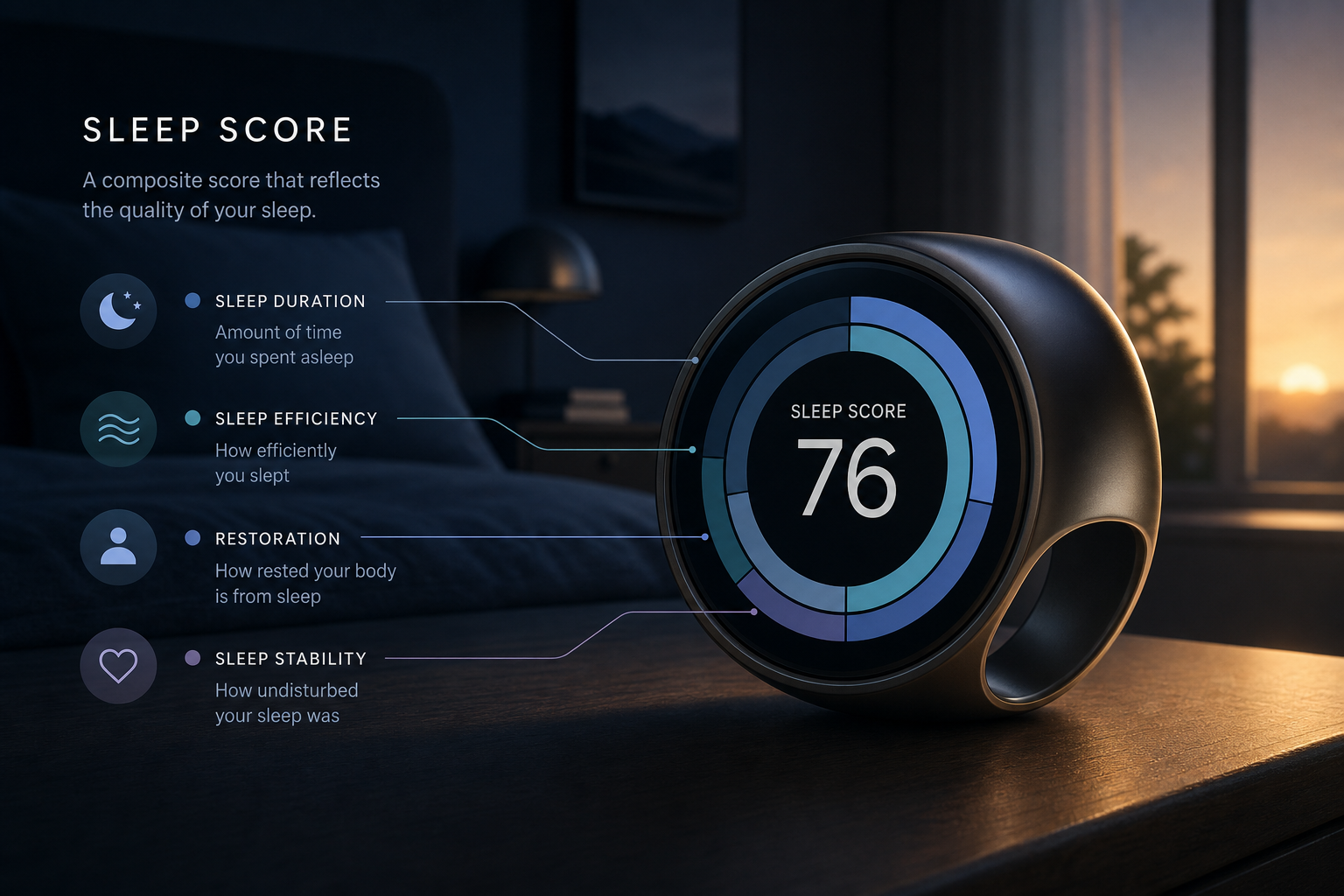
    Your morning sleep score is a proprietary composite index assembled differently by every platform — not a clinical measurement — and understanding how Oura, Fitbit, Garmin, Apple Watch, and WHOOP each construct it is the key to reading your score correctly, comparing across devices, and avoiding the trap of treating a single night's number as a verdict on your health.

    Tracks: sleep score, sleep stages, HRV, sleep duration, sleep efficiency, sleep latency, SpO2, skin temperature, restfulness, circadian timing
    Reviewed: Jun 8, 2026
    Accuracy: PSG validation studies show epoch-by-epoch Cohen's kappa of 0.30–0.65 depending on device and population. Healthy-adult studies yield higher kappa (Oura Gen3: 0.65, Apple Watch S8: 0.60, Fitbit Sense 2: 0.55); mixed-disorder populations yield lower kappa (0.30–0.42). All devices systematically overestimate sleep by misclassifying quiet wakefulness as light sleep. Apple Watch underestimated deep sleep by 43 min in the Brigham/Harvard study. Studies used older hardware generations; current-generation accuracy may differ.
    View device profile →
  • WHOOP Band Sleep Tracking Review: Accuracy, Metrics, and How It Compares
    Sleep Trackingfitness bandNo subscription

    WHOOP Band Sleep Tracking Review: Accuracy, Metrics, and How It Compares

    An evidence-anchored review of WHOOP's sleep tracking capabilities, examining what the device actually measures, what independent PSG validation studies show metric by metric, and how WHOOP compares to Oura Ring, Garmin, Apple Watch, and Fitbit on sleep accuracy.

    Tracks: sleep stages (light, deep/SWS, REM, wake), total sleep time, sleep efficiency, sleep latency, sleep consistency, sleep need, sleep debt, Sleep Performance Score, respiratory rate, resting heart rate, HRV
    Reviewed: Jun 7, 2026
    Accuracy: Miller et al. 2022 (n=53, PSG): multi-state kappa 0.44, 60% agreement; REM sensitivity 66%, deep 62%, light 58%, wake 56%; REM overestimation +22.9 min; TST bias −12.2 min; HRV ICC 0.99 vs. ECG (best of six devices). Schyvens et al. 2024 (JMIR systematic review): mean TST bias −1.4 min, REM overestimation mean +21.0 min, kappa range 0.44–0.47. Khodr et al. 2024: acceptable two-stage accuracy, room for improvement on four-stage classification. All validation conducted on WHOOP 3.0; WHOOP 5.0 not yet independently PSG-validated as of June 2026.
    View device profile →
Related content groups