
How to Master Your EV Car Camping Sleep Setup
A good EV car camping sleep setup starts before the mattress comes out of its bag. The electric advantage is real: unlike a gas car, an EV can run climate control through the night without idling an engine, fumes, or the stop-start noise that wakes everyone up. But that advantage only helps if the vehicle will actually stay awake in the right mode, the sleep platform fits your body and pad, the insulation matches the overnight temperature, and the cabin stays private, dry, breathable, and charged until morning.
That sequence matters. A plush mattress is not much use if it rides up over the wheel wells. A perfect window cover can make the cabin feel darker and warmer while also trapping moisture if ventilation is ignored. A climate setting that feels luxurious at bedtime can become a range question before sunrise. The most reliable setup is not the most expensive one; it is the one you can test, repeat, and adjust without solving the hard parts at 2:40 a.m.
First, Prove the EV Can Stay in Its Overnight Mode
Before the first trip, park at home, fold the seats, plug in or unplug as you expect to be at camp, and run the exact overnight mode for at least long enough to catch the obvious problems. Does the screen stay on? Does the HVAC keep running after the doors lock? Do interior lights shut off? Can you open a door without disabling the mode? Does the alarm object to someone moving inside?
There is no universal EV camping button. Tesla uses Camp Mode, Rivian has Camp Mode and Pet Mode, Hyundai and Kia commonly use Utility Mode, and Ford uses Generator Mode for some use cases. Some EVs, including the Kia EV6 and VW ID.4, do not have a dedicated camping mode but may have workarounds depending on model year, settings, and owner practice.[1]
For a beginner, the dry run is not a formality. It is where you learn the difference between a vehicle that can run climate while parked and a vehicle that behaves conveniently while someone is trying to sleep inside it. If your car needs the seatbelt buckled, the key placed in a certain location, a lock setting changed, or a screen brightness adjustment, find that out in the driveway.
| Pre-trip test | What you are checking |
|---|---|
| Start the vehicle’s camping, utility, generator, or workaround mode | HVAC stays on without the car shutting itself down |
| Lock the vehicle from inside and outside | Doors, lights, alarm, and app controls behave as expected |
| Lie down for 20–30 minutes with your normal bedding | Screen glare, fan noise, seat bumps, and headroom are tolerable |
| Check battery percentage before and after the test | You understand the direction of drain in your actual settings |
| Practice exiting quickly | You can get out without moving a pile of gear in the dark |
Plan Battery Reserve as a Range, Not a Promise
Battery anxiety is usually worse before the first night than during it, because most new EV campers have no scale for what overnight climate control costs. The useful answer is a range, not a single percentage. Owner-reported and field-tested examples show overnight drain as low as 2–4% in a Rivian R1S in mild weather and as high as 14–21% in a Tesla Model Y in cold weather.[2]
A real-world EV camping test found a Hyundai Ioniq 9 with a 110 kWh battery losing about 1% per hour with ambient temperature at 22°C and cabin climate also set to 22°C. In the same report, a smaller Inster Cross with a 49 kWh battery lost about 2% per hour under similar conditions.[3]
Those numbers are reassuring only if they are treated honestly. They are not manufacturer guarantees. Battery size, outside temperature, wind, sun exposure, heat pump performance, cabin set point, window insulation, occupant count, and whether the vehicle is preconditioned can all move the result. Extreme heat and deep cold deserve a larger margin than a mild spring night near a charger.
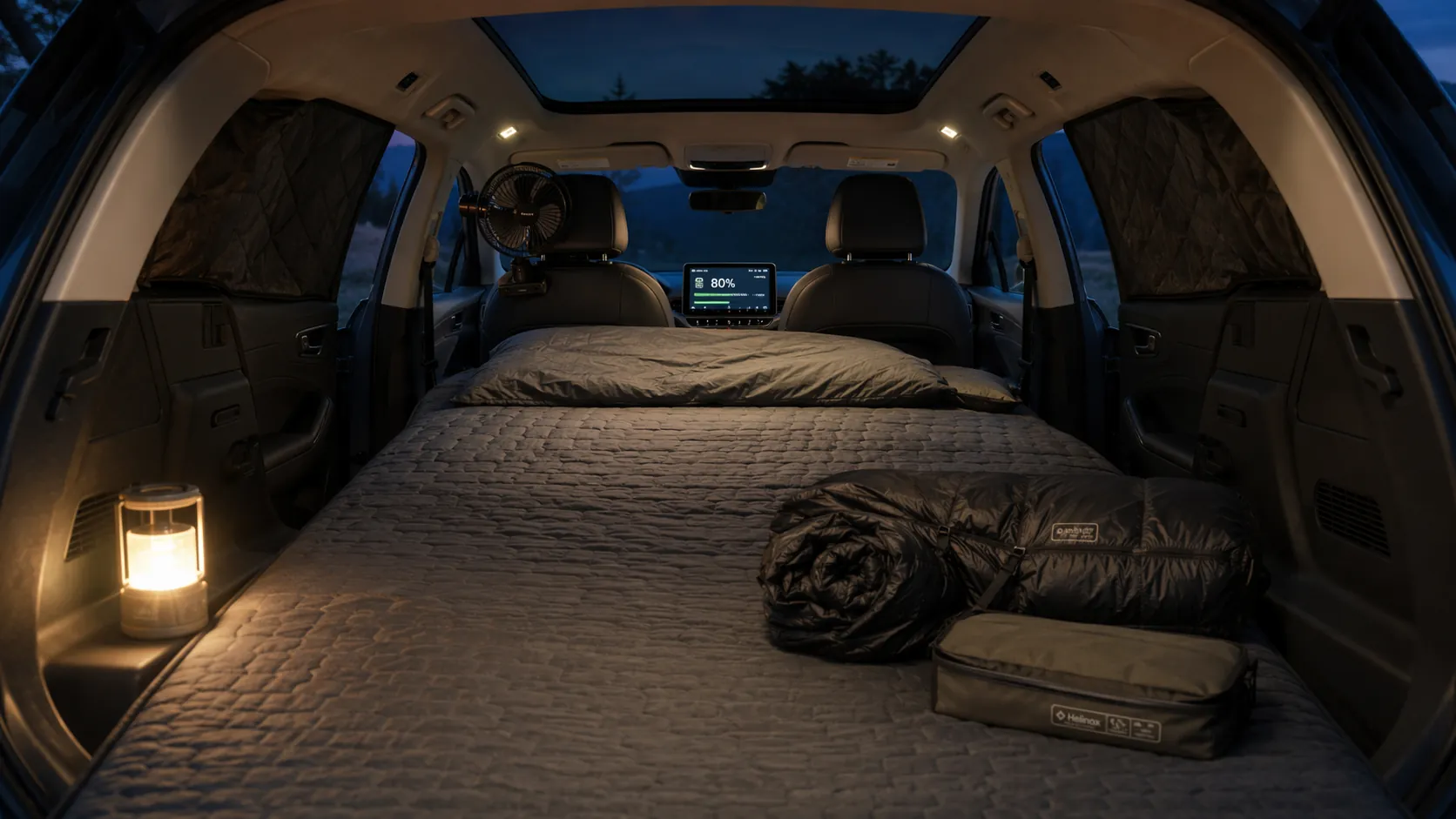
A practical reserve rule is to decide the next morning’s driving requirement before you leave home. If the trailhead is remote, the nearest charger is unreliable, or the forecast is cold, do not plan the night around arriving with just enough charge. The sleep system includes the route out.
Vehicle-to-load, often shortened to V2L, is separate from sleeping climate. It lets some EVs power external devices, but it is not required for a basic inside-the-car sleep setup. A phone, headlamp, fan, or small lantern can usually run from its own battery. The important overnight load is still the vehicle’s climate system.
Measure the Bed You Actually Have
Cargo volume does not tell you whether you can sleep flat. Liters and cubic feet count space that may be vertical, irregular, or unusable once a mattress and shoulders are involved. The number that ruins trips is usually the narrowest floor width between the rear wheel wells.
Owner-verified measurements collected in 2026 show why this matters. A Tesla Model Y sleep area is listed at 76–83 inches long by 52 inches wide, a Rivian R1S at 84–85 inches by 51 inches, a Kia EV9 at 81 inches by 52 inches, and a Hyundai Ioniq 5 at 73 inches by 47 inches. The VW ID.4, despite offering a listed sleeping length of 77 inches, narrows to 37 inches at the wheel wells. A Ford F-150 Lightning bed is listed at 64 inches by 52 inches.[2]
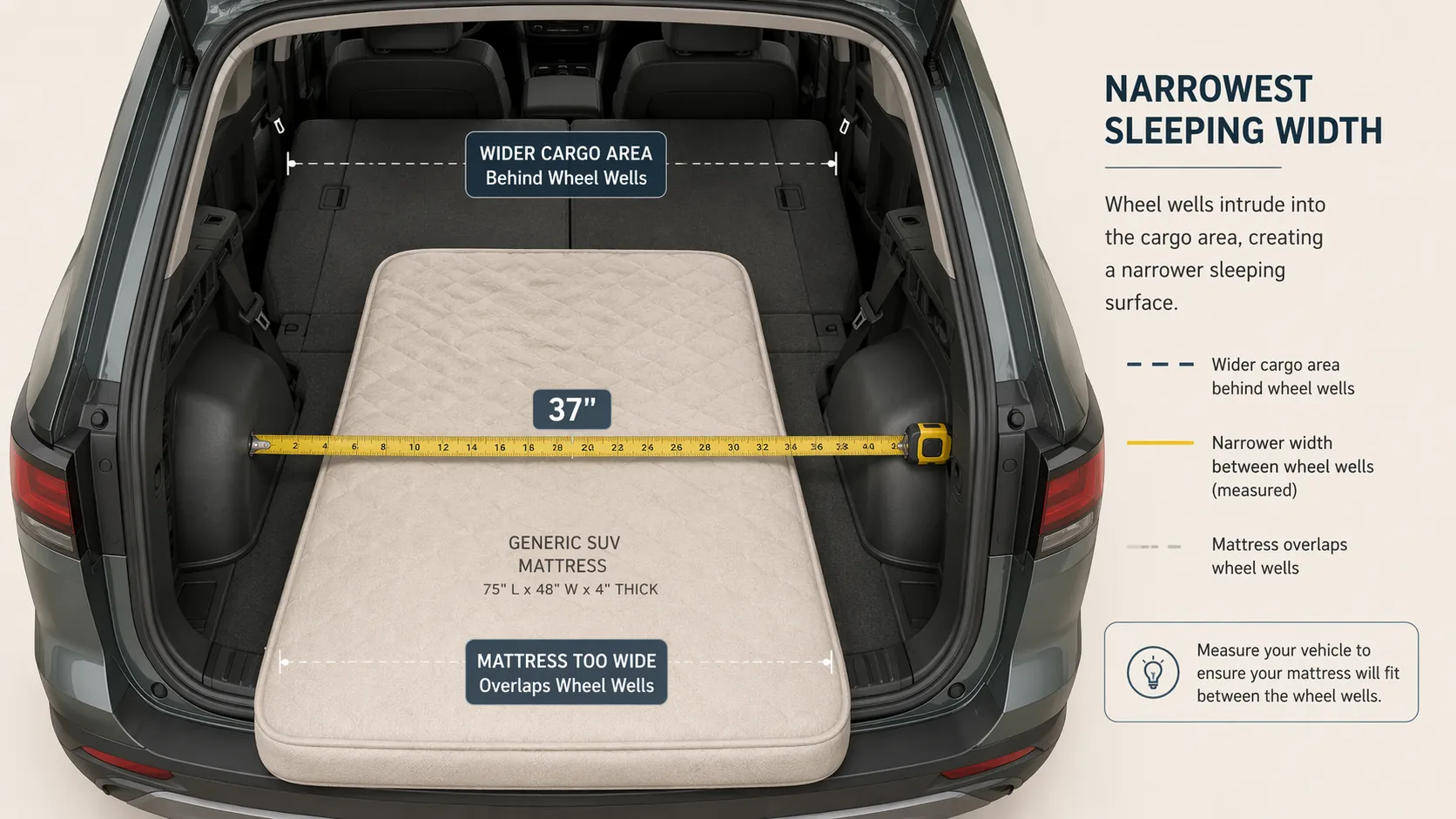
The ID.4 example is the cleanest warning: 37 inches rules out double-wide mattresses, no matter how generous the cargo area looks in a listing photo. A pad that is three inches too wide does not become three inches softer. It curls, buckles, lifts one sleeper toward the glass, or pushes bedding into the hatch trim.
Measure your own vehicle even if it appears in a published chart. Model year, trim, seat position, cargo floor height, aftermarket liners, subtrunk covers, and seatback angle can change the usable surface. Use a tape measure across the narrowest width, then measure length from the closed hatch to the front-seat position you can actually drive with the next morning. If you need to move the front seats forward to sleep, confirm you can put them back without unpacking half the cabin.
Check the surface, not just the rectangle
A long, wide rectangle can still sleep badly if the folded seats create a ridge under your hips or a downhill slope toward the hatch. During the home test, put down the actual mattress or a blanket stack, lie on your side and back, and notice where pressure collects. Many first setups fail at the hip and shoulder, not at the headline dimensions.
If the cargo floor is uneven, solve that before upgrading bedding. A thin plywood platform, firm foam shim, folded moving blanket, or purpose-built leveling insert can do more for sleep than adding another soft layer over a bad angle. Keep any platform secure; loose boards inside a vehicle are not worth the marginal comfort gain.
Choose the Mattress by Fit and R-Value
The right EV mattress has two jobs. It has to fit the narrowest usable floor, and it has to slow heat loss enough for the overnight temperature. Comfort matters, but comfort changes quickly when the pad is folded against a wheel well or when cold metal pulls heat through the sleep surface.
R-value is the insulation rating used for sleeping pads and mattresses: higher numbers resist heat loss better. General outdoor guidance in the available mattress reviews points toward R-5 or higher near freezing, R-7 or higher below freezing, and R-11 or higher when sleeping directly on a cold metal vehicle floor. The Luno AIR+FOAM PRO Vehicle Mattress was reported at R-11 and named “Best Mattress for Car Camping” in Outside Online’s 2026 test of 25 pads.[4]
The Exped MegaMat Duo 10 is another heavily cross-referenced premium option, with an R-value of 8.1 in car-camping mattress coverage.[5] That level of insulation can make sense for cool shoulder-season trips, especially where the vehicle floor remains cold even while the cabin air is comfortable.
Budget setups are still legitimate. EV Central’s camping test used a generic SUV blow-up mattress from a hardware store costing about $40 and found it worked sufficiently for the trip.[3] That does not make a low-cost air mattress equal to a fitted insulated vehicle mattress; it proves the first night does not have to require a four-figure gear order.
| Condition | Mattress priority |
|---|---|
| Mild weather and one sleeper | Exact width, stable inflation, enough thickness over seat hinges |
| Near-freezing forecast | R-5+ insulation before extra softness |
| Sub-freezing forecast | R-7+ insulation and a conservative battery reserve |
| Sleeping directly over cold metal | R-11+ insulation or an added insulated layer |
| Narrow wheel-well vehicle | Single pad, split pads, or a fitted mattress instead of a double-wide SUV pad |
For two sleepers, split pads often solve more problems than one large mattress. They let each person control firmness, they tolerate slight floor irregularities better, and they can fit narrow vehicles that reject a double pad. The tradeoff is the center gap, which may need a strap, sheet, or fitted cover to keep the pads from drifting apart.
For one sleeper, do not automatically buy the widest pad that fits on paper. Leave room for shoes, glasses, water, a phone, and an exit path. A cabin that looks efficient in a product photo can feel clumsy when every nighttime movement knocks into loose gear.
Treat Privacy, Darkness, Ventilation, and Condensation as One System
Window covers do more than hide you. They darken the cabin, reduce radiant heat loss in cold weather, block early sun, and make the space feel less exposed when headlights sweep through a campground. Cut-to-fit Reflectix-style covers are commonly recommended for cold-weather car camping because they can improve comfort and reduce HVAC demand when fitted well.[6]
The same covers can also change airflow. EV climate control reduces condensation compared with sleeping in an internal-combustion vehicle because the HVAC can run continuously without idling, but humid climates and sealed cabins can still fog windows. Luno’s cold-weather guidance recommends ventilation support such as a portable fan or a cracked window with a bug screen where conditions call for it.[6]
Camp Mode temperature preferences vary, but reported comfortable settings commonly fall around 60–69°F, or 16–20°C.[6] That range is a better starting point than setting the cabin to bedroom warmth and asking the battery to absorb the difference all night. A warm mattress, dry base layers, and a moderate cabin set point usually make a more stable system than blasting heat over a poorly insulated pad.
Darkness deserves its own check because EV cabins are full of small lights: screen glow, charge indicators, door LEDs, app notifications, and reflected campsite lighting through the glass roof. During the home test, sit in the vehicle after dark and look for the light sources you would not notice while packing. Tape, a cloth, a dimming setting, or a different charging display setting may fix a problem that would otherwise feel absurdly large at midnight.
Pack the small items that prevent wake-ups
- A battery-powered fan for air movement when the cabin feels still
- Bug screens if you plan to crack windows
- Window covers that fit each piece of glass without sagging
- A headlamp or low lantern that can be reached from the mattress
- A small towel for unexpected condensation, spills, or wet shoes
- A clear place for keys so the vehicle does not lock, unlock, or wake unpredictably
The goal is not to seal the vehicle like a cooler. It is to control light, heat loss, visibility, and moisture without making the cabin stale. That balance changes by season. In cold dry air, insulation may do most of the work. In warm humid air, airflow may matter more than another reflective panel.
Load the Cabin So Sleep Still Works After Arrival
EV camping often fails during the conversion from driving mode to sleeping mode. The mattress is under the cooler, the window covers are behind the duffel, the shoes are wet, and the charging cable has to be moved before anyone can lie down. A repeatable setup gives every bulky item a destination before the hatch opens.
Keep the sleep surface empty until you intentionally build it. Put bedding in one bag, window covers in one reachable sleeve or stack, and nighttime essentials in a small pouch that stays inside the cabin. If you need to move gear to the front seats, practice that move at home with the seats in their real sleeping position.
A simple setup order works well: park level if possible, confirm battery and next-day route, start the vehicle’s overnight mode, move cargo, lay the mattress, install window covers, set ventilation, place shoes and keys, dim screens, then get in. The order is boring on purpose. Boring is good when it is raining, cold, or late.
A Repeatable Pre-Trip Check
Run this check once before the first overnight, then repeat the parts that change with season, route, or vehicle load.
- Vehicle mode: Confirm the EV can run parked climate overnight in the mode or workaround you plan to use.
- Battery reserve: Estimate overnight drain as a range, then leave enough charge for the next morning’s drive and charger uncertainty.
- Measured fit: Measure length and the narrowest wheel-well width in your own vehicle, not just published cargo volume.
- Mattress choice: Match pad width to the measured floor and R-value to the coldest expected sleep surface.
- Cabin control: Test window covers, screen dimming, ventilation, fan placement, and bug protection together.
- Night access: Place keys, shoes, water, light, and exit path where they still work after the mattress is inflated.
If those checks pass in the driveway, the first trip becomes less of a gear experiment. You already know how the car stays on, where the mattress fits, how warm the sleep surface should be, and what battery margin you expect to see in the morning.
References
- Ultimate Guide to Camping in an Electric Vehicle — Luno
- Best EV for Camping 2026 — SleepInMyEV, July 2026
- Want to go camping in your EV? We’ve done it: Here are seven things you must know before your first electric car sleep-over — EV Central
- Best Camping Mattresses and Sleeping Pads of 2026 — Outside Online, May 2026
- 9 Best Car Camping Mattresses of 2025 — Field Mag, 2025
- A Beginner’s Guide to Car Camping in Cold Weather — Luno, February 2026
Read the full guide: Where Can You Legally Sleep While Camping in Tennessee?