
Where Can You Legally Sleep While Camping in Tennessee?
If your Tennessee camping law sleep concern is really “Can I sleep here tonight without risking a felony charge?” the short answer is: Tennessee has not banned sleeping or camping everywhere. The risk turns on where you sleep. Sleeping on undesignated public property can fall under Tennessee Code § 39-14-414, while designated campgrounds, lawful dispersed camping areas, and private property with permission remain different categories entirely.[1]
That distinction matters at 10 p.m., when a shoulder looks quiet, a city park looks empty, or a big parking lot looks like other people have already solved the problem. Tennessee’s law is not mainly a question of whether you are tired. It is a question of designation and permission.
The part of the law that changes the sleep question
The uneasy detail is the definition of “camping.” The law has been described as covering “the act of sleeping,” along with activities such as cooking or setting up shelter, and it can apply whether the person is inside or outside a vehicle.[2] So the question is not only “Did I pitch a tent?” A person sleeping in a car on undesignated public property can still be in the danger zone.
The stakes are not small. The public-property camping offense is treated as a Class E felony, and reporting on the statute describes the penalty as up to six years in prison and up to a $3,000 fine. A separate highway-camping offense is a Class C misdemeanor with a $50 fine and community service.[3]
That does not mean every exhausted traveler in Tennessee is committing a felony by closing their eyes. It means the old road-trip habit of judging a place by whether it feels out of the way is a bad guide here.
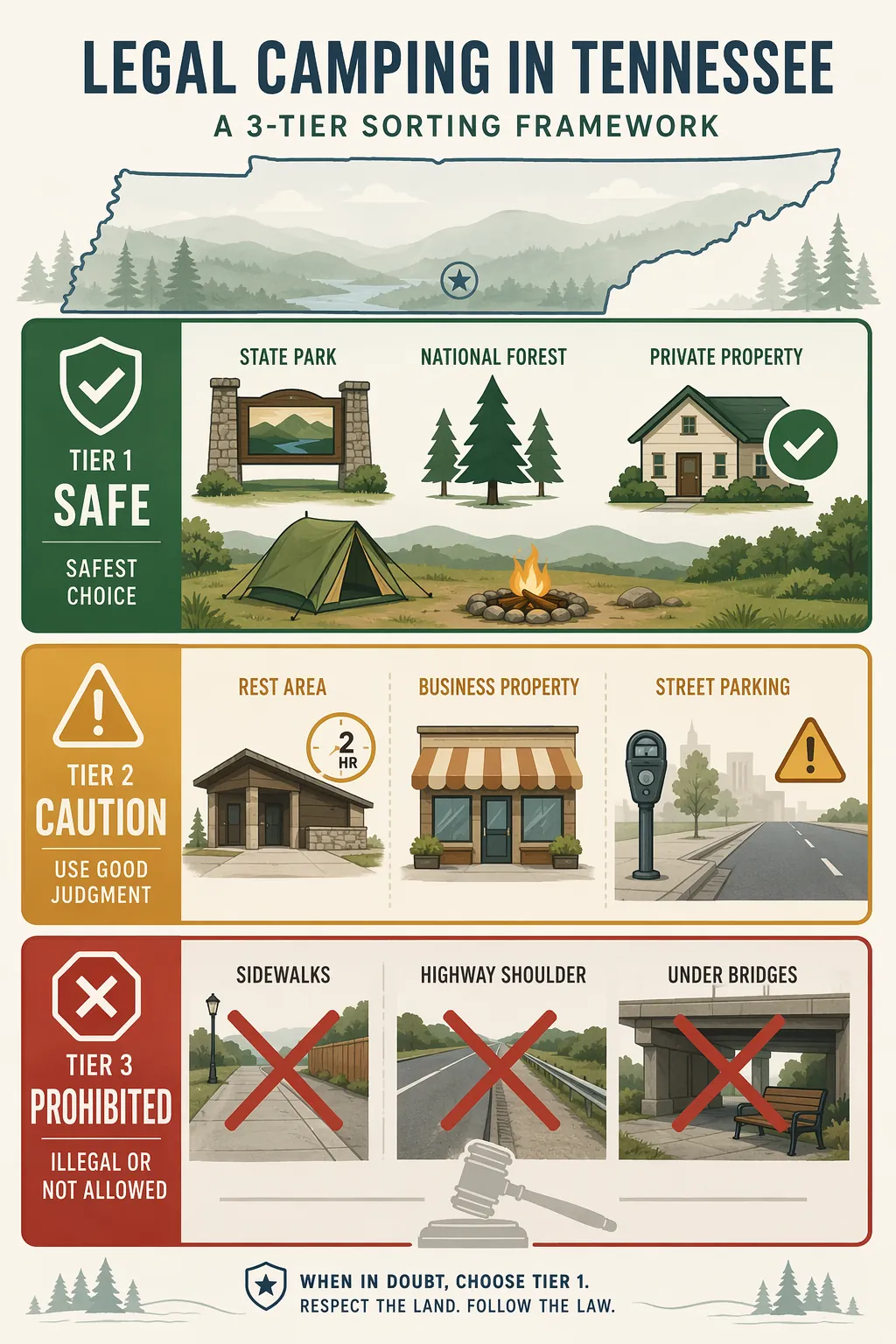
| Tier | Examples | Practical meaning |
|---|---|---|
| Clearly legal when rules are followed | Designated state park campgrounds; Cherokee National Forest dispersed camping areas; private property with permission | You are sleeping where camping is designated, federally permitted, or authorized by the property owner. |
| Limited or risky | Rest areas; store and truck-stop lots; city street parking | A stop may be lawful for a short time or with permission, but it is not automatically an overnight camping site. |
| Illegal or not a safe legal bet | Sidewalks; highway shoulders; under bridges; undesignated public parks or public land | These fit the public-property problem the statute was built around. |
Clearly legal places to sleep while camping in Tennessee
Designated Tennessee State Parks campgrounds
A designated campground in a Tennessee State Park is the cleanest answer for most recreational campers. Tennessee State Parks’ policies point campers toward specific designated camping areas rather than treating the whole park as open sleeping space.[4]

The word “designated” is doing the work. A reserved campsite, marked campground, or park-approved camping area is not the same thing as pulling into a day-use lot after dark and deciding it seems harmless. In one case, the land manager has set aside a place for overnight camping. In the other, you are guessing.
Before you drive in late, check the specific park’s reservation rules, gate hours, campground check-in procedures, and any seasonal closures. A lawful campground can still be unavailable if you arrive without a reservation or after access is closed.
Cherokee National Forest dispersed camping
Cherokee National Forest is the main public-land exception travelers tend to look for, and it is a real one. Dispersed camping is allowed without a permit in Cherokee National Forest, which covers more than 660,000 acres, subject to rules including a 14-day consecutive limit and 100-foot setbacks from water and trails.[5]
This is different from sleeping on undesignated public property because the land manager allows dispersed camping under specific conditions. It is still not a license to sleep anywhere that has trees. The safer planning question is: Is this spot within an area where dispersed camping is allowed, and am I following the forest’s distance, duration, fire, waste, and access rules?
If you are tired and navigating by phone signal, this is where preparation matters. Save the relevant ranger district information before the trip, know whether the road you are using is open to public motor vehicles, and avoid inventing a campsite at a trailhead, boat ramp, overlook, or blocked pullout unless the rules actually permit overnight camping there.
Private property with permission
Private property is the other major lawful path, but only when permission is real. Legal overviews of Tennessee car sleeping distinguish privately owned lots from public property and emphasize that places such as store lots, truck stops, or private host sites depend on owner or management authorization and local rules.[6][7]
That is why the usual internet shorthand — “try Walmart,” “try a truck stop,” “try Cracker Barrel” — is incomplete. A chain logo is not permission. A row of RVs is not permission. A night manager saying yes, a posted overnight policy, or a formal booking through a host platform is much stronger than assuming nobody will care.
- Ask the on-duty manager whether overnight sleeping is allowed in that specific lot.
- Park where directed, not wherever the lot feels darkest or most private.
- Avoid setting up chairs, cooking outside, or making the stop look like an informal campsite.
- Leave if staff, security, or law enforcement asks you to move.
Limited or risky places that travelers often misread
Tennessee rest areas
Tennessee rest areas are for resting, not overnight parking. Tennessee rest area guidance has been summarized as allowing a maximum stay of two hours and prohibiting overnight parking, which makes them a poor choice for sleeping through the night.[8]
This is the kind of place where other vehicles can fool you. A rest area full of cars at midnight may include drivers taking short fatigue breaks, commercial traffic moving on a schedule, or people taking their chances. Their presence does not change the posted limit.
Walmart, truck stops, and other commercial lots
Commercial lots sit in the middle because the land is private, but access is conditional. A Love’s, Flying J, Pilot, Walmart, Cracker Barrel, or similar stop may be a workable overnight option if that location allows it. It may also be posted against overnight parking, restricted by a local ordinance, or controlled by security that does not have patience for informal camping.
The safest habit is boring: go inside, ask, buy something if appropriate, and accept the answer. If the answer is no, it is much better to learn that under fluorescent lights at the counter than through a knock on the window after you have fallen asleep.
City street parking
Street parking is not a reliable camping plan. Even where a curb space is legal for parking, sleeping in the vehicle can run into local ordinances, time limits, residential permit rules, anti-camping provisions, or enforcement practices that vary by city. Nashville, Memphis, Knoxville, and smaller municipalities may not treat the same curbside behavior the same way.
For a traveler, the practical problem is that you may not know the local rule until someone is standing outside the car. If you need actual sleep, not just a short break, street parking should be a last resort rather than a plan.
Places to treat as off-limits
Sidewalks, highway shoulders, underpasses, areas under bridges, undesignated public parks, and other undesignated public property are not gray-area camping suggestions. They are exactly the kinds of places where “I was only sleeping” may not help, because the statute’s camping definition reaches sleep itself.
Highway shoulders deserve separate caution. Aside from the legal issue, they are bad sleep sites: traffic is close, visibility is poor, law enforcement may reasonably treat the vehicle as disabled or hazardous, and a sleeping driver may wake up to lights in the mirror with no good explanation for why that shoulder was chosen over a lawful stop.
- Do not sleep on a sidewalk or in a public plaza.
- Do not sleep under a bridge or highway structure.
- Do not use a highway shoulder as an overnight campsite.
- Do not assume a park allows camping unless the specific area is designated for it.
A separate risk: sleeping in the car after drinking
There is another Tennessee sleep-in-the-car problem that is not really about camping. A DUI risk can exist if you are intoxicated and sleeping in a vehicle with the keys accessible, even if the engine is off, according to Tennessee legal guidance on actual physical control of a vehicle.[9]
For campers and road-trippers, the cleanest answer is not to use a driver’s seat as a substitute bed after drinking. Arrange a lawful campsite, a sober driver, a room, or another option that does not leave you intoxicated in apparent control of the vehicle.
Why this issue still feels current
Tennessee’s camping law is not just a road-trip inconvenience. It has direct consequences for unhoused Tennesseans, and later reporting has described lawmakers adding more penalties connected to homelessness and public-space sleeping.[3] That broader impact is part of why the topic stays tense, even when a particular traveler is simply trying not to make a bad overnight choice.
The legal background also shifted nationally. In 2024, the U.S. Supreme Court ruling discussed in Tennessee coverage made it harder to challenge outdoor-sleeping penalties on Eighth Amendment grounds, which reinforced the practical importance of knowing the rule before choosing a sleep site.[10]
Some 2025–2026 commentary has also described faster encampment clearing under highways and bridges, vacant-commercial-property enforcement, and even National Guard involvement in Memphis encampment enforcement, but that reporting is best treated as enforcement context rather than a route-planning rule.[11] If your trip depends on a marginal location, verify current local conditions instead of leaning on a blog post or a forum thread.
The practical rule before you close your eyes
In Tennessee, do not ask “Am I allowed to sleep?” in the abstract. Ask a narrower question: Is this a designated campground, a federally permitted dispersed camping area where I am following the rules, or private property where I have permission?
If the answer is yes, you have a much stronger legal sleep plan. If the answer is “it looks quiet,” “other people are doing it,” or “I’ll be gone early,” keep driving until the answer is better.
References
- Tennessee Code Title 39. Criminal Offenses § 39-14-414, FindLaw
- Tennessee Makes it Illegal to Camp on Public Property, Boondocker's Bible
- Three years after making camping a felony, Tennessee lawmakers add more homelessness penalties, WPLN
- Policies, Tennessee State Parks
- Cherokee National Forest Camping Rules, Boondocker's Bible
- 7 States Tightening Rules on Overnight Car Sleeping in 2026, Backroad Planet
- Is It Legal to Sleep in Your Car in Tennessee? A Legal Overview, Queener Law
- Tennessee Rest Area Rules, Boondocker's Bible
- Is It Illegal to Live and Sleep in Your Car in Tennessee, Labrum Law Firm
- Supreme Court ruling may affect Tennessee homelessness law, Nashville Banner, July 18, 2024
- Tennessee’s Homeless Laws Now Affecting Vanlife, BigRobsVan, October 24, 2025
Read the full guide: Why You Can't Sleep Your First Night in the Boundary Waters