
Does filter coffee affect blood sugar and sleep?
Filter coffee can be a reasonable choice for blood sugar and sleep, but not at any hour and not in any sequence. The shortest useful answer is this: paper-filtered coffee has evidence pointing toward better long-term blood sugar markers, especially HbA1c, while caffeinated coffee taken before breakfast can worsen the immediate glucose response to that meal. If sleep is also part of the equation, the safest pattern is coffee after food, earlier in the day, with decaf used when glucose spikes or insomnia matter more than stimulation.
That split is what makes the filter coffee effect on blood sugar and sleep confusing. The same cup can be metabolically interesting over months and still be the wrong first thing after a bad night. The difference is not just whether coffee is “healthy.” It is whether the person drinking it has eaten, how close bedtime is, how fast they clear caffeine, and whether they are trying to manage fasting glucose, post-meal spikes, or sleep continuity.
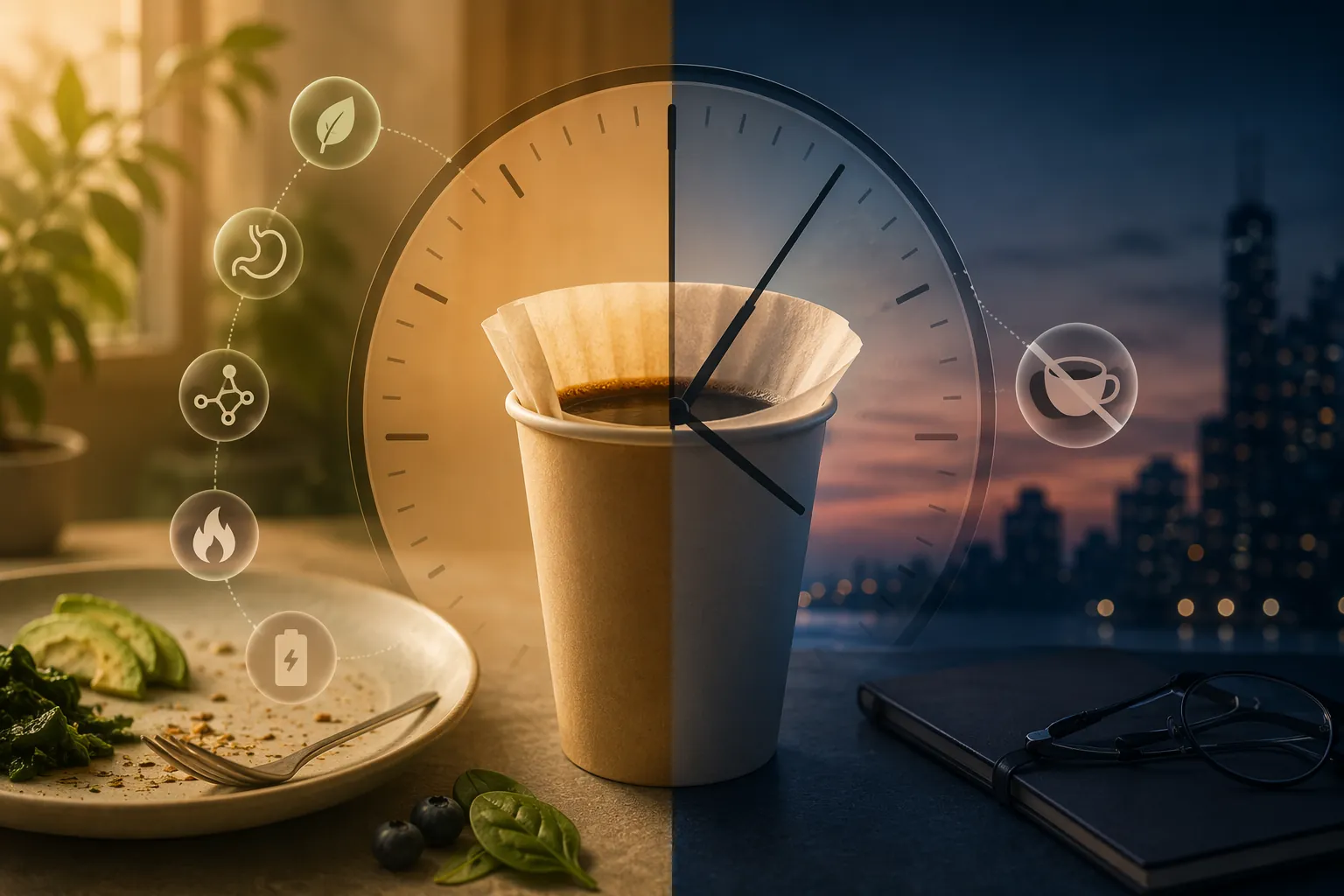
The useful answer starts with separating HbA1c from the breakfast spike
HbA1c and a same-morning glucose spike are not the same outcome. HbA1c reflects longer-term glycemic exposure. A post-breakfast glucose reading reflects how the body handled one meal under one set of conditions. Coffee can plausibly push those two outcomes in different directions.
The strongest reason to take filtered coffee seriously for long-term glucose control is a Mendelian randomization study published in npj Science of Food. Among six coffee consumption patterns tested, filtered coffee was the only pattern with a statistically significant causal association with lower HbA1c. The reported odds ratio was 0.97, with P=0.04. The study also identified a gut-microbiome pathway: Veillonella, a propionic-acid-producing bacterium, mediated 43.33% of the glycemic benefit, with propionic acid described as a short-chain fatty acid that improves insulin sensitivity.[1]
That is much more specific than the usual “coffee has antioxidants” explanation. It does not mean every cup lowers every glucose reading. It means filtered coffee, as a pattern of exposure, may influence HbA1c partly through gut bacteria and short-chain fatty acid production. The study population was of European descent from the UK Biobank, so it should not be treated as a universal biological guarantee for every ancestry group.[1]
The counterweight is the University of Bath trial, which tested what happens when coffee comes before breakfast. In 29 participants, strong black coffee consumed 30 minutes before a standardized breakfast increased the blood glucose response to breakfast by about 50%. A disrupted night of sleep alone, without the pre-breakfast coffee, did not significantly worsen glucose tolerance in that trial.[2]
That finding does not erase the HbA1c evidence. It narrows the advice. If someone drinks coffee first, then eats, the stimulant effect can land directly on the body’s handling of breakfast. If someone eats first, then drinks coffee, the same habit is less likely to create that particular pre-meal glucose problem.
Why the paper filter matters
Filter coffee is chemically different from French press, boiled coffee, Turkish coffee, and many metal-filter methods. A paper filter removes most of the diterpenes cafestol and kahweol, compounds that can raise cholesterol. Harvard Health describes paper-filtered coffee as removing more than 90% of these cholesterol-raising diterpenes, while NutritionFacts.org notes that unfiltered coffee can contain about 30 times more diterpenes than filtered coffee.[3][4]
The filter does not strip coffee down to brown caffeine water. Filter coffee still retains chlorogenic acids and polyphenols, which is one reason it remains biologically relevant even after the diterpenes are reduced.[3] That matters for blood sugar because the July 2026 microbiome finding was not about coffee as a generic category; filtered coffee was the pattern that stood out.[1]
Earlier observational research is directionally consistent, but it should be kept in its lane. A Swedish/Chalmers study reported in 2019 found that drinking 2–3 cups of filtered coffee daily was associated with about a 60% lower risk of type 2 diabetes compared with drinking less than one cup. That is an association, not proof that filtered coffee caused the lower risk.[5]
So the brewing method matters, but it is not the whole decision. Paper filtering makes the cup more defensible as a regular habit. Timing decides whether that defensible habit collides with breakfast glucose or sleep pressure.
A practical timing pattern
For most regular coffee drinkers who are watching blood sugar and sleep, the working pattern is simple: eat first, drink coffee after, and keep most caffeinated coffee before early afternoon. That does not require turning coffee into medicine. It just stops the cup from doing its most predictable damage at the two vulnerable points: before breakfast and too close to bed.
| Situation | Better choice | Why it matters |
|---|---|---|
| First thing in the morning, before food | Delay coffee until after breakfast | Pre-breakfast caffeine can worsen the glucose response to the meal. |
| Breakfast is mostly refined starch or sugar | Add protein, fiber, and fat before or with coffee | The meal itself is already glucose-raising; coffee does not need to amplify the response. |
| Afternoon fatigue | Use a smaller serving or decaf, especially after about 2 PM | Caffeine may still be active at bedtime in slow metabolizers. |
| Insomnia, pregnancy, marked glucose spikes, or medication concerns | Use decaf or ask a clinician about caffeine limits | The stimulation may be more costly than the ritual is useful. |
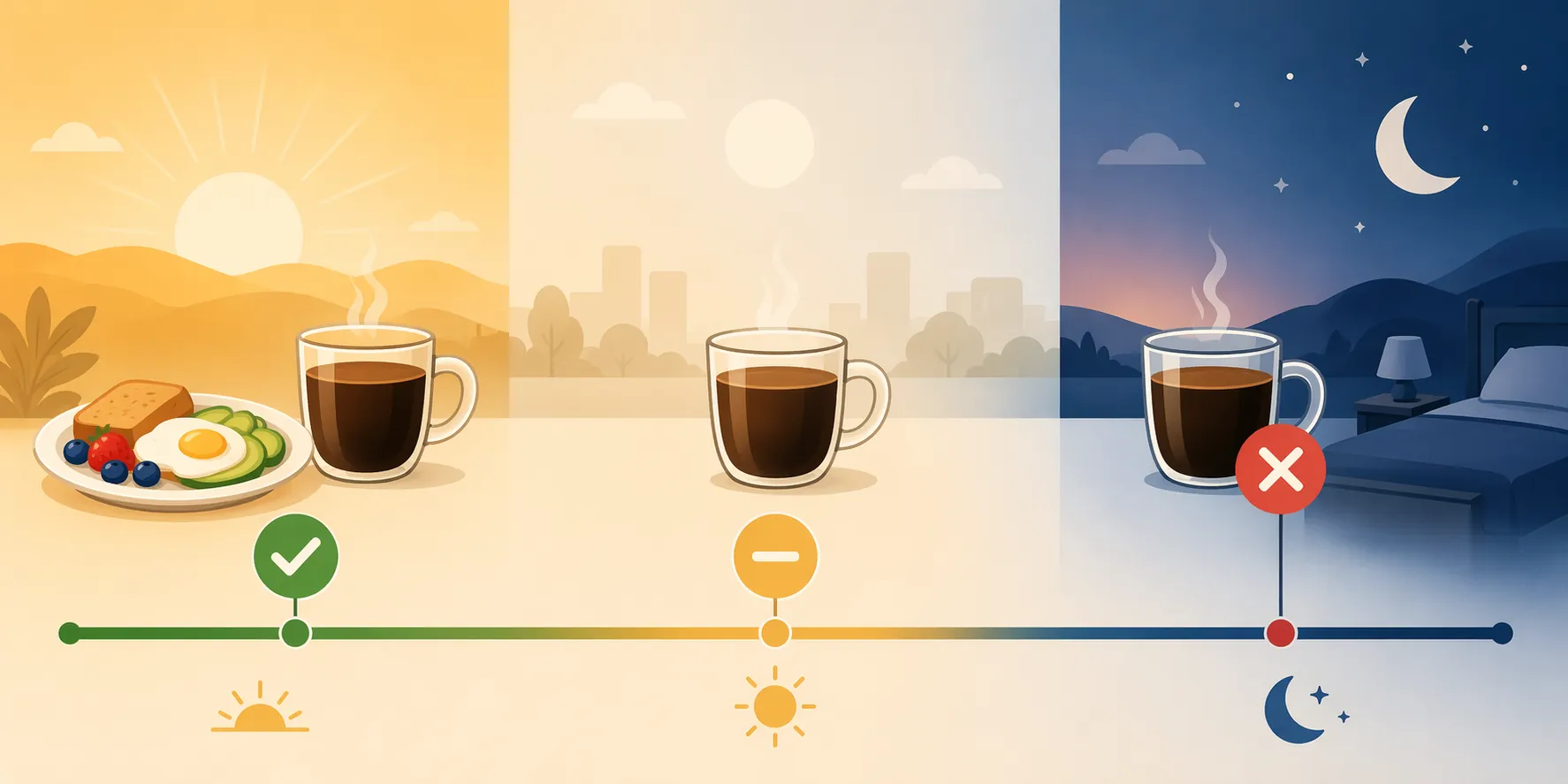
Drink it after breakfast, not as breakfast
The most important adjustment is also the least dramatic. If the morning routine is currently coffee, email, then food, reverse the order. Put breakfast first, or at least put some food in place before the caffeine. The Bath trial tested coffee 30 minutes before breakfast, which is a common real-world pattern: people wake tired, use coffee to function, then eat once the day is already moving.[2]
This is especially relevant after poor sleep. Many people respond to a bad night by making the first coffee stronger or earlier. In the Bath trial, the disrupted sleep itself was not the main glucose problem; the strong coffee before breakfast was.[2] That makes the usual rescue strategy look less harmless for someone watching morning glucose.
Do not make the meal do all the damage
Coffee timing cannot compensate for a high-glycemic breakfast. If breakfast is mostly sweet cereal, white toast, pastry, or sweetened coffee creamer, the glucose load is already high. A paper-filtered cup after that meal is still different from a sugary coffee drink, but the meal composition matters.
A more stable pairing is ordinary food physiology: protein, fiber, and some fat before or with the coffee. Eggs with vegetables, Greek yogurt with nuts, oatmeal with seeds, or leftovers from dinner are not magic combinations. They simply slow the meal down. For someone using a glucose monitor, this is also easy to test without turning breakfast into a science project: compare coffee before food with coffee after a balanced meal on otherwise similar mornings.
Keep caffeinated coffee early enough for your bedtime
Sleep is where the clock becomes less negotiable. Caffeine blocks adenosine receptors, interfering with the sleep-pressure signal that builds across the day. Its half-life varies widely, from about 2 to 12 hours, depending on factors including genetics, pregnancy, and smoking status. Pregnancy can double caffeine half-life, while smoking is associated with about 50% faster caffeine metabolism.[6]
That range is why a single cutoff time is only a starting point. For many adults, keeping most caffeinated coffee before about 2 PM is a reasonable default. For a slow metabolizer, a pregnant person, an older adult with fragmented sleep, or someone who notices anxiety or restless sleep after caffeine, noon may be more realistic. For someone who metabolizes caffeine quickly, the cutoff may be less strict, but the only useful test is the next night’s sleep, not the confidence felt at 4 PM.
People can also misread their own sleep response. The Sleep Foundation notes that even when people feel they fall asleep normally after caffeine, objective polysomnography can show reduced slow-wave sleep and more fragmented rest.[6] For a deeper explanation of that mechanism, Restful Ground’s guide to how coffee interferes with sleep walks through adenosine, timing, and cutoff windows in more detail.
Where decaf fits
Decaf is not a consolation prize in this question. It is the cleanest option when the goal is to keep the coffee polyphenol habit while reducing the acute caffeine problem. Decaf filter coffee will not be identical to caffeinated filter coffee in every compound or effect, but it removes the main stimulant that can worsen pre-breakfast glucose handling and disrupt sleep.
The best candidates for decaf are not only people who “cannot handle coffee.” Decaf makes sense when morning glucose readings rise after coffee, when insomnia is active, when pregnancy slows caffeine clearance, when medications interact with caffeine, or when an afternoon cup is really a ritual break rather than a need for alertness.
There is also an interesting chlorogenic-acid sleep study, but it should not be oversold. In a randomized double-blind trial, 5 days of 600 mg/day chlorogenic acids shortened sleep latency from 16 to 9 minutes and increased fat oxidation during sleep by about 54%, without disrupting sleep architecture.[7] That was isolated chlorogenic acid, not a cup of caffeinated filter coffee at night. It is a reason to remain interested in coffee compounds, not a reason to drink regular coffee after dinner.
Who should be more cautious
General coffee advice often assumes an average adult with average caffeine clearance, average sleep pressure, and no glucose monitor on the counter. That person is not everyone. The same routine can have a different cost in people who clear caffeine slowly, are pregnant, sleep lightly, or are actively adjusting diabetes prevention or treatment plans.
- Pregnancy: caffeine clearance slows, and caffeine half-life can double, so a cup that used to clear by bedtime may last much longer.[6]
- Older adults: lighter sleep and more nighttime awakenings can make late caffeine more costly, even if the same dose felt harmless years earlier.
- ADHD and circadian sensitivity: stimulant response and sleep timing can be less predictable, so the practical test is whether coffee shifts bedtime, sleep depth, or next-day sleepiness.
- Non-habitual coffee drinkers or people increasing dose: acute glucose effects may be more noticeable before tolerance develops.
- Medication users: caffeine can interact with some medications or complicate symptom tracking, so dose and timing are worth reviewing with a clinician when treatment decisions are involved.
Habitual coffee drinkers may develop some tolerance to acute hyperglycemic effects over longer periods, so the pre-breakfast problem is not equally large for every person. But tolerance is not a blank check. If the measurable problem is a morning spike, the first experiment is still timing: food first, coffee second.
A bounded recommendation
For most regular coffee drinkers concerned about blood sugar and sleep, paper-filtered coffee is a defensible habit when it is taken after food and early in the day. It is less defensible as a pre-breakfast stimulant after poor sleep, and less defensible as a late-day pick-me-up when sleep quality is already fragile.
If morning glucose spikes, insomnia, pregnancy, slow caffeine metabolism, or medication interactions are in play, move coffee later in the morning, reduce the dose, or switch to decaf. Filter coffee is not simply good or bad for blood sugar and sleep. The cup matters, but the clock matters more.
References
- Different coffee consumption patterns affect HbA1c via propionic acid-producing gut microbiota, npj Science of Food
- Drink coffee after breakfast, not before, for better metabolic control, University of Bath, 2020
- What’s the healthiest way to brew coffee?, Harvard Health
- Paper-Filtered Coffee and Cholesterol, NutritionFacts.org
- Study: Filtered Coffee Associated With 60% Decrease in Type 2 Diabetes Risk, Daily Coffee News, 2019
- Caffeine and Sleep, Sleep Foundation
- The Effects of Chlorogenic Acid on Sleep Architecture and Energy Metabolism Through Activity of the Autonomic Nervous System: A Randomised, Placebo-Controlled, Double-Blinded Cross-Over Trial, PubMed, 2017
Read the full guide: How travel weather delays affect sleep and stress