
How travel weather delays affect sleep and stress
Weather delays can leave you feeling depleted for days because they do two things at once: they shorten and fragment sleep, and they keep the body’s stress systems on alert while plans remain unresolved. That wired, hollow, irritable feeling after arrival is not simply annoyance with an airline app. It is what happens when your body has been asked to stay vigilant through uncertainty while also losing the sleep that normally helps regulate emotion, attention, and recovery.
The best direct sleep data comes from an Oura analysis of 1.5 million nights from 57,240 users. Travelers lost about 30 to 50 minutes of sleep the night before travel, and on the travel day itself, sleep loss reached up to about 62 minutes for long eastward trips. The same analysis found that REM sleep and deep sleep could remain disrupted for 5 to 6 or more days after travel.[1]
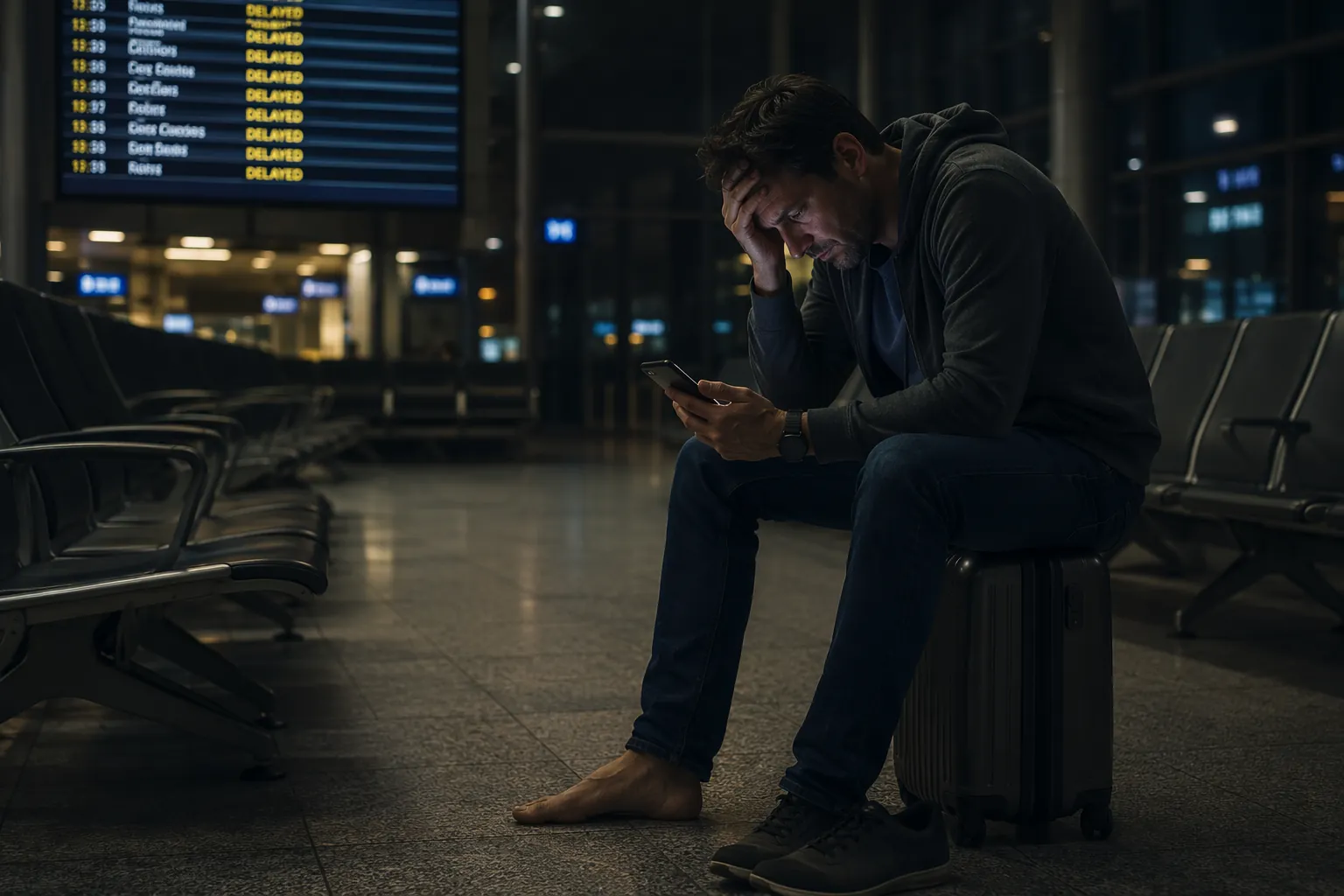
That evidence is not specifically a weather-delay study. No study in the research base isolates “weather delay” as its own variable and follows travelers through cancellation, rebooking, layover, and arrival. The most defensible answer comes from putting together what is known about travel sleep loss, jet lag, flight disruption, uncertainty, and acute sleep deprivation. The conclusion is narrower than “every delay damages sleep,” but still strong enough to matter: weather disruption creates conditions that are unusually good at producing both sleep loss and stress activation.
Why the delay keeps costing sleep after the boarding pass changes
Travel already trims sleep before anything goes wrong. The night before departure tends to include earlier alarms, packing, schedule checking, transportation planning, and a lighter kind of sleep because the next morning has consequences. The Oura data’s 30-to-50-minute pre-travel loss is useful because it gives a familiar feeling a measurable shape: many travelers start the travel day already behind.[1]
A weather delay then removes several of the cues that normally tell the brain it is safe to stand down. Bedtime becomes conditional. The next sleep opportunity depends on a gate update, a crew decision, a hotel voucher line, a standby seat, or a rebooked itinerary. Even when nothing physically prevents sleep, the traveler has to keep checking: Is the flight canceled? Did the gate change? Is the connection gone? Will the bag arrive? That monitoring state is poorly matched with sleep onset.
Overnight rebookings make the problem more blunt. A traveler may spend the biological night in a bright terminal, in a shuttle queue, in a hotel check-in line, or trying to sleep upright near other stranded passengers. If that night happens in an airport, even a practical guide to DFW airport sleeping options can only solve part of the problem: the body is still sleeping in a place built for movement, announcements, lighting, security awareness, and interruption.
Rebooked flights can also shift sleep into the least sleep-friendly part of the itinerary. A traveler who expected to sleep in a hotel may instead try to sleep on a red-eye, across a connection, or in a seat selected at the last minute. Cabin design can help at the margins — lighting, air pressure, humidity, and noise are part of why aircraft such as the Boeing 787 Dreamliner get discussed in relation to in-flight sleep — but a rebooked flight still asks the body to sleep on command, often at the wrong circadian time.
Direction matters, too. Long eastward travel is especially punishing because it tends to require the circadian system to advance, meaning the body is asked to feel sleepy earlier and wake earlier than its internal clock prefers. In the Oura analysis, long eastward trips showed the largest travel-day sleep loss, up to about 62 minutes, and changes in REM and deep sleep persisted for several days.[1]
The survey number is messier, but it captures the scale of the complaint
A commercially commissioned Airport Dimensions/Sleepover survey of 1,500 U.S. and U.K. travelers found that 8 in 10 reported travel-induced sleep debt, with an average self-reported loss of 4 hours and 42 minutes per journey; 30% attributed that loss to travel-related stress.[2]
That survey should not be treated the same way as wearable-based or peer-reviewed sleep research. It is self-reported, commercially commissioned, and likely captures memory, frustration, and perception as much as sleep physiology. Still, it is useful for one reason: it shows that travelers experience travel sleep debt as larger than a single short night. People often count the half-slept night before departure, the broken travel day, the airport dozing, the rebooked flight, and the foggy night after arrival as one continuous debt.
Stress and sleep loss are not separate delay symptoms
The mistake is to describe the delay as “stressful” in one paragraph and “sleep-disrupting” in another, as if the two processes politely take turns. In the body, they overlap. Uncertainty and loss of control activate stress pathways, including sympathetic nervous system arousal and HPA-axis signaling. That arousal makes it harder to fall asleep or return to sleep. Then shortened sleep lowers the threshold for irritation, anxiety, fatigue, confusion, and emotional overreaction when the next update arrives.
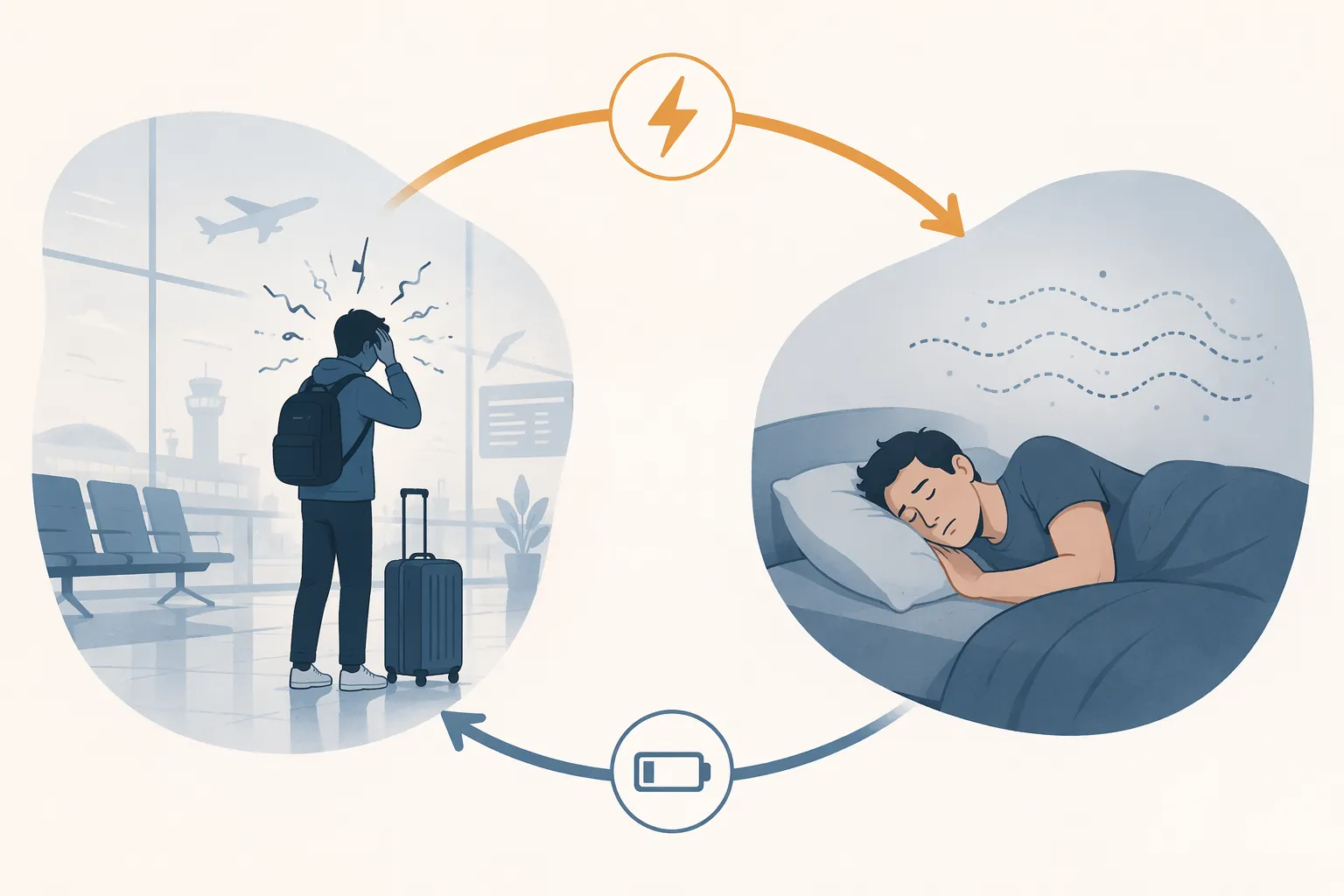
This is why the second or third announcement can feel disproportionate. The first delay may be processed by a rested person with options. Several hours later, the same person may be hungry, underslept, overstimulated, worried about a connection, and trying to remain civil with gate staff who also do not control the weather. The event has not only changed; the nervous system receiving the event has changed.
Cortisol evidence belongs here, but carefully. Wright et al. found that acute sleep deprivation significantly elevated cortisol, with p<0.0001.[3] Thompson et al., however, found that 24 hours of sleep deprivation increased anxiety, fatigue, confusion, and depression while decreasing morning cortisol.[4] Those findings do not support a simple universal claim that “sleep deprivation always raises cortisol.” They support a more precise point: acute sleep loss alters stress biology and mood, and the direction of measured cortisol change can depend on study design, timing, and sampling.
For a delayed traveler, the lived sequence is usually more important than one hormone value. The body keeps watch because plans are unresolved. Sleep becomes shorter, lighter, later, or displaced. The next disruption lands on a brain with less regulatory capacity. Then the stress response makes the next sleep opportunity less stable. That is the loop.
Why you can feel impaired after you finally arrive
Arrival does not instantly end the physiology of the delay. The itinerary may be over while the sleep system is still recalibrating. If REM and deep sleep have been reduced or shifted, the next day can carry a strange combination of heaviness and agitation: tired enough to feel slowed down, but keyed up enough that sleep does not come cleanly at the local bedtime.
REM sleep is closely tied to emotional processing, and deep sleep is part of the body’s restorative architecture. The Oura finding that these stages can remain compromised for 5 to 6 or more days after travel helps explain why a delay can seem to outlast the inconvenience itself.[1] It is not that one bad gate experience medically injures every traveler. It is that a disrupted trip can push sleep timing, duration, and architecture out of alignment at the same time.
Mental fog fits the same pattern. Sleep deprivation reliably makes sustained attention and flexible decision-making harder, and travel disruption demands exactly those functions: reading new itineraries, comparing options, finding transportation, tracking luggage, communicating with family or work, and deciding whether to sleep now or wait for another update. The more the delay asks of executive function, the less sleep-deprived executive function has to give.
Weather adds a particular kind of uncertainty
A mechanical delay can be maddening, but weather disruption often spreads across routes, crews, gates, and arrival airports. The traveler is waiting on a system that is waiting on another system. A thunderstorm line, snowstorm, hurricane, or wind event can make departure time feel provisional for hours. That uncertainty is not a soft inconvenience; it is one of the conditions that keeps vigilance active.
For some people, the weather itself is also part of the arousal. The delay is not only a transportation problem but a reminder of risk, turbulence, flooding, family safety, or what may be happening at home. Readers interested in that broader weather-and-sleep connection may recognize similar mechanisms in discussions of hurricane-related sleep disruption and hurricane anxiety and sleep disruption. The setting is different, but the body’s problem is related: sleep needs safety and predictability, while weather disruption supplies neither.
The evidence does not justify turning every delayed flight into a health emergency. It does justify taking the aftermath seriously. A weather delay is not only a schedule event. It can be a compounding physiological stressor: less sleep before and during travel, poorer sleep architecture afterward, prolonged uncertainty, and a stress-sleep loop that makes each new disruption harder to absorb.
References
- Willoughby et al. 2025 Oura 1.5M-night travel sleep study, Oura, 2025.
- Airport Dimensions/Sleepover survey of 1,500 US/UK travelers, Airport Dimensions/Sleepover.
- Wright et al. 2015 acute sleep deprivation and cortisol study, Brain, Behavior, and Immunity, 2015.
- Thompson et al. 2022 24-hour sleep deprivation, mood, and cortisol study, Frontiers in Behavioral Neuroscience, 2022.
Read the full guide: How Severe Storm Flight Delays Disrupt Sleep