
Flood risk sleep safety for pregnancy, aging, and CPAP users
To stay safe and sleep well during flood risk, the first rule is still the ordinary one: do not sleep through an evacuation order, do not walk or drive through floodwater, and do not let a sleep plan outrank electrical safety or rescue access. Ready.gov tells households to know their flood risk, prepare supplies, and leave when local officials say to evacuate; CDC flood guidance also includes avoiding floodwater and following instructions about shutting off power when needed.[1][2]
That baseline matters. It is also incomplete if the person trying to sleep is pregnant, over 65, using a cane or walker, managing several prescriptions, or relying on a CPAP machine. A generic go-bag can miss the exact thing that keeps the night from becoming a medical problem: prenatal vitamins, a written medication list, a mobility-aware exit route, distilled water, or a charged CPAP battery.
For the general setup—where to sleep, how to handle a flood warning, and how to think about emergency rest—start with Restful Ground’s guides to flash flood warning sleep plans, sleeping during a flood emergency, and deciding whether you can sleep during a flood warning. This article adds the layer those guides cannot safely compress: what changes when your body, medications, mobility, or medical device has to be planned for before the water rises.
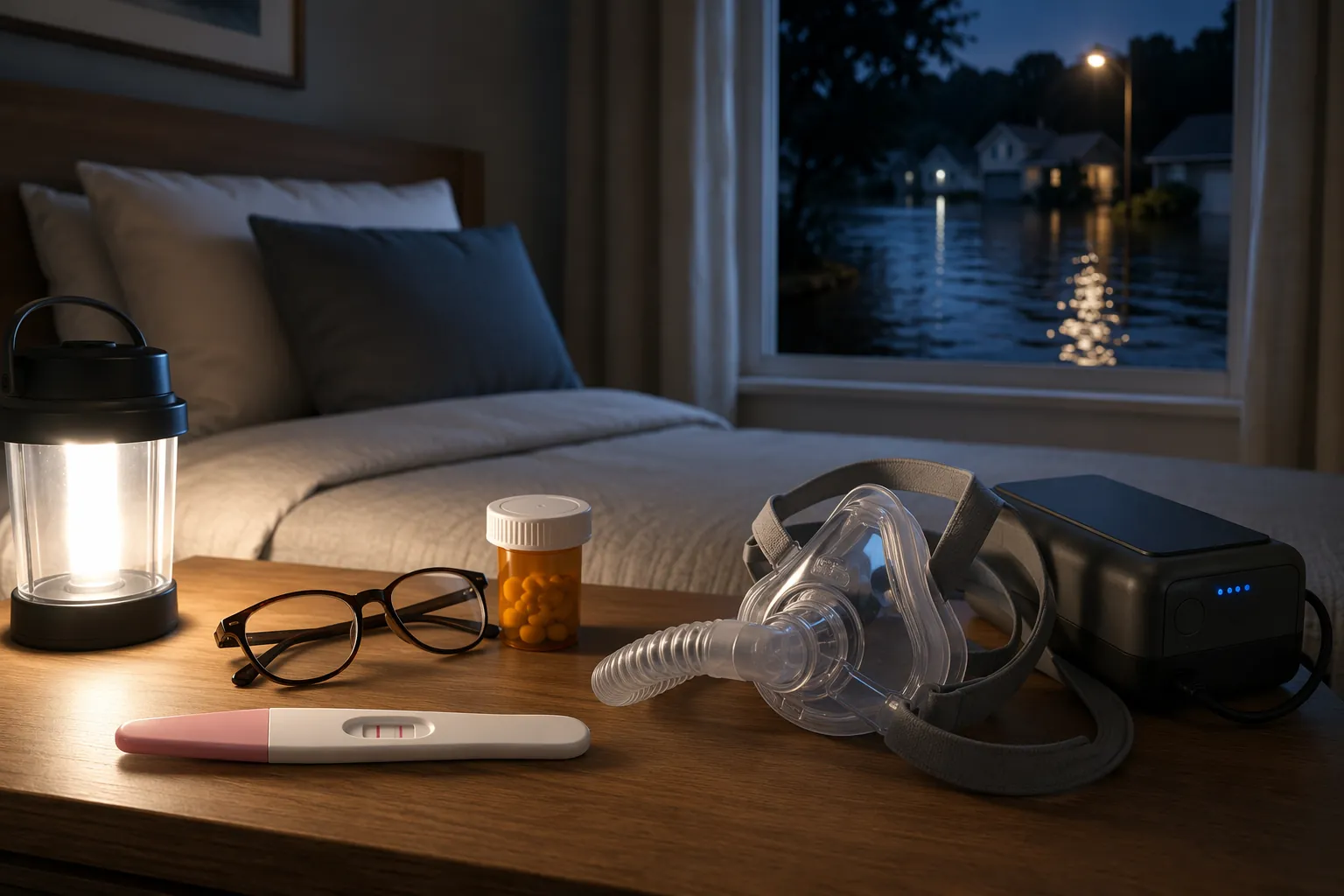
Before You Try to Sleep, Clear the Safety Line
A flood-risk night is not a normal insomnia night. The question is not simply where you can get comfortable. It is whether you can remain reachable, evacuate quickly enough, keep essential treatment running, and avoid the exposures that make the next morning harder.
The American Red Cross warns that 6 inches of moving water can knock a person down.[3] That number matters more at 2 a.m. than it does on a calm afternoon, because darkness, grogginess, pregnancy-related balance changes, walkers, oxygen tubing, and CPAP cords all add friction to an already dangerous exit.
- Do not sleep if an evacuation order is active or likely to be missed because alerts are silenced.
- Do not choose a sleep spot that requires crossing a dark hallway, stairs, standing water, or clutter to exit.
- Do not plug medical equipment into an outlet that may be exposed to water or power surges.
- Do not use sleep medication as a way to ignore anxiety if it will make evacuation slower or increase fall risk.
- Do not wait until the warning to ask how to handle pregnancy symptoms, oxygen use, or CPAP power loss.
Once that line is clear, sleep can become part of the plan: a prepared person resting in a reachable, safer location with alerts on and essential supplies ready. Without that preparation, “try to rest” is too vague to be useful.
The Add-On Flood Sleep Matrix
Use this as a quick sorting tool before the forecast gets worse. It does not replace local emergency instructions or clinician advice, but it shows where pregnancy, aging, and CPAP use change the overnight plan.
| Question before sleep | Pregnancy | Older adults | CPAP users |
|---|---|---|---|
| Medications and supplies | Keep a 7–10 day supply of prescriptions and prenatal vitamins, as CDC advises for pregnancy emergency preparedness.[4] | Keep a 30-day medication supply where possible, plus dosing supplies and a backup plan for refills. | Keep CPAP mask, tubing, filters, power cords, and any prescribed related supplies together. |
| Records | Pack prenatal records, clinician contact information, medication names, and insurance details.[4] | Carry a written medication list, diagnoses, allergies, pharmacy information, and emergency contacts. | Keep machine settings, prescription information, device model, and supplier or clinician contacts accessible. |
| Mobility and evacuation | Plan for more frequent bathroom needs, slower movement, and avoiding floodwater exposure. | Choose a route that works with canes, walkers, wheelchairs, low vision, hearing aids, or caregiver support. | Avoid routing cords across walking paths; keep the device ready to unplug and move. |
| Sleep location | Sleep close enough to a bathroom and exit, but not where floodwater or electrical hazards are more likely. | Use a location with clear floor space, lighting, shoes nearby, and a stable path to the door. | Sleep where the CPAP can run safely, alerts can be heard, and the device can be disconnected quickly. |
| Power and water | Prioritize phone power for alerts and clinician contact. | Prioritize power for phones, hearing aids, mobility devices, oxygen equipment, and medical alert systems. | Have a charged backup battery, surge protection, and at least one week of distilled water if humidification is used.[8] |
| When not to sleep through it | Do not sleep through evacuation instructions, heavy bleeding, severe symptoms, or suspected contamination exposure. | Do not sleep if leaving later would require unsafe movement, missed medication, or caregiver absence. | Do not sleep if the only CPAP power source is unsafe, cords are in water risk areas, or breathing support questions are unresolved. |
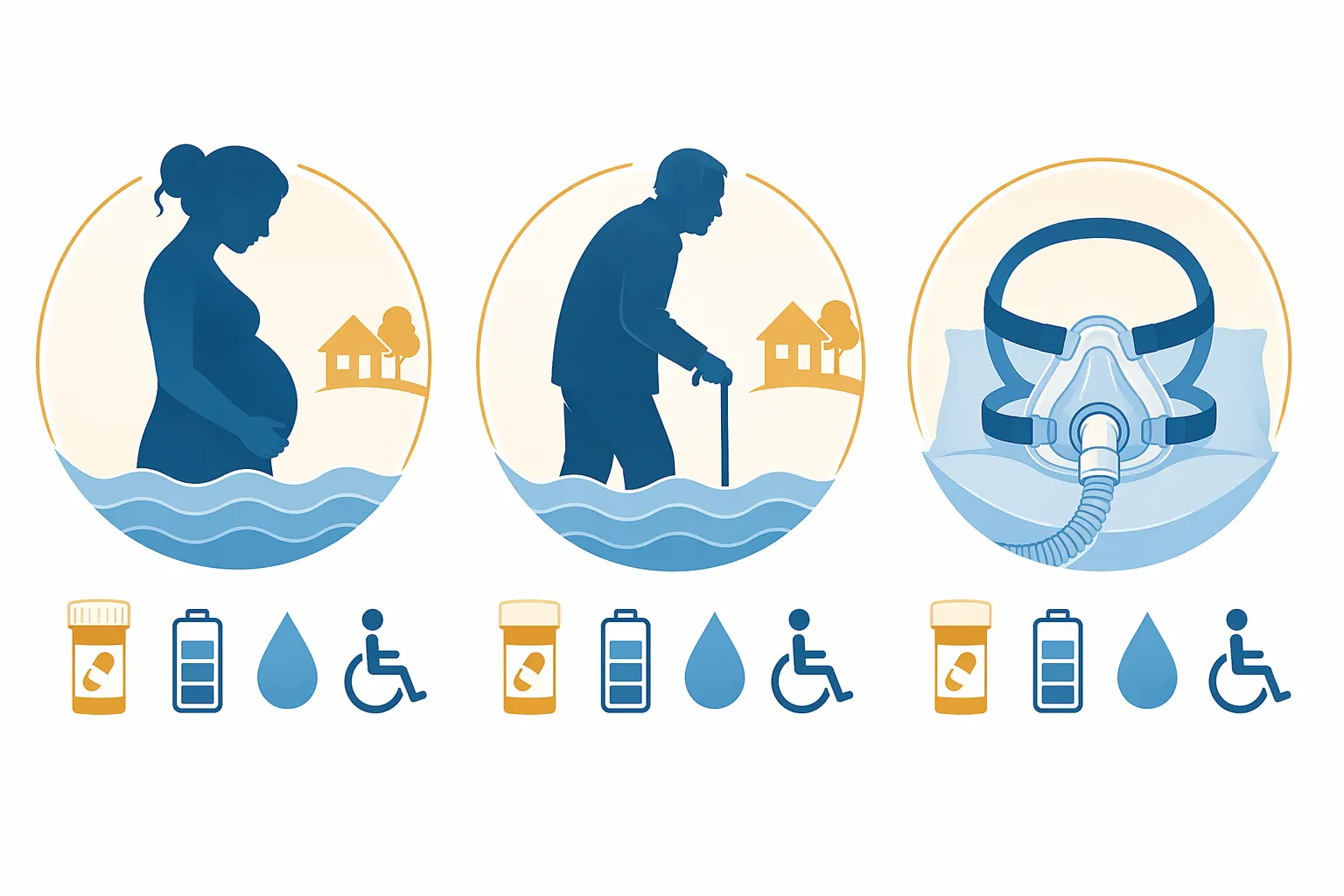
If You Are Pregnant
Pregnancy changes flood sleep planning mostly through continuity: continuity of medication, prenatal care, records, hydration, and clean surroundings. CDC’s pregnancy emergency guidance says to keep a 7–10 day supply of prescription medications and prenatal vitamins, and to have copies of important medical records available during emergencies.[4]
That is the part to handle before a watch becomes a warning. Put prenatal vitamins, prescriptions, clinician contacts, insurance information, and any relevant pregnancy records in one waterproof bag or folder. If you use medication for nausea, blood pressure, diabetes, asthma, thyroid disease, mood symptoms, or another condition, do not assume a shelter, pharmacy, or closed clinic can reconstruct your routine overnight.
Floodwater avoidance also deserves more than a passing mention. CDC pregnancy emergency guidance specifically includes avoiding floodwater contamination.[4] During a flood-risk night, that means planning the bathroom route, footwear, lighting, and evacuation path before bedtime. A pregnant person who needs to urinate more often should not be left to discover at 3 a.m. that the only route to the bathroom is dark, wet, or blocked by packed bags.
- Move the sleep setup closer to a safe bathroom and exit if doing so does not increase floodwater or electrical risk.
- Keep shoes, a flashlight, phone, charger, water, and the prenatal medication bag within reach.
- Write down where prenatal care will continue if your usual clinic is closed or unreachable.
- Ask your prenatal clinician in advance which symptoms during a storm should trigger urgent care rather than waiting.
Sleep aids are not the first tool to reach for during flood risk. If pregnancy insomnia is already part of the picture, it is better to sort out medication and non-medication options before storm season. Restful Ground’s guides to sleep aids for pregnancy insomnia and CBT-I during pregnancy are better places for that decision than the middle of a warning.
If You Are Over 65 or Preparing for an Older Adult
Older-adult flood sleep planning is where the ordinary checklist fails most quietly. A younger adult may be able to sleep lightly, hear the alert, grab shoes, and leave. An older adult may need glasses, hearing aids, a walker, blood pressure medication, diabetes supplies, oxygen equipment, continence supplies, a caregiver, and time.
Start with medications. Older-adult emergency preparedness guidance from the National Institute on Aging recommends keeping at least a 30-day supply of medicines when possible and keeping a complete medication list, including dosage information and allergies.[5] During flood risk, that list should travel with the person, not sit in a kitchen drawer or pharmacy app that no one else can unlock.
- Medication name, dose, timing, and reason for use.
- Prescriber name, pharmacy, and refill information.
- Allergies, major diagnoses, implanted devices, and recent procedures.
- Emergency contacts, caregiver contacts, and preferred hospital or clinic.
- Copies of insurance cards, identification, and advance directives if available.
The next issue is movement. A flood sleep location for an older adult should be judged from the bed outward: Can they sit up safely? Are glasses, hearing aids, phone, shoes, and cane within reach? Is there a clear path to the door? Is there light if power fails? Can a caregiver enter the room quickly? If the answer depends on someone stepping over boxes or unplugging cords in the dark, the plan is not ready.
Shelter planning should happen earlier, too. Ready.gov’s flood guidance emphasizes evacuation planning and supplies before a flood event.[1] For an older adult, the useful question is not only “Where is the shelter?” but “Can this person actually use it?” Ask about accessible entrances, bathroom access, medication storage, oxygen or electrical-device rules, pet policies if a service animal or companion animal is involved, and transportation that can accommodate mobility equipment.
Sleep medication deserves special caution. The 2023 American Geriatrics Society Beers Criteria lists first-generation antihistamines, including diphenhydramine and doxylamine, as potentially inappropriate for many older adults because of anticholinergic effects and related safety concerns.[6] That matters during a flood night because the same pill someone might take “just to sleep” can be poorly matched to a situation that may require waking, walking, toileting, hearing alerts, or evacuating.
If an older adult already uses a sleep medicine, follow their clinician’s instructions rather than stopping abruptly because a storm is coming. If they do not normally use one, a flood warning is a bad time to experiment. For broader context on OTC choices, see Restful Ground’s comparison of doxylamine and diphenhydramine and its guide to choosing an over-the-counter sleep aid. During flood risk, though, the immediate standard is simpler: do not trade alertness and stable movement for a few hours of forced sleep unless a clinician has already told you that medication is appropriate.
If You Use a CPAP
A CPAP machine is not a comfort item. For someone prescribed PAP therapy, the flood-night question is not “Can I sleep without my usual setup?” It is “Can my prescribed treatment run safely, and what is the backup if power becomes unstable?”
Sleephealth.org’s disaster sleep guidance encourages people to protect sleep routines where possible during disasters, but it also frames sleep as one part of coping during an emergency rather than a reason to ignore safety instructions.[7] For CPAP users, that means the routine needs infrastructure: power, clean water if humidification is used, dry equipment, and a way to evacuate without leaving the device behind.
A CPAP manufacturer’s storm-preparedness guidance recommends a backup power source such as a portable CPAP battery or marine battery, at least one week of distilled water, and surge protection for power fluctuations.[8] Because that source has a commercial interest in battery products, treat it as practical equipment guidance rather than independent clinical evidence. The basic logistics still stand: if the power fails at midnight, the answer cannot be “I meant to order a battery.”
- Charge the CPAP backup battery before storm season and again when flood watches are issued.
- Test the battery with your actual machine and settings before you need it overnight.
- Keep the machine, tubing, mask, filters, power supply, extension needs, and distilled water together.
- Use surge protection when grid power is unstable, and keep cords away from walking paths and possible water exposure.
- Ask your sleep clinician or durable medical equipment supplier what to do if power loss interrupts therapy.
The humidifier chamber needs its own plan. If you use distilled water at home, keep enough for at least one week as part of the CPAP supply, consistent with the manufacturer storm-prep recommendation.[8] Do not improvise with floodwater, and do not place the machine where water can reach the outlet, cord, or device.
Storms may also change sleep quality in ways that are hard to separate from anxiety, noise, pressure changes, and disrupted schedules. The same manufacturer page notes that barometric pressure changes during storms may affect sleep apnea severity, citing NIH research, but that concern should not outrank the more immediate tasks of safe power, dry equipment, and following evacuation orders.[8]
If you also use oxygen, bilevel PAP, or another respiratory device, do not rely on CPAP battery advice alone. Ask your clinician and equipment supplier before storm season which devices can run on backup power, for how long, and which emergency services or utility medical-needs registries apply in your area.
Sleep Shifts Are Useful Only After the Medical Plan Is Covered
Sleep shifts can help when a household needs someone awake for alerts, pump checks, caregiver needs, or changing conditions. Amerisleep’s hurricane sleep guide suggests 3–5 hour shifts as a practical way to divide rest during storm disruption.[9] That is a commercial mattress-site recommendation, not a clinical standard, but the idea is reasonable when the household can do it safely.
The order matters. Do not set up shifts while prescriptions are still scattered, the older adult’s walker is in another room, or the CPAP battery is uncharged. First decide who needs help waking, who needs help evacuating, who manages medications, who monitors alerts, and who can drive or call for help if local officials say to leave.
| If this is true | Do this before assigning sleep shifts |
|---|---|
| A pregnant person may need frequent bathroom trips | Clear and light the bathroom path; move supplies within reach; avoid routes near water or electrical hazards. |
| An older adult uses mobility equipment | Put the equipment at bedside; clear the exit path; keep shoes, glasses, hearing aids, and medications together. |
| Someone uses CPAP | Confirm safe power, battery charge, dry placement, distilled water, and a fast unplug-and-go setup. |
| One person is responsible for alerts | Use loud emergency alerts, backup phone power, and a written handoff so the next person knows what changed. |
National Weather Service flood safety resources emphasize taking flood warnings seriously and avoiding flooded roads and areas.[10] A rested household is helpful; a household that slept through a worsening warning because the “awake” person was too sedated, too far from the phone, or unsure what to do is not.
The Bedside Setup Should Match the Person
A safe flood-night bedside setup is not the prettiest version of emergency preparedness. It is the version that keeps the next necessary action short.
- For pregnancy: prescriptions, prenatal vitamins, records, phone, charger, water, shoes, flashlight, and a bathroom route that does not require crossing unsafe areas.
- For older adults: medication list, 30-day supply if possible, glasses, hearing aids, cane or walker, shoes, continence supplies, phone, charger, emergency contacts, and clear floor space.
- For CPAP users: machine, mask, tubing, filters, power supply, charged backup battery, surge protector, distilled water, dry surface, and cords kept out of the walking path.
- For everyone: alerts on, evacuation instructions visible, go-bag reachable, keys and wallet in one place, and local emergency guidance followed.
The point is not to make flood sleep feel normal. It will probably be lighter, shorter, and more interrupted than usual. The point is to remove the preventable failures: the missing refill, the lost medication list, the dead battery, the walker behind a pile of supplies, the CPAP cord stretched across the exit path.
When Generic “Sleep Somewhere Safe” Advice Is Not Enough
Generic flood sleep advice becomes too thin when it cannot answer these questions: Can the pregnant person continue prescribed care if the clinic closes? Can the older adult leave without rushing through a dark hallway? Can the CPAP user keep therapy running without creating an electrical hazard? Can everyone who needs medication still get it if the pharmacy is unreachable?
If prescriptions, records, mobility route, evacuation contact, CPAP power, clean water, and clinician-specific instructions are not handled, do not rely on a generic sleep setup as if it covers the real risk. Sleeping during flood risk is not only about where you lie down. It is about whether the medical dependencies that keep you safe overnight have already been planned before the water rises.
References
- Floods, Ready.gov, updated April 2026, https://www.ready.gov/floods
- Flood Safety, Centers for Disease Control and Prevention, updated February 2024, https://www.cdc.gov/floods/safety/index.html
- Flood Safety, American Red Cross, https://www.redcross.org/get-help/how-to-prepare-for-emergencies/types-of-emergencies/flood.html
- Emergency Preparedness and Response: Pregnancy, Centers for Disease Control and Prevention, updated May 2026, https://www.cdc.gov/pregnancy/during/emergency-preparedness.html
- Emergency Preparedness for Older Adults, National Institute on Aging, https://www.nia.nih.gov/health/safety/emergency-preparedness-older-adults
- American Geriatrics Society 2023 Updated AGS Beers Criteria for Potentially Inappropriate Medication Use in Older Adults, Journal of the American Geriatrics Society, 2023, https://agsjournals.onlinelibrary.wiley.com/doi/10.1111/jgs.18372
- How to Manage Your Sleep During a Disaster, Sleephealth.org, https://www.sleephealth.org/how-to-manage-your-sleep-during-a-disaster/
- Storm Preparedness with Sleep Apnea Therapy and CPAP Machines, Transcend CPAP, https://mytranscend.com/storm-preparedness-with-sleep-apnea-therapy-and-cpap-machines/
- Hurricane Preparedness and Sleep, Amerisleep, https://amerisleep.com/blog/hurricane-preparedness-and-sleep/
- Flood Safety, National Weather Service, https://www.weather.gov/safety/flood
Read the full guide: Does filter coffee affect blood sugar and sleep?