Why Do Heat and Storms Together Disrupt Sleep So Much?
The question after a bad storm night is usually not “Why was I hot?” It is more specific: why was last night worse than other hot nights, even when the room temperature was not dramatically different? Heat and sleep disruption during storms are harder to untangle because the bedroom problem is not only thermal. The body is trying to cool itself for sleep, the weather system is changing pressure and humidity around it, and thunder or lightning is telling the nervous system to stay available.
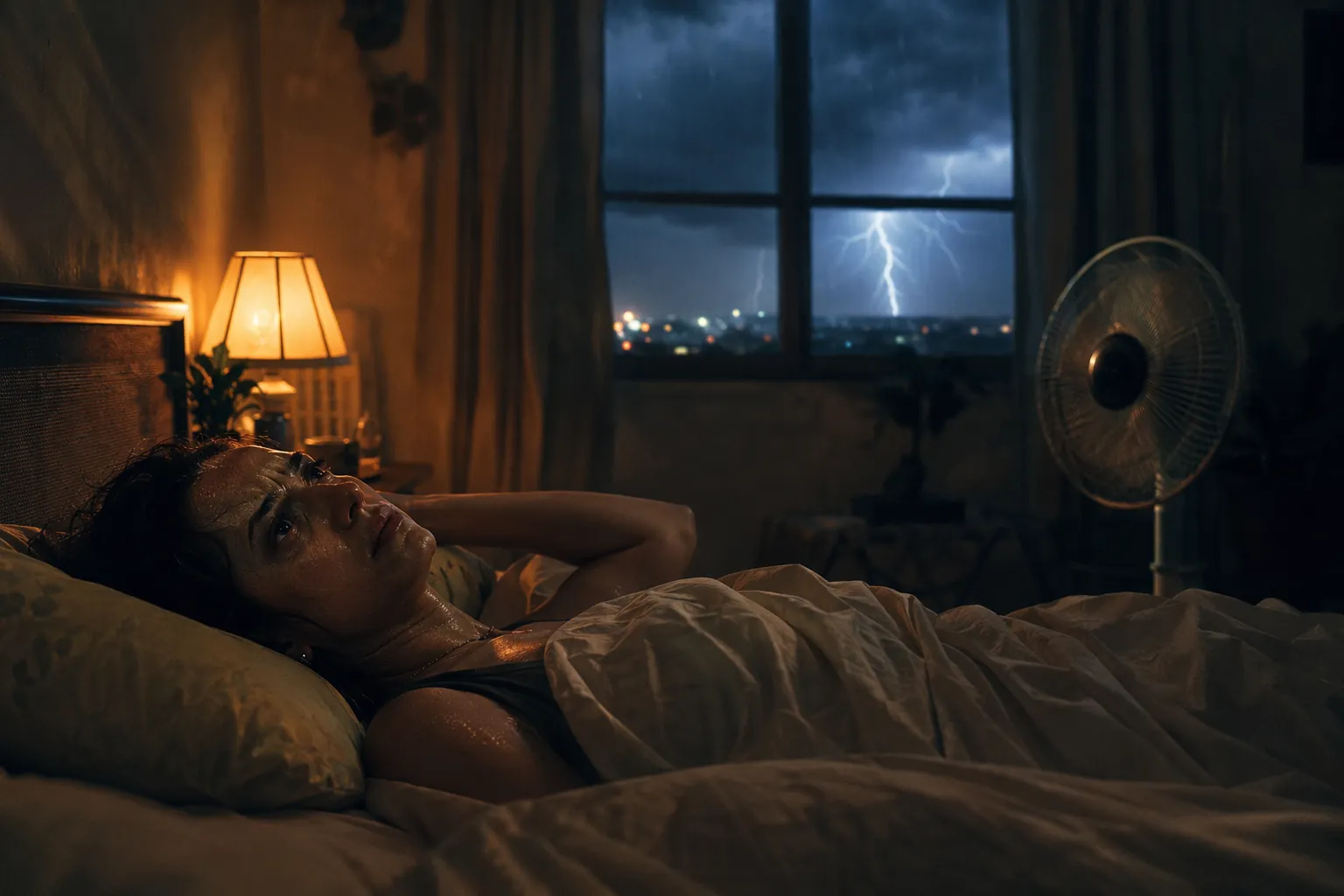
Quick answer: a hot storm night is three sleep problems at once
A hot, stormy night can feel strangely contradictory: you may be exhausted, sticky, tense, and unable to settle at the same time. That mix makes sense if you separate the layers.
| Layer | What it does to sleep | Why it feels different during storms |
|---|---|---|
| Heat | Interferes with the normal core temperature drop that helps sleep begin and stay stable. | Warm, humid air reduces the body’s ability to shed heat, especially when windows are closed or power is unreliable. |
| Falling pressure | May contribute to pre-storm drowsiness while also worsening bodily discomfort for some people. | The sleeper can feel heavy and tired without feeling physically comfortable. |
| Storm cues | Thunder, lightning, alerts, and worry about outages activate the stress response. | The nervous system treats the night as something to monitor, not simply sleep through. |
That does not mean one study has already measured the full combined effect of heat, barometric pressure, and storm anxiety in a sleep lab. The useful “triple-disruptor” explanation is a synthesis: strong population evidence for warm nights disrupting sleep, paired with more limited explanatory evidence on pre-storm pressure and sensory arousal.
The heat layer does most of the damage
The clearest evidence starts with temperature, not thunder. In a 2017 Science Advances study using CDC Behavioral Risk Factor Surveillance System data from about 765,000 U.S. adults, Obradovich and colleagues found that a 1°C increase in nighttime temperature anomalies was associated with roughly three additional nights of self-reported insufficient sleep per 100 people per month. The effect was about three times larger in summer, and the estimated burden was much higher among older adults and lower-income respondents, reaching up to about 10 times the effect seen in other groups in the authors’ subgroup analyses.[1]
That study matters because it measures ordinary people’s sleep complaints at population scale, not just a small laboratory sample. It also has a limitation worth keeping in view: the outcome was self-reported insufficient sleep, not polysomnography. A person has to notice and report the sleep loss for it to appear in the data, so the study is better read as a strong real-world signal than as a complete measurement of every minute of lost sleep.[1]
The mechanism is straightforward and easy to underestimate. Sleep onset is helped by a drop in core body temperature of about 0.5–1°C, and sleep quality tends to decline when the surrounding temperature rises above roughly 24–25°C.[2] If the room stays warm, the body has to keep working at heat release at the very time it is supposed to be downshifting.
Humidity makes this more stubborn. When the air is damp, sweat evaporates less efficiently, so the body’s cooling system loses one of its best tools. Sleep Foundation’s guidance on humidity and sleep treats moisture in the bedroom as part of the sleep environment, not just a comfort preference, because humidity can intensify heat discomfort and interfere with stable rest.[3]
This is why summer heatwave sleep coverage has become so familiar in 2026: people are not simply annoyed by warm bedrooms; they are running into a biological requirement that a warmer night makes harder to meet. Le Monde’s July 2026 heatwave piece framed the problem in those terms, focusing on how heat disrupts sleep and what people can do to protect it during extreme summer conditions.[4]
Pressure changes can make “sleepy” feel physically restless
The storm layer begins before the rain arrives. Weather explainers commonly describe falling barometric pressure ahead of storms as one reason people feel unusually drowsy 12–24 hours before rainfall.[5] Amerisleep and Dreams.co.uk both discuss this pre-storm pressure pattern in relation to sleepiness and melatonin, though this material should be treated as explanatory support rather than the same grade of evidence as the large temperature-sleep study.[6][7]
That distinction matters because drowsiness is not the same as good sleep. A pressure drop may make a person feel heavy or foggy, while the same weather change can coincide with headaches, sinus pressure, or joint discomfort for people who are sensitive to pressure shifts. The result is not clean sleepiness. It is more like being tired in a body that cannot quite get comfortable.
On an ordinary hot night, the main fight may be heat release. On a hot pre-storm night, a person may be trying to cool down while also noticing pressure in the head, aches in the joints, or a dull physical unease that keeps prompting position changes. That is enough to fragment the beginning of the night even before the first thunderclap.
Thunder and lightning keep the nervous system on watch
The final layer is sensory and emotional, but it is not imaginary. Thunder can reach up to about 120 decibels, a level that is obviously capable of startling a sleeper even if the person is not especially afraid of storms.[8] Lightning adds a different problem: sudden contrast. A dark room becomes bright for a fraction of a second, then dark again, and the brain receives another cue that the environment is changing.
Storm anxiety also has a body. Sleep-oriented clinical and mattress-industry explainers describe storm noise, lightning, and worry as triggers that can heighten alertness and stress physiology, including cortisol-related arousal.[9][10] In practical terms, the sleeper may feel exhausted but still primed to listen: Was that thunder closer? Did the power flicker? Is the phone charged? Is the dog pacing? This is not the parasympathetic state sleep depends on.
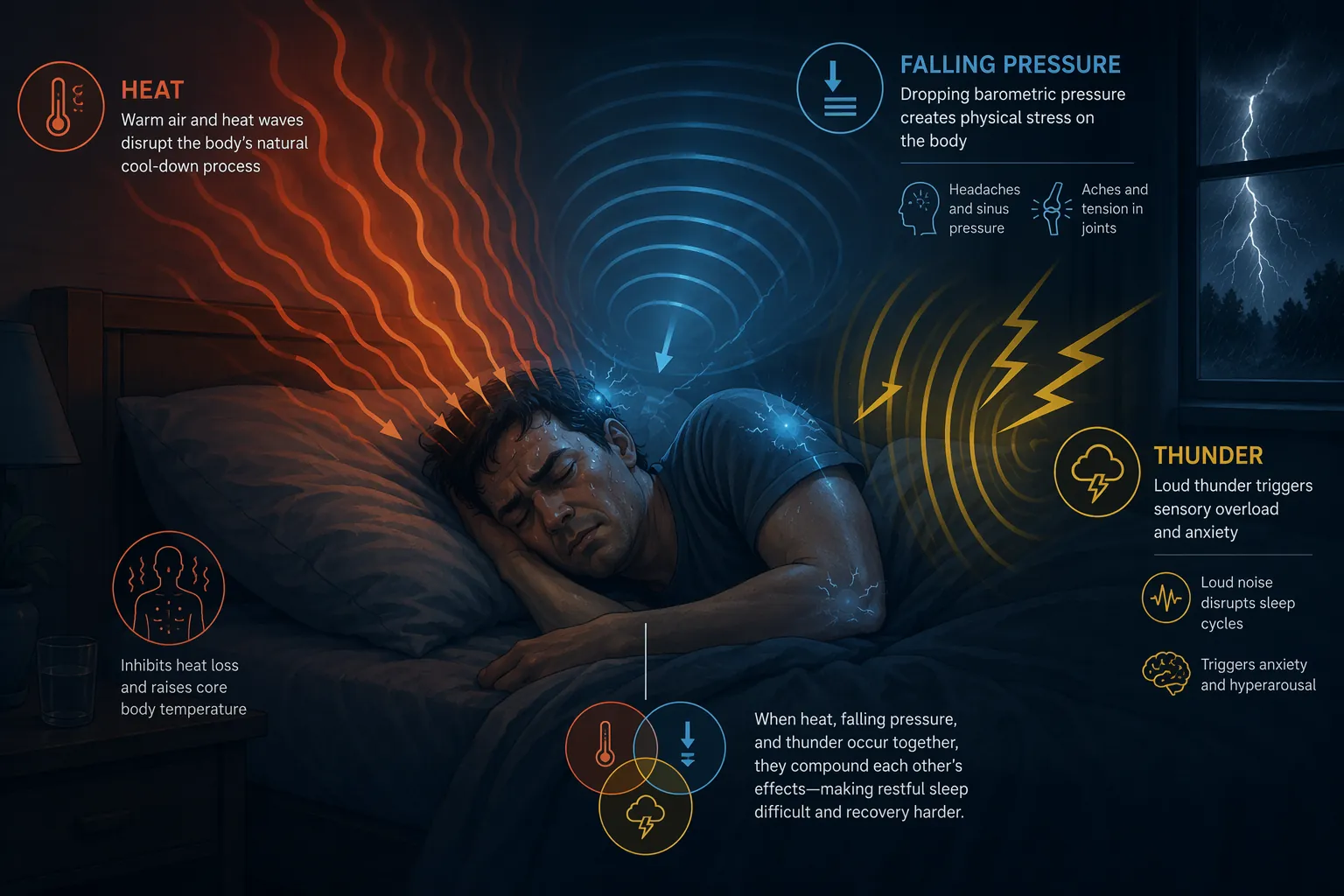
Why the three layers feel so unfair in the same night
The reason a hot storm night can feel worse than heat alone is that the disruptions do not wait politely in line. They stack.
- The room stays warm, so the body struggles to drop core temperature.
- Humidity limits evaporative cooling, especially if windows are shut against rain or safety concerns.
- Pressure changes may make the person feel drowsy but physically uncomfortable.
- Thunder, lightning, weather alerts, and outage worries keep attention scanning the environment.
That combination explains a common complaint: “I was tired all evening, but the moment I got into bed I couldn’t sleep.” The tiredness may be real. The sleep opportunity may also be real. But sleep onset still needs a cooler core, a tolerable body, and a nervous system willing to stop monitoring the room. A storm can interfere with all three.
It also explains why “just cool your bedroom” is incomplete advice. Cooling is still the most important layer to address when possible, but it does not quiet thunder, prevent a pressure-sensitive headache, or remove the low-level concern that the power may fail before morning.
What you can actually address
The practical response should match the three-part problem rather than pretending every storm night is a generic sleep-hygiene failure.
Reduce the heat load first
If you have cooling, start it before the bedroom has already stored the day’s heat. Use breathable bedding, keep the sleep surface as dry as possible, and avoid trapping humid air under heavy covers. If storms make outages likely, charge fans and cooling devices ahead of time, freeze water bottles if you have freezer space, and decide where you would sleep if the bedroom becomes the warmest room in the home.
For a more detailed outage plan, use How a Power Outage Disrupts Your Sleep (and What to Do) or the hot-and-cold guide How to Sleep During a Power Outage, Whether It's Hot or Cold.
Treat pressure-related discomfort as comfort planning, not a willpower problem
If storms reliably bring headaches, sinus pressure, or joint aches, plan for that before bedtime instead of waiting until you are already awake and irritated. Support painful joints, keep needed doctor-approved medications accessible, and choose a sleep position that reduces pressure points. The goal is not to control the barometer; it is to remove as many reasons as possible for the body to keep asking for a new position.
Buffer the cues your brain keeps monitoring
White noise, steady fan noise, blackout curtains, an eye mask, and a clear alert plan can reduce the stop-start pattern of “almost asleep, startled awake.” The alert plan matters: if your phone is set to wake you only for essential weather warnings, you may be less likely to keep checking it manually. If the storm is tropical or severe, a sleep plan has to include safety, not only comfort; the companion guide How to Sleep Safely During a Tropical Storm Landfall goes deeper on that tradeoff.
Know when ordinary advice is too small
The Obradovich findings are a reminder that adaptation is not evenly available. Older adults and lower-income adults showed much larger sleep-loss associations during warmer nights, which makes sense when cooling access, housing quality, medication burden, and heat vulnerability are not evenly distributed.[1] Pregnancy, perimenopause, ADHD, chronic pain, respiratory disease, and caregiving responsibilities can also make storm nights harder to ride out with a fan and a pep talk.
For those life-stage complications, see Tropical Storm Bertha Sleep for Pregnancy, Perimenopause, and ADHD. The general mechanism is the same, but the consequences and thresholds for intervention may be different.
The restrained answer is also the most useful one: summer storm sleep loss is distinct from ordinary hot-night insomnia because the body is trying to cool down, tolerate pressure-related discomfort, and downshift a threat-responsive nervous system at the same time. You may not be able to remove every layer, but naming them correctly shows which parts of the night are actually addressable.
References
- Nighttime temperature and human sleep loss in a changing climate — Science Advances, 2017.
- Tossing and Turning? How Heat Waves Disrupt Sleep Quality — Eastside Family Health Center.
- Humidity and Sleep: Optimize Your Sleep Environment — Sleep Foundation.
- Why heatwaves disrupt our sleep – and how we can protect it — Le Monde, July 11, 2026.
- Why Storms Make You Sleepy: The Science Behind Pre-Storm Drowsiness — Weather.com.
- How Does Barometric Pressure Affect Sleep? — Amerisleep.
- How Does Barometric Pressure Effect Sleep? — Dreams.co.uk.
- Does Weather Affect Your Sleep? Six Tips To Sleep Through Storms — Valley Sleep Center.
- How Summer Thunderstorms Affect Your Sleep (and What You Can Do About It) — City Mattress.
- How Weather Impacts Insomnia — Behavioral Sleep Solutions.
Read the full guide: How to Sleep During Tropical Storm Anxiety