
How summer 2026 heatwaves disrupt sleep, by life stage
If you are trying to understand how heatwaves affect sleep in summer 2026, the shortest honest answer is this: your body normally has to shed heat before sleep begins, and a hot bedroom makes that biological step harder. Sleep onset depends on a drop in core body temperature of about 0.5–1°C; during a heatwave, warm night air slows the transfer of heat out of the body, so you may feel tired, even exhausted, while still unable to cross into sleep [1].
That is why a heatwave night can feel different from an ordinary restless night. It is not only that the sheets feel sticky or the pillow is wrong. The cooling process that usually helps move you from alertness into sleep is being blocked at the level of physiology.

The bedroom temperature threshold matters. Sleep quality begins to worsen sharply once nighttime ambient temperature rises above roughly 24–25°C, and European Insomnia Network recommendations place the bedroom target below 25°C when possible [2]. That does not mean everyone sleeps well at 24°C or badly at 26°C. It means the margin gets thinner, especially for people whose thermoregulation is already working harder.
Why hot nights delay sleep instead of just making it uncomfortable
In a cooler room, the body can release heat through the skin, especially through the hands, feet, and other blood-rich surface areas. That outward heat loss helps core temperature fall. As core temperature drops, sleep becomes easier to initiate.
On a heatwave night, the gradient is smaller. The air around you is already warm, and sometimes humid, so your body has fewer easy routes to dump heat. You may kick off covers, move from side to side, wake after brief dozing, or feel a strange mix of fatigue and wired discomfort. Those behaviors are not proof that you lack discipline. They are often signs that the body is still trying to solve the temperature problem.
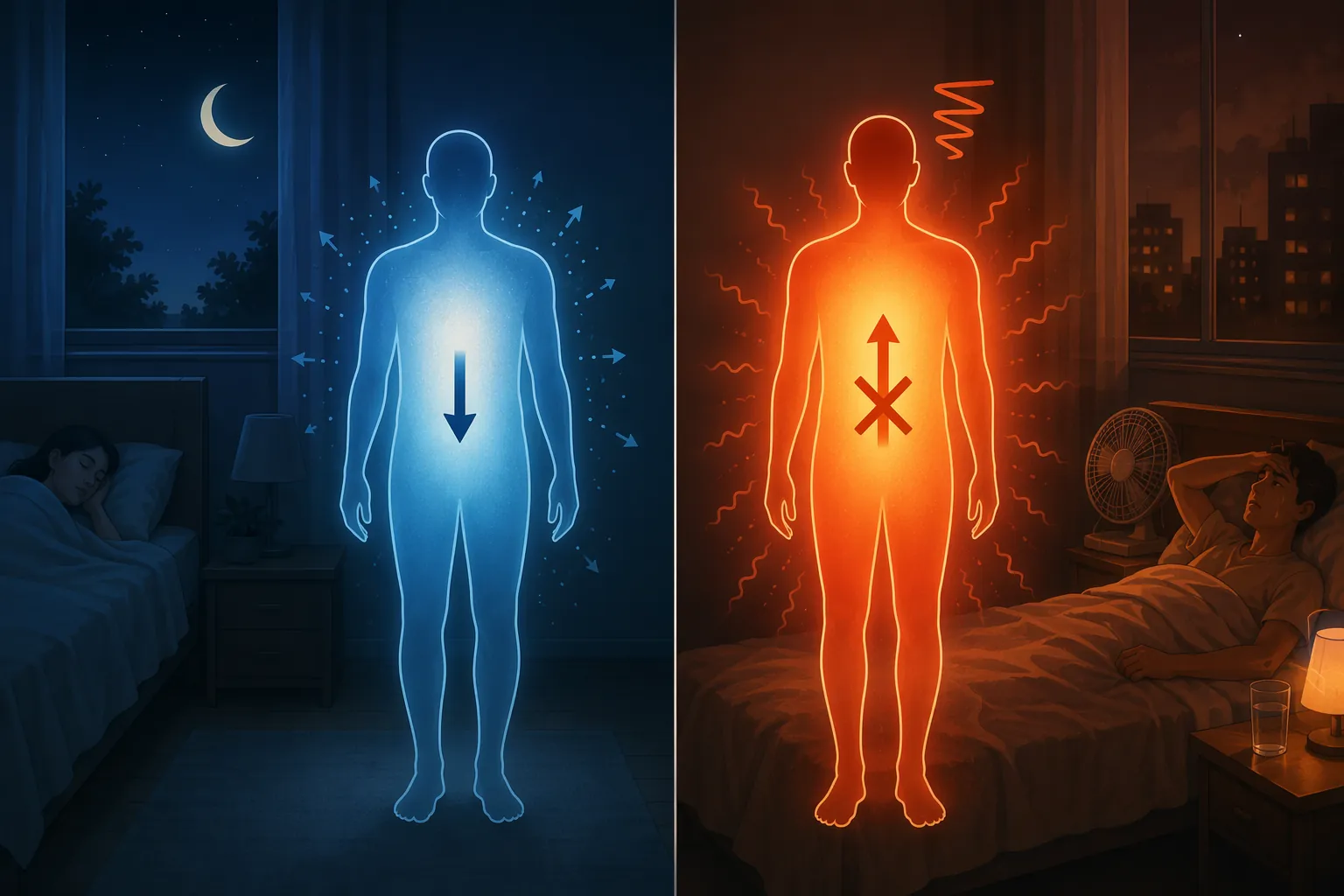
| Normal sleep transition | Heatwave interruption |
|---|---|
| Core temperature begins to fall before sleep | Warm air slows heat loss from the body |
| Sleep onset becomes easier | Sleep onset is delayed even when you feel tired |
| Deeper sleep is easier to sustain | Deep sleep may shrink disproportionately |
| Morning recovery depends on enough consolidated sleep | Fragmented sleep leaves less recovery time for the body and brain |
The deep-sleep piece is especially important. In Li et al.’s 2025 sleep-temperature analysis, the proportion of deep sleep fell by 2.82% for every 10°C rise in nighttime temperature, using data from Huawei smartwatch users in China [1]. That sample limits how far the finding can be generalized on its own. But the direction of the signal fits the larger pattern: hotter nights do not merely shift bedtime later; they can also reduce the stage of sleep most associated with physical recovery and brain waste-clearance processes.
What the summer 2026 numbers show — and what they do not
The summer 2026 sleep complaint is not private or rare. A July 2026 YouGov poll reported by The Guardian found that two-thirds of UK adults struggled to sleep during the June 2026 heatwave, and half said they lost at least three hours of sleep per night [3]. The poll covered 2,135 UK adults, so it should not be treated as a global clinical estimate. Its value is more immediate: it shows how widely people recognized sleep loss while the heatwave was happening.
A wider climate-sleep frame points in the same direction. Climate Central estimated in July 2026 that the average person globally loses 56 hours of sleep per year because of climate-warmed nights, and that nighttime temperatures in the United States have warmed by about 3°F since 1970 [4]. That 56-hour figure is model-derived, based on previously published temperature-sleep response functions, not a direct measurement of every person’s sleep across the globe [4].
Wearable data add another layer. Liao et al.’s large U.S. study analyzed 12.5 million nights from 14,232 adults and found that each 10°C increase in nighttime ambient temperature was associated with 2.63 fewer minutes of sleep [5]. That may sound small for one night. Across repeated hot nights, and in people who already sleep lightly or wake often, small average losses can become very noticeable. The study population also skewed female, white, and higher-income, so it may underrepresent people with fewer resources to cool their homes [5].
Taken together, these sources do not prove that every sleepless night in summer 2026 is caused by heat. They do show a converging pattern: hotter nights interfere with sleep timing, sleep duration, and sleep depth, and the people with the least thermal margin pay first.
Why it can hit harder in perimenopause
Perimenopause is one of the clearest places where generic heatwave advice can miss the body in front of it. A person in perimenopause may already be dealing with vasomotor symptoms — hot flashes, night sweats, sudden heat surges, abrupt awakenings — before the weather is added. A warm room does not create that whole system from scratch. It narrows the space in which the body can recover from it.
The practical problem is that weather heat and internal heat can become hard to separate. If you wake sweating at 3:00 AM, was it a hot flash, a room that never cooled, bedding that trapped heat, or all three? The answer may matter less than the sequence: heat builds, the body triggers cooling behaviors, sleep fragments, and the next sleep cycle starts from a more activated state.
There is an important evidence boundary here. The claim that heatwaves compound perimenopausal sleep disruption is a reasonable synthesis of heat-sleep physiology, vulnerable-group guidance, and perimenopause sleep literature; it is not based on one direct trial that tests a heatwave-by-perimenopause interaction. That caveat does not make the burden less real. It means the evidence is assembled from adjacent, biologically compatible findings rather than from a single perfect study.
For perimenopausal sleepers, the most useful cooling choices are the ones that make heat release easier after an internal surge: layered bedding that can be removed quickly, breathable sleepwear, a cooling pillow or surface if it genuinely stays cool, and a room plan that prevents heat from accumulating during the day. The goal is not to chase a perfect sleep gadget. It is to reduce the number of times the body has to climb out of both environmental heat and vasomotor heat at once.
Why pregnancy changes the heatwave calculation
Pregnancy already changes the architecture of a night. Sleep is more likely to be interrupted by body position, bathroom trips, reflux, discomfort, fetal movement, or the sheer work of trying to settle in a body that is changing quickly. Add heat, and the issue is not only comfort. The body has to cool itself while also supporting pregnancy’s increased physiological demands.
That is why some standard heat advice can feel inadequate or even careless. “Just use a fan” may not be enough if the room never drops below the mid-20s Celsius. “Take a cold shower” may feel shocking rather than settling. “Hydrate before bed” can collide with nocturia. The right advice has to respect both sleep and safety.
Heat exposure during pregnancy has been associated with adverse birth outcomes in research cited by the European Insomnia Network review [2]. That does not mean one hot night predicts harm, and it does not mean anxiety is helpful. It does mean pregnant people deserve more than minimalist comfort advice during heatwaves. Cooling the sleep space, reducing heat gain before bedtime, and seeking medical guidance during extreme heat or concerning symptoms are proportionate responses.
A warm bath one to two hours before bed can help some adults sleep because the warmth draws blood toward the skin and can promote later heat loss through vasodilation [2]. In pregnancy, that should mean warm, not hot, and it should be skipped or discussed with a clinician if there are medical restrictions, dizziness, overheating, or any pregnancy-specific concerns. The mechanism is useful only when the method fits the person safely.
Why older adults have less room for error
Older adults often have less forgiving thermoregulation. The body may sense heat less efficiently, sweat less effectively, or respond more slowly to temperature changes. Medications, cardiovascular disease, mobility limits, and living alone can all make a hot night more than a nuisance.
The wearable data point in that direction. In Liao et al.’s U.S. study, the temperature-related sleep effect was 22.9% larger per degree among females, and 24% higher among people with cardiovascular disease [5]. Those findings should not be stretched into a complete risk map for every older adult. But they do show that the same hot room does not land evenly across bodies.
For an older sleeper, the most important question may not be “Can I tolerate this?” but “Is my body recovering overnight?” A person can lie still in a warm room and appear to be managing while sleep becomes lighter, shorter, and more fragmented. If there is heart disease, breathing difficulty, dizziness, confusion, or poor access to cooling, the threshold for getting help should be lower.
Why ADHD can make one hot night cost more tomorrow
For ADHD adults, the heatwave problem is often less about a unique heat sensor and more about the next-day cascade. A hot room delays sleep. Short sleep makes attention, inhibition, planning, emotional regulation, and task-switching harder. Those are already expensive functions for many ADHD brains.
That can turn one bad night into a wider systems problem. The alarm goes off after broken sleep. Medication timing may feel harder to manage. Morning routines take longer. The person who meant to close blinds early, refill water, set up cross-ventilation, or prepare a cooler sleep surface may now be trying to do all of that with depleted executive function.
There is not enough evidence here to claim a precise heatwave-by-ADHD sleep effect. The stronger claim is practical and physiological: when heat strips away sleep, it removes one of the supports ADHD adults rely on for next-day regulation. Cooling plans for ADHD therefore need to be low-friction. The setup has to happen before the bedroom is unbearable and before the brain is running on emergency power.
What to change tonight
The goal is to help the body lose heat before and during sleep. That is the thread that separates useful cooling steps from random summer tips.
- Aim for a bedroom under 25°C when possible. This aligns with European Insomnia Network guidance, but it is a target, not a moral test. If your home cannot reach it, reduce heat wherever you can [2].
- Block daytime heat gain. Close blinds or curtains on sun-facing windows, especially before the room heats up. It is easier to prevent heat buildup than to remove it at midnight.
- Use cross-ventilation when outdoor air is cooler than indoor air. Open windows on opposite sides if safe, then close them when outdoor air becomes hotter.
- Use air conditioning, a cooling center, or another cooled space when heat risk is high and access is available. This matters most for pregnancy, older adults, cardiovascular disease, and anyone with symptoms of heat illness.
- Consider a warm bath or shower one to two hours before bed. The point is not to chill the skin abruptly; it is to encourage later heat loss as blood flow moves toward the skin [2].
- Make bedding adjustable. Layers, breathable fabrics, and a cooler pillow surface are especially useful when heat comes in waves, as with perimenopausal night sweats.
- For ADHD, set up the cooling routine before the usual crash point. Close blinds, place water nearby, choose bedding, and start ventilation earlier than feels necessary.
Adult bedroom-temperature advice should not be applied casually to infants. If you are caring for a baby during a heatwave, follow infant safe-sleep and overheating guidance rather than using adult comfort targets as a substitute.
Heatwave insomnia is not a character flaw, and it is not merely discomfort. It is a predictable disruption of the cooling process that helps sleep begin and deepen. When perimenopause, pregnancy, aging, ADHD, cardiovascular strain, or limited access to cooling narrows the body’s margin, the same hot night can have a larger cost. The next best step is not to blame the sleeper. It is to cool the sleep environment in the safest way that fits the body actually trying to sleep there.
References
- Why heatwaves disrupt our sleep and how we can protect it, Le Monde, July 11, 2026
- How to deal with sleep problems during heatwaves: practical recommendations from the European Insomnia Network, Journal of Sleep Research, 2023
- June heatwave in UK led to mass sleep deprivation, poll suggests, The Guardian, July 7, 2026
- Climate Change and Sleep Loss, Climate Central, July 2026
- Study links rising temperatures to reduced sleep in U.S. adults, USC Keck School of Medicine, 2025
Read the full guide: How Severe Storm Flight Delays Disrupt Sleep